Mount Aragats in winter: the snow experience
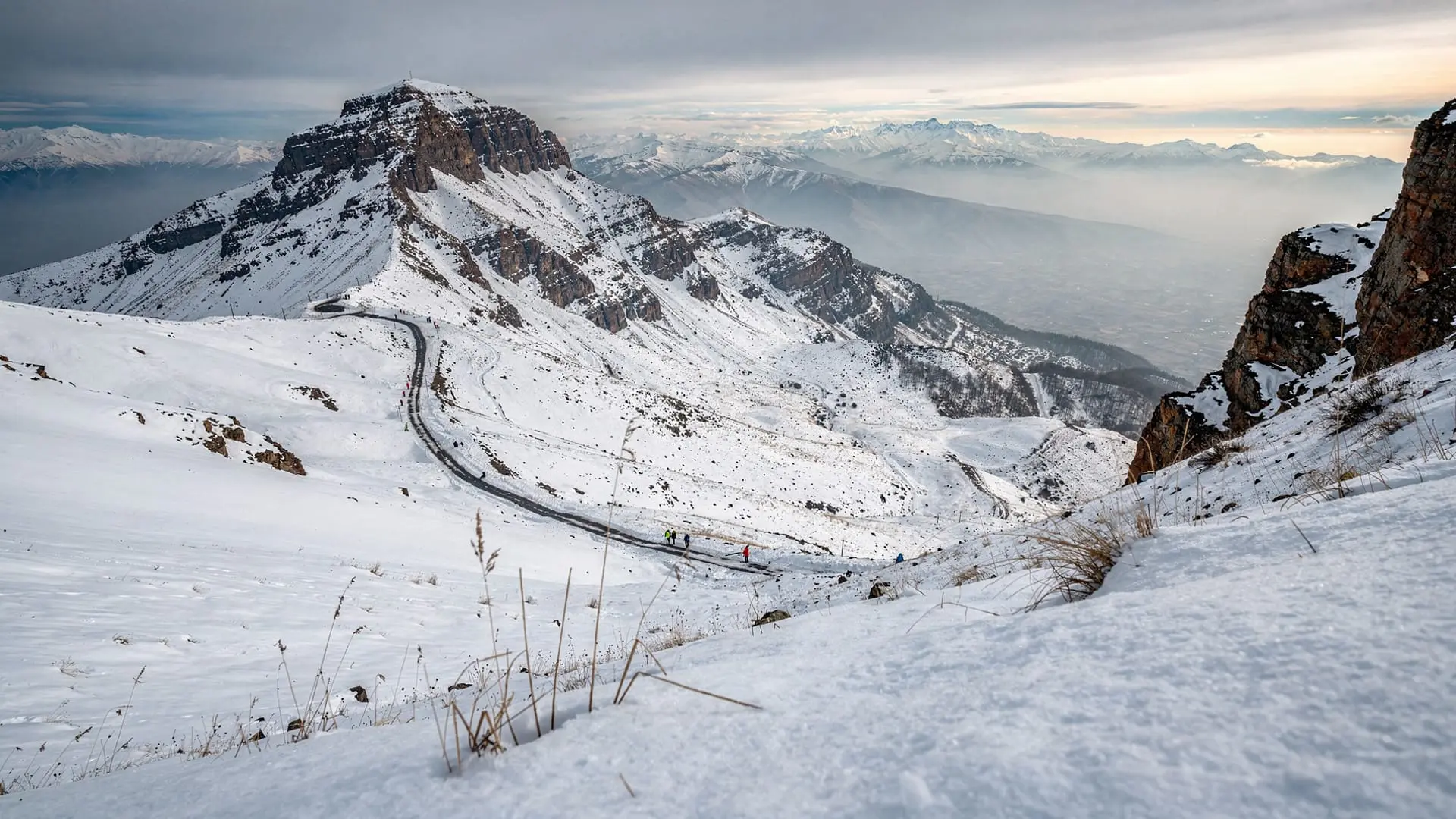
When Aragats becomes a white giant
In summer, Mount Aragats is a challenging hike with extraordinary views. In winter, it becomes something else entirely: a snow-laden volcanic massif that looks from Yerevan like it has been carved from white marble, with the four summits visible on clear days from 70 km away. The snowpack on Aragats’ upper slopes begins in October and can persist through late May or even June, making it one of the few places in Armenia where genuine alpine snow conditions exist within a 2-hour drive of the capital.
Visiting Aragats in winter is not about skiing — the mountain has no ski infrastructure. It is about something more elemental: the experience of standing in a landscape where the scale of the snow transforms the familiar into the extraordinary, where the Armenian Alphabet Monument, the medieval fortress of Amberd, and the volcanic slopes above are all reconfigured by winter into versions of themselves that summer visitors never see.
A growing number of Yerevan tour operators offer what they call “snow experience” tours to Aragats in winter — essentially guided 4WD excursions to the accessible lower and mid-slope zones with activities including snowshoeing, sledding, and simply playing in the deep powder. These tours are excellent value and represent one of the most distinctive winter day trips in the country.
| Where | Aragatsotn province, Amberd fortress area (2,300m) |
| Cost | Guided full-day snow experience tour, transport included |
| Time needed | Full day, 8–10 hours round trip from Yerevan |
| Getting there | 4WD required; tour strongly recommended over self-drive |
| Best time | December–March; road to Lake Kari never opens in winter |
What the winter Aragats tour involves
The standard winter Aragats snow experience from Yerevan typically covers:
Departure: Early morning from Yerevan (8:00–9:00 AM), 70–80 km north via the M1 highway to Ohanavan and then the mountain road.
Armenian Alphabet Monument (Artashavan): The first significant stop, at approximately 1,900 m, where 39 enormous stone letters of the Armenian alphabet stand in a field on the Aragats slopes — a tribute to the scholar Mesrop Mashtots who created the alphabet in 405 AD. Read the full story in the Armenian Alphabet Monument history guide. In summer this is a standard tourist stop; in winter with snow on the ground and the volcanic slopes above frosted white, it becomes genuinely stirring.
Amberd Fortress (2,300 m): The medieval fortress of Amberd dates from the 10th–13th centuries and stands at the confluence of two gorges on a cliff above the Arkashen and Amberd rivers. In winter, with the fortress walls coated in snow and ice and the Aragats peaks rising dramatically behind, Amberd is at its most visually powerful. The access road to Amberd requires 4WD in winter — a standard car cannot manage it safely.
Snow play and activities: Most tours allow 1–2 hours of unstructured time in the deep snow above Amberd. Some operators bring sledges. The snow at 2,300–2,500 m in December–February can be 1–2 metres deep, which provides genuinely playful conditions.
Views: On clear winter days, the view from Amberd or the snowfields above includes the Ararat plain to the south (sometimes with Ararat itself visible), the Debed valley to the north, and the vast Aragats massif above. The clarity of winter air frequently produces the best visibility of the entire year.
Book a guided full-day snow experience tour to Mount Aragats from YerevanKey sites in winter
Amberd Fortress
Amberd is Armenia’s most dramatic highland fortress, built by the Kamsarakan and later Pahlavuni dynasties and substantially expanded in the 10th–11th centuries. The main tower is largely intact, and the adjacent Church of Vahramashen (1026 AD) is one of the best-preserved examples of Bagratid ecclesiastical architecture in the country.
In winter, the access road from the paved highway to Amberd (approximately 3 km) requires 4WD. The walk from the parking area to the fortress involves crossing snow that can be knee-deep in heavy years. Come prepared with waterproof boots, warm layers, and the expectation that the approach will be part of the adventure.
The Armenian Alphabet Monument
The monument at Artashavan, installed in 2005 to celebrate the 1,600th anniversary of Mesrop Mashtots’ creation of the Armenian alphabet, consists of 39 basalt sculptures representing each letter. The sculptures are each about 1.5 metres tall and are set in a sweeping arc on the mountain slope. They look best in dramatic lighting — and winter morning light, with long shadows across snowy ground, provides exactly that.
The Hovhannavank and Saghmosavank monasteries (lower slopes)
Both monasteries are on the lower Aragats slopes in the Kasakh gorge area, below the snow line for most of the winter. They can be combined with a winter Aragats trip: Saghmosavank, perched above a snow-filled gorge in February, is one of the most atmospheric winter monastery photographs in Armenia. The nearby Hovhannavank monastery is equally rewarding in snow conditions.
Winter conditions: what to expect
December: Lower snowpack, still building. The upper slopes are white but Amberd is sometimes accessible without deep snow. Temperature at 2,300 m: -10 to -20°C possible.
January–February: Peak winter. Snowpack at 2,300 m is typically 1–2 metres. Access requires chains or proper snow tyres even on the lower approach tracks. Temperature at altitude can drop to -20°C with wind chill. The views are extraordinary but the cold is serious.
March: Spring melt beginning. Snow is still deep above 2,000 m but the lower approach roads clear. March visits offer a softening of conditions while still delivering genuine winter scenery.
April–May: The upper slopes remain snow-covered but melting. The road to Amberd reopens (typically April). The road to Lake Kari (3,190 m) does not open until late June in a normal snow year.
Safety on winter Aragats
The mountain demands respect. Several winter emergencies have occurred on Aragats when visitors underestimated the conditions:
Never attempt the upper slopes (above 2,600 m) in winter without proper mountaineering equipment and experience. This includes the summit routes to all four peaks. The conditions are genuinely alpine and avalanche risk exists after heavy snowfall.
4WD is not optional for the Amberd road in January–February. Even with 4WD, driving on the upper approach track in icy conditions requires careful judgment. Snow chains on all four wheels are recommended for heavy snow days.
Go with a guided tour for first visits. The local drivers who run Aragats snow experience tours know the road conditions, have local emergency contacts, and can make the call to turn back when conditions deteriorate. This judgment is worth the tour price.
Book a winter Armenia day tour covering monasteries, the Alphabet Monument, and Aragats snowPhotography in winter
Winter Aragats is one of the most rewarding photography subjects in Armenia. Key tips:
- Golden hour: The pre-dawn drive up to reach Amberd at sunrise, with the sun hitting the snowy fortress walls from the east, produces extraordinary light. Plan to leave Yerevan at 6:00–6:30 AM.
- Blue hour: The blue hour after sunset on the mountain, with the peaks turning purple against a darkening sky, is equally powerful.
- Alphabet Monument: Works best with a low sun angle casting long shadows across the letters. Morning or late afternoon.
- Amberd in mist: On some winter days a temperature inversion produces valley fog while the upper slopes are clear and sunny — the fortress emerging from mist is genuinely cinematic.
Frequently asked questions about Aragats in winter
What is the minimum equipment for a winter visit to Amberd/Aragats lower slopes?
Minimum: 4WD vehicle with snow tyres or chains, waterproof boots rated to -15°C, warm insulated jacket, hat and gloves, sunglasses (snow glare is intense), and a fully charged phone. A thermos of hot tea is practical wisdom rather than optional comfort.
Can children visit Aragats in winter?
Yes — the snow experience format is excellent for families with children 5 and up. The snow play sections, the Alphabet Monument, and Amberd are all accessible and engaging for children. Ensure children have proper cold-weather gear including waterproof boots and insulated outerwear.
Is the road to Lake Kari ever open in winter?
No. The road from Amberd to Lake Kari (3,190 m) is buried under many metres of snow from November through June in a typical year. Attempts to reach the lake in winter are mountaineering expeditions, not tourist excursions.
How does winter Aragats compare to summer Aragats?
Summer offers full access including Lake Kari and summit hike options — see the four peaks summer guide. Winter offers the most dramatic visual experience but limits access to the lower slopes and Amberd. The two are complementary — if you visit Armenia in both winter and summer, visit Aragats both times.
Do tours run in bad weather?
Professional operators check weather forecasts and mountain conditions before departing. Blizzard days or days with -25°C wind chill and poor visibility are cancelled or postponed. Clear cold days are the best for this tour — ask your operator about their weather cancellation policy.
What to wear and pack
Layering matters more than any single item. Base layer in wicking fabric, a warm mid layer (fleece or down), and a genuinely windproof-waterproof outer shell are the minimum for standing around at 2,300m in January wind chill. Waterproof, insulated boots rather than fashion boots — the snow play sections and the walk from the Amberd parking area both mean direct contact with deep snow. Sunglasses or ski goggles are not optional: snow glare at altitude on a clear day is intense enough to cause snow blindness within hours for unprotected eyes. A thermos of hot tea or coffee, brought from Yerevan or bought at a stop en route, makes a real difference over a long cold day. For a general seasonal packing reference beyond the winter-specific mountain items, see the Armenia packing list by season.
Combining with a wider winter Armenia trip
A winter Aragats day pairs naturally with the rest of a cold-season Armenia itinerary. Skiers often add Tsaghkadzor, roughly 90 minutes from Yerevan in the opposite direction, on a separate day. Travellers who want the monastery side of winter Armenia should look at Armenia’s winter monasteries in snow, which covers Geghard, Khor Virap, and Noravank under snow — a gentler, lower-altitude complement to the Aragats snow experience. For overall trip planning across the cold months, the Armenia winter travel guide sets expectations on temperatures, daylight hours, and what stays open.
Mount Aragats: some essential facts
For visitors who encounter Aragats primarily as a winter snow destination, a brief introduction to the mountain’s broader significance. Planning a ski day nearby? See the Tsaghkadzor ski resort guide.
Aragats (Արագած) is a shield volcano and the highest mountain entirely within the Republic of Armenia. Its four distinct summits — Northern (4,090 m), Western (4,080 m), Eastern (3,916 m), and Southern (4,022 m) — form a rough square around a central volcanic depression. The southern summit is the most accessible to hikers and is the target of most summer climbing attempts.
The mountain is not a single peak in the visual sense of Ararat or Fuji — it is a massif, spreading across a large area of the Aragatsotn province. From Yerevan, the entire western horizon in clear weather is defined by Aragats, though from this angle it appears as a broad, multi-humped form rather than a classic alpine peak.
Cultural significance: Aragats appears in Armenian mythology as the male counterpart to the feminine Ararat — the two mountains were said to have been brothers or lovers in pre-Christian legend, separated by a curse. Read more about Mount Ararat views from Armenia. The Armenian poet Hovhannes Shiraz wrote about Aragats with the same intensity that Charents wrote about Sevan.
Climbing history: The first recorded ascent of the northern (highest) summit was by a scientific expedition in 1834. Armenian alpinists have climbed all four summits, including winter traverses, throughout the 20th century.
The snowpack in numbers
Understanding winter snowpack on Aragats helps calibrate expectations:
- Tree line: Approximately 2,800–2,900 m on the south-facing slopes
- Permanent snow (normal year): Above approximately 3,200–3,400 m
- Amberd area (2,300 m) snowpack in January: Typically 50–150 cm
- Lake Kari area (3,190 m) snowpack in January: Typically 200–400 cm
- Road closure dates (average): Amberd access road: November → April; Lake Kari road: October → late June
These figures are averages — individual years vary significantly. A dry autumn can mean the Amberd road stays accessible through December; a heavy October snowfall can close it by mid-month.
What to photograph in winter at Aragats
The Aragats winter tour offers photography that summer visits cannot:
The Alphabet Monument in snow: Each of the 39 basalt letter sculptures casts a different shadow in low winter sun. Snow on the base of the letters, with the white Aragats slopes behind, is an extraordinarily powerful image. Best photographed 30–60 minutes after sunrise when the sun is low enough for long shadows.
Amberd in ice: The fortress walls develop ice formations from snowmelt refreezing — particularly on the north-facing walls where ice can persist for weeks. The combination of medieval stone and natural ice sculpture is a winter-specific photograph.
Frost on the volcanic rock: At dawn on the upper slopes, the frost patterns on the dark volcanic basalt create abstract textures that are essentially impossible to photograph at any other time of year.
The frozen world below: From Amberd or the slopes above it, looking south and west, the Ararat plain in winter is a low-contrast mosaic of grey-brown fields and occasional snow patches. Mount Ararat above this plain, white and enormous, is the key element — clear winter air gives the best Ararat visibility of any season.
Should I self-drive or book a guided tour for winter Aragats?
Book a guided tour unless you have genuine winter mountain driving experience and a properly equipped 4WD with snow tyres or chains. Local operators know current road conditions, carry recovery gear, and make the call to turn back when conditions deteriorate — judgment that is difficult to replicate on a first visit.
How does the winter experience compare to the summer Lake Kari trip?
They are different trips entirely. The summer Aragats and Amberd day trip reaches Lake Kari at 3,190m and can include a summit hike; the winter version stops at Amberd (2,300m) because the upper road is buried in snow. Winter trades altitude range for dramatic snow scenery and near-total solitude on the mountain.