Yerevan playgrounds & parks for kids
Finding play spaces in Yerevan
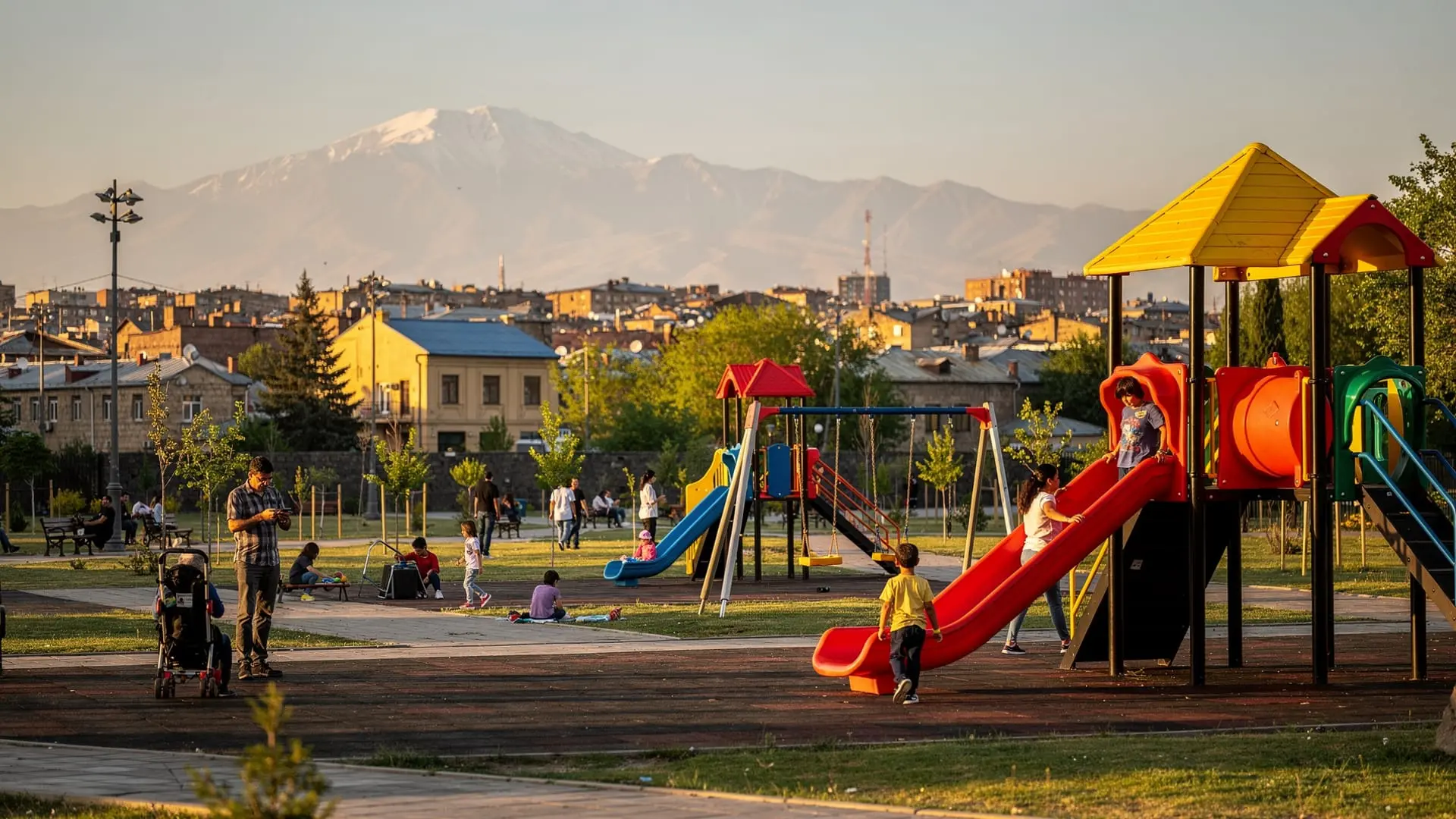
Yerevan has invested steadily in its parks and public spaces in recent years, and the city’s playgrounds have improved noticeably. That said, expectations should be calibrated: these are not the elaborate rubber-surfaced play complexes of Scandinavian parks. Most are simple structures — swings, slides, climbing frames — in well-shaded gardens where local families gather on weekday mornings and weekend afternoons.
What Yerevan does exceptionally well is the atmosphere around the play spaces: the parks are social, animated places where children are clearly welcomed and where parents can sit with a coffee while children roam. The culture of leaving children in a park under loose communal supervision — grandmothers watching from benches, neighbouring families helping if a child falls — makes the parks relaxed in a way that feels old-fashioned in a good sense.
This guide covers the best play and outdoor spaces for children in and around Yerevan’s centre, from the most manicured parks to informal spaces that children turn into playgrounds naturally.
| Where | Central Yerevan (Lovers Park, Cascade) plus Nor Norq and outskirts |
| Cost | Mostly free; Botanical Garden ~500 AMD, Aquatek ~6,000–7,000 AMD |
| Time needed | An hour for a central park stop; half a day for Aquatek or Botanical Garden |
| Getting there | Walkable in the centre; taxi for Nor Norq, Botanical Garden, Aquatek |
| Best time | Morning (7–11am) or evening (4pm–dark) in summer to avoid midday heat |
Lovers Park: the best central playground
Lovers Park (locally: Sirekanerits Bagh — “Sweethearts’ Garden”) is the most popular park in central Yerevan, occupying a long green corridor between the Cascade Complex and the beginning of the Mashtots Boulevard pedestrian zone. It has been significantly renovated since 2019 with new playground equipment, fresh paving, and improved seating.
Playground equipment: Modern climbing frames, slides, swings, a small zip-wire element, and a sandpit area make this the most well-equipped standard playground in the city centre. The equipment suits children aged 2–12. The surface is rubber-matted under the main equipment area — a genuine safety improvement over the older concrete-base parks.
Atmosphere: Weekend mornings bring large gatherings of local families. During school terms, weekday mornings from about 9 am bring grandmothers with toddlers. The park fills again after 5 pm when parents arrive after work. This social density is actually a positive: children find others to play with almost immediately.
Adjacent to: The Cascade (5 minutes’ walk) and several good cafés on Tamanyan Street.
Practical: No entry fee. Benches throughout. An ice cream cart operates in summer. Small café nearby.
The Cascade: not a playground, but it functions as one
The Cascade Complex wasn’t designed as a play space, but it functions brilliantly as one. The three main elements:
Sculpture garden at the base: The lower Cascade park has large-scale sculptures including Fernando Botero’s bronze cat (known locally as simply “the fat cat”), which every child in Yerevan has climbed. The sculptures are part of the open-air collection of the Gerard L. Cafesjian Museum of Art and are not explicitly intended for climbing — but this is not enforced, and the culture of children playing on the sculptures is well established.
The staircase and terraces: 572 steps in total, but the lower section — perhaps 80 steps to the first terrace — is a manageable climb for children aged 4 and up. The terraces have benches, shade, and views. Running up and down is a normal activity for Yerevan children.
Interior escalators: Inside the Cascade building, escalators carry visitors (and children delighted by the novelty of escalators inside a hillside staircase) through the modern art gallery. For children aged roughly 4–10, riding the escalator up and running down the outside is endlessly repeatable entertainment.
Best time for families: early morning or late afternoon to avoid summer heat.
Children’s Railway Park
Located in the Nor Norq district of eastern Yerevan (about 25–30 minutes by taxi from the centre), the Children’s Railway is a relic of the Soviet tradition of teaching children about railway operations through miniature railways. A narrow-gauge train circles a small park.
The train runs on summer weekends and some weekday mornings; schedules are not perfectly consistent. Confirm operating status before making a dedicated trip — this is disappointing as a destination if the train isn’t running. As a destination to combine with another eastern Yerevan visit, it’s charming for children aged 3–8.
The park surrounding the railway has basic play equipment and green space.
Yerevan Botanical Garden
The Botanical Garden sits on a hillside in the Nor Norq area, roughly 20 minutes by taxi from the city centre. It is large, green, and — significantly outside peak summer weekends — quiet.
What the Botanical Garden offers families:
- Open lawns for picnics and running
- A small pond with ducks in the lower section
- Shade: The established tree cover makes this the best hot-weather outdoor space in Yerevan
- Greenhouses: The small greenhouse section has tropical plants including cacti that children find unusual in an Armenian context
The garden is not heavily manicured, which is part of its appeal — it feels like a wild escape within the city. The paths are mostly walkable but uneven in places; pushchairs manage the main paths.
Entry fee: Small charge (around 500 AMD per adult, children typically free or nominal).
Republic Square: summer fountain playground
Republic Square is not technically a playground, but on summer evenings when the dancing fountains are running (June to September, from 9 pm), it functions as one of the most spectacular free children’s entertainment events in Yerevan. The fountains are choreographed to music — a 30 to 40-minute show of light and water that draws families from across the city. Children sit on the paving surrounding the fountains; some wade in at the edge in warm evenings.
On non-fountain days and in daylight, the square’s wide paving makes it suitable for children on scooters or bicycles in the evening hours, when traffic is excluded from the pedestrian zone.
Indoor play options
Summer heat (July–August peak at 35°C+) makes indoor options valuable.
Megamol trampoline zone: The Megamol shopping centre on Komitas Avenue has a trampoline park area with foam pits and climbing elements, suitable for roughly ages 4–14. Useful for a 1–2 hour session when the heat outside is oppressive.
Indoor play centres: Several shopping malls in Yerevan include children’s indoor play areas. The Dalma Garden Mall in the west of the city has a comprehensive indoor play zone that is particularly suitable for children under 8.
AquaCity/Aquatek waterpark: The main outdoor waterpark, open June to mid-September. Multiple slides, a wave area, and shallow zones for young children. Located on the outskirts (take a taxi). Entry around 6,000–7,000 AMD per adult, with concessions for children. A reliable half-day or full-day option for families in peak summer.
The Tumo Center: digital play for teens
Tumo Center for Creative Technologies (near Tigranashen, 15 minutes from the centre) is not a playground in any conventional sense, but for children aged 12–18 with any interest in animation, coding, music production, or filmmaking, it is one of the most remarkable free creative spaces in the world. The Yerevan original (2011) is the flagship of a network that now has branches in Paris, Berlin, Beirut and beyond.
Walk-through visits are possible; full programme participation requires registration. Even a 45-minute tour of the building and its self-learning stations is inspiring for technologically-minded teenagers. Free.
Parks in the broader city
Beyond the central parks, every Yerevan neighbourhood has at least one small park with basic equipment. Notable:
Mashtots Park (along Mashtots Boulevard): The pedestrianised central boulevard has a strip park along its length. Basic benches and trees rather than play equipment, but good for pram-walking. Popular for evening strolls.
Circular Park (Kund): North of the centre, one of the older Soviet-era parks. Quieter, greener, less developed than Lovers Park. Good for toddlers who need space to roam.
Haghtanak (Victory) Park: Large park on the south-western edge of the city. A Ferris wheel operates here in summer; the park has extensive walking paths. Slightly further from the tourist centre but worth the taxi ride for a longer afternoon out.
Heat management in Yerevan parks: practical tips
Yerevan’s summers are genuinely hot — July and August regularly exceed 35°C at midday. This changes the rhythm of outdoor play fundamentally. The practical framework:
Morning play (7–11 am): The best window for outdoor parks in summer. Temperatures are comfortable, the parks are not yet crowded, and the morning light is beautiful. Lovers Park, the Cascade lower terraces, and the Botanical Garden are all good morning destinations.
Midday shelter (11 am – 4 pm): Air-conditioned options are the priority. The Cascade interior (escalators, modern art gallery) is air-conditioned. The History Museum on Republic Square is cool inside. A midday restaurant meal at a place with indoor seating takes the worst of the heat out of the afternoon. The Megamol trampoline zone is ideal.
Evening play (4 pm – dark): The second good window. Temperatures drop to a comfortable 24–28°C and the parks come alive again. Republic Square fills with families in the hour before the fountains begin. The Cascade terraces are pleasant for evening walks.
Sunscreen and water: These are not optional for children in Yerevan summer. Apply sunscreen before going out in the morning and again at midday. Keep a water bottle per child at all times. Electrolyte sachets are useful for young children who run around a lot — available from any pharmacy.
Buying ice cream: Yerevan’s street cart culture
Ice cream culture in Yerevan deserves its own brief mention in a playground guide, because the ice cream cart is as much a part of the play experience as the swings. Street carts operate throughout the central parks from May to September; the reliable brand is Yummy, a locally produced ice cream available in cones and bars. Quality is good, prices are very low (typically 400–800 AMD per serving).
For something more substantial, the Cascade Café midway up the staircase serves proper scooped ice cream with various toppings. Children who have climbed the lower Cascade steps tend to feel this is a proportionate reward.
For context on the broader Yerevan family experience, see the complete Yerevan with kids guide. For a full week in Armenia with children, see the 7-day family itinerary.
City Tour in Yerevan with local guideSummary table
| Space | Best for | Central? | Cost |
|---|---|---|---|
| Lovers Park | All ages, daily play | Yes | Free |
| Cascade sculpture garden | Ages 3–12, art + movement | Yes | Free |
| Republic Square (evenings) | All ages, fountain show | Yes | Free |
| Children’s Railway Park | Ages 3–8, train ride | No (taxi) | Nominal |
| Botanical Garden | Picnics, shade, toddlers | No (taxi) | ~500 AMD |
| Megamol trampoline | Ages 4–14, indoor | No | Paid |
| Aquatek waterpark | Ages 3–15, summer | No (taxi) | ~6,000–7,000 AMD |
| Tumo Center | Ages 12–18, creative tech | No | Free |
Frequently asked questions about Yerevan playgrounds
Are Yerevan playgrounds fenced?
Most larger playgrounds, including Lovers Park, have partial fencing or low barriers defining the play zone. They are not fully enclosed in the way some European city playgrounds are. Supervision of young children (under 4 particularly) near roads requires attention.
Is there shade at the main playgrounds?
Lovers Park has good tree cover providing natural shade. The Cascade is partially shaded on the lower terraces. For the hottest days (above 32°C), plan playground time before 11 am and after 5 pm.
Can we take a bicycle or scooter to Yerevan parks?
Yes. Children on scooters and bicycles are common in the parks and on the pedestrian sections of Mashtots Boulevard, particularly on weekend mornings and evenings. No specific rules apply; normal care around other pedestrians is expected.
Are dogs allowed in Yerevan parks?
Yes. Dogs are common in Armenian parks and are generally friendly. Leashing is inconsistently practiced. If your child is nervous around dogs, the Republic Square area is less dog-heavy than the parks.
What’s the Republic Square fountain schedule?
In summer (approximately June to September), the fountains typically run from 9 pm, sometimes with an additional early evening show on weekends. Exact scheduling changes year to year; check locally on arrival. The show is approximately 30–40 minutes.
Do we need to bring our own playground equipment or toys?
Not generally — the main central playgrounds (Lovers Park especially) have enough fixed equipment for most children. If your child has a favourite scooter, bucket-and-spade set for the Botanical Garden pond area, or bike, bringing it adds options, but nothing is essential for a first visit to any of the central parks.
Are there playgrounds within walking distance of the main hotel districts?
Yes — Lovers Park and the Cascade sculpture garden are both within a 10–15 minute walk of most central Yerevan hotels, making them the easiest choice for families without a car who want a quick outdoor break without planning a taxi trip.
Planning a full family day around the parks
For a single day that combines several of these spaces without excessive taxi time, start at Lovers Park in the cool of the morning, move to the Cascade for the sculpture garden and air-conditioned interior during the hottest midday hours, then finish at Republic Square in the evening if the fountains are running. This loop keeps everything within a compact central area and avoids the longer taxi rides out to Nor Norq or the western malls, which are better treated as their own half-day outings. For a broader family itinerary beyond playgrounds specifically, see the complete Yerevan with kids guide, and for families exploring further afield, the kid-friendly monasteries guide covers which of Armenia’s major religious sites work well with children in tow.