Plugs, power and internet in Armenia
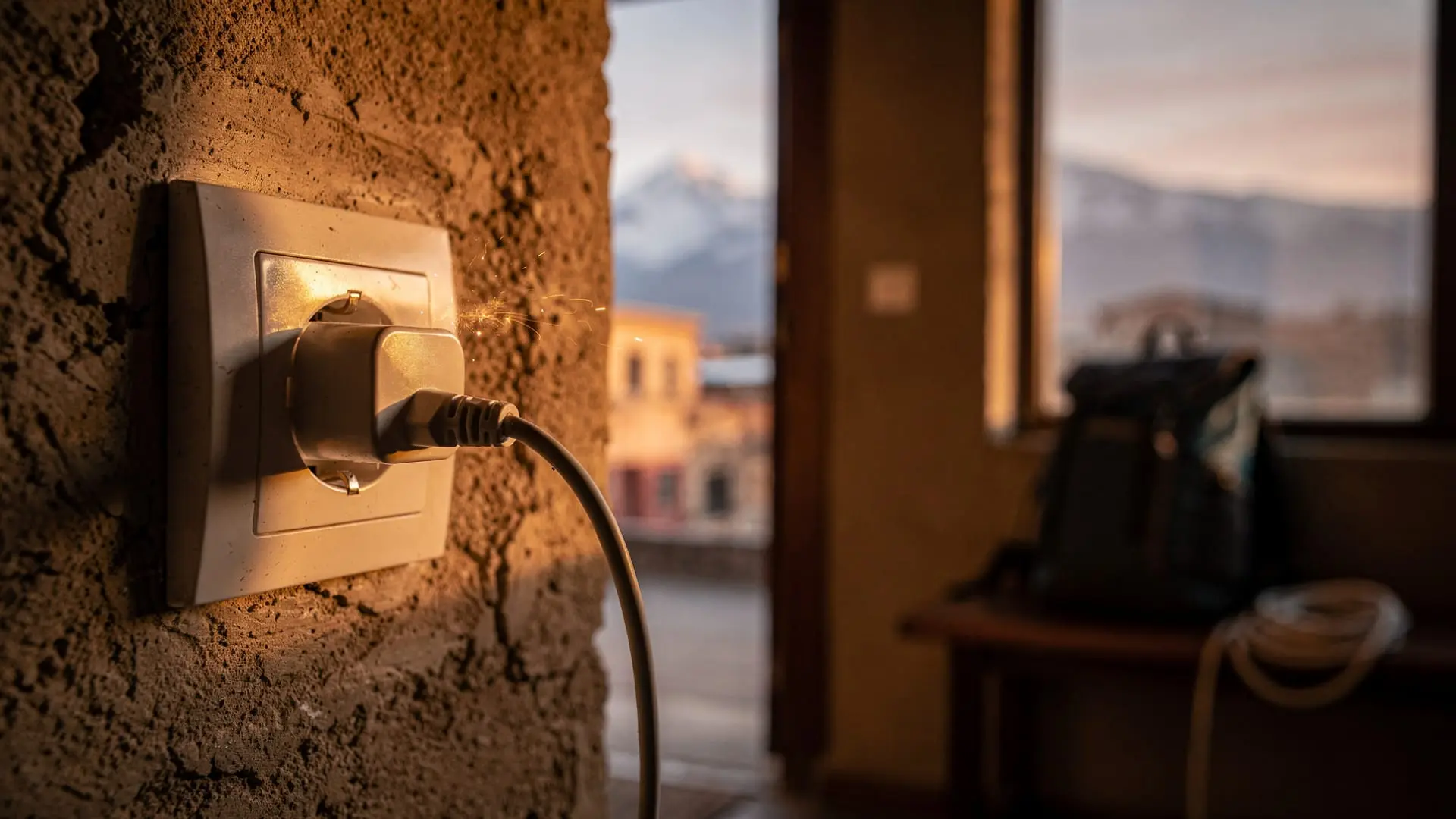
Armenia is an easy country for power and connectivity — European-standard sockets, reliable grid power in every city, and mobile data good enough to navigate a mountain monastery road. The only real friction points are North American voltage mismatches and the patchy coverage in deep valleys and high passes. Sort your plug adapter and SIM or eSIM before you land, and the rest takes care of itself.
Electrical system at a glance
| Item | Detail |
|---|---|
| Plug type | Type C (Europlug) and Type F (Schuko) |
| Voltage | 220V |
| Frequency | 50Hz |
| Adapter needed for UK travellers? | Yes — Type G to C/F |
| Adapter needed for US/Canada travellers? | Yes — Type A/B to C/F |
| Voltage converter needed? | Usually no (most modern electronics are universal 100–240V) |
Plug types explained
Type C (Europlug)
The type C plug has two round pins and is the most widely used in the world — found across Continental Europe, South America, Asia, and the Middle East. Armenia’s older sockets accept type C.
Type F (Schuko)
Type F also has two round pins but with two grounding clips on the sides. Armenian sockets accept both type C and type F without an adapter between them — a type C plug fits in a type F socket without issue.
UK travellers: The UK uses type G (three rectangular pins). You will need a UK-to-EU adapter. These are inexpensive and available at airports, Yerevan electronics shops, and pharmacies.
US and Canadian travellers: North America uses type A and B (flat pins, 110V). You need a flat-to-round-pin adapter. More importantly, confirm that your devices support 100–240V (check the label on the charger brick — most modern phones, laptops, and camera chargers do). If a device is 110V-only, a voltage converter is necessary.
Australian travellers: Australia uses type I (angled flat pins). A type I to type C adapter is needed. Most Australian devices are rated 100–240V so no converter is needed.
Voltage and frequency
Armenia operates at 220V, 50Hz. This is the same standard as most of Europe, Africa, Asia, and Australia. Problems arise only for travellers from North America (110V, 60Hz) using devices that are not dual-voltage.
How to check: Look at the label on your charger or device. If it says “Input: 100–240V, 50/60Hz”, it is universal and works anywhere with the right plug adapter. If it says “Input: 110–120V”, it needs a voltage converter.
Devices that are almost always universal: Phone chargers, laptop chargers, camera battery chargers, tablet chargers, travel hairdryers (often marked “dual voltage”).
Devices that are often NOT universal: High-wattage devices like full-sized hair dryers, electric shavers with motors, old kettles.
Power reliability
Yerevan and major cities have reliable power supply. Outages are rare in the capital and in tourist-facing accommodation.
In rural areas and small villages, occasional power interruptions occur, particularly in winter. If you are staying in a remote guesthouse near Haghpat, Tatev, or in the Aragatsotn highlands, having a fully charged power bank before your stay is good practice.
Charging on the go
Power banks: Essential for day trips of 8–12 hours away from power sockets. Churches, gorges, and hiking trails do not have charging points. A 10,000–20,000 mAh power bank covers most phones for two full days.
In cafés and restaurants: Free charging points at café tables are available in some Yerevan establishments, particularly specialty coffee shops and tourist-facing restaurants. It is courteous to buy something first.
In marshrutkas and taxis: Some marshrutkas and taxis have USB charging ports, but this is not universal. Do not rely on it.
Mobile internet and SIM cards
Coverage overview
Armenia has excellent 4G coverage in Yerevan, all regional capitals, and along main highways. 3G and 4G coverage extends to most populated areas. In truly remote zones — deep mountain valleys, the far south of Syunik, some Aragatsotn highland areas — coverage becomes patchy or absent.
5G: Rolling out in Yerevan as of 2026 but not yet universal.
Local SIM cards
Buying a local SIM is the cheapest way to get mobile data in Armenia. Three main providers operate:
Beeline Armenia (formerly MTS Armenia)
Wide coverage, competitive data packages. A tourist SIM with 20–30 GB of data typically costs 3,000–6,000 AMD (7–15 EUR) for 30 days. Available at Beeline shops, kiosks, and some pharmacy/tobacco outlets.
VivaCell-MTS (MTS Armenia)
The market leader by subscriber count. Strong coverage, including in some rural areas where competitors are weaker. Similar pricing to Beeline.
Ucom
Growing network, competitive pricing. Known for good data speeds in Yerevan.
What you need: A passport is required to register any SIM card in Armenia (a legal requirement since 2019). The registration process takes a few minutes at any operator’s shop. Bring your passport.
Buying at Zvartnots Airport: SIM counters operate in the arrivals hall at Zvartnots. Prices at the airport are sometimes slightly higher than city stores, but the convenience on arrival is worth it for most travellers. Compare packages before committing.
Hotspot/tethering: All Armenian SIM data plans support mobile hotspot, useful for sharing connectivity with travel companions.
eSIM options
eSIM technology is supported by most recent smartphones (iPhone XS and later, many Android flagships). For Armenia specifically, Airalo offers eSIM plans starting from approximately 5 USD for 1 GB, up to 20+ USD for larger data packages. Activation is instant and requires no physical SIM swap — ideal for travellers who want to set up connectivity before they land.
For a GetYourGuide-bookable eSIM option specifically for Armenia:
Which to choose: Airalo eSIM is convenient and instant. A physical local SIM from Beeline or VivaCell provides better value for longer stays (10+ days) and typically offers more generous data allowances.
Wi-Fi coverage
Yerevan: Wi-Fi is ubiquitous in hotels, hostels, cafés, restaurants, and many public spaces. Republic Square and Northern Avenue have public Wi-Fi zones. Quality varies from excellent (specialty cafés) to frustrating (older hotels).
Accommodation outside Yerevan: Most guesthouses in Dilijan, Goris, and Gyumri offer Wi-Fi. Expect speeds that are functional for messaging and navigation but not always adequate for large uploads. In remote guesthouses (village homestays), Wi-Fi may not exist.
Monasteries: Do not expect Wi-Fi at monasteries. Many are deliberately removed from modern infrastructure. This is partly the point.
Offline navigation: Download the Armenia area on Google Maps offline or Maps.me (which has excellent Armenian road and trail coverage) before leaving Yerevan. Mobile data signals can drop at exactly the moment you need navigation at a mountain monastery.
Useful apps that require data or pre-download
- GG Taxi: Requires internet connection. Download and set up before leaving your accommodation. Add a payment method in advance. See the GG Taxi guide for the full setup walkthrough.
- Google Maps offline Armenia: Download the region while on Wi-Fi for offline navigation.
- Maps.me Armenia: Better for hiking trails and rural roads.
- Google Translate with Armenian downloaded: Offline translation for Armenian script signs and menus.
- Wisesheets or XE Currency: For live AMD exchange rates when online.
Connectivity in specific locations
At Zvartnots Airport
Zvartnots Airport has free Wi-Fi in the terminal. The password and network name are posted at access points. Speed is adequate for messaging and basic browsing but not streaming. Mobile data activates immediately on an Armenian SIM or eSIM as soon as your flight lands. The SIM counter in the arrivals hall (past customs) sells activated SIMs.
In monasteries and remote sites
Khor Virap, Garni, and Geghard are close enough to populated areas to have reasonable mobile data coverage. Sites further afield have variable coverage:
- Tatev monastery: Surprisingly decent 4G in the main area, due to the tourist infrastructure investment around the Wings of Tatev cable car
- Haghpat and Sanahin: Lori gorge has 3G/4G along the main road but can drop in the gorge itself
- Aragats summit area: 4G at the Lake Kari plateau, deteriorates above 3,500 m
- Deep Tavush forests (Haghartsin, Lake Parz trail): Sporadic 3G; download offline maps before leaving Dilijan
The golden rule: Always download Google Maps or Maps.me offline before leaving your accommodation in the morning. Connectivity at the exact moment you need navigation is never guaranteed.
Long-distance marshrutka journeys
Major routes (Yerevan–Goris, Yerevan–Gyumri, Yerevan–Dilijan) follow main highways with generally good 4G coverage. You may experience brief dead zones in mountain passes and gorge sections. Download audio or video content for offline playback if you want entertainment on a 4–5 hour route to the south.
Charging infrastructure at accommodation
Budget hostels and guesthouses: USB charging ports are increasingly standard at hostel beds. Bring your own USB-A to device cable. Wall sockets in shared bathrooms are usually European two-pin.
Mid-range hotels: Bedside lamp sockets, dedicated phone charging areas in rooms, and USB ports on European-style power strips are common at 3-star hotels in Yerevan. Ask reception if you need a specific adapter. For accommodation tips, see the Armenia budget travel guide.
Luxury hotels: Universal adapters and charging stations in rooms. Higher-end hotels (Marriott, Radisson Blu, Republica Hotel) cater to international travellers with all plug types.
Rural guesthouses: Basic wall sockets only, type C/F. If the guesthouse is rustic (a village homestay rather than a proper guesthouse), confirm electricity reliability before booking — some very remote areas have occasional cuts.
Socket variations: old Soviet buildings vs. new hotels
Armenia’s electrical infrastructure dates from two distinct eras, and the socket you encounter depends heavily on the age and renovation status of the building you are staying in.
Soviet-era sockets
Soviet-era buildings (most housing stock outside newly built areas, many guesthouses, older hotel wings) typically have recessed type C sockets — a deep circular recess that accepts both type C and type F plugs. The socket depth is occasionally tighter than modern European standards, but this is rarely a problem for phone and laptop chargers.
The bigger issue is the number of sockets per room — often one or two, inconveniently placed. A travel power strip with 2–3 EU outlets solves this immediately.
New hotels and recently renovated accommodation
Mid-range and above hotels built or renovated since 2010 (including the Marriott, Radisson Blu, Republica Hotel, and boutique hotels in the Cascade area) typically feature:
- Multiple type C/F sockets per room at desk height and beside both beds
- A dedicated phone-charging alcove or bedside USB dock
- A universal socket panel in the bathroom (often accepting Type A, C, G in a single multi-standard socket)
- Good socket quality — no loose or intermittent connections
Bathroom sockets: In Armenia, bathroom sockets (for shavers, hair dryers) are typically type C at 220V. Do not plug in a North American shaver rated for 110V only — it will be damaged or destroyed. Most modern electric shavers are dual-voltage (100–240V); check the label.
USB outlets: still rare, improving
USB-A and USB-C charging ports built into wall sockets or bedside panels are still uncommon in Armenian accommodation relative to Western Europe. They are appearing in newly renovated boutique hotels but should not be assumed. Bring your own USB charger (a compact GaN 3-port charger is ideal) and rely on the wall socket plus your own cables.
High-wattage devices: the North American warning
This is the most practically important electrical concern for travellers from the US and Canada. Armenia’s 220V supply will destroy or severely damage devices that are rated for 110V only and connected without a voltage converter. The damage is instantaneous and irreversible.
Devices that are almost always 110V only (check the label before plugging in):
- Full-sized hair dryers purchased in North America (unless explicitly marked “dual voltage 110–240V”)
- Electric hair curlers and straighteners purchased in North America
- Some older electric shavers with motors (not modern dual-voltage models)
- Some travel kettles rated for 110V only
The dual-voltage hair dryer solution: Most travellers are now advised to buy a compact dual-voltage travel hair dryer before departure — these are widely available for 20–40 USD and eliminate the problem entirely. Alternatively, virtually all Armenian hotels with hair dryers built in will have a European-compatible device that you can use instead of bringing your own.
Voltage converters: If you must use a 110V-only device, a voltage converter is required. These are heavy and bulky — purchasing a dual-voltage replacement before travel is almost always worth it. Converters are available at Tech chain stores in Yerevan at 10,000–20,000 AMD (24–50 EUR).
Power outages: frequency and practical response
Yerevan and major cities
Power interruptions in Yerevan are rare — the capital has reliable grid infrastructure and outages are typically brief (minutes, not hours) when they occur. In three to five days in Yerevan, you are unlikely to experience any interruption at all.
Rural areas and mountain villages
Outside major cities, the situation varies by season and location:
- Summer: Power is generally reliable in tourist areas. Minor outages lasting 30–60 minutes can occur after thunderstorms in mountain areas.
- Winter: Some very remote village areas experience more frequent supply fluctuations, particularly during heavy snowfall that damages overhead lines. Guesthouses in isolated locations near Haghpat, Tatev, or in the Aragatsotn highlands sometimes have a backup generator for these situations — worth asking when booking.
- Long day trips: If you are on a 10–12 hour day trip away from your accommodation, your main exposure to power constraints is a dead phone battery at hour eight. This is the situation a power bank solves, not the grid.
Recharging on the go in Yerevan
If you need to recharge quickly in Yerevan and your hotel is not convenient:
- Specialty cafés: Many Yerevan specialty coffee shops (Gourmet Coffee House, Double Double, Coffee Studio, and similar) have charging points at tables. Order a coffee, ask about sockets if you do not see them. This is normal and accepted.
- Shopping malls: Dalma Garden Mall and other commercial centres have seating areas with charging points.
- Republic Square fountain area: Public Wi-Fi zone, but no public charging sockets — do not rely on this.
Power banks for hiking and day trips
A power bank is essential equipment for Armenian day trips, not a luxury. Here is why: the most visited sites (Khor Virap, Garni, Geghard, Tatev, Lake Sevan, Dilijan forest trails) have zero charging infrastructure on site. A full day trip from Yerevan to Tatev and back is 10–12 hours. Most smartphones drain to below 20% on a day of navigation, photography, and WhatsApp over that period.
Recommended capacity:
- 10,000 mAh: Covers one smartphone from 0% to full 2.5–3 times. Adequate for solo travellers on day trips.
- 20,000 mAh: Covers two phones, or one phone plus camera battery. Better for couples or anyone using navigation heavily.
- 26,800 mAh (airline carry-on maximum): The standard “best value for weight” size among frequent travellers. Check airline carry-on rules — most allow up to 100Wh (approximately 27,000 mAh at 3.7V) in carry-on (not checked) luggage.
Where to buy in Yerevan: Power banks are available at Tech chain electronics stores, mobile phone shops in the Dalma Garden Mall and in the shopping gallery below the Cascade, and on the Armenian Amazon equivalent (Am.am). Brands readily available include Samsung, Xiaomi, Anker, and local-distribution generics. Prices: 15,000–35,000 AMD (37–85 EUR) for quality options.
Recommended travel adapters
Armenia uses standard EU type C/F sockets. The best adapter choices depend on your origin:
For UK travellers: A UK-to-EU adapter (Type G to Type C/F) is all you need. These are available for 500–1,500 AMD (1.20–3.65 EUR) at pharmacies, electronics shops, and Zvartnots Airport. The cheap ones work fine for low-wattage devices (phone and laptop chargers). For high-wattage devices, buy a quality grounded adapter.
For US/Canadian travellers: A Type A/B to Type C/F adapter is required. Note: this is a plug shape adapter only — it does NOT convert voltage. You still need your devices to be rated 100–240V. Universal adapters that include Type A, B, C, G, and I positions in one compact unit are the most convenient option; brands like BESTEK, EPICKA, and Ceptics are widely available and priced at 15–25 USD.
Universal travel adapters: A multi-standard universal adapter (EU, UK, US, Australia in one unit) is the simplest solution. Ensure it is rated for 220V with at least 3A for laptop charging. Models from Anker or BESTEK with integrated USB-A and USB-C ports are available in Yerevan at Tech stores if you forget to pack one.
Frequently asked questions about plugs and power in Armenia
Do I need a voltage converter for my laptop?
Almost certainly no. Modern laptop power bricks (MacBook, Dell, HP, Lenovo, Asus) are all rated 100–240V. Check the label on your charger — if it says 100–240V, you need only a plug adapter, not a voltage converter.
Where can I buy a plug adapter in Yerevan?
Plug adapters are available at electronics shops (including Yerevan-based Tech chain stores), pharmacies, and souvenir kiosks near major hotels. They are inexpensive (1,000–2,000 AMD). Also available at Zvartnots Airport duty-free shops.
Is the internet reliable enough for remote work in Yerevan?
Yes. Yerevan’s internet infrastructure has improved significantly since 2020 and the city has attracted a growing digital nomad community. Fibre broadband in most central apartments runs 50–200 Mbps. Many co-working spaces and cafés offer stable high-speed connections. For a dedicated remote work setup, check nomad community platforms for the latest co-working space recommendations in Yerevan.
Can I use my EU roaming in Armenia?
Armenia is not part of the EU, so EU roaming regulations (free roaming in EU member states) do not apply. Your EU SIM card will charge international roaming rates in Armenia unless your carrier has a specific arrangement. Check with your home provider. Most travellers find a local or eSIM solution more cost-effective.
Does Armenia have type E sockets (France/Belgium style)?
Type F (Schuko) sockets dominate in Armenia, but type C plugs fit them perfectly. You will not find type E (which has a hole for earth) as standard. French travellers with type E plugs will find type C plugs fit into Armenian sockets without issue.
My phone died on a day trip with no power bank — what now?
Ask at the nearest café, guesthouse, or souvenir stand — most will let you top up for the price of a coffee, especially around Tatev, Garni, and Lake Sevan where tourist infrastructure is used to the request. In genuinely remote stretches (deep Tavush forest, the Aragats summit road) there may be nothing until you are back on a main route, which is exactly why a power bank belongs in every day-trip bag rather than being optional.
Does my driver’s car have a charging port?
Some marshrutkas and private drivers have a USB or 12V socket, but it is inconsistent and unmarked in advance. If you are booking a private driver for a longer trip — say a Garni and Geghard day trip or the drive south to Tatev — ask when booking rather than assuming, and keep a car charger or full power bank as backup regardless of the answer.
Local SIM vs. eSIM vs. Wi-Fi only: quick comparison
| Option | Best for | Typical cost | Downside |
|---|---|---|---|
| Local SIM (Beeline, VivaCell, Ucom) | Trips of 10+ days, heaviest data use | 3,000–6,000 AMD / 30 days | Passport needed, small setup time |
| Airalo eSIM | Short trips, instant setup before landing | ~5–20+ USD | Usually less data per dollar than a local SIM |
| Wi-Fi only, no mobile data | Very short, city-only stays | Free (with accommodation) | No offline navigation on day trips — risky in gorges and monasteries |