Armenia trekking gear checklist
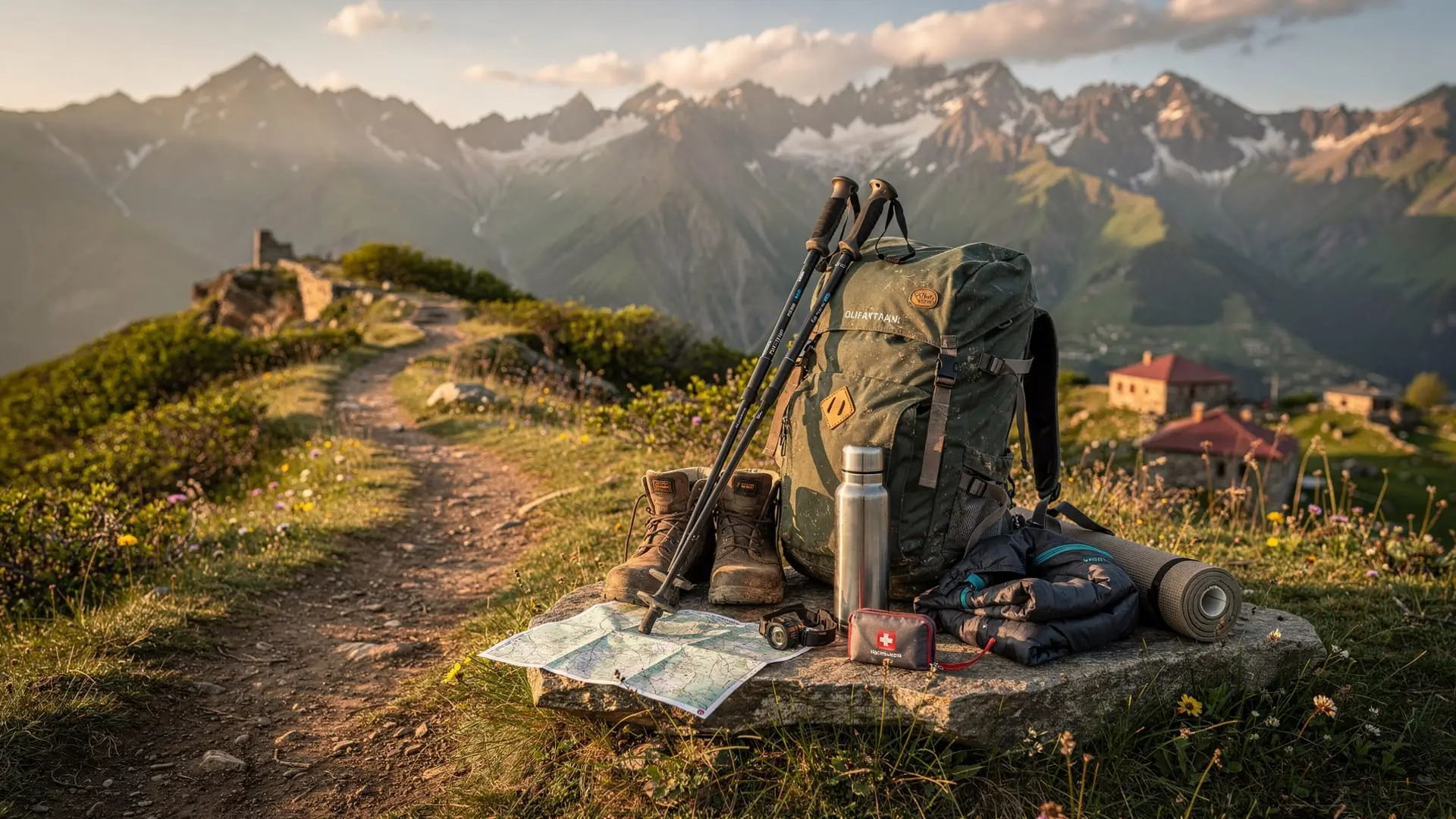
Gear that actually matters in Armenia
Most online packing lists for hiking are generic. This one is specific to Armenia: its terrain (volcanic scree, forest, alpine meadow), its climate (dry and sunny most of summer but with rapid afternoon storm development at altitude), and its infrastructure reality (no mountain rescue services comparable to the Alps, limited gear shops outside Yerevan).
The list is divided by use case: day hikes, high-altitude summit days, and multi-day trekking. You don’t need everything on this page for every hike — scroll to the relevant section and take what applies.
| Non-negotiables | Waterproof shell, sturdy footwear, 2–3L water, sun protection |
| Best season | June–September for high altitude; April–October for lower trails |
| Buy before arrival | Technical gear — Yerevan’s selection is limited and pricier |
| Mid-range kit cost | around 360–675 EUR from scratch (Europe/UK prices) |
| Rescue services | None comparable to the Alps — tell someone your route |
Before you pack: know the terrain
Armenia’s highland hiking terrain has three main characters:
Volcanic scree and basalt: Common on Aragats, Azhdahak volcano, and the Geghama plateau. Loose, sharp, and energy-sapping on descents. Trekking poles and gaiters help.
Forest trail: Common in Dilijan, Tavush, Lori, and the Bjni–Tsaghkadzor area. Often muddy in spring and autumn. Waterproof trail shoes outperform boots in deep forest sections.
Alpine meadow and ridge: Common at 2200–3200m on Aragats and the TCT alpine sections. Firm underfoot when dry, boggy when wet. Standard hiking boots work well.
Day hike kit (all Armenian trails)
Footwear
Trail running shoes or lightweight hiking boots are the right choice for most Armenian day hikes. Full mountain boots are overkill unless you are doing the Aragats northern summit or technical high-altitude terrain. The ideal: a waterproof trail shoe (Gore-Tex membrane) in a low-to-mid cut, with decent lug sole for scree traction.
Buy hiking footwear before leaving home. Yerevan has very limited trail shoe options (some sport shops in the Dalma Garden Mall carry basic trail shoes, but selection is poor).
Waterproof jacket
Mandatory for any mountain day, even in July. Afternoon storms develop fast in the Armenian highlands. A waterproof-breathable shell (Gore-Tex or equivalent) packs into a jacket pocket and weighs 300–500g. The temptation in summer sun is to leave it in the car — resist this.
Waterproof trousers: useful for Dilijan forest in spring, less critical for summer mountain days unless you are doing extended ridge walking.
Trekking poles
Strongly recommended for Aragats, Azhdahak, and Khustup. The volcanic scree on Armenian summit approaches is treacherous on descent without poles. A single pole is better than none; a pair is better than one. Collapsible aluminium or carbon fibre poles pack into luggage easily.
For flat forest trails (Lake Parz loop, lower Dilijan trails), poles are not necessary.
Sun protection
The Armenian sun at altitude is brutal. The combination of high UV at 2500–4000m and clear skies makes sunburn a genuine risk even in late September. Pack:
- SPF50 sunscreen (face, neck, arms, backs of hands — reapply every 2 hours)
- Polarised sunglasses (the basalt glare at altitude is intense)
- Wide-brim hat or cap
This is the most commonly underestimated risk for first-time Armenian hikers.
Water
Carry more than you think you need. Reliable water sources exist on forest trails (streams) but not on the open mountain sections of Aragats, Geghama, or Khustup above the forest zone. The standard recommendation: 3 litres for an Aragats summit day, 2 litres for a Dilijan forest hike.
A water filter bottle (LifeStraw or Katadyn) lets you refill from streams if needed and reduces plastic waste.
Navigation
Offline GPS maps are essential for any off-road hiking in Armenia. Mobile signal is present at popular trailheads but disappears on many ridge and alpine sections. Before any hike:
- Download the Armenia offline map in maps.me
- Download the specific route GPX track from Wikiloc, AllTrails, or transcaucasiantrail.org
- Know how to use GPS navigation on your device
A dedicated GPS device (Garmin eTrex or similar) is worth carrying for multi-day treks. For day hikes, a charged smartphone with offline maps is adequate.
First aid kit
Minimum contents for any Armenian mountain day:
- Ibuprofen (altitude headache, muscle pain)
- Blister plasters (Armenian scree destroys feet on long descents)
- Elastic bandage (ankle support)
- Antiseptic wipes and gauze
- Altitude sickness awareness: if symptoms worsen (confusion, coordination loss, vomiting), descend immediately
High-altitude summit kit (Aragats, Azhdahak, Khustup)
For summit days above 3000m, add the following to the day hike kit above:
Warm mid-layer: A fleece jacket or lightweight down vest. Summit temperatures on Aragats are 10–15°C below the temperature at Lake Kari, which is already 10°C below Yerevan. In July, the Aragats south summit can feel like 5°C with wind. Prepare accordingly.
Gaiters: Low-cut trail gaiters keep scree out of your shoes on the upper Aragats sections. Not essential but notably comfortable on long scree descents.
Headtorch: For sunrise summit attempts (Khustup) or if your timing slips. Spare batteries.
Emergency bivouac bag: A foil survival blanket or lightweight bivouac bag weighs almost nothing and can be critical if you are caught by weather or injury on high ground.
Communication: Tell someone your route and expected return time before departing. In truly remote terrain (Geghama plateau, Syunik TCT sections), a satellite communicator (Garmin inReach Mini) is worth its weight. Mobile phones have no signal on much of the high terrain.
Multi-day trekking kit (TCT, Janapar Trail, Syunik sections)
For multi-day trekking involving camping or remote guesthouses, the list expands significantly.
Tent or sleeping bag: The guesthouse network along the TCT and Janapar is developing but not complete. Carry a 3-season sleeping bag for sections where guesthouses may be unavailable or full. A lightweight tent (1–1.5 kg) expands options enormously.
Backpack: 50–65 litre pack for multi-day with camping gear. 30–40 litre pack for multi-day with guesthouse-only accommodation. Load it the night before and walk around the room — if it’s uncomfortable at home, it will be unbearable on a ridge.
Stove and cookware: For sections without village food options. A small gas canister stove (MSR PocketRocket or equivalent) weighs under 100g. Gas canisters are available in Yerevan outdoor shops (try the Alpindustria store or similar) but may be unavailable in provincial towns — buy in Yerevan before departure.
Food: High-calorie, lightweight. Armenian dried fruits and nuts (purchased at GUM market in Yerevan or Dilijan supermarkets) are excellent trail food. Local bread (lavash) keeps well for 2–3 days. Bring enough for one extra day beyond your planned route.
Trekking poles: Essential for multi-day pack hiking, particularly on the steep TCT sections.
What not to bring (or leave at your accommodation)
- Heavy DSLR camera kit: the terrain and altitude make weight painful. Mirrorless or a good phone camera is sufficient for most hikers.
- Large insulated water bottles: heavy when full. A 1-litre soft flask plus a 1-litre hard bottle is lighter and more packable.
- Cotton clothing: cotton retains moisture and is cold when wet. Synthetic or merino wool base layers only.
Where to buy gear in Yerevan
If you arrive without hiking equipment, Yerevan has limited but usable options:
- Alpindustria (several locations in Yerevan): the best-stocked outdoor shop, carrying shoes, poles, and technical clothing. Not cheap by Armenian standards.
- Sports stores at Dalma Garden Mall: basic trail shoes and outdoor clothing at reasonable prices.
- Online order to hotel: if staying in Yerevan for several days, Amazon or European online retailers can sometimes deliver to Armenian addresses — check before relying on this.
For anything specialist (GPS devices, technical mountain gear), buy before you leave home. If you are combining hiking with a broader Armenia trip, it is worth packing hiking gear separately from the rest of your luggage so you can leave the bulk of it at your Yerevan accommodation on non-hiking days rather than hauling a full pack to Tatev or Dilijan.
Booking guided hikes
Guided hiking significantly reduces gear stress — your guide handles navigation, carries group safety equipment, and knows the terrain. For most Armenian mountain objectives, a guided hike is the safest and most informative approach.
The private Aragats southern summit day hike includes guide service and transport, letting you focus on the walk itself rather than logistics.
For a multi-day trekking experience where gear and route planning are handled for you, the 5-day private hiking and cultural tour is the most comprehensive guided option — accommodation, transport, and guides included throughout.
Armenia-specific considerations
Altitude awareness: Many visitors underestimate the altitude effect at Lake Kari (3200m) and above. Arrive well hydrated. Spend a night at moderate altitude (Byurakan at 1400m, or in Dilijan at 1500m) before attempting any summit above 3000m. See the Mount Aragats four peaks guide for altitude profiles.
Shepherds and sheep: The Armenian highland grazing season runs from June to September. You will encounter shepherds and large flocks on many mountain routes. Shepherd dogs (large Caucasian ovcharka breeds) can be aggressive if they perceive you as a threat to the flock. Keep your distance, do not run, and let the shepherd control the dogs. A stick (or trekking pole held visible) helps signal that you are not a wolf.
Snakes: The Armenian viper (Montivipera raddei) is present above 1000m on rocky terrain, particularly in spring and autumn when snakes bask in sun. Watch where you place your feet and hands on rock sections. Bites are rare but serious; carry antihistamine and get to a hospital if bitten.
Weather checking: Armenia has no mountain weather service comparable to mountain.forecast.eu. Use weather.com or windy.com for general forecasts. The rule of thumb holds: if heavy clouds are building before noon, consider turning back.
Frequently asked questions about Armenia trekking gear
Do I need crampons for Aragats?
For the southern, eastern, and western peaks in normal season (mid-June to October), no crampons are required. For the northern summit in early season (June–early July when glacier remnants persist), light crampons or microspikes are useful. For any Aragats summit attempt in winter, full crampons and ice axe are mandatory.
Can I rent hiking gear in Yerevan?
Limited rental options exist. Some guest houses and tour operators loan basic equipment (trekking poles, rain jackets). For reliable quality gear, renting in advance from a specialist operator is better than relying on last-minute Yerevan options.
Is there a weight limit for the Aragats approach via Lake Kari?
No formal weight limit. The road to Lake Kari is rough, and cars carrying heavy loads should be high-clearance vehicles, but this applies to vehicle weight not your pack.
What type of shoes work best for the Kasakh gorge trail?
The Kasakh gorge trail is relatively flat with rocky sections and occasional muddy patches. Trail running shoes or basic hiking boots both work well. Avoid smooth-soled shoes.
Should I bring hiking poles for Dilijan forest trails?
Trekking poles are optional for Dilijan’s established forest paths. On the steeper sections of the Gosh–Haghartsin trail, they are mildly helpful. For the Lake Parz loop, entirely unnecessary. See the Dilijan National Park hikes guide for trail-specific notes.
Is a guide necessary, or can I hike Armenia’s trails independently?
The well-marked, popular routes (Lake Parz loop, Kasakh gorge, Aragats southern summit in season) are genuinely fine for independent hikers with offline GPS maps and reasonable fitness. Less-marked routes — Azhdahak volcano, the TCT’s remoter Syunik sections, anything involving shepherd territory or river crossings — benefit significantly from a guide, both for navigation and for local knowledge of current conditions that no app can provide.
What should I do if I encounter a shepherd dog?
Stop, do not run, and avoid direct eye contact with the dog while looking for the shepherd. Caucasian ovcharkas are working guard dogs, not pets, and their aggression is protective rather than random. A trekking pole held visibly and a calm, slow retreat if the shepherd is not immediately visible is the standard approach. Once the shepherd is in sight, they will typically call the dogs off.
Gear by Armenia trail type: quick reference
| Trail | Footwear | Poles | Water (litres) | Warm layer | GPS critical? |
|---|---|---|---|---|---|
| Lake Parz loop (Dilijan) | Trail shoes | No | 1 | No | No |
| Kasakh gorge hike | Trail shoes | Optional | 1.5 | No | Helpful |
| Bjni–Tsaghkadzor traverse | Hiking boots | Recommended | 2 | Light fleece | Yes |
| Aragats south summit | Boots or trail shoes | Yes | 3 | Mid-layer + shell | Yes |
| Aragats north summit | Mountain boots | Yes | 3+ | Full mountain kit | Yes |
| Khustup (4WD approach) | Hiking boots | Yes | 3 | Mid-layer + shell | Yes |
| Azhdahak volcano | Hiking boots | Yes | 3 | Mid-layer + shell | Yes (mandatory) |
| TCT Tavush section | Trail shoes or boots | Optional | 2 | Light layer | Yes |
| TCT Syunik section | Mountain boots | Yes | 3+ | Full mountain kit | Yes |
Clothing system for Armenia mountain hiking
Armenia’s climate is dry and continental, which means temperature swings are large and clothing needs to work across a wide range. The three-layer system used in Western European mountain hiking applies here:
Base layer: Synthetic or merino wool, wicking moisture away from the skin. Cotton is inappropriate — it holds sweat and chills rapidly. A lightweight synthetic T-shirt for summer; a merino long-sleeve for shoulder months.
Mid-layer: Insulation for high altitude or cold evenings. A 100-weight fleece is appropriate for summer Aragats; a lightweight down vest adds significant warmth for minimal pack weight in cooler conditions. In September–October, a heavier fleece (200-weight) is more comfortable on summit days.
Outer layer: Waterproof-breathable shell. This layer is not about rain proofing for the whole day (the hike will be over before afternoon storms usually develop) but about wind protection and emergency weather response. A packable rain jacket weighing 300–400g is the minimum. Combined waterproof-insulated jackets (3-in-1) are convenient but heavy.
Trousers: Softshell trousers (wind-resistant, slightly stretchy, quick-drying) work for most Armenian hiking conditions. Waterproof trousers as an additional layer for extended wet-weather hiking.
Building a base kit for Armenia from scratch: approximate costs (Europe/UK)
If you need to buy gear specifically for an Armenia trip, the following budget guide assumes mid-range quality purchases rather than budget or premium options:
- Trail shoes (Gore-Tex): 80–130 EUR
- Waterproof shell jacket: 80–150 EUR
- Fleece mid-layer: 40–70 EUR
- Trekking poles (pair): 40–80 EUR
- Daypack 28–35L: 50–100 EUR
- Sunscreen SPF50 (100ml): 8–15 EUR
- Sunglasses (polarised): 30–80 EUR
- Water filter bottle (LifeStraw Go): 35–50 EUR
Total mid-range kit from scratch: 360–675 EUR. If you already own hiking shoes, a waterproof layer, and a daypack (as many visitors do), the additional Armenia-specific purchases are mainly poles, sun protection, and navigation tools.
Where to buy gear in Yerevan: updated 2026
Yerevan’s outdoor gear market is small but has grown since 2020. Current best options:
Alpindustria: Multiple branches, including in the Yerevan City shopping complex. Stocks Mammut, Black Diamond, and Salomon products. Price point: European prices (not discounted). Best for: technical gear, poles, specialist footwear.
Sport shops in Dalma Garden Mall: Lower price, more basic kit. Good for last-minute purchases of waterproofs, basic footwear, and sun protection.
Vernissage Market (outdoor section): Not recommended for technical gear — sells decorative items, not functional hiking equipment. Useful for: local ceramic and craft gifts for the non-hiking members of your group.
Online delivery to Armenia: Express delivery from Amazon or European retailers typically takes 5–7 business days to Yerevan addresses. If you have a confirmed guesthouse and arrive a week after ordering, this can work for forgotten items.
A note on leaving gear behind
Armenia has a growing community of local hikers who use and maintain trails, and a small but enthusiastic community of international volunteers working on the TCT. If you have gear you no longer need at the end of your trip — worn but functional boots, poles, a rain layer — donating to a Yerevan outdoor club (Hiking Club of Armenia accepts donations) or leaving at a guesthouse for the next hiker is both practical and appreciated.
Seasonal gear adjustments
Spring (April–May): Add a waterproof layer as a genuine priority, not an afterthought — April is Armenia’s wettest month and forest trails around Dilijan turn muddy fast. Snow can still linger above 3,000m into May, so the Aragats summit routes are usually not viable until late May at the earliest.
Summer (June–August): The core hiking season. Prioritise sun protection and water capacity over warmth — the main risk is heat and UV exposure, not cold, except at altitude where the standard mid-layer applies. Afternoon thunderstorms are the defining summer hazard; plan to be off exposed ridges by early afternoon.
Autumn (September–October): A superb hiking window with fewer crowds, but pack a warmer mid-layer than summer — mornings at altitude can be genuinely cold by October, and daylight hours shorten noticeably. See the shoulder season guide for the broader seasonal picture.
Winter (November–March): Serious mountaineering territory on Aragats — full crampons, ice axe, and avalanche awareness are required, and this is not a checklist for casual hikers in winter conditions. Lower-elevation forest trails around Dilijan remain walkable with standard winter layers and good traction.
Renting vs buying: a quick calculation
For a single Armenia trip with one or two mountain days, renting or borrowing gear where possible — trekking poles from a guesthouse, a rain jacket from a tour operator — often makes more sense than buying a full kit for 360–675 EUR. The calculation flips if you plan repeat Caucasus trips or already hike regularly at home: in that case, the gear pays for itself across future trips regardless of Armenia specifically. A middle path many visitors take: buy the items that are genuinely reusable anywhere (trail shoes, a waterproof shell) and rely on a guided tour’s equipment for the Armenia-specific extras like GPS navigation and safety kit.
Guided Aragats and Saghmosavank hiking day tour from Yerevan