The Yerevan-Tbilisi night train experience
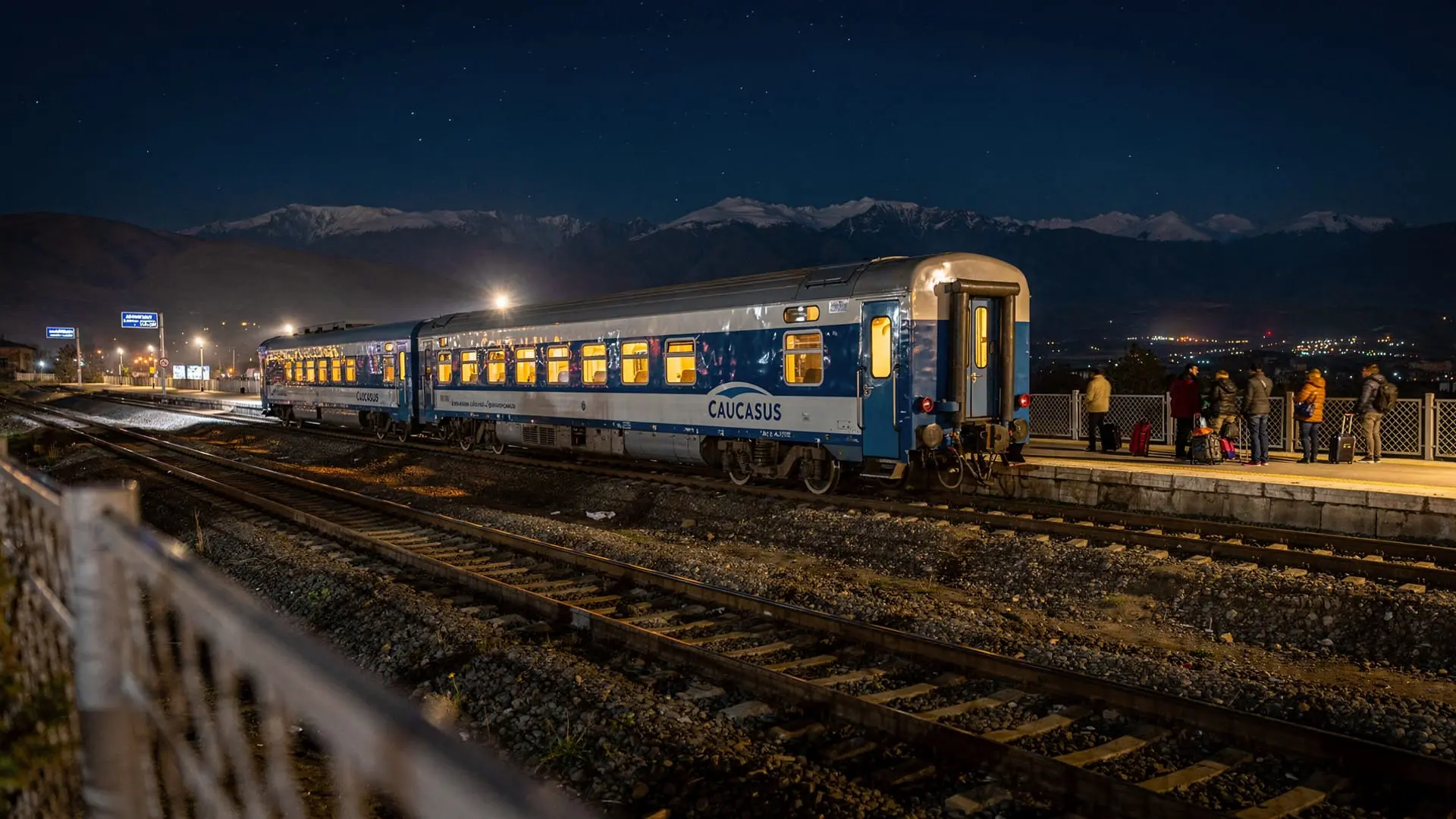
| Departs Yerevan | Sasuntsi David station, ~21:30 |
| Arrives Tbilisi | ~07:30 next morning |
| Duration | ~10 hours |
| Cost (platzskart) | ~$30–40 USD |
| Border check | On board, ~1:30–2:30am, stay in your bunk |
Of all the ways to travel between Yerevan and Tbilisi, the overnight train is the most satisfying. It converts 10 hours of transit into a night’s sleep, delivers you to the Georgian capital in time for breakfast, and wraps the entire border crossing into a half-awake passport presentation at 2am while you stay horizontal in your bunk. For travellers who value experience over efficiency, it is the only real choice.
The Trans-Caucasian Railway between Armenia and Georgia has been operating in various forms since the late 19th century, when the Russian Empire built rail lines across the Caucasus to connect Baku’s oil fields to the Black Sea. Today’s Yerevan–Tbilisi service is a direct descendant of that network — slower than modern alternatives, somewhat worn in its infrastructure, but possessed of a character that modern highways cannot provide.
This guide covers everything: the current schedule, how to buy tickets, what the compartments actually look like, the border crossing procedure, and practical tips for making the night comfortable.
The current schedule (April 2026)
Yerevan → Tbilisi:
- Departs: Sasuntsi David station, Yerevan, 21:30
- Arrives: Tbilisi Central (Tbilisi-pas), approximately 07:30 the next morning
Tbilisi → Yerevan:
- Departs: Tbilisi Central, approximately 21:30
- Arrives: Yerevan Sasuntsi David, approximately 07:30
Important: The train does not run every day. Current schedules operate several times per week. Always verify the exact current days and times at the Armenian Railways website (southcaucasus-railway.am) or at Sasuntsi David station ticket office before planning. Schedules have changed historically and can shift seasonally.
The route covers approximately 375 km of track, crossing the Debed canyon on the Armenian side and the Kura river valley on the Georgian side.
Ticket classes and prices
Platzskart (third class — open couchette car):
- 4-berth couchette bays open to the corridor
- Cost: approximately $30–40 USD per person (12 000–16 000 AMD)
- Clean, functional, used by most travellers
- Bedding available from the train attendant (provodnisa) for approximately $2–3
Kupe (second class — closed compartment):
- 4-berth closed compartments with a door
- Cost: approximately $45–65 USD per person
- More privacy than platzskart; still basic
- Recommended for those carrying valuables or wanting to sleep without corridor noise
Luxe (first class — 2-berth compartment):
- 2-berth closed compartments
- Cost: approximately $80–120 USD per person
- Maximum privacy and comfort
- Bookable in advance; often fills up
All prices are indicative as of April 2026. Railway pricing varies and can be lower or higher than these ranges depending on demand and booking timing.
How to buy tickets
In person at Yerevan station (Sasuntsi David): The most reliable method. The ticket office is open daily. Ticket sellers often speak some English. Bring your passport for identification.
Online: The Armenian Railways website (southcaucasus-railway.am) offers online booking. The interface can be challenging if you’re not reading Russian or Armenian — a workaround is booking via a local tour agency in Yerevan.
Via a Yerevan tour agency: Numerous agencies near Republic Square sell train tickets for a small booking fee — saves the trip to the station.
How far in advance: Book 1–3 days ahead in normal season. In July–August peak, book 3–5 days ahead — the train fills up, especially kupe and luxe.
Book a Trans-Caucasian railway adventure from Armenia to Georgia
What the train actually looks like
Yerevan–Tbilisi trains use Soviet-era and post-Soviet rolling stock that varies in age and condition. The most common configuration:
- Platzskart car: Open plan, with side bunks along the corridor and 4-berth bays with upper and lower bunks. Clean but basic — think overnight bus in terms of privacy, but more comfortable than any bus because you can lie flat.
- Kupe car: Individual compartments of four bunks (two upper, two lower) with a sliding door. Reasonably comfortable; the compartment window can be opened for air. Luggage fits under the lower bunks.
- Dining car: Operates in the evening before the border. Basic hot food and drinks — think simple Georgian and Armenian dishes, beer, tea. Closes after the border crossing.
The train attendant (provodnisa, usually a woman in both Armenia and Georgia) manages your car, controls the samovar for tea, and sells bedding. Tip appropriately: 500–1 000 AMD or equivalent.
The border crossing procedure at 2am
This is the part that intimidates first-time passengers and turns out to be entirely manageable:
Armenian exit (approx. 1:30am): The train slows and stops at Ayrum station on the Armenian side. Armenian border officers board the train. They walk through the carriage, collect all passports from your car’s attendant (or directly from you), disappear for 10–15 minutes, and return with your stamped passport. You do not need to leave your bunk.
Drive to Georgian post: The train moves to the Georgian Sadakhlo station (about 5 minutes).
Georgian entry (approx. 2:00am): Georgian officers board, perform the same procedure — passports collected, stamped, returned. The whole process on the train typically takes 30–45 minutes at the border, including both sides.
Total disruption to sleep: About 45–60 minutes. Most passengers fall back asleep immediately after.
Bring to bed: Your passport (keep it in your daypack or under your pillow, not locked in luggage). Georgian and Armenian customs declarations may be distributed — they are simple forms; fill in “tourist” and “nothing to declare” for standard travellers.
What to bring for comfort
- Small padlock: To secure your luggage under the lower bunk. Not essential but peace of mind.
- Earplugs: Platzskart can be noisy (fellow travellers, corridor sounds, the samovar at 3am).
- Warm layer: Even in summer, nights at altitude in the Caucasus are cool and the train’s ventilation can make compartments chilly.
- Snacks and water: The dining car closes after the border. Stock up at Yerevan’s Yerevan City supermarket near the station.
- Power bank: Electrical outlets in compartments are limited and sometimes non-functional.
- Offline maps: Download Tbilisi offline on Maps.me before boarding — you’ll arrive in a new city at 7:30am without having had time to orient. See the getting around Armenia guide for marshrutka alternatives on the Yerevan side.
Arriving in Tbilisi
Tbilisi Central (Tbilisi-pas) station is located about 1.5 km from the old town, walkable in 20 minutes or a short taxi ride. The Didube metro is nearby; the Red Line connects to the old city in 15 minutes.
Tbilisi is wide awake at 7:30am — bakeries are open, coffee shops serve the morning rush, and the old town is quiet enough in the early hours for a pleasant first walk. For comprehensive Tbilisi travel information — what to see, where to eat, where to stay — visit georgia-spirit.com.
The return: Tbilisi to Yerevan by night train
The reverse service departs Tbilisi Central at approximately 21:30 and arrives Yerevan around 07:30. Same procedure, same compartment classes, same border stop in reverse order (Georgian exit first, Armenian entry second).
Buy tickets at Tbilisi station or through a Tbilisi travel agency.
Comparing the night train to the alternatives
| Option | Duration | Cost (per person) | Comfort | Border experience |
|---|---|---|---|---|
| Night train (platzskart) | 10 h | ~$35 | Moderate | At berth, minimal disruption |
| Night train (kupe) | 10 h | ~$55 | Good | Private compartment |
| Shared marshrutka | 6 h | ~$22 | Basic | Exit vehicle twice |
| Private transfer | 6 h | ~$100+ | Comfortable | Stay in car |
| Guided tour | 8–10 h | ~$100–200 | Variable | Stay in vehicle |
The night train is not the cheapest option (marshrutka is) and not the fastest (both road options are). It is, however, the option that converts dead travel time into sleep, delivers you rested, and adds the experience of a Trans-Caucasian railway journey to the trip.
For most travellers combining Armenia and Georgia for a week or more, the night train in one direction and a road transfer in the other (to see the Debed canyon monasteries en route) is the ideal combination.
The history of the Trans-Caucasian Railway
The railway line that the overnight train follows is one of the historic infrastructure achievements of Tsarist Russia’s Caucasus expansion. The Trans-Caucasian Railway was built in stages between 1871 and 1900, connecting Baku (oil), Tbilisi (commercial hub), Batumi (Black Sea port), and eventually Yerevan (then called Erivan). The economic logic was the Baku oil trade; the political logic was the consolidation of Russian control over the three South Caucasus nations.
The Yerevan section of the line skirts the Ararat plain, crosses the Debed canyon — where you can see Haghpat monastery on the ridge above from the train window in daylight — and connects to the Georgian network at the border. The Haghpat–Sanahin UNESCO corridor is easily explored before or after the train journey.
Today the line operates at a fraction of its Soviet-era capacity — passenger trains are slow, freight traffic is limited, and the broader Trans-Caucasian route to Baku has not functioned since the Nagorno-Karabakh conflict closed the direct Armenian–Azerbaijani railway connection in the early 1990s. What remains is the Armenia–Georgia segment: slow, atmospheric, historically resonant.
Alternatives for the return: train vs road
Most travellers who take the night train in one direction choose a daytime road option for the return — this gives them the sightseeing benefits of the road (Debed canyon monasteries, scenic Lori province) without repeating the overnight train experience.
Option A (best overall): Night train Yerevan → Tbilisi, then return by daytime shared minibus or private transfer via Haghpat and Sanahin. You sleep through the transit on the way in, and see the landscape on the way out.
Option B: Daytime road Yerevan → Tbilisi (with monastery stops), return by night train. Same logic in reverse — see the landscape on the way in, sleep through the return.
Option C: Night train both ways. If you have a very tight schedule and don’t want to spend daytime hours on transit in either direction. Less common but works.
Platform life and departure etiquette at Sasuntsi David
Yerevan’s main railway station (Sasuntsi David — named for the Armenian epic hero David of Sassoun, whose equestrian statue stands in front) is worth arriving at 30–45 minutes before your 21:30 departure. See the Armenia train network guide for full schedules within the country. The station is modest by European standards but has a café, luggage lockers, and an ATM.
Sasuntsi David metro station is directly connected to the train station — the metro’s red line runs from the station through central Yerevan.
The departure platform is typically announced 15–20 minutes before departure. Carriages are numbered; find your carriage number on your ticket and locate the corresponding car on the platform. The provodnisa (carriage attendant) will check your ticket as you board.
A practical note: The train sometimes departs a few minutes early if all passengers are boarded. Be on the platform 10 minutes before departure time, not on it exactly at 21:30.
What it feels like to wake up in Tbilisi
The Yerevan–Tbilisi night train arrives at Tbilisi Central station around 7:30am — early enough that the city is still waking up. If it’s your first time in Georgia, the visual shift is immediate: the Tbilisi skyline (the medieval Narikala fortress above the old town, the Peace Bridge, the cable car to Mtatsminda park) is visible from the elevated approach to the station.
The old town of Tbilisi (Kala quarter and the sulfur bath district of Abanotubani) is about 1.5 km from the station — walkable on a clear morning with luggage that isn’t too heavy. The walk follows the Mtkvari (Kura) river through increasingly picturesque streets.
For your first hours in Georgia — where to get a Georgian SIM card, where to eat breakfast (spoiler: a local bakery near Sioni cathedral for khachapuri at 7:30am is the correct first meal in Tbilisi), how to get from the station to your accommodation — georgia-spirit.com has the practical guidance.
Frequently asked questions about the Yerevan–Tbilisi night train
Is the train safe?
Yes. The train is used regularly by travellers, expatriates, and businesspeople. Valuables should be kept close (in your daypack or under your pillow) rather than in accessible luggage. The main proviso is the standard advice that applies to any overnight train anywhere in the world.
Can I eat on the train?
The dining car operates from departure until the border crossing (about 4 hours). Basic hot food, beer, Armenian brandy, tea. After the border, the dining car closes. Bring your own snacks for the second half of the journey.
Does the train have Wi-Fi?
No. The Armenian and Georgian railway networks do not offer Wi-Fi on trains. Use your mobile data (Armenian SIM data works for the Armenian portion; switch to roaming or a Georgian eSIM after the border). Download offline maps and entertainment before boarding.
What language is used on the train?
Armenian on the Armenian side of the border, Georgian on the Georgian side, with Russian as the de facto lingua franca understood by most train staff of all ages. English is spoken by some younger staff but not universally.
Should I take the train or the road?
If you value the experience of overnight rail travel — the sound of the tracks, the border at 2am, waking up in a new country — take the train. If you want to see the Debed canyon monasteries (Haghpat, Sanahin) during daylight, take a daytime road option. Many travellers do the train in one direction and the road in the other. The full Yerevan to Tbilisi overland guide covers all options.
Is the night train suitable for families with children?
It can work well for families, particularly for children who sleep reasonably well in unfamiliar settings — a kupe compartment gives a family its own closed space rather than the open platzskart layout. The 1:30–2am border stop rarely wakes children fully, since it happens without leaving the bunk and the disruption is brief. The main practical consideration is booking early enough to secure a full kupe compartment for the family rather than being split across open platzskart bunks, which matters more with young children than with older kids or adults travelling solo.
What happens if I miss the train?
There is no simple rebooking for a missed departure — tickets are for a specific date and train. If you miss it, your options are the next scheduled departure (which may be days away depending on the current weekly schedule), a daytime road transfer via Bagratashen, or a private transfer service. Given the schedule’s limited frequency, arriving at Sasuntsi David station with a comfortable buffer — ideally 30–45 minutes before departure — is worth the wait rather than risking a missed connection with few good alternatives, particularly if the rest of your itinerary depends on arriving in Tbilisi on a specific morning, and double-check the current weekly schedule at the ticket office rather than relying on an old timetable.
Is the night train more or less reliable than the road crossing at Bagratashen?
Both are generally reliable, but for different reasons. The train’s schedule is fixed and rarely delayed by more than 20–30 minutes, since it doesn’t face the variable queue lengths that affect the Bagratashen road crossing on summer weekends. Road transport, by contrast, gives you more flexibility to stop, but exposes you to the unpredictability of border wait times, which can add an hour or more on a bad day. If your onward plans (a flight, a booked tour) depend on precise timing, the train’s schedule reliability is a genuine practical advantage over road options.
Can I book the night train and a Debed canyon stop in the same trip?
Yes, but not simultaneously — the train passes through the Debed canyon in darkness, so you won’t see Haghpat or Sanahin from the window at night. The practical solution most travellers use is the “one train, one road” combination described above: take the night train one direction for the sleep and border-crossing experience, then do the return leg by road with a stop at Haghpat and Sanahin monasteries in daylight.