Dilijan National Park: best day hikes
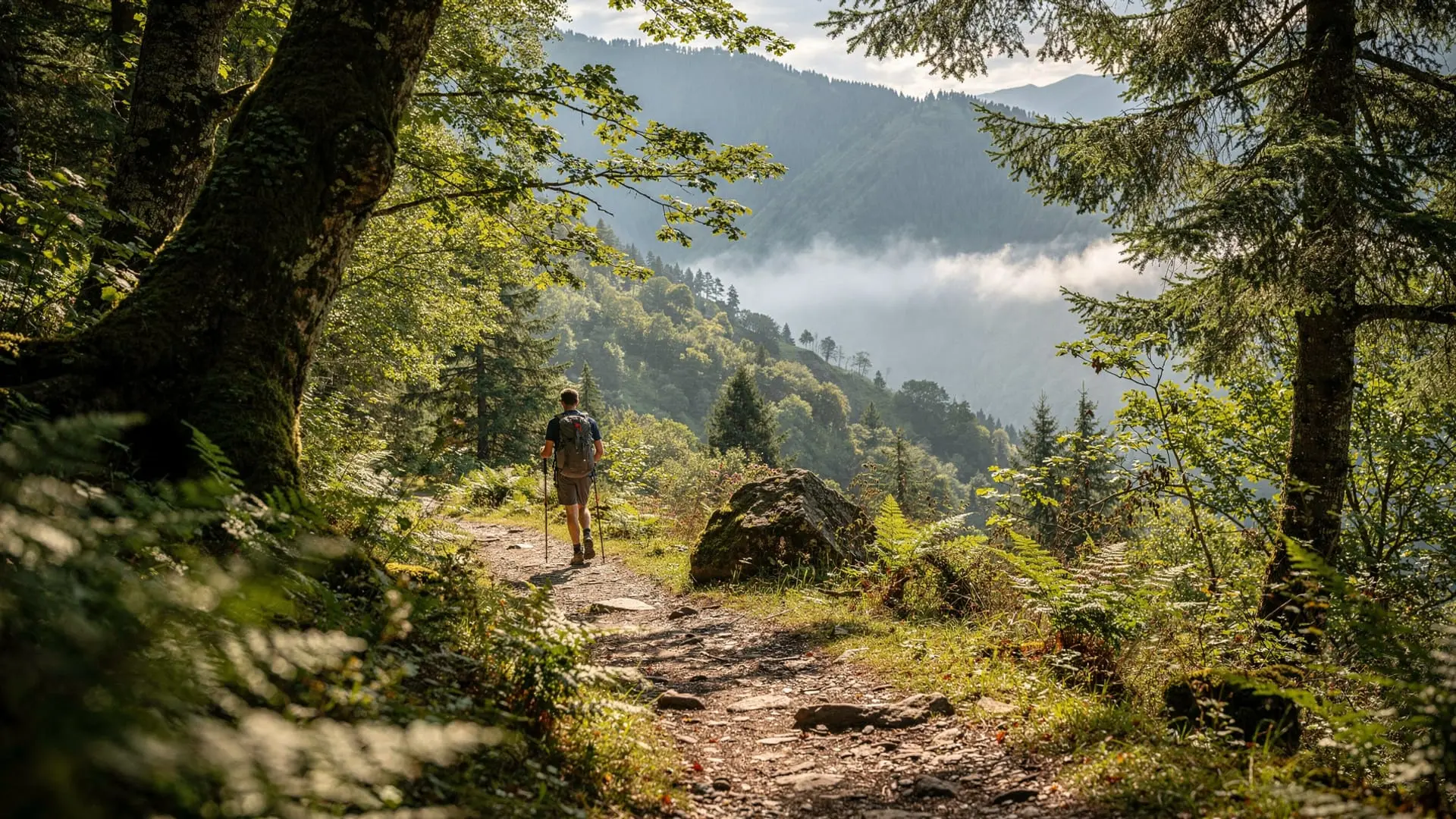
The green heart of Armenia
Dilijan National Park protects 28,000 hectares of mixed broadleaf forest in Tavush province — the densest and most biologically diverse woodland remaining in Armenia. The park’s canopy is dominated by Oriental beech, hornbeam, and oak, with understorey wildflowers in spring and spectacular bronze and gold autumn colour from late September. The town of Dilijan sits at the park’s edge, earning its nickname “Armenian Switzerland” from both the forested hills and the crisp mountain air.
| Where | Dilijan National Park, Tavush province, 95 km from Yerevan |
| Cost | ~1,000 AMD park entry per person, plus a vehicle fee |
| Time needed | 1.5 hrs (Lake Parz loop) to 5 hrs (Kirants) per hike |
| Getting there | Marshrutka or shared taxi from Kilikia station, ~1h45 |
| Best time | Late April–June (wildflowers) or Sept–Oct (autumn colour) |
For hikers, the park offers something rare in the South Caucasus: established, signed trails ranging from a flat lakeside stroll to demanding full-day ridge traverses. You don’t need a guide for most routes (though they significantly enrich the experience) and you don’t need to be a serious mountaineer to explore the interior.
The park is also a Transcaucasian Trail and Janapar Trail corridor, meaning that dedicated long-distance hikers can connect day-hike sections into multi-day trail experiences.
Hike 1: Lake Parz loop (easy, 3 km, 1.5h)
Lake Parz — “transparent lake” in Armenian — is a small, jewel-clear forest lake 7 km east of Dilijan town. It sits at about 1400m within the national park and is reached by a paved road (accessible by taxi or GG Taxi from Dilijan, 500 AMD).
The circular loop trail follows the lake’s perimeter through mixed woodland. The path is wide, mostly flat, with wooden boardwalks over the boggy eastern shore. Facilities at the lake include a small café and zip-line (popular with families). In spring, the forest floor around the lake is carpeted in wild anemones and wood sorrel; in October, the reflections of turning beech leaves in the lake create one of the most photographed scenes in northern Armenia.
Trailhead: Lake Parz parking area (easily reached by taxi from Dilijan).
Best for: families, non-hikers, elderly visitors, those arriving late in the day.
Hike 2: Gosh village to Haghartsin monastery (moderate, 9 km, 4h)
This is the most satisfying half-day hike in the national park — a forest traverse linking the medieval village of Gosh (home of Goshavank monastery) with the valley of Haghartsin monastery. The route climbs through beech forest to a ridge at about 1700m before descending into the Haghartsink valley.
The trail is reasonably well marked but requires basic navigation skills (download an offline GPS track). The Janapar yellow blazes appear on parts of this section. At Haghartsin, you arrive through the forest above the monastery — a far more memorable entrance than the road approach most visitors use.
One-way logistics: this hike works best as a point-to-point with a taxi waiting at Haghartsin at the end (arrange by phone before you leave Gosh). Alternatively, return the same way.
Trailhead: Gosh village, reached by taxi from Dilijan (20 min, about 1,500 AMD).
Best for: experienced day hikers who want the best of the national park’s interior.
Hike 3: Dilijan town forest trails (easy to moderate, 5–8 km, 2–4h)
The town of Dilijan is surrounded by a network of signed forest trails that the national park administration has gradually developed and improved. Trail markers (numbered wooden posts) are posted at junctions.
Trail 1 (easiest, 5 km, 2h) climbs through pine and beech above the old town to a viewpoint overlooking the Aghstev river valley — on clear days you can see across into Georgia. Trail 3 (moderate, 8 km, 3.5h) extends the ridge walk further before looping back via a waterfall on the park’s western boundary.
Maps of these numbered trails are available at the national park visitor centre in Dilijan town or downloadable from the park’s website.
Trailhead: National park visitor centre, Myasnikyan Street, Dilijan town.
Best for: visitors staying in Dilijan who want to hike without transport logistics.
Hike 4: Kirants monastery forest trail (moderate, 12 km, 5h)
The trail to Kirants monastery (a ruined 13th-century complex in the Aghstev valley, close to the Georgian border) is one of the most immersive walks in Tavush. The route follows the river before climbing through old-growth forest to the monastery’s isolated setting above the canyon. Kirants is far less visited than Goshavank or Haghartsin, which adds to the sense of discovery.
The Kirants monastery guided hike from Yerevan covers this remote trail with local guides who know the forest paths and can provide context for the monastery’s history and the surrounding ecology.
Trailhead: Aghavnavank village, accessible by taxi from Ijevan (40 min).
Best for: fit hikers interested in remote monasteries and old-growth forest.
Choosing between the four hikes
| Hike | Distance | Difficulty | Best for |
|---|---|---|---|
| Lake Parz loop | 3 km | Easy | Families, non-hikers, short stops |
| Gosh to Haghartsin | 9 km | Moderate | Half-day hikers wanting the park’s interior |
| Dilijan town trails | 5–8 km | Easy–moderate | Visitors staying in town without transport |
| Kirants monastery | 12 km | Moderate–hard | Fit hikers seeking remote, quiet forest |
Guided day hikes in Dilijan National Park
The Dilijan National Park lake trek from Yerevan is the most popular guided day option, combining Lake Parz and forest sections in a full-day trip departing from Yerevan. It’s the best choice for visitors with limited time who want to experience the park without overnight logistics.
Wildlife and nature notes
Dilijan National Park is classified as an Important Bird Area. The forest holds the South Caucasus’s best populations of Syrian woodpecker, black woodpecker, and grey-headed woodpecker, alongside breeding raptors (short-toed snake eagle, honey buzzard) and the endemic Caucasian black grouse at higher altitudes. The 3-day bird-watching and hiking tour from Yerevan specifically focuses on the Tavush forest zone and is the best option for birders.
Mammals in the park include roe deer, wild boar, brown bear, and the rare Armenian viper (a venomous snake — watch where you step on rocky sections, particularly in spring and autumn when snakes sun themselves on path edges).
Spring (late April–May) brings extraordinary wildflower blooms in forest clearings: wild orchids, wood anemones, Caucasian rhododendron, and numerous endemic Tavush species. Autumn (late September–October) is the most visually dramatic season for photography.
Practical park information
Entry fees: There is a national park entry fee of approximately 1,000 AMD per person. Fees are collected at the main entry point on the road to Lake Parz and at some trailheads. A vehicle fee also applies.
Visitor centre: Open daily June–October, reduced hours in shoulder months. Staff can provide trail maps, current condition updates, and guide referrals. The centre also has a small exhibition on park ecology and history.
Guides: Local park guides can be hired at the visitor centre for 8,000–15,000 AMD per day (group rate). For guided birdwatching, specialist guides need to be booked in advance through Yerevan operators.
Rules: Open fires are prohibited. Camping requires a permit (applied for at the visitor centre). Stay on marked trails in the core zone. Do not pick wildflowers or disturb wildlife.
Getting to Dilijan
From Yerevan: marshrutkas depart Kilikia bus station throughout the day (95 km, about 1h 45min, around 1,000 AMD). Shared taxis take the same route in about 1h 30min. The road runs through the Sevan–Dilijan tunnel — a short but spectacular stretch where the road plunges underground for 2 km before emerging into Tavush’s green valleys.
Accommodation in Dilijan ranges from the Hotel Old Dilijan Complex (excellently restored Soviet-era building with traditional cuisine, mid-range price) and Tufenkian Old Dilijan Complex (boutique, higher-end) to family guesthouses at 10,000–15,000 AMD per night.
Combining Dilijan hikes with regional highlights
Dilijan pairs naturally with a Lake Sevan visit — the two destinations sit less than 40 km apart via the mountain tunnel. See the Lake Sevan & Dilijan day trip guide for logistics. For those with more time, Haghartsin and Goshavank monasteries (both 15–20 km from Dilijan town) are in their own league architecturally; hiking to Haghartsin on Trail 2 above and driving to Goshavank makes a near-perfect Tavush day.
The Bjni to Tsaghkadzor traverse and the Janapar Trail guide both provide complementary hiking options in the broader northern Armenia region.
Frequently asked questions about Dilijan National Park hikes
Is Dilijan National Park suitable for families with young children?
Yes, for the right trails. The Lake Parz loop (Trail 1) is ideal for families — flat, short, with facilities at the lake. The town forest trails (Trail 1 from the visitor centre) are also manageable for children aged 6–7 upward. More demanding trails like the Gosh–Haghartsin route are suitable for older children (10+) with hiking experience.
Do I need a guide to hike in Dilijan National Park?
For the Lake Parz loop and the numbered town trails, no guide is necessary. For the Gosh–Haghartsin route and especially the Kirants trail, a guide or good GPS navigation is recommended. The interior forest can be disorienting without trail markers.
What is the best time of year to visit for hiking?
Late April to June for wildflowers and fresh spring green. September to early October for autumn colour — the beech forests turn spectacular bronze and gold. July–August for reliable weather but more humidity at lower elevations.
Are there bears in Dilijan National Park?
Yes, brown bears are present but rarely encountered. They are generally shy and avoid hikers. Make noise on the trail (trekking poles, conversation), and if you camp, store food in hard containers away from your tent. Encounters with hikers are extremely rare.
How do I get trail maps?
The national park visitor centre provides printed maps for the numbered town trails. The Gosh–Haghartsin and Kirants routes are best navigated with downloaded GPX tracks (available on transcaucasiantrail.org or Wikiloc). The maps.me app with the Armenia offline map loaded is a reliable backup navigation tool.
Can I combine Dilijan National Park with Haghartsin monastery?
Absolutely — this is one of the park’s best combinations. Hike the Gosh–Haghartsin trail for a forest approach to the monastery, then arrange a taxi back to Dilijan from the Haghartsin car park. Alternatively, drive to Haghartsin and use it as the starting point for a walk into the forest.
Dilijan town: the hiker’s base
Dilijan is not just a gateway to the national park — it is one of the most pleasant small towns in Armenia for an overnight stay. The Old Town (reconstructed as a pedestrianised cultural zone) has restored 19th-century merchant houses, several art galleries, a pottery workshop, and a string of cafés and restaurants serving traditional Tavush cuisine. The local specialty is ishkhan (Sevan trout), often smoked or grilled, and the mountain honey sold from local producers is outstanding.
Where to stay:
- Hotel Old Dilijan Complex (Tavush, mid-range, ~40–60 EUR/night): An expertly restored Soviet-era sanatorium with large rooms, a good restaurant, and a 10-minute walk from national park trailheads. The building’s mid-century architecture is interesting in its own right.
- Tufenkian Old Dilijan Complex (boutique, ~80–120 EUR/night): The more polished Tufenkian brand’s Dilijan property, with individually decorated rooms and the brand’s characteristic commitment to local craft and food sourcing.
- Family guesthouses: Numerous options at 10,000–18,000 AMD per night. Ask the national park visitor centre for current recommendations — quality varies.
Eating: Arevi restaurant (on Sharambeyan Street, traditional Armenian, open most days) is reliably good. The café inside the Old Dilijan Complex serves strong Armenian coffee and excellent pastries. For post-hike calories, the restaurants on Myasnikyan Street near the visitor centre have outdoor seating through summer.
Multi-day hiking from Dilijan
For visitors with more than one day in Dilijan, the following multi-day structure uses the town as a base for progressive exploration of the national park:
Day 1 — Lake Parz loop and visitor centre orientation (3 km, 2h). Low impact, gets you into the forest, acquaints you with the park’s character.
Day 2 — Gosh to Haghartsin traverse (9 km, 4–5h). The park’s best medium-effort day. Finish with a visit to Haghartsin monastery before taxi back to Dilijan.
Day 3 — Ridge walk above Dilijan via Trail 3 (8 km, 3.5h). The most demanding town-based trail, with the best long-distance ridge views. Combine with an afternoon at Goshavank monastery (15 min by car).
Day 4 — Kirants monastery excursion (longer day, requires taxi out). Optional for fit hikers who want the deepest national park experience.
Dilijan and the TCT connection
Dilijan is one of the key nodes of the Transcaucasian Trail in Armenia. The TCT enters the Tavush corridor near the Georgian border, passes through the Kirants and Ijevan zone, and reaches its most well-developed section in the Dilijan National Park area. For hikers walking sections of the Transcaucasian Trail, Dilijan offers the best infrastructure on the entire Armenian route: accommodation, food, gear supplies (limited but better than most trail towns), and transport connections.
The Janapar Trail shares substantial overlap with the TCT through Dilijan, and the yellow Janapar blazes complement the TCT white-red-white markings on many sections around the park.
Photography guide for Dilijan
The Dilijan National Park is exceptional for forest photography. Key recommendations:
Best light: The beech canopy filters morning light into scattered columns — a condition that improves enormously in autumn (late September–October) when the leaves turn amber and golden. Arrive at the forest edge at dawn for the best atmospheric light. Noon light in summer creates harsh, flat contrast — rest during midday, hike at ends of day.
Best subjects: Reflections of Haghartsin monastery in the monastery’s courtyard pool (morning); autumn beech canopy on the Gosh–Haghartsin ridge (late September); Lake Parz reflections (morning calm, before wind disturbs the surface); the moss-covered stone walls of Kirants monastery ruins in forest shadow.
Camera settings: In the forest interior, exposure bracketing is useful for the high contrast between canopy and shadow. A polarising filter reduces glare on Lake Parz and improves colour saturation on the forest canopy.
What to pack for a Dilijan hiking day
Beyond the standard trail kit — sturdy trail shoes or boots, layers, rain protection, water, and snacks — a few Dilijan-specific items matter. The forest interior is noticeably cooler and damper than the Ararat plain, so pack a warm layer even in July for the Gosh–Haghartsin and Kirants routes. Insect repellent is worth having in the wetter margins near Lake Parz. A downloaded offline map is essential for the Kirants trail, where phone signal is patchy in the canyon. The full Armenia trekking gear checklist covers broader multi-day considerations if you’re combining Dilijan with other hiking regions, and the Armenia packing list by season has month-by-month detail.
Extending into wider Tavush and northern Armenia
Hikers who enjoy Dilijan’s forest often want more of the same terrain. Ijevan, 35 km east, is the gateway to further Tavush forest and adventure routes, including off-road access toward Mount Vitasar. To the north, Lori province offers a different character of forest and canyon hiking around Stepanavan and the Debed valley’s UNESCO monasteries at Haghpat and Sanahin. Those planning a longer northern Armenia loop that strings together Dilijan, Ijevan, and the Debed valley should budget at least 4–5 days to do the region justice without constant driving.
Can I hike Dilijan National Park as a day trip from Yerevan, or do I need to stay overnight?
The Lake Parz loop and a guided lake trek both work comfortably as a day trip from Yerevan. The Gosh–Haghartsin traverse and the Kirants trail are better with an overnight in Dilijan, since early starts and taxi logistics are far easier from town than driving out from the capital the same morning.
How does Dilijan compare to hiking around Lake Sevan or Tsaghkadzor?
Dilijan offers dense forest hiking with monastery destinations; Lake Sevan’s trails are more open, lakeside, and exposed; Tsaghkadzor sits higher and combines forest with alpine meadows and ski infrastructure. Hikers who want tree cover and shade should prioritise Dilijan; those who want lake views should look at the Lake Sevan complete guide or the Tsaghkadzor–Sevan day combo.