Dolma & tolma: Armenia's stuffed-vine tradition
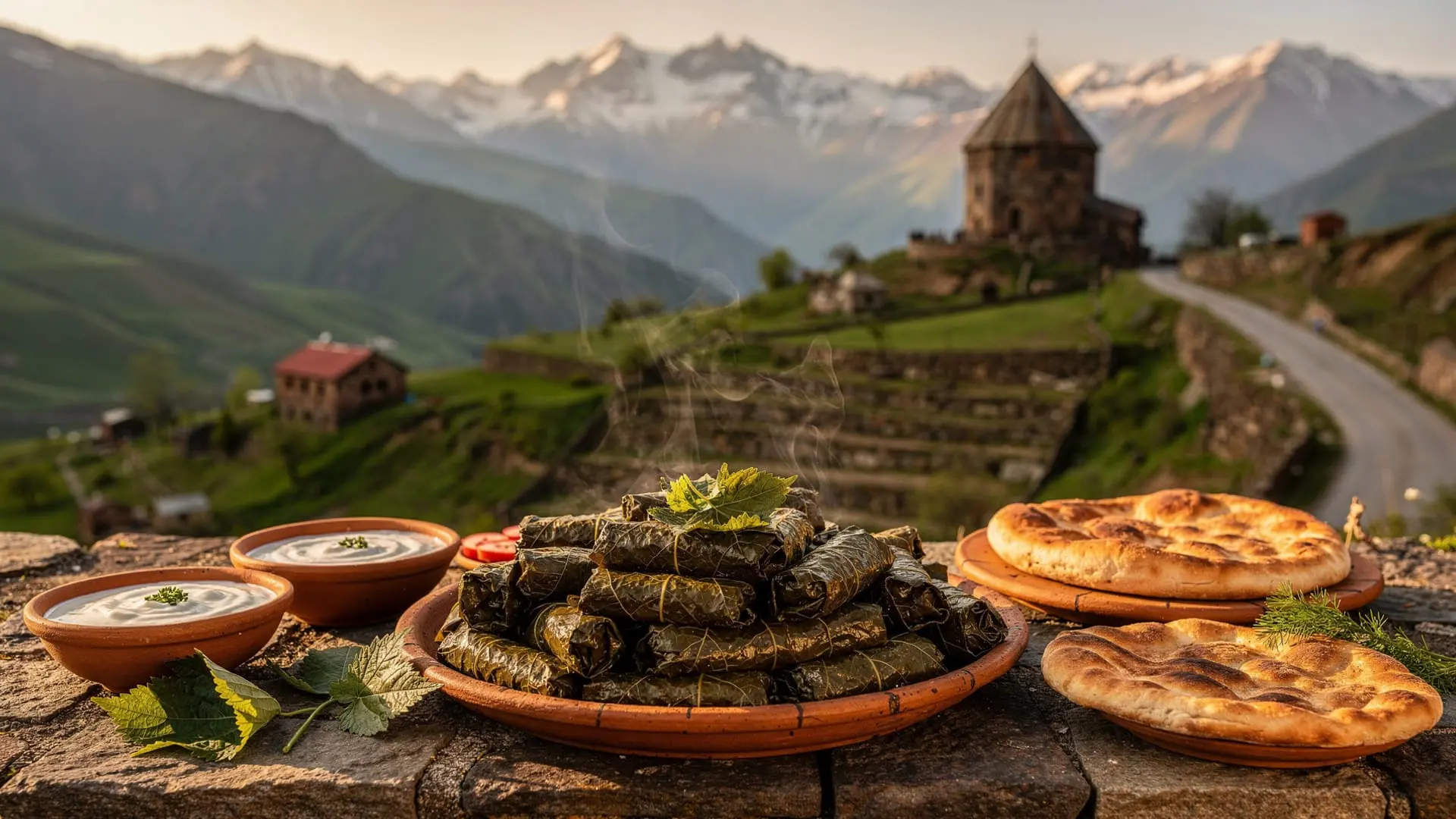
Two words, one ancient tradition
Of all the dishes in the Armenian kitchen, dolma and tolma carry perhaps the strongest sense of ceremony. Both require patience — the rolling, the stuffing, the careful stacking in the pot. Both are inseparable from family occasions: the extended gathering where someone’s grandmother rolls dozens of vine leaves with casual precision, each one uniform without looking at her hands.
The distinction matters to Armenians and confuses most visitors. The words dolma and tolma are not interchangeable, though they share a root and a method. Understanding the difference opens a small window into how Armenian food culture thinks about itself — precise about tradition, passionate about the details.
| What it is | Stuffed grape leaves (dolma) and stuffed vegetables (tolma) |
| Where to try | Yerevan restaurants, guesthouse home cooking, cooking classes |
| Cost | around 2,500–5,000 AMD for a restaurant portion |
| Best season | Fresh vine leaves April–September; quince tolma Sept–Nov |
| Good to know | Order with matsun (yoghurt) on the side |
The etymology and the politics
Both dolma and tolma derive from the same Turkic root: doldurmak in Turkish, meaning “to fill” or “to stuff.” The Armenian word tolma (sometimes toli) preserves an older phonetic form. Some Armenian scholars argue the practice itself predates the Turkic vocabulary and that the root word was adopted into Turkic from an earlier Anatolian or Caucasian source — a claim hard to prove but not impossible given the culinary archaeology of the region.
Whatever the origin, stuffed grape leaves appear in Armenian cooking manuscripts going back to at least the medieval period, and the practice of stuffing vegetables has deep roots across the entire Eastern Mediterranean and Caucasus. Armenians do not claim invention; they claim a specific and distinct version that is theirs.
The word choice also reflects a quiet political awareness. In Armenia, calling a dish by a term that sounds identical to its Turkish version is occasionally noted. Most Armenians use tolma as the general term when speaking Armenian, but dolma in English (and in restaurant menus) is understood universally.
Dolma: the grape leaf version
Classic Armenian dolma uses young grape vine leaves, blanched to soften, then rolled around a filling of:
- Minced lamb (or a lamb-beef mix) — not too lean; fat in the filling is essential
- Short-grain rice — uncooked, so it absorbs the cooking liquid inside the roll
- Onion — finely grated so it dissolves into the filling
- Fresh herbs — flat-leaf parsley, coriander, and dried mint
- Spices — black pepper, allspice, cinnamon (a small amount; the spicing is warm rather than strong)
- Tomato paste — a small spoon for colour and acidity
- Salt — generously
The rolls are packed tightly into a heavy pot, often layered with sliced tomatoes at the base to prevent sticking and add flavour. A plate is pressed on top to stop the rolls unfurling during cooking. Chicken stock or water covers the rolls, and they simmer on a low heat for 45–60 minutes until the rice is cooked and the vine leaves are silky.
Dolma is served with matsun — Armenian strained yoghurt — poured over or served alongside. The cool, sharp yoghurt against the warm, herb-fragrant roll is the combination that makes the dish complete.
Sourcing the vine leaves
Fresh vine leaves are ideal and available in Armenia from April through September. In spring, when the leaves are young and at their most tender, the rolling is easiest and the flavour most delicate. Later-season leaves are tougher and slightly more bitter; the rolls taste better but take more skill to prepare. Preserved (brined) vine leaves are used year-round in restaurants; the brine adds a faint saltiness that slightly changes the flavour profile.
If you pass vineyard country in Vayots Dzor or Tavush between April and June, you may see vine leaves being harvested for kitchen use — they are collected in bundles and either used fresh or preserved in salt water.
Tolma: the stuffed vegetable versions
Tolma covers a family of dishes using the same filling logic as dolma but substituting vegetables for the grape leaf wrapper.
Pepper tolma (biber tolma)
The most common: round sweet red or yellow peppers, tops removed and seeded, then filled with the lamb-rice mixture and baked or simmered. The pepper walls soften to tenderness and the filling absorbs the pepper’s sweetness. A restaurant standard across Yerevan.
Tomato tolma
Summer tomatoes, their tops sliced off and pulp removed, filled with a mixture that often includes the scooped-out tomato pulp mixed with the lamb and rice. The tomato walls collapse slightly during cooking, concentrating their flavour around the filling.
Eggplant tolma (badrijani tolma)
Eggplants slit lengthwise or halved, the flesh scooped out and the cavity filled, then braised. The eggplant develops a smoky sweetness as it cooks down. This version is often made alongside khorovats using the side of the grill.
Quince tolma (ayva tolma)
The autumn speciality: hard quinces are hollowed and filled, then braised long and slow. The quince’s tartness balances the rich lamb filling in a way no other vegetable does. Seasonal — available September through November only. Rarely found on restaurant menus; look in traditional home-cooking contexts or seasonal specials at Sherep or Lavash restaurant.
Pasuts tolma (Lenten stuffed leaves)
The meatless version made during the 48-day Great Lent before Easter. The filling uses dried beans, lentils, rice, and dried fruit — apricots, raisins, and sometimes plums. The flavour is completely different from the meat version: sweet, earthy, fruity, and surprisingly filling. Pasuts dolma is not a compromise; it is a dish in its own right and many non-fasting Armenians eat it by preference. Available in traditional restaurants during Lent (usually February–April).
The cooking method: a note on patience
The key technical challenge in Armenian dolma is that the rice inside the roll must cook without the outer leaf overcooking. This requires controlled, gentle, sustained heat. Too high a flame and the rice remains hard when the leaves have dissolved; too low and the rolls fall apart before the rice is done.
The fix: do not pre-cook the rice. Raw rice absorbs the cooking liquid gradually and finishes at the same time as the leaf. This is the Armenian method and the reason that restaurant dolma made by someone trained in the tradition eats differently from a rushed approximation.
Stacking matters too. Rolls packed loosely rattle around and unwrap; packed tightly with the seam downward, they hold their shape and compress into each other, creating a cleaner serving. The plate pressed on top during simmering is not optional.
Where to eat dolma and tolma in Yerevan
Dolmama (Pushkin Street) — named for the dish, naturally. Dolmama was one of the first upscale Armenian restaurants in Yerevan and remains the city’s benchmark for refined traditional food. The dolma is impeccable: the vine leaves are silky, the filling well-seasoned, the matsun cold and sharp. Mid-range to fine dining; book ahead for dinner. See our Yerevan best restaurants guide.
Lavash Restaurant (Tumanyan Street) — excellent dolma alongside the full range of traditional dishes. See the lavash baking experience guide for more on this culinary tradition. Known for consistency; a reliable choice.
Tavern Yerevan — reliable mid-range execution; the dolma here is a crowd-pleaser rather than an art form, but the setting (traditional wooden interior, cold beer) makes it enjoyable.
Achajour — focuses more on breakfast and brunch but the lunch menu includes tolma options. Worth trying if you are already there.
Home cooking — the best dolma in Armenia is invariably made by a grandmother in her own kitchen. If your guesthouse or accommodation host offers a home-cooked dinner, this is likely to appear. Accept every time.
Making dolma: the process as a social activity
In Armenian households, dolma-making is communal in the same way as lavash baking. A large batch — 50, 100, even 200 rolls for a family gathering — requires multiple pairs of hands. The rolling itself is calming and meditative once learned; experienced rollers achieve a uniform tightness without measuring.
The social dynamic follows a similar pattern to lavash: older family members teach, younger ones learn, and the kitchen becomes the real site of cultural transmission. A cooking class in Yerevan that includes dolma-rolling (the traditional cooking class covers this) gives you enough of the technique to attempt it at home, plus an understanding of why the process feels the way it does in an Armenian family kitchen.
Dolma and tolma across the Armenian calendar
Stuffed dishes appear year-round, but certain forms have seasonal associations:
| Season | What’s served | Notes |
|---|---|---|
| Spring–summer (Apr–Jun) | Fresh vine leaf dolma | Peak tenderness, easiest to roll |
| Summer (Jun–Aug) | Tomato, pepper, eggplant tolma | Uses peak-season vegetables |
| Autumn (Sep–Nov) | Quince tolma | Rare on menus; ask at guesthouses |
| Winter/Lent (Feb–Apr) | Pasuts dolma (meatless) | Beans, lentils, dried fruit filling |
| Weddings/celebrations | Meat dolma, large batches | The prestige version, made in quantity |
There is also a tradition of making dolma for New Year gatherings, and it appears at the memorial meals (hokehats) held on the 7th, 40th, and anniversary days following a death.
Regional variations in Armenia
In Gyumri (Shirak province), the dolma filling tends toward more onion and dried apricot, giving a sweeter note. In Syunik, near the Iranian border, some families add a small amount of dried barberry (sumac-adjacent) to the filling for sharpness. In Tavush, wild herbs from the forest supplement the cultivated herb mix.
These are variations on a theme rather than distinct dishes. The vine-leaf format is universal; the filling is a family signature. This means that the dolma you eat in Yerevan at a restaurant and the dolma made in a village in Lori are both authentically Armenian despite tasting noticeably different.
The politics of the name: a note for visitors
It is worth being clear about a dimension of this dish that surfaces occasionally in conversations with Armenian hosts. The shared etymology of dolma and tolma with Turkish cooking vocabulary is a historical fact; acknowledging this does not diminish the Armenian origin or the distinctiveness of the Armenian version. Most Armenians who care about food are comfortable discussing the shared history of Caucasian and Anatolian cuisines.
What is more sensitive is the occasional reduction of Armenian dolma to a “version” of a Turkish dish in travel writing that lacks historical context. The cultural relationship between Armenia and Turkey is defined by the 1915 Genocide and its still-unresolved status; any framing that treats Armenian culinary identity as derivative risks landing poorly. The safe and accurate position is this: stuffed vine leaves and stuffed vegetables are a shared tradition across a large region, and Armenian tolma is a distinct expression of it with its own history, its own flavour profile, and its own ceremonial functions.
Learning to make dolma: cooking classes in Yerevan
The traditional Armenian cooking class in Yerevan typically includes dolma rolling as a central activity. The session usually runs 3 hours and covers: preparing the filling, blanching vine leaves (or working with preserved leaves), rolling technique, cooking, and eating what you made. Hosts are usually family households rather than professional chefs — which makes the transmission feel authentic.
Dolma rolling is a skill that requires only a little practice to become functional. The first few rolls will be loose and imperfect; by the tenth you will have the tension right. The key insight, which experienced rollers share without being asked: do not pull the leaf tight against the filling, but compress the filling slightly before rolling, so the rice has space to expand during cooking without splitting the leaf.
Dolma and the Armenian diaspora
For diaspora Armenians everywhere from Beirut to Los Angeles, dolma carries intense associative power. It is the dish made at family gatherings that connects present-day diaspora life to the homeland. See the Armenia heritage trip for diaspora guide for the fuller context of reconnecting through food and culture. The vine leaves are important in this symbolism — the grapevine is one of the oldest Armenian cultural symbols, appearing in khachkar stone carvings and in literary imagery going back to medieval manuscripts. Rolling dolma with a grandmother in Los Angeles using preserved leaves shipped from Yerevan is both a practical act and a cultural maintenance ritual.
Some diaspora families have variant recipes that diverged from the Yerevan mainstream over generations of adaptation — more dried fruit in the Los Angeles version, a pinch of cinnamon from the Aleppo Armenian tradition, a yoghurt sauce adapted to available ingredients in France. These variants are not inferior; they are the food equivalent of the diaspora’s language, slightly different in cadence but immediately recognisable.
Ordering dolma and tolma like a local
A few habits distinguish a confident order from a tentative one. Ask specifically whether the vine leaves are fresh or preserved — in season (April–September), a good restaurant will usually tell you unprompted, and it is a legitimate question rather than a fussy one. Order the matsun alongside if it does not automatically arrive; some newer, more international-leaning restaurants forget it, and the dish is genuinely worse without it. If pasuts (Lenten) dolma is on the menu outside the fasting period, it is usually there because a regular customer requested it — worth trying even if you are not observing any fast, since the dried-fruit sweetness is a different, valid experience of the dish.
For visitors combining food exploration with a wider Yerevan trip, dolma tasting pairs naturally with a walk through the Vernissage flea market, where ceramic bowls and traditional serving dishes similar to those used for dolma are sold, and with the Armenian food essential dishes guide for the wider culinary context beyond stuffed vegetables.
Pairing dolma with Armenian wine or brandy
Dolma’s rich, herb-heavy filling and sharp matsun accompaniment pair surprisingly well with both ends of Armenia’s drinks culture. A dry Areni red — see the Armenian wine grapes: Areni noir guide — cuts through the lamb fat without overwhelming the herbs. For those who prefer spirits, a small glass of Armenian brandy after the meal, rather than during it, is the more traditional pairing; the Armenian brandy and cognac guide explains why brandy is treated as a digestif rather than a dinner drink in most Armenian households.
Frequently asked questions about dolma and tolma
Is dolma the same in Armenian and Turkish cuisine?
The dishes share a common ancestor and many techniques are identical. Armenian cooks typically use more sour (matsun, pomegranate) flavour notes in the filling and yoghurt alongside rather than olive oil. Turkish dolma often uses more currants and pine nuts in the rice. Both are excellent; they are regional variations of the same idea rather than one copying the other.
Why is the meat version better with matsun?
The fat and warmth of the lamb filling needs the cool, acidic matsun to come into balance. Without it, the dish is one-dimensional. Some restaurants add a splash of garlic in the matsun; this is a Yerevan refinement rather than a universal practice.
Can I freeze dolma?
Finished dolma freezes well for up to two months. Reheat gently in the pot with a little added water, covered. The vine leaves hold their texture better after freezing than most people expect.
Is there a version without rice?
In some regional traditions, bulgur wheat replaces rice, particularly in older recipes. The texture is firmer and nuttier. You are unlikely to encounter this in Yerevan restaurants but may in village homestays in Aragatsotn or Lori.
How many dolma pieces are a serving?
Restaurant servings are typically 5–8 pieces as a main course. At a family gathering, the bowl contains more than anyone can count and the host will insist you take more.
Where is the best place in Yerevan to try dolma if I only have one meal for it?
Dolmama on Pushkin Street is the safest single recommendation — it is named for the dish and treats it as the centrepiece rather than one item among many. See the Yerevan best restaurants guide for how it compares to other traditional-food destinations in the city.
Is dolma easy to make at home after a cooking class, or does it take years to master?
The basic technique is learnable in one class — rolling a passable dolma takes about ten attempts to get the tension right. What takes longer to master is the instinct for seasoning the filling by feel and judging the cooking liquid level, which is the part experienced Armenian cooks do without measuring. Expect your first home attempt to taste good but look less uniform than a grandmother’s; that’s normal and improves quickly with repetition.