Why Gyumri is Armenia's cultural capital
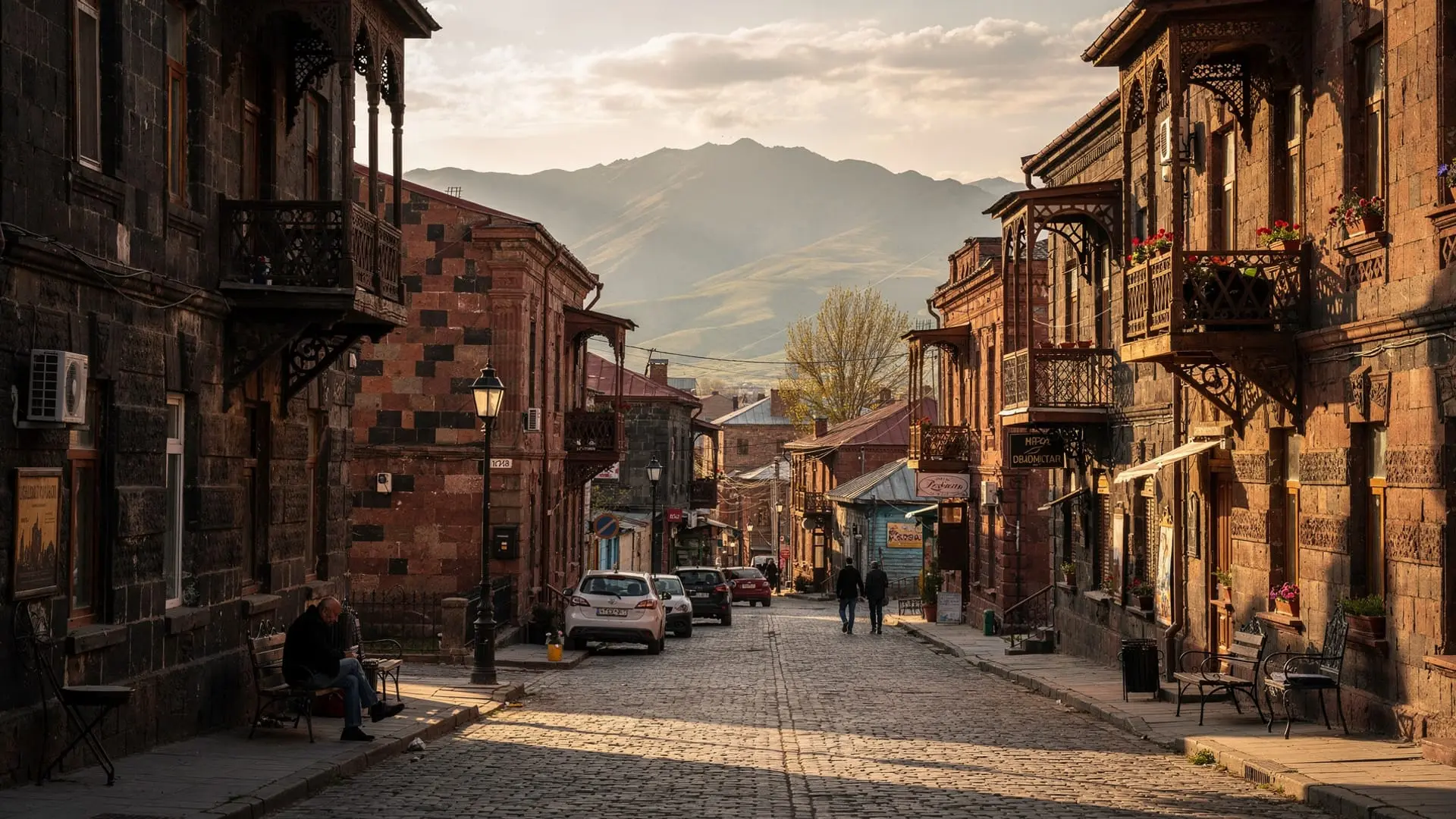
A city that rebuilt itself in stone
Gyumri (population approximately 120,000, Armenia’s second city) has a claim on Armenian cultural identity that Yerevan’s capital status does not diminish. While Yerevan was transformed by Soviet urban planning into a capital designed to project state power, Gyumri remained — partly by misfortune, partly by character — a city shaped by its 19th-century origins and its response to catastrophe.
The catastrophe was the earthquake of 7 December 1988: 6.8 magnitude, centred near Spitak but devastating Gyumri (then still called Leninakan under its Soviet name). Over 25,000 people died across the region; much of Gyumri collapsed. But the older stone quarters — the 19th-century Russian-imperial city with its black volcanic tuff mansions — survived better than the Soviet concrete apartment blocks. What the earthquake revealed was that the older city had been built more honestly.
Thirty-seven years later, the consequences of that day are still visible: reconstructed apartment buildings alongside ruins still awaiting repair, temporary metal shelters (domiks) that were meant to be emergency housing and became permanent for thousands of families. But the 19th-century core of the city — the streets of Abovyan and Vartanants, the Kumayri historic district — survives and thrives. And with it, Gyumri’s claim to the cultural capital title.
| Where | Shirak province, 120 km / ~2h north of Yerevan |
| Cost | Free to walk the Kumayri district; museums nominal fee |
| Time needed | Half-day minimum, full day or overnight better |
| Getting there | Train (~3h, atmospheric), marshrutka, or private car (~2h) |
| Best time | May–October for weather; winter for dramatic snow on black stone |
The 19th-century city and its architecture
Gyumri’s claim to architectural significance rests on the Kumayri historic district — a preserved area of roughly 2 square kilometres in the old city centre where black volcanic tuff stone buildings from the Russian imperial period (1820s–1917) survive in significant density.
The black tuff used in Gyumri construction is called “gyumri black” and comes from quarries in the Shirak region. Unlike Yerevan’s pink tuff, which produces warm, honeyed tones, Gyumri’s black stone gives the city a severe, powerful character — particularly in winter under snow, when the dark facades against white ground create a visual contrast of unusual drama.
The architectural typology of Kumayri is Russian provincial neoclassicism adapted to local conditions: symmetrical facades with arched windows, carved stone ornament, enclosed courtyards (berd), and rooflines with bracketed cornices. Many buildings have ground-floor arcades that once housed shops and workshops. The overall effect is of a provincial Russian city with a specifically Armenian overlay — the ornamental details, the courtyard configurations, and the scale of the street are Armenian in character even if the broader style is Russian imperial.
Key buildings and streets worth exploring:
Vartanants Square: The central square, rebuilt after the earthquake but maintaining its historic form, with a monument to the 5th-century Armenian warriors of the Battle of Avarayr (451 AD). The square is Gyumri’s civic centre and the best starting point for a walking tour.
Abovyan Street and Gyuzalyan Street: The two main residential streets of the Kumayri district, lined with 19th-century black stone buildings in various states of repair and restoration. The variation between carefully restored mansions and semi-ruined shells gives the streets an authentic texture that over-restored historic districts lack.
The Dzitoghtsyan House-Museum (Ethnographic Museum): Housed in a 19th-century merchant mansion, this is the most atmospheric museum in Gyumri — an ethnographic collection covering Armenian domestic life, crafts, and regional costume, displayed in period-furnished rooms. The building itself is as interesting as the collection. Admission is nominal.
Saint Nshan Church: An Armenian Apostolic church from the 19th century that survived the earthquake with significant but repairable damage. The interior retains original frescoes and woodwork.
Surp Amenaprkich Church (Church of All-Saviour): The most significant pre-earthquake church in Gyumri, partially destroyed in 1988 and under long-term restoration. The partially ruined nave is accessible and haunting.
Architectural walking tour of the Kumayri district
The Kumayri historic district takes two to three hours to explore on foot. Start at Vardanants Square — the civic centre, with its monument to the warriors of the Battle of Avarayr (451 AD) and a ring of restored 19th-century black tuff facades. A five-minute walk north leads to the Iron Fountain (Yerkat Ashkharhagits), a Victorian cast-iron fountain from the Russian imperial period, a reminder that Gyumri (then Alexandropol) was a significant garrison town with access to metropolitan materials.
Abovyan and Gyuzalyan streets are the main residential arteries — lined with merchant mansions and townhouses from the 1840s–1900s in varying states of repair. Key architectural features: arched ground-floor shop openings, enclosed courtyard (berd) entrances, bracketed stone cornices, and carved ornamental panels above windows. The carving style is distinctly Armenian — florid, symbolic, drawing on both Eastern and neoclassical Western traditions.
Aslamazyan Sisters House-Museum: The former home of Marianne (1907–2006) and Yeranuhi (1910–1987) Aslamazyan — two significant Soviet Armenian painters who documented Armenian life and craftsmanship. The house-museum displays their paintings alongside the textile arts and applied crafts they collected. The building is a fine Kumayri townhouse; the collection is one of the most charming small museums in Armenia outside Yerevan. Admission nominal; opening hours vary by season.
Surp Amenaprkich Church (Church of All-Saviour): Built between 1859 and 1880 in pink tuff (unusual for Gyumri, which mostly uses black tuff), the church’s dome and much of its nave collapsed in 1988. Reconstruction has been ongoing since 2009. As of 2026, the partially restored nave is accessible — standing in the roofless interior, where the dome once stood, is one of the most moving experiences Gyumri offers. The restored apse and khachkar displays are excellent.
Saint Nshan Church (Surp Nshan): A well-preserved 19th-century Armenian Apostolic church a few minutes’ walk from Amenaprkich. Saint Nshan survived the earthquake with repairable damage; the interior retains original frescoes, a carved wooden altar screen (khoran), and period oil lamps. Visitors welcome outside service times.
Belle Époque vs Soviet vs post-earthquake architecture: reading the city
Gyumri is an unusually legible city architecturally — three very different construction eras are visible simultaneously and tell the story of Armenia’s 20th century without any need for signage.
Belle Époque / Russian imperial (1840s–1920s): The Kumayri district. Black volcanic tuff, neoclassical ornament, human scale, enclosed courtyards. Built by Armenian merchants and Russian administrators. These buildings survived the earthquake better than anything built after them — the stone is solid, the mortar is good, and the construction philosophy acknowledged seismic risk in the local building tradition.
Soviet (1950s–1980s): The residential blocks that ring the historic centre. Standard Soviet prefabricated concrete construction — the same panels assembled across every Soviet city. These blocks are characterised by their regularity, their lack of ornament, and their age-related deterioration. In 1988, they failed catastrophically; the collapse of Soviet apartment buildings caused the overwhelming majority of the 25,000 deaths in the Spitak-Gyumri earthquake zone.
Post-earthquake reconstruction (1990s–2010s): The most visible new buildings in the city, ranging from emergency prefabricated shelters (the metal domiks that became permanent homes for thousands of families) to new residential blocks built with international aid and improved construction standards. The contrast between these and the surviving 19th-century buildings is stark and deliberate — the new construction lacks the confidence of the old.
The result is a city where walking 200 metres can take you from a restored merchant mansion of 1870 to a Soviet apartment block of 1975 to a post-earthquake temporary shelter of 1993. Nowhere in Armenia is the architectural history of the country more compressed and more readable.
| Era | Period | Material | What happened in 1988 |
|---|---|---|---|
| Belle Époque / imperial | 1840s–1920s | Black volcanic tuff | Survived comparatively well |
| Soviet | 1950s–1980s | Prefabricated concrete | Collapsed catastrophically |
| Post-earthquake | 1990s–2010s | Mixed, aid-funded | New construction, some still incomplete |
Reading this table on the ground is straightforward: stand in Vartanants Square and you can usually see examples of all three within a single sweep of the eye, which is part of what makes Gyumri such an unusually legible city for understanding 20th-century Armenian history without a guidebook.
Gyumri vs Yerevan: personality and character
Yerevan is the capital — prosperous, fast-changing, increasingly cosmopolitan. Gyumri is slower, more embedded in its own traditions, prouder of its distinctiveness. The “gyumretsi” self-image — the clever, self-deprecating provincial who sees through Yerevan’s pretensions — is widely recognised across Armenia and is not simply a cliché. Locals are warmer to independent travellers than in the capital; the absence of tourist-trap economics means interactions are more genuine. An overnight stay reveals this more effectively than a day trip.
Poloz Mukuch café and where to eat
Poloz Mukuch is a Gyumri institution — a traditional Armenian café and restaurant in a restored Kumayri building, known for its honest local cooking, strong coffee, and the particular warmth of a place that has been feeding locals and passing visitors for decades. The name refers to a famous Gyumri humourist; the place embodies the city’s self-aware, literary café tradition. It is one of the most recommended spots for experiencing Gyumri’s cultural character without tourist-centric packaging.
Cherkezi Dzor (mentioned above in the food section) remains the prestige restaurant option — worth the 4 km taxi ride for a full traditional Armenian meal in a remarkable setting.
For lighter options: the market area around Vardanants Square has stalls selling local breads, dried fruit, regional cheeses, and ready-made dishes at genuinely local prices. A meal assembled from the market is both the cheapest and often the most authentic way to eat in Gyumri.
The 1988 earthquake: context for visitors
The December 7, 1988 earthquake (magnitude 6.8, epicentre near Spitak, 40 km from Gyumri) killed between 25,000 and 50,000 people across the affected zone. In Gyumri alone the death toll was approximately 17,000–20,000 — concentrated in Soviet-era apartment blocks that collapsed while the older stone buildings largely survived. International aid arrived rapidly; Gorbachev cut short a US visit to return to Armenia.
Reconstruction was complicated by the Soviet collapse in 1991, which disrupted aid flows and left thousands of families in temporary metal domik shelters for decades. Some domik communities still exist in Gyumri as of 2026. For visitors, the earthquake is not distant history — it is within living memory of most adults in the city. The visible contrast between surviving 19th-century stone and post-earthquake construction is not picturesque decay; it is ongoing human consequence.
Yerevan: Day Trip to Gyumri, Armenia's 2nd Biggest CityThe cultural tradition: wit, theatre, and satire
Gyumri’s cultural capital claim is not only architectural. The city has a specific cultural personality — one based on wit, self-deprecating humour, theatrical tradition, and a proudly non-Yerevan identity.
Gyumri humour: In Armenian culture, Gyumri (and before it, Alexandropol and Kumayri) is the home of the “gyumretsi” joke — a particular style of dry, absurdist, often self-mocking humour that is widely recognised and celebrated across Armenia. The gyumretsi is supposed to be canny, quick, and slightly world-weary. This reputation has deep roots in the city’s history as a trading centre and military garrison, where exposure to multiple cultures and a certain distance from the capital bred a particular kind of lateral thinking.
Theatre tradition: Gyumri’s Varduhi Varderesyan Dramatic Theatre is one of Armenia’s oldest and most respected theatrical institutions. The tradition of serious theatrical production in Gyumri predates Yerevan’s theatre culture by decades; the city has produced numerous actors, directors, and playwrights of national significance. The theatre building, on Vartanants Square, was substantially damaged in 1988 and rebuilt; it remains an active and highly regarded institution.
Artists and craftsmen: Gyumri has historically been a centre for visual arts, ceramics, and metalwork. Several significant 20th-century Armenian painters were born or trained here. The Dzitoghtsyan Museum collection includes examples of local decorative arts; independent galleries in the Kumayri district show contemporary work by Gyumri-based artists.
Getting from Yerevan to Gyumri
The 120 km journey from Yerevan to Gyumri takes approximately 2 hours by car or 3 hours by train. The train is a genuine experience worth taking in its own right — the Yerevan-Gyumri service is a Soviet-era diesel train (or occasionally a newer Armenian Railways car), passing through the Ararat valley and then climbing into the Shirak plateau, with views of Mount Aragats and the surrounding high steppe. See the Gyumri day trip by train guide for full logistics. Trains depart from Yerevan’s Sasuntsi Davit station multiple times daily; tickets are inexpensive (around 700–1,000 AMD). The train station in Gyumri deposits you close to the historic centre.
By marshrutka (shared minibus) from Yerevan’s Kilikia bus station, the journey costs around 1,000 AMD and takes 2.5–3 hours depending on stops. By private car, 2 hours.
Discover Gyumri by Train, the City of Art and CultureWhat to eat in Gyumri
Gyumri has its own food culture, distinct from Yerevan’s increasingly cosmopolitan restaurant scene. The city’s strongest culinary tradition is in:
Khorovats and grilled meats: Gyumri’s butchery tradition is highly regarded. Several restaurants near the central market grill meats over wood in the traditional way; the quality of the lamb in particular reflects the Shirak region’s pastoral traditions.
Cherkezi Dzor: The most famous restaurant in the Gyumri area is Cherkezi Dzor, a traditional Armenian restaurant in a renovated stone mill building on the edge of the city (approximately 4 km from the centre). The setting — rushing water, old millstones, vaulted stone rooms — is outstanding, and the food is solidly traditional: tolma, khorovats, mountain herb salads, local cheese. Book ahead; it fills with both tourists and locals.
The Central Market: The covered market on Vartanants Square area is a genuinely local food market — fruit, vegetables, dairy products, dried herbs, and local cheeses from the Shirak plateau. Worth a browse even if you are not buying.
Gyumri bread: The local sourdough bread (locally called “Gyumri hats”) has a particular character — thicker crust, slightly denser crumb — attributed to the higher altitude and different flour traditions of the Shirak region.
Group Tour: Gyumri Sightseeing, Black Fortress & HarichavankThe Black Fortress and Harichavank
Two sites outside the city centre complete the Gyumri picture:
The Black Fortress (Sev Berd): A Russian imperial military fortress on the northwestern edge of Gyumri, built in the 19th century during Russian expansion into the Caucasus. The fortress is not architecturally remarkable but has excellent elevated views over the city and surrounding plateau. Free to visit; accessible by taxi.
Harichavank monastery: 15 km north of Gyumri, a 13th-century Armenian monastery in excellent condition, rarely crowded, set in an agricultural valley with views of Aragats. The church has fine medieval stonework and is still used for occasional services. A half-hour detour from the Gyumri day trip, easily combined with a private tour.
Visiting Gyumri: practical notes
Best time to visit: May–October for comfortable weather; November–March for dramatic snow landscapes around the black stone buildings (but cold, with Shirak’s famously harsh winters). Gyumri is noticeably cooler than Yerevan year-round due to its 1,500-metre altitude.
Where to stay: Gyumri has a growing boutique accommodation scene in restored 19th-century buildings in the Kumayri district. Jermuk Grand Hotel (a Soviet-era spa hotel, recently renovated, about 90 km from Gyumri) is an option if combining with a Jermuk visit. For a Gyumri overnight, the Gyumri Hotel on Gortsaranain Square is the most central established option.
Guided tours from Yerevan: Several tour operators run day trips from Yerevan to Gyumri. The train-based tour (yerevan-gyumri day-trip key) is recommended for atmosphere; private car tours allow more flexibility for Harichavank and surrounding villages.
Gyumri’s craft revival
Beyond the house-museums, Gyumri has a small but genuine contemporary craft scene worth seeking out on foot through the Kumayri district. Independent studios and small workshops — often run by artists who trained in Yerevan and returned to Gyumri — produce ceramics, textiles, and metalwork that draw on the same decorative vocabulary visible in the 19th-century stone carving: rosettes, interlace, and floral motifs adapted to modern objects. These workshops are not heavily signposted; asking at the Aslamazyan Sisters House-Museum or Dzitoghtsyan Museum for current studio recommendations is more reliable than searching online, since opening hours and locations shift.
This craft continuity matters for how you read the city: Gyumri’s reputation as Armenia’s cultural capital rests as much on this living, ongoing production of art and craft as it does on the surviving 19th-century buildings that house it. A visitor who only photographs the facades misses half of what makes the city distinctive — the same decorative instincts that carved the stone cornices are still active in contemporary hands, just applied to smaller, more portable objects.
A weekend in Gyumri: suggested pacing
Gyumri rewards an overnight stay far more than a rushed day trip. A comfortable two-day pattern: arrive by train on day one (a scenic 3-hour journey worth taking for its own sake — see the Gyumri day trip by train guide), spend the afternoon walking Vartanants Square, Abovyan and Gyuzalyan streets, and the Dzitoghtsyan Museum, then dinner at Poloz Mukuch or the market. Day two: Surp Amenaprkich and Saint Nshan churches in the morning, then a taxi out to Harichavank monastery and the Black Fortress before an afternoon train or marshrutka back to Yerevan. This pacing avoids the rushed feeling that a single-day trip almost always produces given the 2–3 hour travel time each way.
Gyumri and the wider Shirak plateau
Gyumri sits at around 1,500 metres on the Shirak plateau, a high steppe landscape quite different from the volcanic gorges of Kotayk or the forests of Tavush. The plateau’s openness and the visible presence of Mount Aragats to the south give Gyumri a distinct sense of place — flatter, windier, and colder than Yerevan, with a pastoral hinterland that shapes the city’s food culture (the lamb, the dairy, the bread). Travellers coming from Yerevan or the wine country of Vayots Dzor often remark on how different Shirak feels climatically and visually — worth factoring into packing, especially outside summer.
Frequently asked questions about Gyumri
Is Gyumri safe to visit?
Yes. Gyumri is a normal Armenian provincial city and safe for visitors. The visible earthquake damage in some residential districts is jarring but presents no safety hazard to visitors; reconstruction is ongoing. Exercise normal urban caution with belongings.
How long does a Gyumri day trip take from Yerevan?
Arriving by train from Yerevan takes about 3 hours each way. A comfortable day trip allowing 4–5 hours in the city requires an early start. Staying overnight is recommended if you want to explore beyond the historic centre and include Harichavank and the market at leisure.
Is the earthquake damage still visible?
Yes, in parts of the city. The newer apartment districts built after 1988 are visually distinguished from the older stone architecture; some areas of temporary housing (domiks) persist. The historic Kumayri district was largely spared. The contrast between the earthquake-damaged newer city and the surviving older core is itself part of understanding Gyumri.
What is the Dzitoghtsyan Museum?
The Dzitoghtsyan House-Museum is an ethnographic museum in a 19th-century merchant mansion in the Kumayri district. It covers Armenian domestic life, traditional crafts, costume, and regional culture, displayed in furnished period rooms. One of the best ethnographic museums in Armenia outside Yerevan’s History Museum.
Can I visit Gyumri by myself without a guide?
Yes. The Kumayri historic district is compact and walkable; a good map (available at hotels or downloaded from OpenStreetMap) is sufficient for independent exploration. A guide adds value for the buildings’ historical context and for Harichavank, which has limited English-language information on site. The two dedicated Gyumri walking tours (gyumri-cultural-capital, gyumri-private-walking-local) are both strong options.
What is the Aslamazyan Sisters House-Museum?
The Aslamazyan Sisters House-Museum is dedicated to Marianne and Yeranuhi Aslamazyan, two significant Soviet-era Armenian painters. It occupies their former family home in the Kumayri district — a fine 19th-century townhouse — and displays their paintings alongside the traditional Armenian textile art and crafts they collected. It is one of the most charming small museums in Armenia outside Yerevan.
Is Poloz Mukuch a tourist restaurant or a local place?
Poloz Mukuch is primarily a local institution that also attracts visitors who seek it out. It is not positioned as a tourist restaurant — the decor, the menu, and the atmosphere are oriented toward the Gyumri local café tradition. It is named after a famous Gyumri humourist, which itself signals how embedded it is in the city’s cultural self-image. Prices are local, quality is honest, and the setting in a restored Kumayri building is excellent.
What was Gyumri called before?
Gyumri has had three official names in the modern era: Alexandropol (under Russian imperial administration, 1837–1924), Leninakan (Soviet period, 1924–1990), and Gyumri (restored after Armenian independence, 1990–present). The city’s older Armenian names — Kumayri and Giumri — are the root of the current name. When reading historical sources, particularly about the 1988 earthquake, the city will appear as Leninakan.
Is the Surp Amenaprkich Church worth visiting if it is still under reconstruction?
Yes. The partially ruined nave of Surp Amenaprkich — open to the sky where the dome collapsed in 1988 — is one of the most emotionally powerful spaces in Gyumri. The contrast between the surviving 19th-century stonework, the reconstruction activity, and the absence of the dome creates an experience that a fully restored church cannot replicate. The khachkars displayed in the restored apse are particularly fine. The church’s ongoing reconstruction is as much part of the story as its history.
Is one day enough for Gyumri, or should I stay overnight?
A single day, arriving by train and returning the same evening, allows 4–5 hours in the city — enough for the Kumayri district’s main streets and one or two museums, but rushed if you also want Harichavank and the market. An overnight stay is genuinely worth it if your schedule allows; Gyumri opens up more once you are not watching the clock for a return train.
Is Gyumri worth visiting if I’ve already spent time in Yerevan and its surroundings?
Yes — arguably more so, since Gyumri offers a genuinely different Armenia from the Yerevan-Kotayk-Vayots Dzor circuit most visitors follow. The 19th-century architecture, the earthquake history, the distinct humour and theatre tradition, and the Shirak plateau setting make it feel like a separate chapter of the country rather than a variation on what you’ve already seen.