Hiking Armenia vs Georgia: which Caucasus trail?
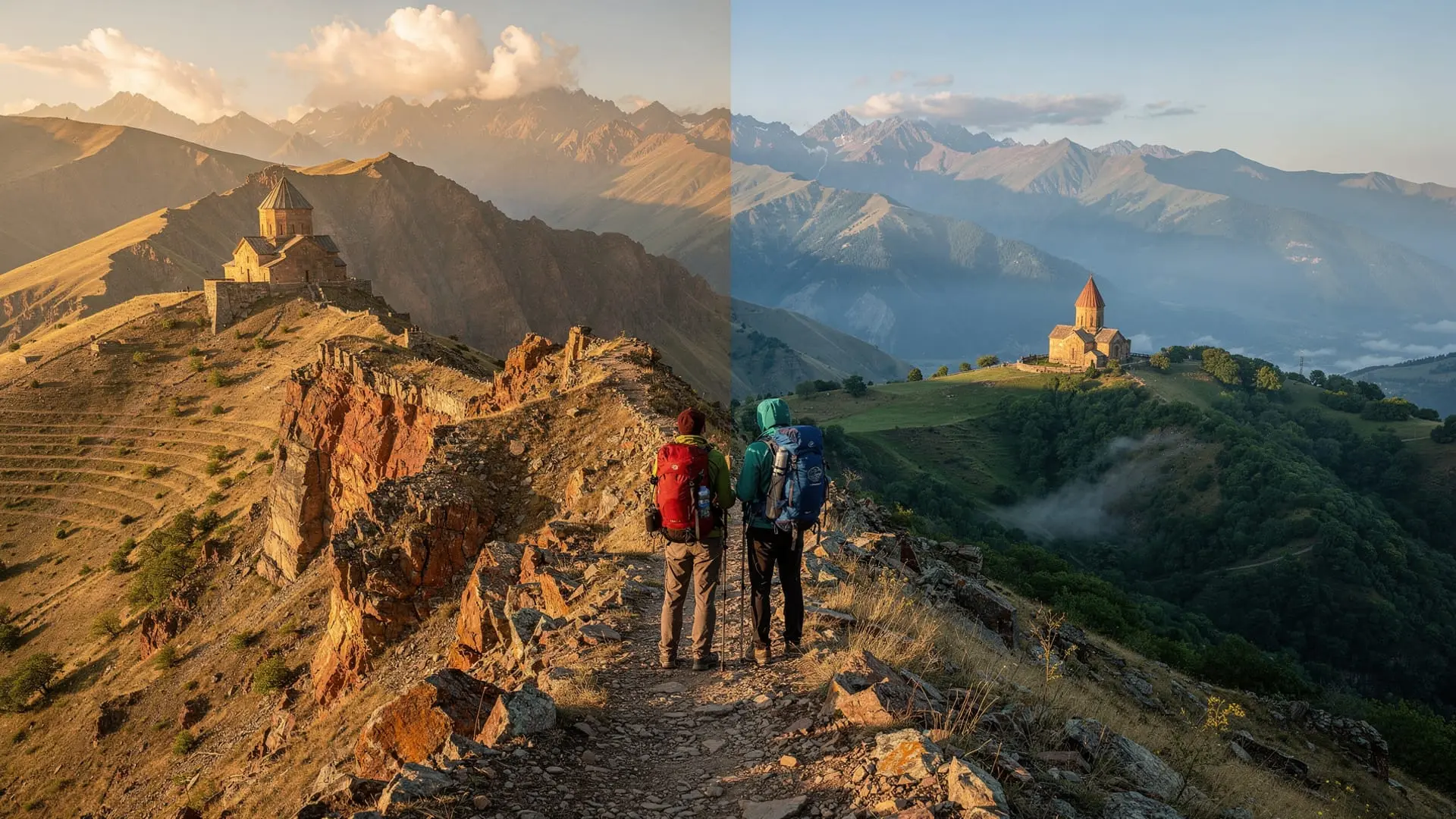
Two countries, one mountain range, very different hiking experiences
Armenia and Georgia share a border, a common geopolitical region (the South Caucasus), and some of the most dramatic mountain terrain outside the Alps. Both countries are on the radar of European and North American hikers seeking alternatives to the well-trodden Pyrenees and Dolomite routes. But they are remarkably different as hiking destinations — in terrain, infrastructure, culture, and the kind of hiking experience each delivers.
| Armenia strength | Cultural integration, volcanic highlands, low crowds |
| Georgia strength | Alpine drama, established trekking infrastructure |
| Best combined trip | 2–3 weeks, split via the Bagratashen border crossing |
| Cost | Both affordable; Armenia slightly cheaper on food |
| First-timer pick | Georgia for reliability; Armenia for depth and solitude |
This comparison is honest. Neither country is objectively “better” for hiking; they serve different purposes and reward different types of travellers. If you have time for both, take both — the Yerevan–Tbilisi overland connection (train, bus, or taxi) is straightforward. But if you are choosing one, the following breakdown should help.
The mountain ranges are not the same
This is the most important geographical distinction to understand. Armenia and Georgia do not share the same mountains.
Georgia sits against the Greater Caucasus — the main chain that forms the de facto boundary between Europe and Asia, reaching peaks above 5000m (Mount Shkhara, 5068m; Mount Kazbek, 5047m). These are genuinely alpine ranges with permanent glaciers, dramatic ridges, and the kind of scenery that recalls the Himalayan foothills.
Armenia sits in the Lesser Caucasus — a geologically distinct range of lower altitude, more volcanic in origin, with no peaks above 4090m (Aragats northern summit). The Lesser Caucasus lacks the glaciated drama of the Greater Caucasus but has extraordinary volcanic landscape character: vast basalt plateaux, crater lakes, dormant volcanoes, and ancient lava fields.
Neither is better — they are simply different. If you want alpine drama comparable to the Alps, Georgia wins. If you want volcanic highland landscapes, Bronze Age petroglyphs, and hiking that weaves through monastery complexes, Armenia wins.
Trail infrastructure: Georgia has the edge
Georgia has been developing trekking infrastructure, particularly in Kazbegi and Svaneti, for longer and with more international investment. Guesthouses along the Mestia–Ushguli trek (Svaneti) and the various Kazbegi trails are well established, widely documented, and served by a robust independent traveller economy.
Armenia’s trails are more variable. The Transcaucasian Trail in Armenia is an active work-in-progress; the Janapar Trail has inconsistent marking; and multi-day trekking infrastructure outside Dilijan is less developed than in Georgian highland regions. Independent multi-day hiking in Armenia requires more planning and self-sufficiency.
For independent, off-grid trekkers: Armenia is arguably more rewarding — you will genuinely be on trails that see little traffic, with communities that are delighted rather than accustomed to hikers.
For first-time Caucasus trekkers wanting a reliable experience: Georgia’s established routes (Kazbegi Rooms rental + Gergeti Trinity Church approach; Mestia village + Svaneti villages) have less logistical uncertainty.
Altitude and difficulty
Georgia’s classic hikes top out at 4000m+ passes (the Chalaadi glacier approach from Mestia reaches 3500m; Kazbek is a 5047m mountaineering objective). Comparable Armenian objectives: Aragats southern summit (3879m) and northern summit (4090m), Khustup (3201m), Azhdahak (3597m).
The maximum altitudes are similar; the character differs. Georgian hikes often involve sustained glacier moraines, permanent snowfields, and more technical terrain above 3500m. Armenian hikes above 3000m are typically on scree and volcanic rock — no glacier travel required below the Aragats northern peak.
For beginner-to-intermediate high-altitude hikers, Armenia’s peak objectives (particularly the Aragats southern summit) are more approachable than Georgia’s technical glacier routes.
Combining culture with hiking
Armenia’s hiking integrates more deeply with cultural heritage. Routes like the Kasakh gorge trail between Hovhannavank and Saghmosavank begin and end at UNESCO-quality medieval monasteries. The Bjni–Tsaghkadzor traverse starts at a medieval fortress. The Geghama plateau hike to Azhdahak volcano passes through one of the world’s richest Bronze Age petroglyph fields.
Georgia’s iconic hiking regions (Kazbegi, Svaneti) also have cultural heritage — Gergeti Trinity Church perched above Kazbek is one of the Caucasus’s most photographed sights — but the integration of hiking with ancient monasteries, wine culture, and archaeology is less dense than in Armenia.
If your ideal hiking trip combines trail days with UNESCO monasteries, winery visits, and ancient sites, Armenia holds the advantage.
Accessibility and logistics
Georgia wins on accessibility from Western Europe: Tbilisi International Airport has more direct European connections than Yerevan’s Zvartnots (though Yerevan does receive direct flights from Vienna, Paris CDG, Rome, Frankfurt, Amsterdam, and Athens). Travel time from most European capitals to Tbilisi is 4–5 hours; to Yerevan, 4–6 hours.
Within each country, Georgia has better-developed tourist transport to hiking regions (shared taxis from Tbilisi to Kazbegi run frequently; Mestia is reachable by marshrutka or charter flight). Armenia’s main hiking areas from Yerevan are similarly accessible — Dilijan 1h 45min by marshrutka, Aragats 1h 30min by car — but Syunik (Khustup) requires 4+ hours.
Visa requirements
Georgia: Visa-free for EU, US, UK, Canada, Australia (180 days). Very accessible.
Armenia: Visa-free for 180 days (on 365) for EU, US, UK, Canada, Australia, and many others. E-visa available. Similarly accessible.
Both countries are easy to enter for Western travellers.
The combined Caucasus option
The strongest recommendation for travellers with 2–3 weeks is to combine both countries. Yerevan to Tbilisi takes 6 hours by road (marshrutka or shared taxi via the Bagratashen border crossing), or 10 hours by overnight train (a classic Caucasus travel experience). A combined 14-day itinerary covering 3–4 days of hiking in each country is well within reach. See the Armenia to Georgia combined trip guide for a detailed itinerary framework.
A 5-day private hiking and cultural tour from Yerevan covers Armenia’s hiking highlights and could form the Armenian component of a Caucasus two-country trip.
Who is each country best for?
Choose Armenia if:
- You want cultural depth alongside mountain hiking (monasteries, wine, archaeology)
- You prefer less-crowded trails and genuine off-the-beaten-track discovery
- You are interested in high-altitude volcanic landscapes rather than glaciated alpine terrain
- You want to combine hiking with winery visits and food experiences
- Budget matters: Armenia is generally cheaper than Georgia’s tourist areas
- You are new to high-altitude hiking and want accessible summit objectives
Choose Georgia if:
- You want the most dramatic alpine scenery in the Caucasus (Kazbegi, Svaneti)
- You prefer established multi-day trekking infrastructure
- You want to attempt a serious mountaineering objective (Kazbek, 5047m)
- You are primarily interested in mountain hiking rather than cultural-hiking combinations
Choose both if:
- You have 2+ weeks in the region
- You want the full South Caucasus hiking experience
- You are building a Caucasus circuit for serious trekking
Practical comparison table
| Factor | Armenia | Georgia |
|---|---|---|
| Highest hikeable peak | Aragats north 4090m | Kazbek 5047m (mountaineering) |
| Best day hike | Aragats south, Kasakh gorge | Gergeti Trinity, Kazbegi area |
| Best multi-day | TCT Tavush section | Mestia–Ushguli (Svaneti) |
| Trail marking | Developing (TCT + Janapar) | Better established in tourist areas |
| Guesthouse network | Growing, variable | Well-established in Svaneti/Kazbegi |
| Cultural integration | Very high | Moderate |
| Crowds on trails | Low | Moderate to high (peak season) |
| Getting there from Yerevan | n/a | 6h by road |
| Getting there from Tbilisi | 6h by road | n/a |
Gear and preparation differences worth knowing
The technical demands of each country’s hiking shape what you should pack. For Armenia’s volcanic highland routes — Aragats, Azhdahak, Khustup — sturdy boots with good ankle support, sun protection, and layers for rapid temperature swings between valley and summit cover most needs; technical mountaineering gear is unnecessary below the Aragats northern peak. Georgia’s Svaneti and Kazbegi routes, especially anything approaching glacier terrain near Kazbek, call for more serious preparation: trekking poles are standard, and any objective involving the Chalaadi or Gergeti glaciers needs proper mountaineering experience or a qualified guide. A useful rule of thumb: pack for Armenia as you would for a demanding alpine day hike, and pack for Georgia’s headline routes as you would for genuine high-mountain trekking.
Water sources also differ in reliability between the two countries. Armenia’s volcanic highland routes have fewer year-round streams than Georgia’s glacier-fed valleys, so carrying more water than you think you’ll need is the safer default on routes like Aragats or Azhdahak, particularly in the dry summer months of July and August.
Guided vs independent: which country rewards which approach
Armenia rewards independent hikers willing to accept more uncertainty in exchange for solitude — trail marking gaps mean a GPS track downloaded in advance (from the Transcaucasian Trail or Janapar Trail resources) is close to essential, but the reward is genuinely empty trails even in peak months. Georgia’s established Svaneti and Kazbegi routes are far more forgiving for independent travellers, with guesthouse-to-guesthouse trekking a realistic option without a guide. If your appetite for logistical uncertainty is low, lean toward guided options in Armenia specifically — a private hiking tour removes most of the friction that makes Armenian trekking harder to plan independently than Georgian equivalents.
Frequently asked questions about Armenia vs Georgia hiking
Which country has better trail marking?
Georgia’s established tourist routes in Kazbegi and Svaneti are better marked for independent hikers. Armenia’s TCT and Dilijan park trails have improved significantly but require GPS backup on many sections. Neither compares to the waymarking standards of Western European trails.
Are there combined Armenia-Georgia hiking tours?
Yes. Several operators offer combined Caucasus hiking packages covering both countries in 10–14 days. The logistics of crossing the Bagratashen border are straightforward; guided tours handle transport between countries seamlessly.
Is hiking safer in Armenia or Georgia?
Both countries are generally safe for hiking. Crime against hikers is rare in both. The main safety concerns are weather (altitude storms, rapid temperature drops), navigation (both countries have routes where trail marking becomes unreliable), and altitude sickness above 3000m. Emergency services are less accessible in both countries’ highland regions compared to Western Europe — carry a satellite communicator for remote routes.
Can I cross from Armenia to Georgia on foot via a hiking route?
The Armenia-Georgia border near Bagratashen/Sadakhlo is a road crossing — there is no established mountain hiking trail crossing. The TCT alignment reaches the Georgian border in Lori province but does not have an official trail crossing at this border. Hikers wishing to cross between countries do so at the road border points.
Is the Transcaucasian Trail a combined Armenia-Georgia trail?
The TCT runs through both countries and is eventually planned to connect them in a single continuous route. The Georgian sections (particularly near Kazbegi) are more developed. The Armenian sections are in active development. Check transcaucasiantrail.org for the current state of cross-border connectivity.
Specific trail comparisons: head to head
Dilijan National Park vs Borjomi-Kharagauli National Park (Georgia)
These are the two most visitor-friendly national parks in the South Caucasus, and both are excellent forest hiking areas. Dilijan is more compact (28,000 ha vs ~85,000 ha for Borjomi-Kharagauli) but has better infrastructure near the park edges (Dilijan town). Borjomi-Kharagauli has a multi-day traversal route (the main ridge trail is 3–5 days) that Dilijan cannot match in length. For a first-time visitor wanting a day or two in a national park, both are excellent; Dilijan edges it for cultural integration with Tavush and ease of access from Yerevan.
Aragats southern summit vs Kazbeki (Kazbek approach, Georgia)
These are not comparable in technical difficulty: Kazbek (5047m) is a serious mountaineering objective requiring glacier travel and crampons; the Aragats southern summit (3879m) is a demanding day hike on non-technical terrain. The comparison is more useful at the base camp level: both Lake Kari (Aragats) and Stepantsminda (Kazbegi base town) are accessible by road to approximately 3000m and serve as starting points for their respective peaks. The cultural surroundings differ significantly — Stepantsminda has Gergeti Trinity Church (one of the Caucasus’s iconic sights), Lake Kari has the raw volcanic highland environment and the Amberd fortress en route.
Svaneti (Georgia) vs Syunik (Armenia)
This is the fairest comparison for serious multi-day trekkers. Svaneti’s Mestia–Ushguli route (3–4 days, 53 km) is one of the finest established multi-day hikes in the Caucasus — excellent guesthouses, well-marked trail, extraordinary glacier and mountain scenery, and the medieval Svan tower villages as cultural anchors. There is no directly comparable multi-day route in Syunik yet — the TCT corridor is still being developed. What Syunik offers instead is greater solitude, more remote terrain, and the Khustup pilgrimage element that Svaneti lacks. Serious trekkers should ideally experience both.
Practical cross-border information for hikers
The Bagratashen/Sadakhlo crossing is the standard Armenia-Georgia land border crossing, approximately 200 km north of Yerevan and 180 km south of Tbilisi. It is open 24 hours. Standard crossing time for EU/US nationals with e-passports: 15–30 minutes. From Yerevan, a marshrutka to the border zone (via Alaverdi or Vanadzor) costs around 1,500–2,000 AMD; from the border, a Georgian marshrutka or taxi continues to Tbilisi. Total travel time Yerevan to Tbilisi via this crossing: 6–7 hours.
The Bavra/Ninotsminda crossing in Shirak province is a secondary crossing used by some travellers to access western Georgia. Less traffic, sometimes slower despite fewer vehicles. Good option for those coming from Gyumri.
The Gogavan/Guguti crossing in Tavush province provides access to the Georgian wine region (Kakheti) and is the most scenic of the three crossings — passing through the Debed and Agstev valleys. Less commonly used by tourists but practical for those ending a Tavush hiking leg.
What Armenian hiking gives you that Georgia can’t
One specific experience available in Armenia that Georgia cannot replicate: the combination of mountain hiking with direct views of Mount Ararat. From the Aragats southern summit on a clear September morning, you can stand at 3879m on Armenian volcanic rock and see Ararat’s snow-capped form across the Turkish border — a view that carries an entirely specific emotional charge for Armenians and that no amount of Georgian mountain scenery can substitute for. For visitors who come to Armenia at least partly because of Ararat’s symbolic pull, this view is the specific reward that only an Armenian summit can give.
Similarly, the petroglyphs of Azhdahak volcano have no Georgian equivalent — Bronze Age rock art of this density and accessibility exists nowhere else in the South Caucasus.
Cost comparison: Armenia vs Georgia for hiking travellers
Armenia is generally cheaper than Georgia for accommodation and food, but the gap has narrowed since 2022 as Georgia’s tourist infrastructure expanded and Armenia’s prices rose with economic growth. As of 2026:
Accommodation: A decent guesthouse on a trail in Armenia costs 5,000–10,000 AMD (12–25 EUR) per night with breakfast. In Georgia’s Svaneti, guesthouses charge 40–60 GEL (15–22 EUR) at similar quality. Broadly comparable.
Food: A full meal at a local restaurant in Armenia: 3,000–7,000 AMD (7–17 EUR). In Kazbegi or Mestia, a comparable meal: 30–50 GEL (11–18 EUR). Armenia has a slight edge on food value.
Transport: Armenia’s marshrutka system is extremely cheap (500–1,500 AMD for most routes). Georgia’s shared taxis to Kazbegi from Tbilisi cost 20–30 GEL (7–11 EUR). Similar range.
Guided tours: GYG-listed guided hikes in Armenia are competitively priced compared to Georgian equivalents — both countries have well-developed guided hiking markets at similar price points.
Overall: Budget travellers will find both countries very affordable compared to Western Europe. Mid-range travellers will find Armenia slightly cheaper on average. The cost difference is not significant enough to drive destination choice; other factors (trail character, cultural depth, specific objectives) should dominate the decision.
Which country is better for a first Caucasus hiking trip if I can only pick one?
If reliability and established infrastructure matter most, Georgia’s Kazbegi or Svaneti routes are the safer first choice. If you value cultural depth, quieter trails, and pairing hikes with monasteries and wine country, Armenia is the better fit — see the 5-day hiking and cultural tour as a starting reference for what an Armenia-focused trip looks like.
Do I need a guide for Armenian hiking if I’ve hiked independently in Georgia before?
Not necessarily, but budget more preparation time. Georgia’s Svaneti and Kazbegi trails are far better marked and guesthouse-served than most Armenian routes; experienced independent hikers can absolutely manage Armenia’s trails with a downloaded GPS track and good planning, but should expect more self-sufficiency to be required than on Georgia’s established routes.