Jermuk waterfall & mineral water galleries
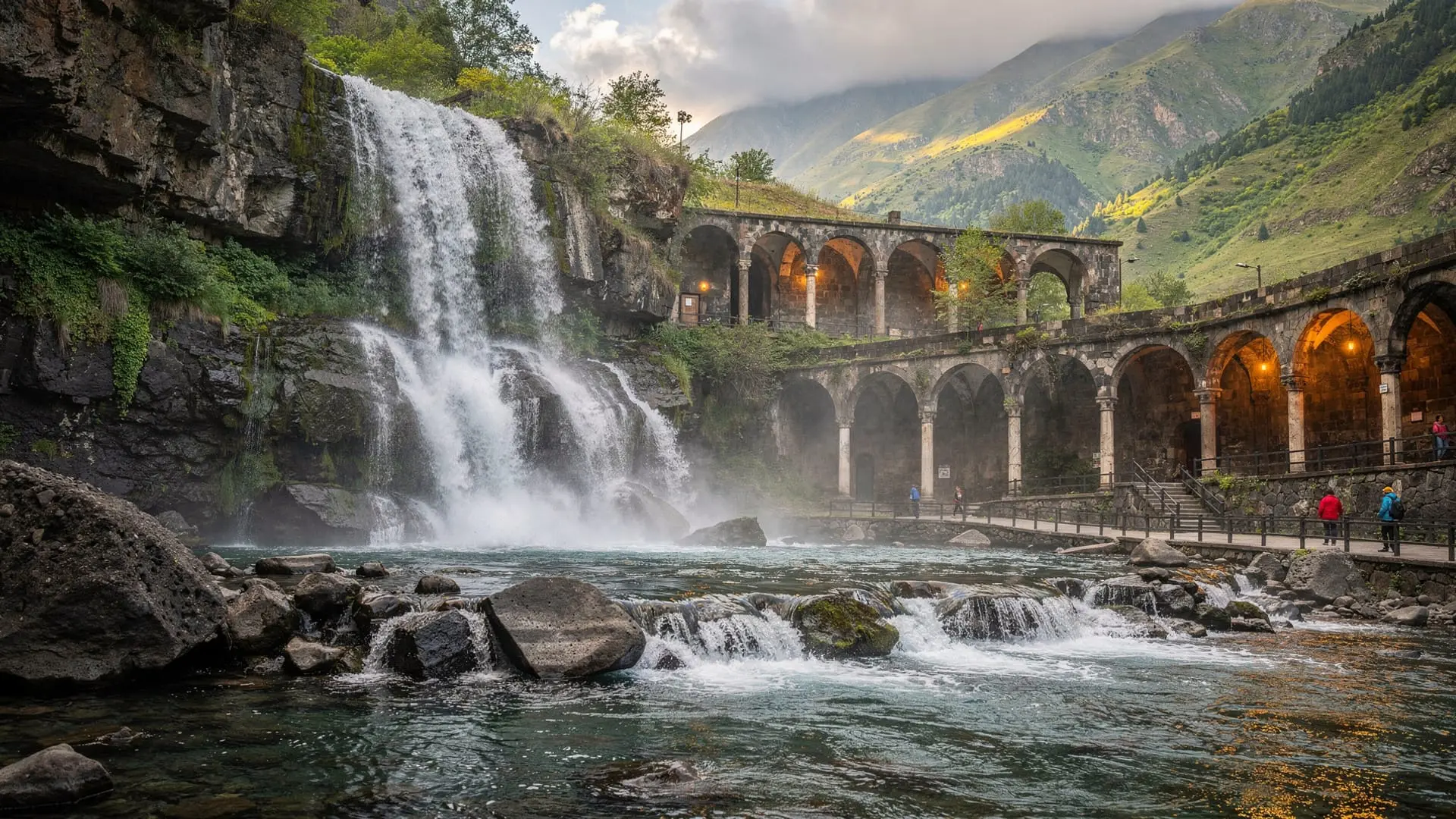
The two experiences that define Jermuk for day visitors
Most day visitors to Jermuk come for two things: the waterfall and the mineral water gallery. These are not the same as the thermal spa treatments — see the Jermuk spa and thermal waters guide for those — they are the accessible, free or low-cost experiences that anyone can have within a 90-minute walk from the town centre.
Both are genuinely worth the drive from Yerevan or from whatever direction you are coming. The waterfall is one of the most dramatic single-point landscapes in Vayots Dzor. The mineral water gallery is one of the more distinctive sensory experiences in Armenian travel — the taste of volcanic mineral water from several different springs, the warm water curling steam in the cold mountain air, the slightly medicinal architecture of the Soviet arcade.
This guide covers both in detail.
| Where | Central Jermuk town, Vayots Dzor |
| Cost | Waterfall ~500–1,000 AMD; gallery free or ~100–200 AMD |
| Time needed | Half-day (1.5–2.5 hours for both) |
| Getting there | Both walkable from central Jermuk hotels |
| Best time | Morning for the gallery; spring for peak waterfall flow, winter for ice formations |
The Jermuk Waterfall
Overview
The Jermuk Waterfall is formed by the Arpa River, which drops approximately 70 metres over a basalt ledge into a narrow gorge. The gorge is cut through red and dark volcanic rock, with pine-covered slopes rising above it on both sides.
The waterfall is about 1.5 km from the town centre, accessible by a well-maintained walking path through the forest. The path is paved for most of its length and suitable for visitors of most mobility levels, though the final section above the viewing platform involves some steps.
The walk
The path begins near the southern end of Jermuk’s main boulevard and follows the gorge rim through pine forest before descending to the viewing platforms above and beside the waterfall. The walk is 15–20 minutes one way. Return the same way or continue on the circular forest trail (adds 30–45 minutes).
Spring (May–June) produces the most powerful waterfall — the snowmelt feeds the Arpa at its maximum flow, and the white plume is genuinely dramatic. Summer (July–August) brings a reduced but still impressive flow. Winter (December–February) transforms it with ice — in cold years, the waterfall partially or fully freezes, with ice columns and frozen spray patterns that are strikingly beautiful. Autumn (September–October) is quieter but the surrounding forest colour adds its own beauty.
Photography
The waterfall photographs best in:
- Morning (the sun illuminates the falls from the east)
- Overcast days (even light with no harsh shadows)
- Winter (the ice formations are extraordinary but require appropriate cold-weather clothing for the photographer)
A wide-angle lens or a standard zoom at the widest setting works best for the falls. The gorge walls frame the shot naturally. Look for the rainbow that forms in the spray on sunny mornings — it appears most reliably between 9:00 and 11:00.
Admission: Free to walk to the waterfall. A small entrance charge (~500–1,000 AMD) applies to the viewing platform area.
Book a guided tour combining the Jermuk waterfall, mineral gallery, and Tatev ropeway in one dayThe mineral water drinking gallery
Overview and location
The mineral water gallery is a Soviet-era covered arcade located near the centre of Jermuk town. Architecturally, it is a long walkway with fountain taps along the walls, each labelled with the spring number and the mineral composition of the water it draws. The design is classical Soviet — slightly grandiose for a drinking fountain, with column details and decorative tilework.
The gallery draws water from several different springs in the Jermuk aquifer system, each with slightly different temperatures and mineral concentrations. The traditional therapeutic protocol involves drinking specific quantities from specific springs at specific times relative to meals — this is the “drinking cure” that Soviet balneology developed and still recommend here.
Location: Central Jermuk, near the main town square. Walking distance (5–10 minutes) from most hotels.
Hours: Typically 8:00–20:00 daily. Verify current hours locally as seasonal adjustments occur.
Admission: Free entry, or minimal charge (100–200 AMD). Small ceramic drinking cups are sold at the gallery entrance (typically 300–500 AMD) and are the recommended vessel — the cups retain heat better than plastic.
The experience of drinking the waters
The springs in the gallery range in temperature from warm (~30°C) to quite hot (~42°C). The mineral content varies but all are noticeably different from ordinary water:
- Spring 1–3 (cooler, milder): Slightly fizzy, a gentle mineral taste, mildly alkaline. Easiest to drink. Recommended for those new to the gallery.
- Spring 4–6 (warmer, more mineral): Distinctly fizzy, somewhat bitter from high bicarbonate content, a slight sulphurous edge. More challenging but the classic “Jermuk taste.”
- Spring 7–9 (hottest, most concentrated): Very hot at the tap (cool slightly before drinking), strongly mineralised, with a pronounced chemical taste that is an acquired one.
Most visitors try a cup or half-cup from several fountains, exploring the variety of tastes. Drinking large amounts on a first visit is not recommended — the mineral content is high enough to cause discomfort if you drink 500 ml of the stronger springs without being acclimatised.
The gallery is busy with local residents in the mornings — grandparents and retirees in particular, many of whom have been drinking specific springs at specific times for years as a health routine. This scene — elderly Armenians filling their cups with quiet ritual, children watching cautiously — is one of the most authentically Soviet-Armenian experiences still alive in the country.
Combining the waterfall and gallery
A natural half-day itinerary in Jermuk:
Morning (8:30–10:30):
- Mineral water gallery (45–60 minutes): try several springs, buy a cup, sit and watch the morning visitors
- Walk or taxi (~500 AMD) to the waterfall trailhead
Mid-morning (10:30–12:30):
- Walk to the Jermuk waterfall (15–20 minutes)
- Time at the viewing platforms and on the forest circuit (45–60 minutes)
- Return to town (15–20 minutes)
Lunch (12:30–14:00):
- Lunch at a Jermuk restaurant — Armenian mountain food, grilled meats, fresh bread, local produce. Several restaurants are on the main boulevard.
This half-day itinerary is feasible as part of a day trip from Yerevan (2.5–3 hours each way by car), though you would arrive exhausted. It is much better as the morning or afternoon programme of a 2-night stay.
Book a day trip from Yerevan to Jermuk and Shaki waterfallThe wider Jermuk water landscape
The Jermuk area’s relationship with water extends beyond the town’s two main attractions:
Arpa River valley: The river that forms the Jermuk waterfall continues southward through a dramatic canyon, passing below Noravank monastery (60 km downstream) and eventually meeting the Aras River near the Turkish border. A drive south from Jermuk along the Arpa valley is one of the most scenic road journeys in Vayots Dzor.
Wild springs outside town: Several smaller natural springs exist in the forest around Jermuk that are not part of the official gallery system. Local residents know their locations and will sometimes guide curious visitors to them. The waters vary significantly from the gallery springs.
Snowmelt and the spring season: Jermuk’s waterfall and river system at peak spring flow (May–June) are considerably more powerful than at any other time. The entire water landscape changes character — the forest is loud with the sound of running water in every direction.
Practical information
- Distance from Yerevan: 175 km, 2.5–3 hours by car
- Getting around Jermuk: Small town, mostly walkable. Taxi for waterfall trailhead: ~500–1,000 AMD
- Best time to visit: Year-round; each season offers a different character
- Waterfall admission: ~500–1,000 AMD (viewing platform)
- Gallery admission: Free or ~100–200 AMD; cups ~300–500 AMD
- Combination with Tatev: Tatev is 100 km from Jermuk — possible in a single long day from Jermuk base, or as part of a south Armenia loop
Frequently asked questions about Jermuk waterfall and gallery
Is the waterfall accessible in winter?
Yes, year-round. In cold winters (January–February), the waterfall partially or fully freezes — this is arguably its most spectacular appearance. The path to the waterfall is maintained but can be icy; wear sturdy boots with grip.
How different do the springs taste from each other?
Noticeably different. The cooler springs are mildly fizzy and pleasant. The hotter, more mineral springs taste distinctly chemical to unfamiliar palates — think of a strong sparkling water with added bicarbonate and a hint of sulphur. Some visitors love the stronger springs immediately; others need time to appreciate them. Try a small amount first.
Are the gallery waters safe for children?
The milder cooler springs are considered safe in small quantities. The stronger, hotter springs should be given to children only in very small amounts (a few sips) and not hot from the tap. The gallery is a social space — children are welcome and part of the scene.
Can I bring bottles to fill at the gallery?
Yes. Many visitors bring their own water bottles to fill from specific springs they prefer. The gallery staff or local visitors are usually happy to recommend which spring to fill from based on what you are looking for.
Is Jermuk worth a day trip from Yerevan?
It is a long drive for a half-day of accessible activities. If you are combining Jermuk with Noravank, Areni wine tasting, and/or Tatev, a full-day trip from Yerevan becomes worthwhile. For the mineral gallery and waterfall alone, staying 1–2 nights in Jermuk gives you the full experience without the exhaustion of a 5–6 hour round trip.
Do I need to book anything in advance for the waterfall or gallery?
No. Both are walk-up experiences with no reservation system — the waterfall viewing platform and the mineral gallery are open to anyone arriving during operating hours. The only thing worth planning ahead is timing: aim for an early morning gallery visit before the local crowd builds, and check seasonal daylight if you want the golden-hour light on the falls.
Which is better for a first-time visitor with limited time — the waterfall or the gallery?
If forced to choose one, most first-time visitors get more from the gallery — it is the more distinctively Armenian experience and cannot really be replicated elsewhere in the country. The waterfall, while beautiful, is one of roughly 30 significant waterfalls in Armenia and shares visual DNA with sites like Shaki waterfall. That said, both take under an hour combined, so unless your schedule is extremely tight, do both.
The history of the mineral water gallery
The gallery building was constructed in the Soviet era as part of the ambitious programme to develop Jermuk into a health resort of all-Union significance. The Soviet health resort network (kurorty) was a distinctive social institution — workers earned vouchers for stays at sanatoriums through their enterprises, and the idea that thermal springs could be medically prescribed was taken very seriously in Soviet medical literature.
The Jermuk gallery was designed as the centrepiece of the drinking-cure programme. Patients were prescribed specific springs in specific quantities at specific times — a morning spring before breakfast, a midday spring after a rest, an evening spring before bed — as part of a course of treatment lasting 2–4 weeks. The gallery was built to accommodate hundreds of patients at once, following their prescribed routines.
Today the gallery is more informal — locals and tourists mix freely, some following their own routines, others simply curious. But the Soviet architecture of the arcade still communicates the original intent: this was a place of medical seriousness, not tourist entertainment.
The waterfall in Armenian geography
The Jermuk Waterfall is one of approximately 30 significant waterfalls in Armenia — a country that has more high-gradient rivers than its size might suggest, due to the rapid elevation changes of the highland terrain. Among these:
Shaki Waterfall (near Tatev): 18 metres, dropping into a narrow gorge. Different character from Jermuk — more enclosed, in a forested canyon.
Trchkan Waterfall (Shirak/Lori border): 23 metres, one of the widest in Armenia. Less visited than Shaki or Jermuk.
The Jermuk Waterfall’s distinction is its combination of height (70 metres), accessibility (15-minute walk from a major town), and the geological context of the volcanic terrain it falls through. The basalt and tuff of the gorge walls change colour visibly through the length of the falls — dark grey basalt at the top, warmer volcanic tuff lower down.
What visitors miss at Jermuk
Beyond the gallery and waterfall, Jermuk has a few less-obvious experiences:
The Soviet sanatorium district walking tour: The collection of Soviet-era sanatorium buildings above the town, designed in a mixture of Stalinist neo-classical and Khrushchev-era functional styles, is an architectural document of Soviet social history. A 45-minute walk through this district is genuinely interesting if you have any interest in Soviet modernism.
The forest therapy paths: Several trails through the pine forest above town were maintained in the Soviet era specifically for therapeutic walks. Some are still maintained; others have grown over. The atmosphere of the Soviet wellness forest — pine-scented, quiet, purposeful — is intact.
Local honey and preserves: Jermuk’s market and small shops sell local highland honey, dried herbs, and fruit preserves that are the food expression of the same mountain landscape that produces the mineral waters. Bring some home.
Early morning at the gallery: Most day visitors arrive at the gallery mid-morning. The early morning scene — local residents in their daily routine, older couples walking the arcade together with their prescribed cups, the gallery largely empty of tourists — is more affecting and more authentic than the busier hours.
Extending beyond the waterfall and gallery
For visitors with more than a few hours in Jermuk, the sanatorium spa facilities are the natural next step — soaking in the same mineral water you tasted in the gallery, at bathing temperature. See the full Jermuk spa and thermal waters guide for facility comparisons and pricing. Those continuing south should factor in Tatev (100 km) or a return north via Noravank and Areni wine country — both make the long drive to Jermuk feel proportionate to the reward.