Kasakh gorge: an underrated half-day hike
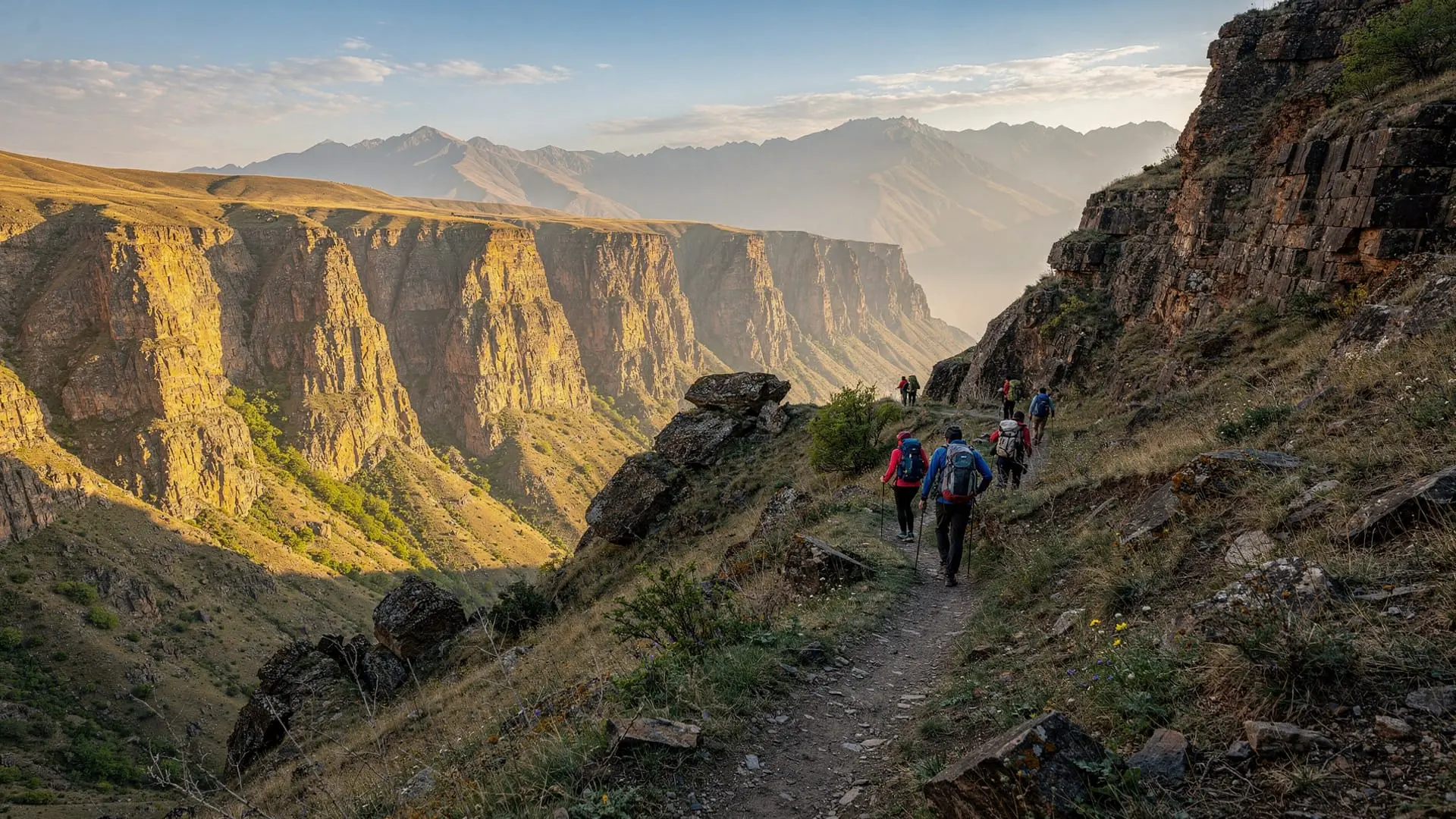
A canyon hiding in plain sight
The Kasakh river carves one of Armenia’s most dramatic canyon systems through the western edge of Aragatsotn province, just an hour’s drive from Yerevan. Yet most visitors who come to see Hovhannavank and Saghmosavank monasteries — both perched on opposite ends of the gorge — arrive by car, walk to the monastery walls, photograph the view, and leave. Few walk the canyon edge between the two sites.
That 4–5 km trail connecting the monasteries is one of the most rewarding half-day hikes near Yerevan. It traverses basalt cliff edges above the Kasakh river, crossing rocky promontories with monastery views both forward and behind, passing wind-eroded volcanic formations, and reaching sections of solitude that are remarkable given the proximity to the capital. On weekdays especially, you can walk the full distance without passing another hiker.
| Where | Between Hovhannavank and Saghmosavank, Aragatsotn |
| Cost | Free (monastery entry by donation) |
| Time needed | 1.5–2.5h one-way, 3–4h round trip |
| Getting there | Car, around 50–55 minutes from Yerevan |
| Best time | April–October; spring for wildflowers and snowmelt flow |
The monasteries as trail endpoints
Hovhannavank
Hovhannavank monastery perches on the eastern rim of the Kasakh gorge above the village of Ohanavan. Founded in the 5th century and substantially rebuilt in the 12th–13th centuries under the patronage of the Zakarian dynasty, it is one of the finest examples of medieval Armenian ecclesiastical architecture in Aragatsotn. The main gavit (vestibule) is elaborately carved; the exterior khachkars are among the most beautiful in the Aragatsotn region.
The monastery grounds offer a panoramic view down into the gorge and across to the volcanic highlands of Aragats above. This is the eastern starting point for the canyon hike, and the better of the two monasteries architecturally.
Saghmosavank
Saghmosavank (“Psalm monastery”) stands on the western rim of the gorge, above the village of Saghmosavan. Built in the early 13th century, the monastery complex includes a church and gavit whose carved exterior stone-work is remarkably well preserved. The setting is if anything even more dramatic than Hovhannavank: the monastery stands at the absolute canyon edge, and the gorge drops sheer below the perimeter walls.
Saghmosavank is slightly less visited than Hovhannavank and retains a quiet, meditative atmosphere even on weekends. It makes an excellent alternative starting point for the gorge hike.
The trail in detail
Distance: 4–5 km one-way (Hovhannavank to Saghmosavank)
Elevation change: minimal — roughly 100m undulation along the rim
Time: 1.5–2.5h one-way, 3–4h round trip
Difficulty: Easy to moderate
Terrain: Rocky path, some sections on loose volcanic soil, occasional brief scrambling over boulders
From Hovhannavank car park, the path descends slightly to the gorge edge before following the rim westward. The trail is faint in places but the canyon edge itself serves as a guide — stay close to the drop and you won’t lose the route. The gorge below is 200–300m deep, with the Kasakh river glinting at the bottom.
The first kilometre is the most dramatic, with views back to the Hovhannavank bell tower framed by the basalt cliffs. Midway, the path crosses a rocky promontory — a good rest point with 270-degree views. The final section approaches Saghmosavank from behind, emerging at the monastery’s east entrance.
One-way logistics: The simplest approach is to have one vehicle at each monastery, or arrange for a taxi to pick you up at Saghmosavank while you start at Hovhannavank. GG Taxi works reasonably well in this area. Alternatively, hike the round trip (Hovhannavank to Saghmosavank and back), which takes about 3.5–4 hours total.
Getting there from Yerevan
Both monasteries lie on the road between Yerevan and Aparan/Aragats. From Yerevan (50–55 km), take the M3 highway toward Aparan, then follow signs for Hovhannavank (via Ohanavan village) or Saghmosavank (via Saghmosavan village). The roads to both monasteries branch from the same main road and are paved but narrow.
By organised tour: The Kasakh gorge trekking tour from Yerevan covers this exact route with guide service and transport — the most convenient option for visitors without a car, and the best way to get proper context on the geological and historical significance of the canyon.
Driving time: 50–55 minutes from Yerevan to Hovhannavank. The road from Hovhannavank to Saghmosavank by car takes about 15 minutes.
Combining the gorge with Aragats and Amberd
The Kasakh gorge trail sits naturally in an Aragatsotn day-trip itinerary. From Yerevan, visit the gorge monasteries in the morning (arriving at 9–10am), complete the canyon hike, then continue north toward Mount Aragats and Amberd fortress in the afternoon. The Amberd fortress guide covers that site’s history and logistics.
For a pure hiking day, the gorge hike pairs beautifully with an easier walk on the Aragats southern summit route — though the two together make for a very full day with substantial elevation difference. The day trip guide to Aragats and Amberd from Yerevan covers the logistics of this combination.
The Armenian Alphabet Monument at Artashavan is also on the same general road, adding a short cultural stop to the day.
Season and conditions
The gorge trail is walkable from April through October. Spring (April–May) is the most atmospheric: the surrounding hills are green after winter rains, wildflowers edge the cliff path, and the Kasakh river runs high with snowmelt — audible from the rim as a continuous rushing sound. Summer (June–August) is comfortable but can be hot in the exposed sections; carry water. Autumn (September–October) offers excellent conditions with cooler temperatures and interesting light.
Winter (November–March): the trail is walkable in dry weather but can be treacherous when the volcanic soil becomes wet clay or when ice forms on exposed sections. Not recommended in snow.
Wildlife and botanical notes
The Kasakh gorge is a good birdwatching location — the canyon thermals attract Egyptian vulture, griffon vulture, and common kestrel. In spring, Caucasian stonechat and black-eared wheatear are common on the rocky sections. The gorge vegetation is predominantly sub-steppe and rock plants; look for cushion plants and endemic Aragatsotn species in the cliff crevices.
The 3-day bird-watching and hiking tour from Yerevan covers the Aragatsotn highlands including canyon zones — a good choice for naturalists visiting the Kasakh gorge area.
Practical notes
- Wear sturdy footwear. The volcanic rock is sharp and the path crosses loose sections.
- Carry at least 1.5 litres of water — no water source on the rim trail.
- The cliff edge has no fence or safety barrier. Keep children and dogs on a short lead near the drop.
- There are no toilet facilities between the two monasteries.
- Church dress code at both monasteries: shoulders and knees covered (scarves and wraps available at the entrance for a small deposit).
Frequently asked questions about the Kasakh gorge hike
Can I walk the Kasakh gorge trail without a guide?
Yes. The route is straightforward enough for independent hikers — the canyon edge is the natural guide for most of the distance. A GPS track (downloadable from Wikiloc) is helpful for the sections where the path fades. The Armenia trekking gear checklist covers what to bring.
How do I get between the two monasteries if I hike one-way?
Options: arrange a taxi pick-up at the end point (GG Taxi works), have a second vehicle at Saghmosavank, or take the round-trip option back to Hovhannavank. The monasteries are about 4 km apart by road (15 min by car, 30 min on foot via road if needed).
Is there an entrance fee at the monasteries?
Hovhannavank and Saghmosavank are active Armenian Apostolic churches and admission is free, though donations are appreciated. A voluntary contribution box is typically placed at the entrance.
How does the Kasakh gorge compare to the Garni gorge (Symphony of Stones)?
The Garni gorge is more famous and more visited — the basalt organ-pipe formations of the Symphony of Stones are visually extraordinary. The Kasakh gorge is less theatrical visually but more immersive as a hiking experience, with more distance to cover and the monastery-to-monastery structure adding cultural depth. Both are excellent; Garni gorge is better for a short visit, Kasakh gorge better for those who want a proper walk.
What footwear and gear should I actually bring for this specific hike?
Trail shoes or light hiking boots with real grip are worth the extra weight over trainers — the volcanic rock underfoot is sharp in places and loose on the descent sections near both monasteries. A hat and sunscreen matter more than most visitors expect, since the canyon rim has almost no shade for the full 4–5 km. A single trekking pole helps on the rockier promontory crossing midway, though it is not essential for most fit walkers. Beyond footwear and sun protection, this is a low-gear hike — no technical equipment, ropes, or specialised clothing required, which is part of what makes it such a good half-day option for visitors without a full trekking kit.
Are there restaurants near the monasteries?
There are no restaurants at the monasteries themselves. Small roadside eateries exist in Ohanavan village (nearest to Hovhannavank), serving basic Armenian food — dolma, khorovats, bread. The better option is to bring a picnic from Yerevan and eat on the canyon rim — the views will be far better than any restaurant.
Is the Kasakh gorge trail suitable for a first hiking day in Armenia?
Yes, it is one of the gentler introductions to Armenian trail hiking — easy to moderate terrain, no technical scrambling beyond the odd boulder crossing, and clear landmarks (the two monasteries) at either end that make navigation forgiving even without a GPS track. It is a good warm-up before attempting something more demanding like the Aragats southern summit or a section of the Janapar Trail.
Can I do the Kasakh gorge hike in winter?
Not recommended without significant caution. The volcanic soil turns to slick clay when wet, and ice can form on exposed sections of the rim in cold snaps. The monasteries themselves remain accessible by road year-round, but the canyon-edge trail between them is best left to April–October conditions.
Hovhannavank in detail
Hovhannavank (Saint John’s monastery) was founded on the eastern rim of the Kasakh gorge in the 5th century — the original structure dates to the period when Christianity had just been established as the state religion of Armenia (301 AD) and monastery-building was a primary expression of the new faith.
The standing structure dates mainly from the 12th–13th centuries, built under the patronage of the Zakarian princes who controlled northern Armenia during the medieval Georgian kingdom’s period of influence. The main church is a classic Armenian hall church with a richly carved gavit (vestibule) added in the early 13th century. The exterior khachkars (cross-stones) are some of the finest in Aragatsotn province.
The monastery’s name honours John the Baptist. A spring inside the compound (now partly covered) was associated with healing miracles in the medieval period and remains a focus of popular devotion — you may see Armenians filling bottles with the water from a small niche in the church wall.
From the monastery perimeter wall on the gorge side, the view directly down into the Kasakh river canyon is vertiginous and spectacular. The monastery appears to have been built at the absolute edge of what the terrain would allow — one wall stands literally at the cliff edge.
Saghmosavank in detail
Saghmosavank (“Psalm monastery”) was founded in 1215 under the Zakarian prince Vache Vachutian. The complex is smaller than Hovhannavank but in some respects more refined — the carved stonework on the church exterior shows the very high quality of 13th-century Armenian decorative art.
The name comes from the Armenian word for psalm (saghmos), reflecting a tradition of psalm-singing associated with the site. The monastery is still active in the Armenian Apostolic tradition.
The gorge setting at Saghmosavank is if anything more dramatic than at Hovhannavank — the western rim is slightly higher and the drop more sheer. Standing at the monastery’s perimeter wall and looking across the gorge to Hovhannavank on the opposite rim creates one of the finest medieval landscape compositions in Armenia: two great monasteries facing each other across a 300m-deep volcanic canyon.
The canyon’s geology
The Kasakh river carved this gorge through basalt lava flows that poured from the volcanic highlands of Aragats to the north during the Quaternary period. The dark grey-black basalt columns visible on the canyon walls — less perfectly formed than the famous Symphony of Stones at Garni but unmistakably the same geological process — record successive lava flows.
The canyon rim path on which the hike runs is the top surface of these lava flows — hence the firm, dark, slightly rough underfoot texture that characterises the trail. The basalt here was quarried by medieval builders for the monastery walls; look at the blocks in Hovhannavank and Saghmosavank and you are looking at the same rock you walked across on the canyon rim.
Road combination: Kasakh gorge, Aragats, Amberd
The Kasakh gorge hike sits on the road axis that connects Yerevan to Aragats via the Aparan highway. A compelling full-day circuit from Yerevan:
- 9am — Arrive at Hovhannavank (50 min from Yerevan), spend 30 min at the monastery
- 9:30am — Begin gorge traverse toward Saghmosavank (1.5–2h)
- 11:30am — Arrive at Saghmosavank, spend 30 min
- 12pm — Taxi north toward Aragats via Aparan
- 1pm — Arrive Amberd fortress (2300m), 45 min visit
- 2pm — Continue to Lake Kari for views or light walk (if not doing summit)
- 4pm — Begin return to Yerevan (arrive 5:30pm)
This is a full but entirely manageable day for visitors with a car and decent stamina. For those planning an Aragats summit in addition, reserve the summit for a separate dedicated day.
The monasteries’ role in medieval Armenian culture
The two monasteries of the Kasakh gorge were not isolated institutions. In the 12th–13th centuries, they were part of a network of educational, religious, and economic centres that made medieval Armenia — under its Zakarian/Zakarid nobility — one of the most culturally sophisticated regions of the Christian east.
The scriptoria (manuscript workshops) of Hovhannavank and Saghmosavank produced illuminated manuscripts that are now in collections worldwide. The Matenadaran manuscript museum in Yerevan holds several examples. Medieval Armenian manuscript production reached extraordinary artistic heights in this period — illuminated pages combining Armenian calligraphy with painted miniatures that rival anything produced in contemporary Byzantium or western Europe.
Visiting these monasteries with the Matenadaran in mind — ideally reading the Matenadaran visitor guide before the trip — creates a fuller picture of what was produced in the workshops behind these carved stone walls.