Mount Khustup: the trek above Kapan
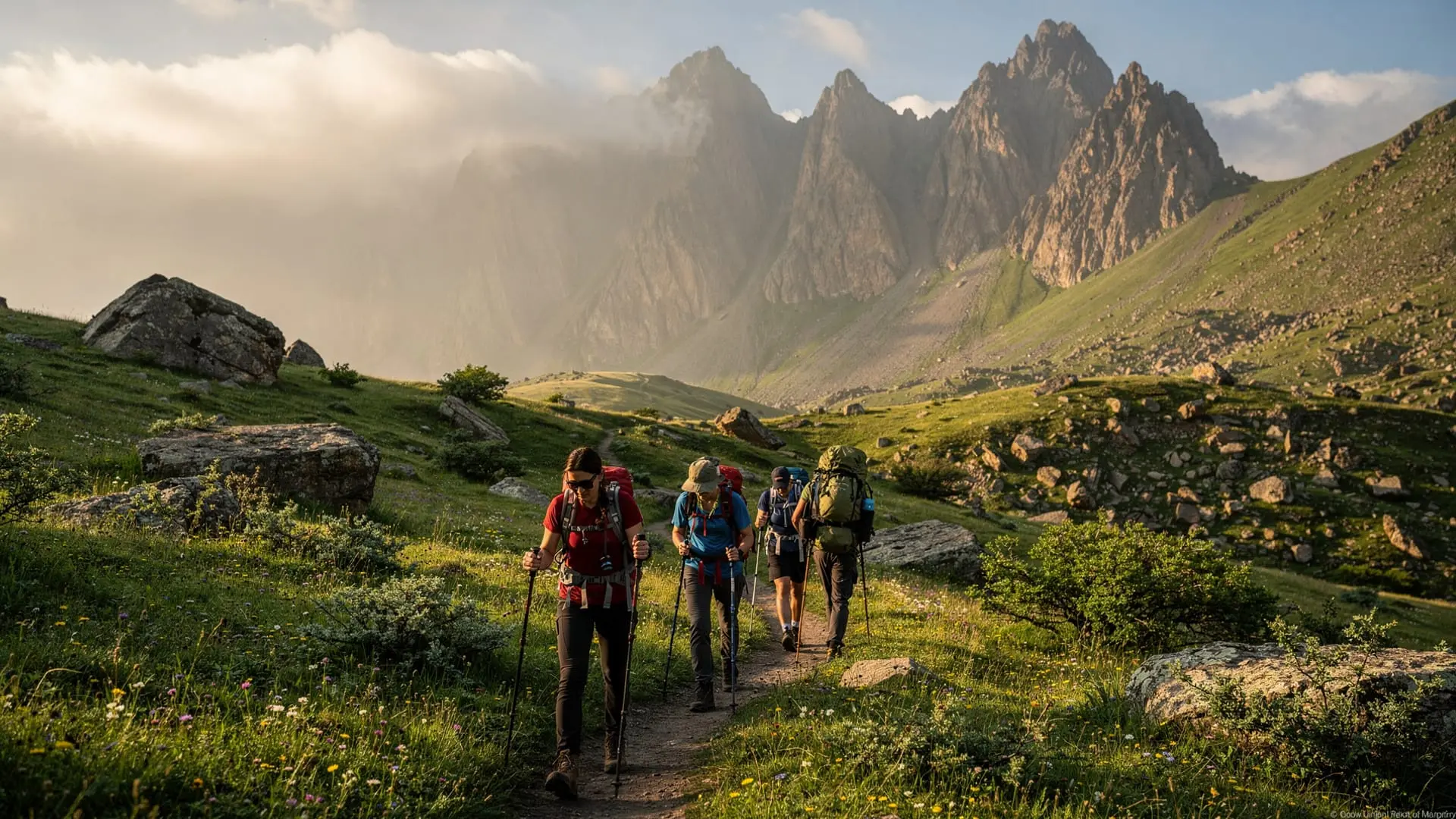
The sacred mountain of Syunik
Mount Khustup (3201m) rises directly above the southern city of Kapan in Syunik province, a sheer volcanic pyramid visible from the city streets below. It is one of the most instantly recognisable peaks in the Armenian south, and one of the most symbolically charged: the mountain is closely associated with Garegin Nzhdeh (1886–1955), the Armenian military commander who organised the last resistance of Armenian forces in Syunik province against the advancing Red Army in 1921 — delaying the Sovietisation of the region by months and enabling negotiations that preserved Syunik within Soviet Armenia rather than Azerbaijan.
Nzhdeh is buried near the summit of Khustup. The mountain is thus simultaneously a hiking destination and a place of pilgrimage for many Armenians, particularly from the diaspora. Climbing to the summit carries emotional weight that few other Armenian hikes can match.
For non-Armenian visitors, Khustup offers something rare: a serious mountain objective in the deep south of Armenia that most tourists never consider, with extraordinary panoramic views across the Zangezur range and, in ideal conditions, toward the border highlands of Iran to the south.
| Where | Above Kapan, Syunik, 4+ hours from Yerevan |
| Cost | Guided 4WD sunrise tour typically 15,000–25,000 AMD per group |
| Time needed | 4–5h round trip (4WD-assisted); 8–10h full foot ascent |
| Getting there | Car/marshrutka to Kapan, then 4WD for the mountain track |
| Best time | June–September; September for the most settled weather |
Getting to Kapan
Kapan is 4+ hours from Yerevan by the most direct route — take the M2 highway south through Vayots Dzor, passing Areni and Jermuk, continuing through Goris before the final descent to Kapan. Marshrutkas from Yerevan’s Kilikia station run to Kapan but schedules are limited (typically one or two departures per day); shared taxis are more reliable for flexible timing.
The drive through Vayots Dzor and Syunik is itself one of the great road trips in Armenia — the landscape shifts from vineyard-covered valleys to high volcanic plateaux to the dramatic Zangezur gorges. Budget a full day for the journey south, ideally stopping at Tatev, Khndzoresk, or Goris en route.
Accommodation in Kapan: the Mirhav Hotel is the best mid-range option (doubles from about 25,000 AMD), with several guesthouses offering basic rooms. The city itself is an interesting post-Soviet industrial town with a copper-mining history and a surprisingly lively café scene.
Route options
Full foot ascent from Kapan
Starting altitude: ~850m (Kapan city)
Summit altitude: 3201m
Elevation gain: 2350m
Distance: 18–20 km round trip
Time: 8–10h round trip
Difficulty: Very hard
The full ascent from the city is a significant undertaking — the elevation gain of 2350m makes it one of the more demanding day hikes in Armenia. The route follows forest tracks south of Kapan, climbing steeply through oak woodland before transitioning to alpine meadows and finally the rocky summit ridge. This is a route for strong, experienced hikers; most people prefer the 4WD-assisted approach.
4WD-assisted ascent (recommended)
Starting altitude: ~1800m (midway point by track)
Elevation gain from midway: ~1400m
Time from midway: 4–5h round trip
Difficulty: Moderate-hard
Most trekkers visiting Khustup arrange a 4WD vehicle (locally called an “off-road”) from Kapan to the midway point. The track is rough, deeply rutted in places, and impassable to standard cars — a proper 4WD with ground clearance is essential. From the drop-off point at approximately 1800m, a well-defined path continues up through alpine zones to the summit.
This approach takes the logistical edge off the climb and makes the experience accessible to fit hikers who are not acclimatised to extreme elevation gain. The views from the midway point alone justify the 4WD drive.
Sunrise option
A popular approach is the overnight drive from Kapan to the 4WD midway point, sleeping in the vehicle or a tent, then climbing through darkness to arrive on the summit at dawn. Sunrise from Khustup is spectacular: the Zangezur peaks catch pink light while the valleys below remain in shadow, and the Ararat massif occasionally appears as a distant silhouette to the north-west.
The Khustup sunrise off-road tour from Kapan handles the entire logistics of the sunrise experience — 4WD access, pre-dawn climb, guide service, and the timing that gets you on the summit as light breaks. It is the best single option for visitors to Kapan who want to climb Khustup memorably.
The summit and its significance
The summit of Khustup is marked by a large khachkar (Armenian cross-stone) erected in memory of Garegin Nzhdeh and the last defenders of Syunik. On national days, small groups make the ascent to lay flowers at the memorial. Armenians from the diaspora — particularly those with Syunik roots — make the climb as a form of pilgrimage.
The physical summit is a narrow rocky ridge with steep drops on both sides. The views encompass the entire Zangezur range, the Arpa valley below, and on clear days the distant highlands of the Iranian border zone to the south. To the north-west, the Vayots Dzor mountains frame the view toward the rest of Armenia.
There are no facilities on the summit or on the mountain above the 4WD midway point. Bring sufficient water and food.
Guided mountain tours
The Armenia Khustup Mountain Tour from Yerevan offers the option of combining the long journey south with a full guided ascent, handling logistics from the capital rather than requiring you to organise independently from Kapan. This is the best choice for those visiting Syunik specifically for Khustup rather than passing through on a broader south Armenia itinerary.
Combining Khustup with southern Armenia
Kapan and Khustup pair naturally with a broader Syunik itinerary. From Yerevan, a 4–5 day southern Armenia circuit typically covers: Khor Virap → Noravank → Areni (wine tasting) → Tatev (Wings of Tatev) → Khndzoresk (cave village) → Goris → Kapan and Khustup → return via a different route.
The Tatev monastery complete guide covers the region’s most famous site, while the Karahunj/Zorats Karer guide is an easy add-on from Goris. The Armenia trekking gear checklist covers what to bring for a multi-day southern circuit that includes a Khustup ascent.
Weather and season
The best months for climbing Khustup are June to September. The summit is snow-free by June in most years; September is particularly fine with settled weather and clear visibility. July–August can bring afternoon thunderstorms to the high ridges — start early and be off the exposed upper section by midday.
October is possible but conditions deteriorate quickly; snow can fall at altitude at any time after early October. The winter months are strictly for experienced mountaineers with proper equipment — deep snow and ice cover the upper mountain from November through May.
Practical notes
- Altitude sickness: 3201m is high enough to cause symptoms for visitors arriving from low altitudes. Spend a night in Kapan (850m) before climbing. Drink plenty of water.
- Water: carry 2–3 litres from Kapan. No reliable water source exists above the forest zone.
- Navigation: a GPS track loaded on your phone or device is recommended for the upper section where the path fades in places. The maps.me Armenia offline map plus a downloaded Wikiloc Khustup track is sufficient.
- The mountain is very popular with Armenian hikers on weekends (particularly in June and September). Weekday ascents are quieter.
Frequently asked questions about Mount Khustup
Is Khustup technically a difficult climb?
No technical climbing is involved — the route is a demanding hike on rocky terrain. The difficulty comes from the elevation gain rather than technical challenge. Strong hikers with experience of mountain days will find it hard but manageable. First-time high-altitude hikers should use the 4WD approach and ideally hire a guide.
Why is Khustup important to Armenians?
Khustup is closely associated with Garegin Nzhdeh, a figure of enormous symbolic importance in modern Armenia and the diaspora. His resistance in Syunik in 1921 is credited with preserving the province as part of Soviet (and later independent) Armenia. The mountain has become a site of national memory as well as a hiking destination. His remains are entombed near the summit — the khachkar memorial there draws regular visits.
Can I hire a guide in Kapan for the climb?
Yes. Local guides can be arranged through the Mirhav Hotel reception or through adventure operators based in Kapan. Rates are typically 15,000–25,000 AMD per group for a full-day guided ascent including the 4WD approach. The GYG-listed tours provide an easier advance booking option for visitors organising from Yerevan.
Is there accommodation near the mountain?
All accommodation is in Kapan city (850m, 20–30 min from the 4WD approach track). No mountain huts or formal camping exists on Khustup. Informal camping at the 4WD midway point is used for sunrise attempts.
How does Khustup compare to Aragats?
Khustup (3201m) is lower than Aragats’ southern summit (3879m) but the full foot ascent is harder due to the much greater starting elevation gain. With 4WD access to 1800m, the climb becomes comparable in difficulty to the Aragats southern peak from Lake Kari. For sheer remoteness and symbolic power, Khustup is unmatched — it draws a more serious hiking audience than the more accessible Aragats.
Do I need my own 4WD, or can I rely on local operators?
Most visitors rely on local operators rather than renting their own 4WD — the track to the midway point is rough enough that inexperienced drivers in an unfamiliar rental can genuinely get stuck or damage a vehicle. Arranging a 4WD and driver through the Mirhav Hotel reception or a listed GYG tour is simpler and safer than attempting the track independently unless you have real off-road experience and a properly equipped vehicle.
Is the Khustup climb realistic as part of a broader Syunik itinerary, or does it need its own dedicated trip?
It can work either way. Fit hikers already spending a night in Kapan as part of a Tatev–Khndzoresk–Goris–Kapan circuit can add the 4WD-assisted sunrise or day ascent without much disruption to the itinerary, since the climbing time itself (4–5 hours from the midway point) fits within a single active day. Less experienced hikers, or those wanting the full foot ascent from the city, are better served treating Khustup as the dedicated purpose of a Kapan stop rather than an add-on.
Kapan: a city worth knowing
Most foreign visitors who reach Kapan treat it as a pure logistics base for the Khustup climb. This is understandable but slightly unfair to a city that has a genuinely interesting character. Kapan was a major copper-mining centre in the Soviet period — the Zangezur Copper Molybdenum Combine still operates in the area — and the city has that particular quality of post-industrial Soviet towns that found second lives after 1991: resourceful, unpretentious, with a lively local culture that doesn’t cater to tourists.
The city sits in a narrow gorge of the Voghji river, with Khustup’s pyramid visible from most streets. The gorge setting means Kapan is noticeably greener and more shaded than the Armenian average — the surrounding forests are some of the richest in Syunik province. A morning walk along the river before heading up the mountain is a pleasant way to start a Khustup day.
Eating in Kapan: The city’s restaurant scene is modest but serves good traditional Syunik food. Look for dishes specific to the south: smoked ham (baster in Armenian), plum-based sauces, and hearty bean soups that reflect the mountain climate. The market on the main street sells local dried fruits and nuts that make excellent trail food.
Getting to Kapan from other sites: Kapan fits naturally into a southern Armenia circuit. From Tatev monastery (one of Armenia’s greatest, accessible via the Wings of Tatev cable car), it is about 1h 30min south to Kapan. From Goris (another excellent base in Syunik), Kapan is 40 min. Building a south Armenia circuit that includes Tatev, Khndzoresk, Goris, and Kapan/Khustup over 4–5 days is one of the best options for visitors who want to go beyond Yerevan and the standard day-trip circuit.
Khustup and Armenian historical memory
The association between Khustup and Garegin Nzhdeh deserves fuller context. Nzhdeh (born Garegin Ter-Harutyunyan in 1886) was a military commander, politician, and nationalist ideologist who played a critical role in several phases of modern Armenian history. He is a complex and contested figure: celebrated in Armenia as a national hero for his military leadership, criticised by some historians for his later political associations.
His final significant military action was the defence of Syunik province in 1920–1921. When the Armenian Republic fell to Soviet power in November 1920, Nzhdeh organised the remaining Armenian forces in Syunik and continued resistance for several months. The “Republic of Mountainous Armenia” he proclaimed in these mountains was a short-lived but historically significant act of defiance that gave Armenians at the Kars Treaty negotiations a leverage point to argue for Syunik’s inclusion in Soviet Armenia.
Without Nzhdeh’s Syunik resistance, the region might have been allocated to Soviet Azerbaijan (which claimed it), permanently separating Armenia from its southern territory and the Iranian border. His bones now rest near the summit of the mountain above which he made his last stand.
For diaspora Armenians visiting Kapan, climbing Khustup carries the weight of this history. The mountain is simultaneously a beautiful hiking destination and a place of national memory in the way that few Armenian mountains can claim.
Flora and fauna on the Khustup massif
The Khustup region is part of Syunik’s remarkable biodiversity corridor. The lower slopes (below 1800m) support mixed oak, hornbeam, and beech forest — some of the largest intact forest patches in southern Armenia. The Transcaucasian Trail Syunik section passes near this zone.
Above the treeline, the Khustup alpine meadows hold populations of Armenian mouflon (a wild sheep native to the South Caucasus), golden eagle, and the bearded vulture (lammergeier) — one of the most visually striking raptors in the world, with a 2.5m wingspan. The bearded vulture is rare elsewhere in Armenia but has a small resident population in the Zangezur range. Early morning on the summit ridge is the best time for observation.
The Armenia bird-watching and hiking tour from Yerevan includes Syunik species in its programme — the Zangezur corridor is considered by ornithologists one of the most significant raptor zones in the South Caucasus.