Lake Parz: Dilijan's forest lake getaway
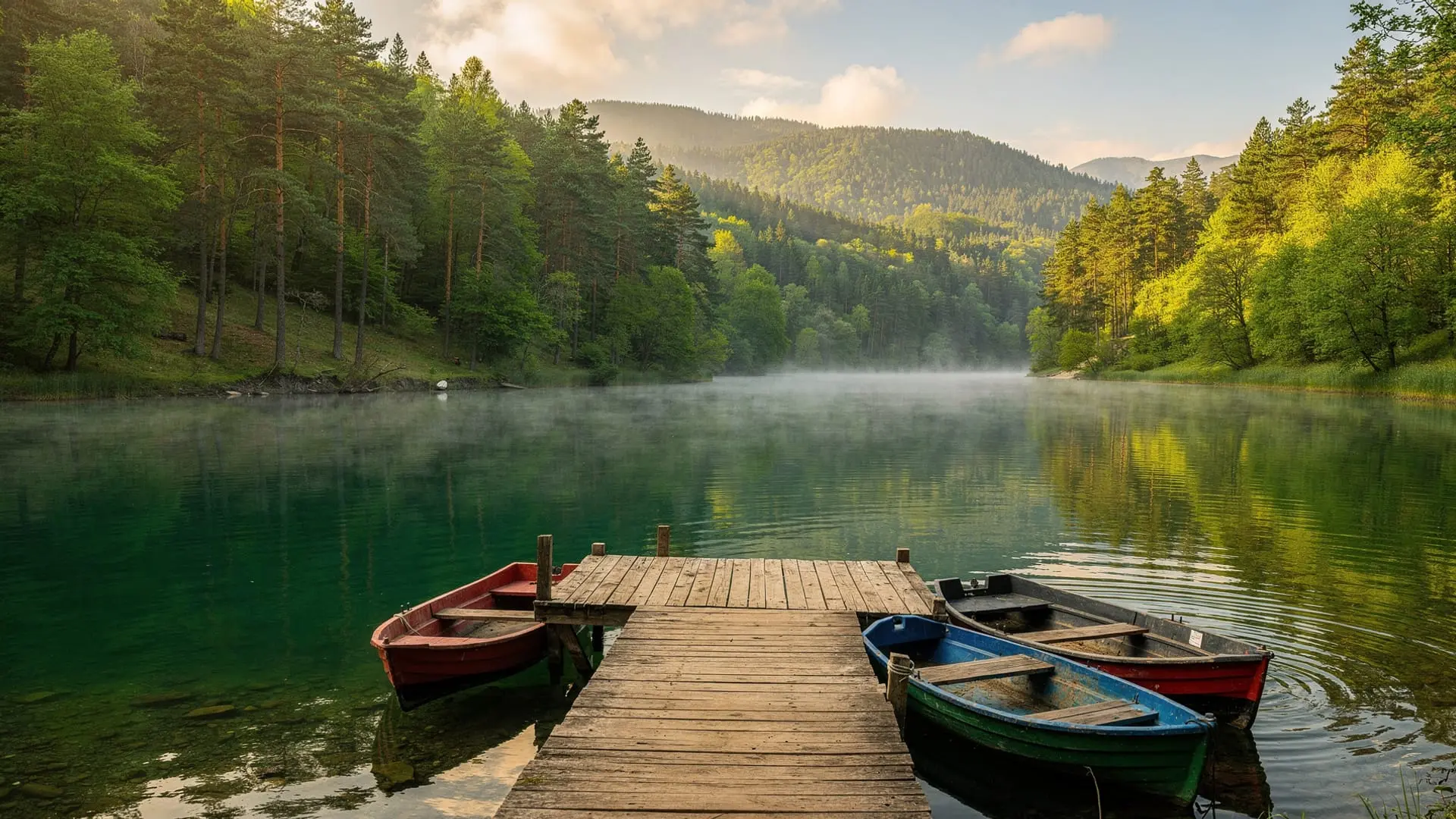
A small lake with a big forest around it
Lake Parz does not dominate the landscape the way Lake Sevan does. It is a small — roughly 1.5 km long — mountain lake tucked into the oak and hornbeam forests of Dilijan National Park in northeastern Armenia, at an altitude of about 1,400 metres. What it offers is not grandeur but intimacy: a calm surface reflecting the forest canopy, rowing boats for hire, a cluster of activity stations on the shore, and the sense that you have found a genuine pocket of natural Armenia rather than a manufactured attraction.
For families with children, Lake Parz is one of the most consistently satisfying stops in the country. For hikers, it sits at the junction of several forest trails that penetrate deeper into the national park toward Goshavank monastery, a full-day walk through some of the finest temperate forest in the South Caucasus. And for anyone who wants to understand what separates Dilijan from Yerevan, an hour by the lake makes the point more effectively than any architecture or restaurant.
At a glance
| Where | Dilijan National Park, 7 km from Dilijan town, Tavush province |
| Cost | Park entry ~500 AMD/person or ~1,000 AMD/car; boats/zip line extra |
| Time needed | 1.5–2 hrs standalone; a full day combined with a hike |
| Getting there | 15 min by car/taxi, or a 2-hour forest walk from Dilijan |
| Best time | May–October for activities; October for autumn colour |
Getting to Lake Parz
The lake is 7 km northeast of Dilijan town centre, inside Dilijan National Park. The park entrance gate is about 3 km from town and a small entrance fee applies (typically 500 AMD per person or 1,000 AMD per car as of 2026 — check current rates on arrival).
By car: 15 minutes from Dilijan centre on a paved but narrow road that winds through forest. Parking is available at the lake.
By taxi: The most practical option without a car. From Dilijan town, expect 1,000–1,500 AMD for the one-way fare. Ask the driver to wait (negotiate 1.5–2 hours) or arrange pick-up.
On foot: A marked forest trail from Dilijan takes roughly 2 hours one way through the national park. This is genuinely enjoyable hiking — well-marked, through mixed forest with minimal elevation gain. The trailhead is near the Hotel Old Dilijan Complex in town.
From Yerevan: Most day tours to Dilijan include Lake Parz as a 1–2 hour stop. The journey from Yerevan is 95 km (1 hour 45 minutes), most efficiently covered by private car or organised tour.
Join a full-day tour covering Lake Sevan, Dilijan, Haghartsin monastery, Goshavank, and Lake ParzWhat to do at the lake
Rowing boats: The most popular activity — wooden rowing boats for hire at the lakeshore, typically 1,000–2,000 AMD for 30 minutes. The lake is small enough to cross entirely in under 10 minutes, so most visitors simply row in circles, stop to trail a hand in the water, and watch the forest reflection. Simple and genuinely enjoyable.
Zip line: A zip line crosses part of the lake, operated by a small station at the shore. It is short (approximately 100–150 metres) and modest by global standards, but provides a decent lakeside view and is popular with children and teenagers. Fee is typically around 2,000–3,000 AMD per person.
Horse rides: Horses and ponies are available for hire at the lake during peak season, mostly for short circuits around the shore. Parents of young children consider this a highlight; the animals are calm and the setting is beautiful.
Walking the lakeside circuit: A simple 30-minute circuit of the lake shoreline is possible and free. The forest comes down to the water on three sides, and the path passes through sections of particularly dense hornbeam — the kind of dense, multi-layered forest that gave Dilijan its “Armenian Switzerland” nickname.
Café and restaurant: There is a café/restaurant at the main activity area near the parking lot, open during summer season. Basic menu: grilled meats, salads, local beer, cold drinks. The setting — wooden terrace overlooking the lake — is better than the food, which is functional rather than memorable.
Combining Lake Parz with Dilijan hiking
Lake Parz sits at the starting point of several longer trails within Dilijan National Park:
Parz Lake to Goshavank: A 10–12 km trail through the park to Goshavank monastery, the 12th-century medieval complex associated with the scholar and legal reformer Mkhitar Gosh. The trail passes through old-growth hornbeam and oak, crosses several streams, and emerges at the monastery from the forested hillside. Allow 3–4 hours one way; arrange a pick-up at Goshavank or double back.
Haghartsin loop: Starting from near Lake Parz, a trail connects through the park to Haghartsin monastery — another 12th-century complex considered among the finest Romanesque-Armenian buildings in Tavush. This route requires good navigation skills or a guide.
Forest circuit trails: The national park has a series of marked shorter circuits of 2–5 km departing from the lake. The signage is reasonable but not infallible — carry a downloaded map from Maps.me or AllTrails.
For a dedicated hiking guide, see Dilijan National Park hikes.
Lake Parz in context: Dilijan and its forests
Dilijan National Park was established in 1958 and covers approximately 240 km². The park protects one of the largest remaining areas of Caucasian mixed forest — oak, hornbeam, beech, ash, and wild fruit trees — in the entire South Caucasus. It is a globally significant biodiversity hotspot, home to brown bears, lynx, wolves, and over 150 bird species.
Lake Parz itself is a naturally formed forest lake, fed by springs and small streams. Unlike Lake Sevan, it has no significant history of industrial intervention or water level manipulation, and the water quality is excellent. The surrounding forest dampens wind, moderates temperature swings, and provides habitat connectivity between the lake and the wider park ecosystem.
The town of Dilijan, 7 km away, has been developing steadily as a wellness and cultural destination. It has the only international school in Armenia (UWC Dilijan, founded 2014), a cluster of artisan studios, and a small but genuinely interesting old quarter with renovated 19th-century merchant houses. Staying overnight in Dilijan rather than driving from Yerevan changes the experience considerably. The Hotel Old Dilijan Complex, a beautifully restored set of stone buildings in the old quarter, is the standout accommodation (roughly 100–150 EUR per night). More affordable guesthouses are available from 30–50 EUR.
Seasons: when to visit Lake Parz
Spring (April–May): The forest explodes into leaf around mid-April. Wild anemones, violets, and forest flowers carpet the ground under the emerging canopy. The lake is cold and the sky often overcast, but the light is extraordinary and the trails are empty. This is arguably the most beautiful time to visit.
Summer (June–August): The high season. Activity stations are fully operational, boats are out, families fill the shore. The forest provides genuine shade and the temperature is cooler than Yerevan by 8–10°C. Weekends are busy.
Autumn (September–October): The second great season. October in particular turns the forest gold, amber, and burgundy — the Tavush autumn colour display is one of the finest in Armenia. See the shoulder season guide for why October is a top month to visit. Lake Parz in October is quiet, cold, and strikingly beautiful.
Winter (November–March): The activities close, the road may be snowy but is passable with care, and the forest takes on a skeletal beauty. Some of the hiking trails are accessible in winter but require proper clothing. The lake may partially freeze in January. The park entrance fee is usually waived or reduced in winter.
Practical information
- National park entrance fee: ~500 AMD (person) / ~1,000 AMD (car) — verify on arrival
- Boat hire: 1,000–2,000 AMD / 30 min
- Zip line: 2,000–3,000 AMD
- Taxi Dilijan–Lake Parz: 1,000–1,500 AMD one way
- Car park: free once inside the park
- Season for activities: May–October
- Year-round access: yes, though activities close in winter
Frequently asked questions about Lake Parz
How long should I spend at Lake Parz?
As a standalone stop, 1.5–2 hours is enough to do a boat trip, walk the shoreline, and have a coffee. If combining with a hike to Goshavank or Haghartsin, allow a full day.
Is Lake Parz suitable for children?
Excellent for children. The boat hire, zip line, and horse rides are all family-friendly and genuinely enjoyable. The lakeside circuit is suitable for children who can walk 2–3 km. The café serves simple food including chips and grilled meats.
Is there a swimming beach at Lake Parz?
There is no formal swimming beach, and swimming in the lake is not officially encouraged. The water is cold, the bottom is silty in places, and the focus is on boats and walking rather than swimming. Most visitors do not swim.
Can I walk from Dilijan to Lake Parz?
Yes — the forest trail takes about 2 hours and is well-marked. It is a pleasant walk through the national park and perfectly manageable for anyone in reasonable fitness. Wear sturdy shoes as the path can be muddy in spring and after rain.
Is Lake Parz worth visiting if I have already been to Lake Sevan?
Absolutely — they are very different experiences. Lake Sevan is vast, high-altitude, and dramatic. Parz is small, forest-enclosed, and intimate. They complement each other well on a combined Dilijan/Sevan day from Yerevan.
The forest ecology: what makes Dilijan’s woods special
The forest surrounding Lake Parz is not just scenically attractive — it represents one of the most significant ecological assets in the South Caucasus. Understanding what you are walking through adds depth to the experience. See the Dilijan wellness retreats guide for forest bathing context.
Species composition: The dominant trees are oriental hornbeam (Carpinus orientalis), pedunculate oak (Quercus robur), caucasian hornbeam (Carpinus caucasica), and in the shadier valleys, European beech. Wild fruit trees — crab apple, wild pear, cornelian cherry — form a secondary layer that is extraordinary in autumn when the fruit hangs unpicked on branches in every direction.
Old-growth structure: Parts of the Dilijan National Park have remained largely unlogged since the Soviet era, and the resulting multi-layered canopy structure — with standing dead trees, fallen logs, and dense undergrowth — provides habitat for species that cannot survive in managed forest. The brown bear population of Tavush province (estimated at a few dozen individuals) uses the park regularly.
Medicinal plants: Traditional Armenian medicine has a long history in these forests. Wild thyme, yarrow, St. John’s wort, linden, and dozens of other medicinal plants grow throughout the park. The Dilijan area has historically been associated with herbal medicine practice.
Fungi: In September and October, the forest floor under the old oaks produces spectacular mushroom flushes — porcini (Boletus edulis), chanterelles, and multiple other edible species. Local families forage here in autumn, and the knowledge of where to find specific species is passed down through generations. Do not forage without local knowledge — several toxic species exist alongside the edible ones.
Dilijan as a cultural town
The forest and lake experience is only part of what Dilijan offers. The town itself deserves more than a brief mention:
Old Dilijan: The historic quarter of Dilijan (Huysisayin Pokots — North Street and adjacent lanes) was partially restored in the 2010s. The restored 19th-century merchant houses now contain artisan workshops, a small photography museum, a café, and a functioning blacksmith. The restoration was done well — the buildings look lived-in rather than museum-ified.
UWC Dilijan: The United World College school opened in Dilijan in 2014 and has had a disproportionate effect on the town’s character. The international student community has supported several small businesses and cultural spaces that would otherwise not exist in a town of this size.
Achajour restaurant: A famous name in Armenian food culture — Achajour, in Dilijan, represents the farm-to-table ideal of the Armenian highlands. The restaurant grows much of its own produce, makes its own cheese and dairy, and serves the kind of food that reassures you that Armenian cuisine is among the most honest in the region. Book in advance for dinner.
Music at Dilijan: The Dilijan International Music Series, held in summer, has brought international chamber musicians to perform in the forests and courtyards of the town since 2012. If your visit coincides with a performance, attend — the combination of first-rate music and a medieval forest town is not something you encounter everywhere.
Making the most of a short visit
If you only have an hour at Lake Parz — a common scenario for tour groups moving on to Dilijan or Sevan the same day — prioritise a slow lap of the free lakeside circuit over paying for the boat or zip line. The forest itself, not the activity stations, is what makes Parz memorable, and the quietest, most atmospheric stretch of shoreline is the section furthest from the car park.
For those with more time, pairing the lake with even a short segment of the trail toward Goshavank — walk 30–40 minutes in and back rather than the full 3–4 hour trek — gives a genuine sense of the old-growth forest without committing to a full-day hike. The Dilijan National Park hikes guide has waypoints for shorter out-and-back options.
Guided hike from Lake Parz through the national park toward Goshavank