Sevan trout (ishkhan): the lake's prized fish
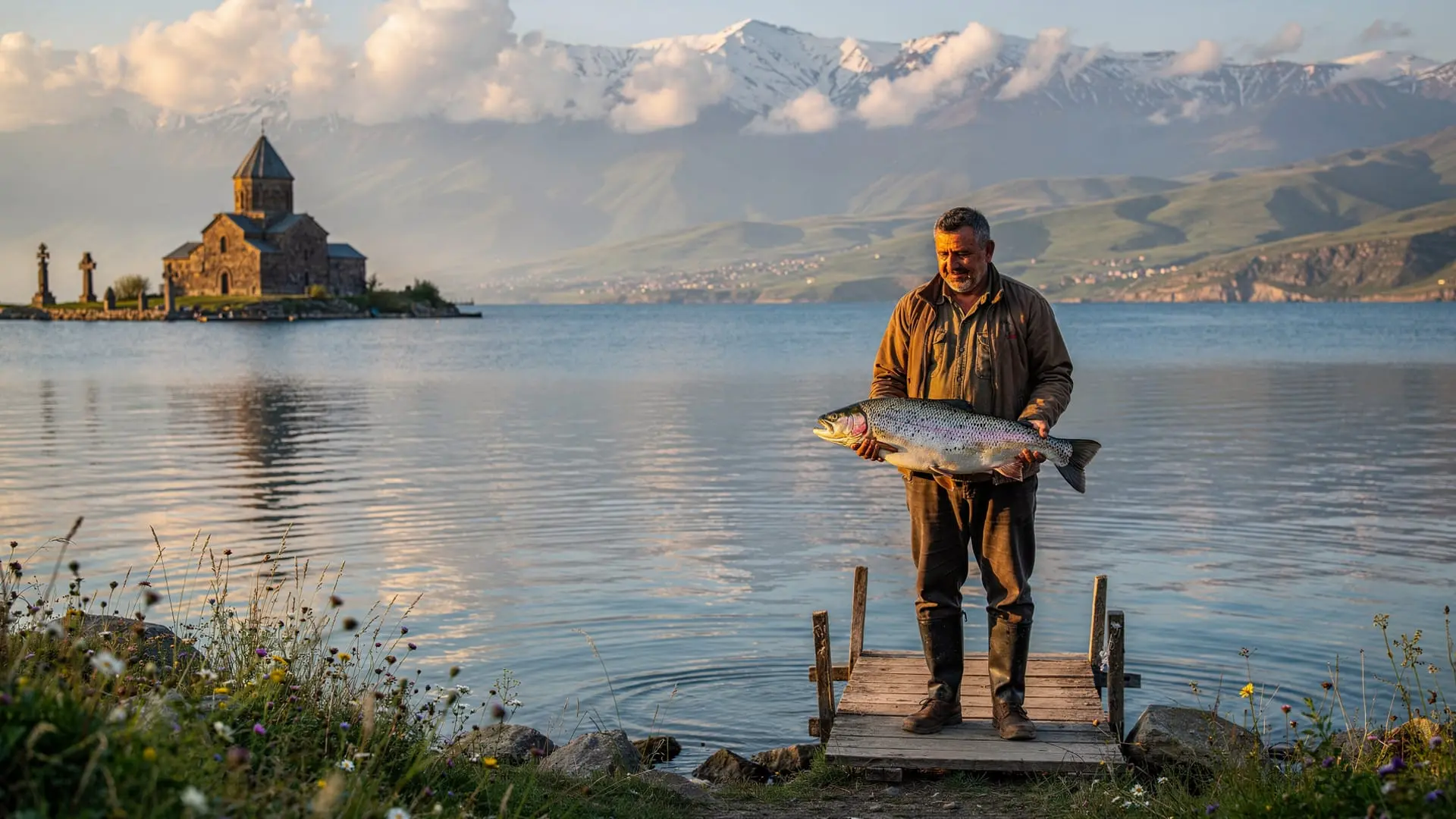
A fish that defined a lake, and a lake that failed a fish
Walk into any restaurant on the shores of Lake Sevan in summer and you will likely see “Sevan trout” on the menu. The dish is legendary in Armenian cuisine — ishkhan, which translates from Armenian as “prince,” is considered one of the finest freshwater fish in the Caucasus, prized for its pink flesh, delicate flavour, and fat content that makes it ideal for grilling over an open fire. Poets and historians wrote about it. It was a symbol of Armenian abundance.
The reality in 2026 is more complicated, and any honest guide to Lake Sevan has to address it directly: ishkhan is classified as critically endangered. Commercial fishing has been legally banned since 2012. The fish you see advertised in lakeside restaurants almost certainly did not come from Lake Sevan through legal channels. What you are choosing to do with that information is genuinely your decision — but you deserve to make it with full awareness of the facts.
At a glance
| Status | Critically endangered / functionally extinct in two subspecies |
| Legal status | Commercial fishing banned since 2012 |
| What’s on menus | Often mislabelled farmed trout or sig, not genuine ishkhan |
| Better order | Freshwater crayfish (khetsgetin) or sig — legal and abundant |
| Where to learn more | Lchashen hatchery, western shore, near Sevan town |
What is ishkhan?
Ishkhan (Salmo ischchan) is an endemic species of trout — meaning it evolved in Lake Sevan and exists nowhere else on earth in wild form. It is a salmonid, related to Atlantic salmon and brown trout, but adapted to the cold, deep, high-altitude conditions of a closed mountain lake. Unlike migratory salmon, ishkhan spent its entire life cycle within the lake, spawning in the inflowing rivers and shallow coastal areas.
Historically, four subspecies were described by Armenian ichthyologists:
- Summer ishkhan (Salmo ischchan ischchan): The largest subspecies, reaching up to 14 kg, spawning in autumn in deep water. Now believed to be functionally extinct in the wild.
- Winter ishkhan (Salmo ischchan gegarkuni): A smaller form, also considered functionally extinct.
- Bakhtak (Salmo ischchan danilewskii): A small, riverine subspecies. Critically endangered.
- Bodjak (Salmo ischchan typicus): The most common form historically. Now critically endangered.
The distinction between subspecies was already blurring by the mid-20th century due to hybridisation as habitat shrinkage pushed populations together. Today, the genetic picture is complex and the practical situation is stark: wild ishkhan in anything close to historical numbers is gone.
What happened: the Soviet water drop and its consequences
The collapse of the ishkhan population is directly traceable to the Soviet-era water diversion described in the Lake Sevan complete guide. Between 1933 and 1990, the lake level dropped 19 metres. This had catastrophic consequences for the fish:
Spawning ground destruction: Ishkhan spawned in shallow coastal areas and the lower reaches of inflowing rivers. The 19-metre water drop exposed and dried out most of these habitats. Hatchlings that survived to juvenile stage found their nursery environment transformed into dry land.
Habitat compression: As the lake shrank, the cold deep-water habitat that supported the largest summer ishkhan subspecies also reduced. Fish populations were compressed into smaller volumes of water, intensifying competition for food and space.
Temperature change: The smaller lake warmed faster in summer, pushing average temperatures above the thermal tolerance thresholds of the cold-adapted trout.
Introduction of competing species: Soviet planners introduced carp, signal crayfish, and several other non-native fish into the lake — partly as a food source, partly as an experiment in maximising lake productivity. These introduced species competed with and preyed on juvenile ishkhan, compounding the pressure from habitat loss.
Intensified fishing during the Soviet collapse: In the late 1980s and early 1990s, economic breakdown meant reduced enforcement and increased subsistence fishing. This period likely delivered the final blow to already depleted populations.
The partial recovery and the hatchery programme
Some good news exists. The Armenian government has operated the Lchashen fish hatchery on the western shore since the Soviet era. The hatchery raises ishkhan fry for annual stocking releases into the lake — tens of thousands of juveniles each year — as part of a population recovery programme. The lake level has also risen roughly 3 metres since 2004 due to the Arpa tunnel diversion, slowly recovering some spawning habitat.
Researchers have documented limited natural reproduction occurring again in a few river mouths where water quality and depth have improved. The ishkhan is not on the brink of total extinction in the way that some species are. But the numbers remain far below the threshold for any sustainable commercial harvest, and the 2012 ban on commercial fishing is the scientific consensus on what is necessary.
The fish you encounter in restaurants, if genuine ishkhan, almost certainly comes from one of two sources: illegal capture from the lake (poaching is persistent despite enforcement), or fish misrepresented as ishkhan that is actually farmed rainbow trout or sig (whitefish). The latter is extremely common — “Sevan trout” on a menu is frequently not ishkhan at all.
Explore Lake Sevan on a private tour — your guide can point out the hatchery and explain the lake’s conservation storyThe ethical question for visitors
This is where the guide stops being purely descriptive and becomes direct: if a restaurant in Sevan offers you “ishkhan trout” at a price that seems normal for a restaurant meal, it is almost certainly illegal. Either the fish was poached from the lake (undermining a fragile recovery) or it is mislabelled (you are being deceived and paying for something that is not what you ordered).
A few responses visitors commonly have:
“But everyone eats it — it can’t be that bad.” This is the tragedy of the commons logic that depleted the species in the first place. Normalised consumption of an illegal product creates persistent demand that makes enforcement harder. The fish does not know that your portion was “just one meal.”
“I want to experience authentic Armenian food.” Historical authenticity is precisely the problem — ishkhan was abundant because it was not being eaten by millions of tourists on top of already depleted stocks. The authentic Armenian experience today would be eating crayfish or sig and being honest about why.
“It might be farmed.” Some small-scale aquaculture operations in Armenia do raise rainbow trout and sell it as “Sevan trout” in a loosely defined marketing sense. If you genuinely want to eat trout at Lake Sevan, ask specifically whether it comes from a licensed aquaculture facility and what species it is. Most waitstaff will not be able to answer this question confidently, which tells you something.
The recommended position of this guide: eat the crayfish (legal, abundant, delicious), eat the sig, and pass on ordering anything called ishkhan at a lakeside restaurant unless you have verified its source. This is not a judgment on Armenian cuisine or culture — it is a straightforward conservation position supported by Armenian environmental scientists.
What to eat instead
Lake Sevan’s other fish and shellfish are genuinely excellent and raise no ethical issues:
Freshwater crayfish (khetsgetin): Introduced to the lake during the Soviet era and now thriving — arguably too successfully, as they compete with native species, but their harvest is legal and encouraged. Boiled in salted water or beer, served by the half-kilo, they are arguably the lake’s best food offering. Widely available June–September from roughly 2,000–3,000 AMD per 500g. The Lake Sevan complete guide covers the best beaches and restaurants around the lake.
Sig (Coregonus lavaretus): A whitefish introduced from northern Russia in the 1920s, now well-established in the lake. It is legal to catch, farmed by several operations, and served grilled or smoked at most lakeside restaurants. Less interesting than crayfish to eat but a perfectly fine grilled fish.
Smoked fish: Several roadside vendors near Sevan town smoke fish on-site and sell it wrapped in paper — atmospheric and good. The species is almost always sig.
The conservation future
The longer-term prognosis for ishkhan depends on several variables that scientists are actively studying:
Lake level recovery: The Arpa tunnel project continues slowly raising the level. Another 1–2 metres of rise would meaningfully expand spawning habitat. Progress is slower than originally projected due to competing demands for Arpa River water from downstream agriculture.
Introduced species management: The crayfish and carp populations that compete with juvenile ishkhan are extremely difficult to reduce without harming the broader ecosystem. Experimental nets and targeted removal have had limited success.
Hatchery genetics: There are concerns that long-term hatchery breeding without sufficient genetic diversity will produce domesticated fish less capable of surviving wild conditions. The Lchashen hatchery has incorporated wild-caught individuals where possible to maintain genetic variation.
Enforcement of the fishing ban: Spot inspections and licensing enforcement have improved since 2012, but poaching remains common. Consumer demand — including from restaurants — is the ultimate driver of poaching. If demand disappeared, poaching would follow.
Frequently asked questions about ishkhan trout
Is it illegal to eat ishkhan in Armenia?
Technically, possessing or serving ishkhan caught from Lake Sevan without a licence is illegal. However, enforcement at the point of consumption (i.e., at restaurants) is very rarely pursued against diners. The legal risk falls on the poacher and the restaurant, not typically on the customer. The ethical burden is a different matter.
Are there any legal ways to eat genuine ishkhan?
There is a small licensed aquaculture sector in Armenia that farms ishkhan. If a restaurant can produce documentation of a licensed farm source, the fish is legal. In practice, this is rare. The hatchery-raised fish released into the lake are not legal to catch either — they are released for population recovery, not harvest.
What does ishkhan taste like?
By historical accounts and the few who have eaten legally sourced farmed specimens, ishkhan has pink flesh (similar to salmon), a rich fat content, and a mild, clean flavour suited to simple preparation — grilled over wood with lemon and herbs. It is commonly compared to wild Atlantic salmon but with a distinctive freshwater character. The fact that it tastes excellent is part of why the poaching problem persists.
Is rainbow trout from Armenian farms a good alternative?
Several farms in Kotayk and other provinces raise rainbow trout in cold mountain streams. This is a legitimate, legal product that is genuinely good to eat and supports Armenian agriculture. It will be labelled differently from wild-caught fish if the farm is operating honestly.
How can I visit the Lchashen hatchery?
The Lchashen fish hatchery is located at Lchashen village on the western shore, roughly 15 km south of Sevan town. It is occasionally open to visitors, though it is not a formal tourist attraction — enquire locally. Some guided tours of the lake include a brief explanation of the hatchery programme.
The broader context: endemic species loss in Armenia
The ishkhan situation is one instance of a wider pattern. Armenia’s biodiversity has been significantly impacted by Soviet-era habitat modification and continues to face pressures from agriculture, mining, and infrastructure development. Understanding the ishkhan story in this context matters:
The Khosrov Forest Reserve: Armenia’s ancient forest reserve near Garni, established in the 4th century AD by King Khosrov III (making it one of the world’s oldest protected areas), contains endemic plant and animal species under increasing pressure. The reserve is part of the same volcanic highland ecosystem that surrounds Lake Sevan.
The Armenian viper (Montivipera raddei): An endemic snake of the Armenian highlands, classified as vulnerable. Killed on sight by many residents — a pattern of conflict between traditional attitudes and conservation needs.
Armenian mouflon: Wild sheep native to the Armenian highlands, with reduced populations due to overhunting. Protected but enforcement is inconsistent.
The ishkhan trout is the most visible of these conservation stories because it intersects with food and tourism. But the pattern — endemic species under pressure from a combination of Soviet-era modification and post-Soviet governance gaps — is characteristic of Armenian ecology broadly. For a broader look at Lake Sevan beaches and activities see our dedicated guide.
What responsible visitors can do
The best contribution a visitor can make to ishkhan conservation is simple: do not create demand for poached fish. But beyond that passive choice, several active options exist:
Support conservation organisations: The Armenian Environmental Front (Կանաչ Ամիdd) and the Foundation for the Preservation of Wildlife and Cultural Assets (FPWC) both work on issues that intersect with the Sevan ecosystem. Donations go further in Armenia than in higher-income countries.
Engage on tours: Ask your guide about ishkhan and lake ecology. Good guides know the situation and will explain it; creating space for the conversation normalises it. The Sevanavank monastery visit combines well with any lake exploration.
Eat the alternatives enthusiastically: The crayfish and sig at Sevan’s lakeside restaurants are genuinely good. Ordering them rather than avoiding fish altogether sends a clearer market signal than simply not eating.
Share what you know: Telling the story of ishkhan to other visitors who may not know it — simply, without lecturing — is a form of conservation education that spreads from visitor to visitor.
What to say if a restaurant insists it’s genuine
Waitstaff at busy lakeside restaurants will sometimes insist their “ishkhan” is legitimate, whether or not they believe it themselves. A polite, direct question — “Is this from a licensed farm, or from the lake?” — is usually enough to reveal the answer in how confidently (or not) it’s answered. If the response is vague, order the crayfish instead. This isn’t about catching anyone out; it’s about not funding a market for an illegal, ecologically damaging catch. For the wider beach and restaurant landscape around the lake, see the Lake Sevan best beaches guide.
A full-day Lake Sevan and Dilijan tour with a guide who can explain the ishkhan story on-site