Malkhas Jazz Club: a Yerevan institution
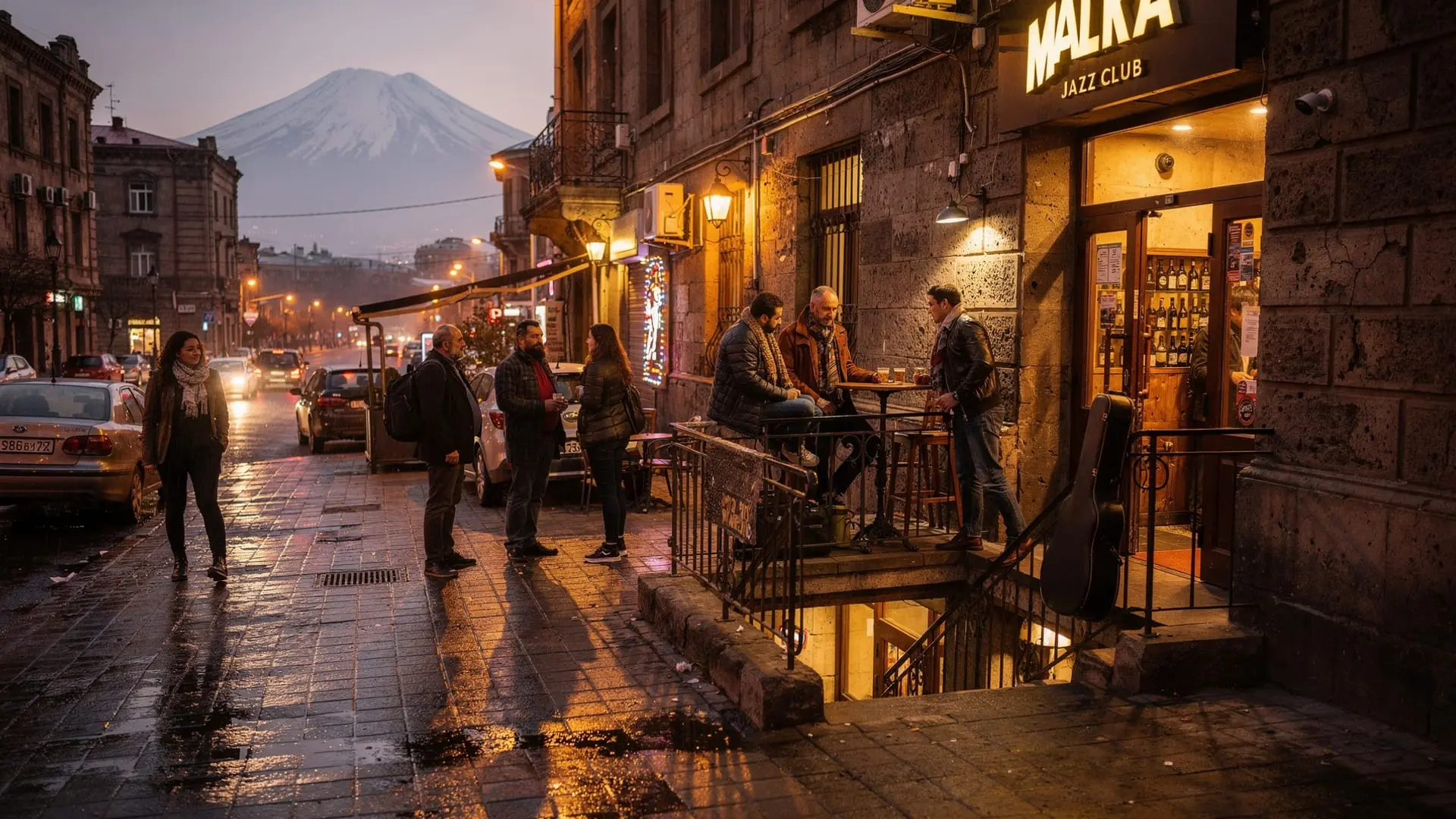
The small room where Yerevan keeps its jazz
Pushkin Street in central Yerevan is quiet and residential in the way that the best streets of old Soviet cities are: wide pavements, plane trees, the ghost of a grander urban plan visible in the building proportions. Number 52 is unremarkable from outside — a doorway with a small sign, steps descending from street level. Inside is Malkhas Jazz Club, and inside is a different world.
The room holds perhaps 60–80 people at small tables arranged around a low stage. The acoustics are live but controlled; you hear the piano resonating in the floor. The walls are dark wood and photographs of musicians, the lighting is warm and low, and on most evenings a trio or quartet plays from 9:30 pm until midnight or beyond. On nights when Levon Malkhasyan — “Malkhas” himself — plays, the room fills before the first note.
Malkhas Jazz Club is not the most technically sophisticated jazz venue you will visit. It is something more durable: a genuine community, a decades-old relationship between a musician and his city, a room that has stayed true to what it is while the city around it changed entirely.
At a glance
| Where | 52 Pushkin Street, central Yerevan |
| Cost | Small cover/minimum spend; wine 2,500–4,000 AMD, brandy 3,000–5,000 AMD |
| Time needed | 2–3 hours; music runs roughly 9:30pm–midnight or later |
| Getting there | 10–15 min walk from Republic Square, or 600–1,000 AMD by taxi |
| Best time | Book ahead for weekends or when a featured musician is billed |
Levon Malkhasyan: the man behind the music
Levon Malkhasyan was born in Armenia in the Soviet era and built a career as a jazz pianist in a country where jazz existed in a complex relationship with officialdom. Soviet cultural policy tolerated jazz intermittently — it was seen as dangerously Western in some periods, as an acceptable form of popular culture in others. For musicians who loved the music, it required both persistence and pragmatism.
Malkhasyan navigated this landscape with a combination of genuine talent and stubbornness. He studied classical piano but found jazz the more compelling form; he performed in hotels, cultural centres, and any venue that would have him. He became, over decades, the central figure in Armenian jazz — not merely as a performer but as an advocate, a teacher, and an institution-builder.
The club was created as a permanent home for the music. In naming it with his own nickname — Malkhas — rather than a generic venue name, he made his intentions clear. This was not a commercial venue with a jazz programme; it was a jazz club that happened to sell drinks. The distinction matters and anyone who spends an evening there feels it.
Today Levon Malkhasyan is in his later years and his health has sometimes limited his performances, but he remains present in the life of the club. When he plays, the evenings carry a weight of accumulated history that no young musician can yet replicate.
The music programme
Malkhas Jazz Club runs live music seven nights a week — this alone distinguishes it from most jazz venues anywhere in the world. The programme is driven by a rotating roster of Yerevan-based jazz musicians, many of whom trained partly under Malkhasyan’s influence.
The typical evening format:
- First set: begins approximately 9:30 pm, duration 45–60 minutes
- Break: 20–30 minutes
- Second set: 11 pm or later, sometimes running to midnight or beyond
- Smaller improvised sessions sometimes follow for those who remain
The repertoire moves fluidly between American jazz standards (Coltrane, Miles Davis, Bill Evans, Monk), Armenian folk themes rendered in jazz idiom, and original compositions. The Armenian folk-jazz hybrid is particularly distinctive: familiar modal figures from duduk music translated into piano, double bass, and drums, creating something that sounds neither entirely Western nor entirely Armenian but something genuinely in between.
The calibre of the musicians is high. Several Malkhas regulars have performed internationally; the bass players and drummers in particular are exceptional by any standard. On nights when Malkhasyan plays, the musical atmosphere changes — the other musicians shift into a more attentive mode, which you can hear in how they comping behind him.
What to expect: atmosphere and logistics
Arriving
The club is at street level, with steps down to the entrance. The door opens from around 8 pm for drinking and conversation; the music starts at 9:30 pm. On busy evenings (Fridays, Saturdays, any evening with a known musician billed) the tables fill by 9 pm. Arriving at 9 pm gives you a reasonable chance of a good table without booking; arriving at 9:30 when the music starts means you may stand.
The Malkhas jazz and wine experience includes reserved seating and Armenian wine as a package — for visitors who want certainty rather than a walk-in gamble on a busy night, this is the practical option.
The room
Low ceilings, dark wood, small candles on the tables, photographs of jazz musicians on the walls (international and Armenian), the stage at one end. No bad seat, but the tables directly in front of the stage are better for watching the piano; the tables toward the back are better for conversation during the break.
Noise level: During performance, noise from the room is expected to drop. This is not a bar where music plays in the background; it is a concert venue where drinks happen to be available. The audience is attentive and the musicians notice.
Drinks and food
The menu is short: Armenian wines, brandy, beer, spirits, and small plates (cheese, bread, olives, cold starters). This is not the place to eat dinner; eat before you arrive and treat the food order as accompaniment. The wine list includes Armenian producers, and the house wine by the glass is reliable.
Prices are reasonable: 2,500–4,000 AMD (6–10 €) for a glass of wine, 3,000–5,000 AMD (7–12 €) for brandy.
The audience
The audience at Malkhas is a genuine local-visitor mix that reflects what the club has always been: not a tourist venue that happens to be popular with locals, and not a local venue that tolerates tourists, but a genuine community gathering. You will sit next to Yerevan intellectuals, Armenian diaspora visitors (French Armenian, American Armenian, Russian Armenian), and curious first-time travellers all in the same small room. Conversations happen during the break.
Jazz in the context of Armenian culture
Jazz arrived in Soviet Armenia through cultural exchange programmes, radio broadcasts of American music, and the slow percolation of recordings through unofficial channels. It found a ready audience among Armenian musicians trained in classical tradition — jazz’s complexity rewarded their technical background, and its freedom offered something the classical form constrained.
The relationship between jazz and Armenian folk music is not merely a stylistic choice for Malkhasyan and the musicians around him; it is a genuine cultural investigation. Duduk scales, modal structures from ancient Armenian song, and the rhythmic patterns of traditional dances translate naturally into jazz improvisation. When a Malkhas regular plays a standard like “Autumn Leaves” and then drifts into something that sounds like an old lullaby from Tavush, it is not a digression; it is the central point.
Armenia’s particular history — the diaspora, the genocide (see Tsitsernakaberd memorial), the Soviet period, the independence, the isolation — gives its jazz a specific emotional character. Listening carefully at Malkhas, this is audible.
Getting to Malkhas Jazz Club
The club is on Pushkin Street in central Yerevan, walkable (10–15 minutes) from Republic Square and from most central hotels. GG Taxi from anywhere in the centre will cost 600–1,000 AMD (1.50–2.50 €) one way.
After the club closes (typically 1–2 am on weeknights, later on weekends), GG Taxi is the reliable return option. Street taxis outside the club will be opportunistically priced; negotiate or use the app.
The broader Pushkin Street area connects to Achajour for pre-jazz dinner (recommended: arrive at 7 pm, eat, walk to Malkhas for 9 pm). See the Yerevan best restaurants guide for pre-concert dinner options.
Combining Malkhas with other Yerevan nightlife
The club closes relatively early compared to the club circuit; 1–2 am is the typical end for most evenings. This makes it natural to start an evening at Malkhas and, if the energy persists, continue to a bar or late-night venue afterward.
The logical sequence: dinner on Pushkin Street or Abovyan Street → Malkhas Jazz Club (9:30 pm–midnight) → +374 cocktail bar or In Vino wine bar for a final hour → return or continue to clubs if that is the mood.
See the Yerevan nightlife guide for the full evening landscape.
Why Malkhas matters beyond the music
There is a type of cultural institution — rare, and recognisable when you encounter it — that holds something essential about its city. It is not the most famous venue, not the most technically sophisticated, and often not the most commercially successful. But it has stayed true to what it is across decades and through everything the city has been through. Yerevan has several of these places; Malkhas Jazz Club is one of the clearest examples.
The club has outlasted the Soviet Union, several economic crises, a pandemic, and the competing pull of a dozen newer and shinier entertainment venues in a city that has been remade several times over. It has done so by being irreplaceable: no other venue in Armenia has Levon Malkhasyan’s history and presence, the musicians he has trained and nurtured, or the community that has formed around the music over decades.
Visiting Malkhas is not a tourist box to tick. It is one of the genuinely unrepeatable evenings Yerevan offers.
The musicians: who plays at Malkhas
Beyond Levon Malkhasyan himself, the club has developed a roster of Armenian jazz musicians who perform regularly and whose careers are intertwined with the space. Without naming performers whose schedules change, the instrumentation at Malkhas tends toward piano-led trios (piano, double bass, drums) with saxophone or trumpet added for quartet format.
The double bass players associated with the Malkhas stable are particularly notable — the instrument has a cultural affinity in Armenia, perhaps because its low register resonates with the duduk’s melancholy character. The piano-bass relationship at Malkhas often takes the foreground in a way that is more evident than in louder, drum-forward jazz venues.
The drumming at Malkhas incorporates subtle influences from Armenian percussion tradition — the dhol (double-headed drum) and the nagara appear in the rhythmic vocabulary of the jazz drummers even when they are playing a standard kit. This is the Armenian folk-jazz integration at its most subliminal and most effective.
Malkhas Jazz Club and the Yerevan cultural scene
The club does not exist in isolation. It sits within a broader Yerevan cultural life that includes the Opera, the Parajanov Museum, the Cascade art collection, and a series of gallery spaces concentrated on Abovyan Street and in the converted industrial spaces north of the centre.
The intersection of the jazz audience and the visual arts audience in Yerevan is substantial — many of the regulars at Malkhas are also regulars at gallery openings, at the Parajanov Museum events, and at the Cafesjian Museum exhibitions inside the Cascade. This cross-fertilisation gives the club a slightly different quality from a venue that only its genre audience attends: conversations at the break range from the music to contemporary art to Armenian cinema with a naturalness that reflects a small city’s concentrated cultural life.
For a cultural evening that starts with visual art and ends with music, the sequence is: afternoon at the Cascade Complex (Cafesjian Museum, sculpture garden) → dinner on Abovyan or Pushkin Street → Malkhas Jazz Club from 9:30 pm. Total time: 5–6 hours; total cost (museum, dinner, club): 25,000–40,000 AMD (60–100 €).
Photography and the club
Malkhas Jazz Club is photogenic in the way that intimate jazz venues always are: the low lighting, the close quarters, the musicians focused entirely on what they are doing. Photography during performance is tolerated but should follow the etiquette of any live music space: no flash, minimal movement, screen brightness at minimum. The best moments for photography are during the break, when the musicians are at the bar or talking with the audience, and the atmosphere is more relaxed.
Cameras with fast prime lenses (f/1.4 or f/1.8) at ISO 3200+ handle the low light without flash. Phone cameras at auto will struggle with the darkness; a phone with a dedicated night mode does better.
Timing your evening around Malkhas
Because the room is small and fills quickly, arrival time matters more here than at most Yerevan venues. Arriving right at 8pm when doors open gives first pick of tables and time to order dinner-adjacent small plates before the music starts. Arriving at 9:30pm when the first set begins means competing for whatever tables remain — workable on a quiet weeknight, risky on a Friday or Saturday. If you want certainty without the gamble, pair an early dinner on Pushkin or Abovyan Street with a booked package rather than a walk-in.
Malkhas as a venue for private events
The club occasionally hosts private events — birthday celebrations, small corporate functions, diaspora family gatherings. These are arranged through the club directly and typically involve a private set by the resident musicians with a reserved section of the room. If you are planning a group visit to Yerevan (diaspora reunion, cultural tour group) and want an evening at Malkhas as a private experience, contact the club in advance; they are responsive to organised group requests.
Frequently asked questions about Malkhas Jazz Club
Do I need to book in advance?
On weekends and when a featured musician is billed, yes — the room fills quickly. On weekday evenings, walk-ins are usually accommodated if you arrive by 9 pm. The Malkhas jazz experience package guarantees a reserved table and simplifies the evening.
What is the minimum spend or cover charge?
Policies change seasonally; check current details via the club directly or via the GetYourGuide package. Typically a small cover charge and/or a minimum drink order apply on performance evenings.
Does Malkhas Malkhasyan still perform?
As of the 2026 review: Levon Malkhasyan performs regularly but not every night. There is no published schedule for his personal appearances; the best approach is to arrive and ask, or to book through a guide service that can confirm scheduled performances.
Is Malkhas Jazz Club suitable for children?
The club operates as an adult evening venue; the late hours (music starts 9:30 pm) make it impractical for young children. Teenagers interested in jazz would find it engaging; it is not a restricted venue.
What style of jazz is played at Malkhas?
The programme covers American jazz standards, Armenian folk-jazz hybrids, and original compositions. Modal jazz in the Coltrane tradition, bebop-influenced piano trio settings, and the occasional swing-era standard all appear. The Armenian folk influence is a consistent thread rather than a novelty.
Are there any other jazz venues in Yerevan?
Malkhas is the dedicated jazz club. Some bars (Calumet, certain spots on Saryan Street) host occasional jazz evenings, but none with the regularity or depth of programming that Malkhas maintains. For live music more broadly, Yerevan has folk music evenings at Sayat-Nova restaurant and classical concerts at the Opera House.