Mount Khustup off-roading from Kapan
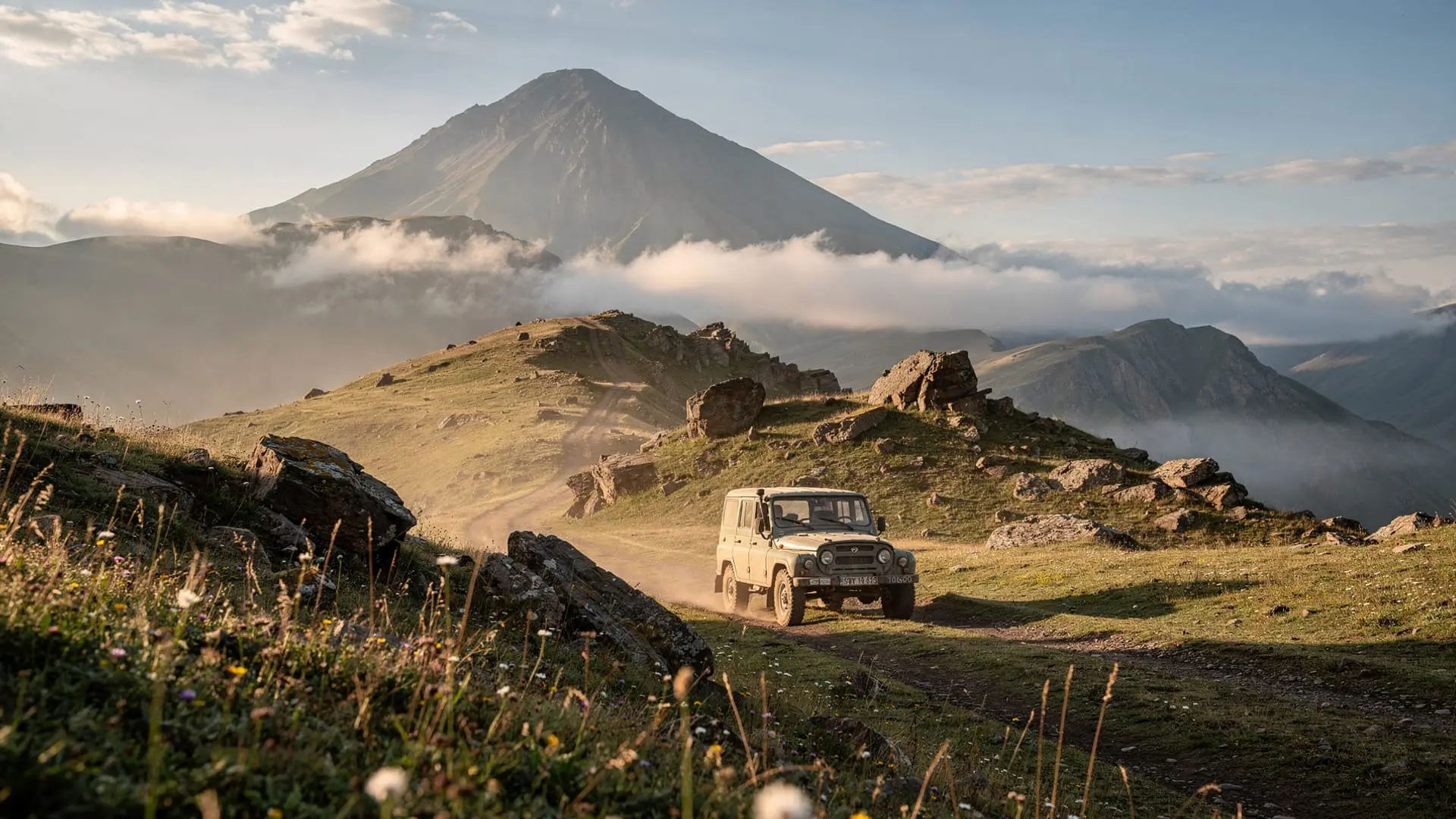
The mountain above the end of Armenia
Kapan is the main city of southern Syunik province, 330 km from Yerevan and about as far south as a regular tourist route goes in Armenia. It sits in a narrow river valley hemmed in by steep ridges, with the Zangezur range rising behind it toward the Iranian border. Above the city, Mount Khustup reaches 3,206 metres — a ridge summit that towers 2,400 metres above the valley floor below.
For hikers, Khustup is a full-day trek requiring significant fitness and proper mountain gear. For off-road enthusiasts, it is something else: a 4WD route that climbs through forest, past old copper-mining ruins, and up to the alpine zone above Kapan — a route that is physically demanding for both vehicle and driver and rewards sunrise arrivals with one of the most spectacular panoramas in southern Armenia.
The Khustup off-road experience is not yet overrun with tourists. Kapan itself is a genuine working city, not a tourist town, and the infrastructure around Khustup is minimal. That is part of the appeal. If you want dramatic mountain scenery without the crowds and the tourist amenity that surrounds Aragats or even Tatev, Khustup is the answer.
| Where | Kapan, southern Syunik province, about 330km (4.5–5h) south of Yerevan |
| Cost | Around 15,000–25,000 AMD (roughly $40–65) per person for a guided sunrise tour |
| Time needed | 3–4 hours 4WD from Kapan, plus 2–3 hours if hiking the summit |
| Getting there | Self-drive from Yerevan, marshrutka to Kapan, or fly to Kapan airport when operating |
| Best time | June–September; depart Kapan around 3–3:30am for a sunrise arrival |
The route: what to expect
Starting point: Kapan city (330 km from Yerevan, 4WD tracks begin at the edge of the urban area) Summit elevation: 3,206 m Driveable section: Up to approximately 2,400–2,600 m via the best 4WD track; the final push to the summit requires hiking Total ascent by 4WD: About 1,600–1,800 metres vertical Route duration: 3–4 hours from Kapan to the upper parking area; add 2–3 hours for a summit hike Best time for sunrise: Depart Kapan around 3:00–3:30 AM for a sunrise arrival at 2,400 m
The track from Kapan climbs through the urban fringe of the city, then enters forest. The forest section is technical — deeply rutted from seasonal logging vehicles, with stream crossings that can be serious obstacles after rain. This section eliminates standard cars and tests AWD vehicles without proper ground clearance.
Above the forest, the track opens onto a series of alpine meadows and old mining spoil heaps — copper was mined on these slopes during the Soviet era, and rusted equipment and faded warning signs give the landscape an eerie, post-industrial character. The mining ruins have their own strange beauty in the early morning light.
The upper track ends at a natural shelf around 2,400–2,600 m (exact endpoint depends on conditions). From here, Khustup’s broad ridge summit is a 2–3 hour hike. The ridge offers panoramic views in all directions: south toward Iran, west toward Tatev and the Vorotan gorge, north along the Zangezur range, and east over the lowlands toward the Azerbaijani border. On exceptionally clear mornings, the volcanic peak of Aragats (4,090 m) is visible 230 km to the north.
Book a guided sunrise off-roading tour to Mount Khustup from KapanSunrise timing and why it matters
The “sunrise off-roading” format is the standard Khustup experience for good reasons. The track is cooler and the rocky surface more grippy in the pre-dawn hours. The air is clear before any heat haze builds. And the moment the sun breaks over the Zangezur ridge from the Iranian side and the entire Kapan valley floods with light below you is genuinely affecting — the kind of experience that makes the 3:00 AM alarm feel entirely worthwhile.
Pre-dawn is also when wildlife activity peaks on the Khustup slopes. The brown bear population in Syunik province is substantial, and while encounters are very rare, the early morning hours are when animals are most active. Bezoar ibex are occasionally visible on the rocky outcrops above the treeline.
Getting to Kapan
Kapan is the most remote major destination in this guide in terms of distance from Yerevan. The route options:
By car: Yerevan to Kapan via the M2 highway is approximately 330 km, 4.5–5 hours. The road through Syunik province — past Goris and down through the Zangezur gorges — is one of the most beautiful drives in Armenia. Consider stopping at Tatev Monastery and Khndzoresk on the way.
By marshrutka: Daily marshrutkas connect Yerevan (Kilikia station) with Kapan, approximately 5–6 hours, around 3,000–4,000 AMD. The journey is long but the scenery makes up for it.
As part of a southern loop: Most visitors who do Khustup incorporate it into a 2–3 day south Armenia loop that includes Tatev, Goris, Khndzoresk, and Karahunj. The Armenia comprehensive 10-day itinerary includes this southern loop.
Guided tours vs self-drive
Self-drive: Feasible only with a proper 4WD and strong off-road driving experience. Navigation on the upper tracks requires local knowledge — the track splits multiple times and the correct route is not obvious. First-time self-drivers almost always take a wrong line and either get stuck or miss the summit approach entirely.
Guided tour: The standard approach. A local driver-guide from Kapan will pick you up in the early hours, drive the technical sections, and guide the optional summit hike. The guides (typically freelance locals who have done the route hundreds of times) know exactly where the track deteriorates, where the wildlife sightings happen, and where to stop for the best views. The experience is significantly better with a guide than without.
Cost: A guided sunrise tour typically costs 15,000–25,000 AMD per person (35–60 EUR) depending on group size and whether the summit hike is included.
What to bring
- Warm clothing: even in summer, 2,600 m pre-dawn is cold — bring a down jacket or equivalent
- Headlamp with spare batteries
- Water: minimum 2 litres per person (no water sources above the forest)
- Snacks: the guide often brings food but bring your own as backup
- Sturdy hiking boots if doing the summit section (not just the 4WD ride)
- Camera with low-light capability — the pre-dawn and dawn light are extraordinary
Combining Khustup with other Syunik highlights
Kapan and Khustup work best as part of a wider southern Armenia exploration:
Tatev Monastery and Wings of Tatev: 80 km northwest of Kapan, the most visited site in southern Armenia. A full day — see the Tatev complete guide.
Khndzoresk cave village and swinging bridge: 60 km northwest of Kapan, near Goris. The medieval cave dwellings carved into the canyon walls and the modern suspension bridge are extraordinary.
Karahunj (Zorats Karer): The “Armenian Stonehenge” near Sisian, 60 km north of Kapan. A Bronze Age stone circle that pre-dates Stonehenge, set on an open highland plain.
Shaki waterfall: Near the village of Shaki, 30 km north of Kapan. A 18-metre waterfall dropping into a narrow gorge — often combined with Tatev and Khndzoresk.
Frequently asked questions about Khustup off-roading
Can I do Khustup in a standard rental car?
No. Standard rental cars (Renault Logan, Toyota Corolla, similar) are not suitable. The track will damage the vehicle and you will almost certainly need to be towed. Several Kapan-based operators rent 4WD vehicles locally if you want to self-drive.
Is Khustup accessible in winter?
The lower forest section of the track can be attempted in winter with proper 4WD and snow chains, but the upper alpine section is typically buried under several metres of snow from November through May. Winter Khustup is a specialist mountaineering objective, not a tourist off-road experience.
Is there accommodation in Kapan?
Yes, though limited. Mirhav Hotel is the standout accommodation in Kapan — a converted mansion with genuine character, good food, and helpful staff who can arrange Khustup guides (~60–80 EUR per night). Several guesthouses offer budget options (~20–30 EUR). Book in advance for summer.
How fit do I need to be for the summit hike?
The optional summit hike from the 4WD endpoint is a 2–3 hour climb on open rocky terrain with significant altitude gain. It requires reasonable fitness and mountain hiking experience. The views from the upper track endpoint (without doing the summit) are excellent and require only a short walk from the vehicle.
What is the Kapan copper mining connection?
Kapan has been a copper-mining city since the Soviet era — the Zangezur Copper-Molybdenum Combine (ZCMC) still operates mines in the area. The Soviet-era mining infrastructure visible on Khustup’s slopes was part of this industrial complex. The environmental legacy of decades of open-pit copper mining in the area is a local issue — visible in the red-tinged riverbanks of the Voghji River as it passes through Kapan.
How does Khustup compare to hiking Mount Aragats?
Khustup is more remote, less developed, and less crowded than Aragats — there is no paved road to a lake trailhead, no café, and far fewer other hikers. The trade-off is logistics: Aragats is reachable as an easy day trip from Yerevan, while Khustup requires either a long drive south or an overnight in Kapan. Hikers who have already done Aragats and want a wilder, more solitary mountain experience often name Khustup as the natural next step.
Do I need to book the sunrise tour in advance?
Yes, ideally a day or two ahead, especially in July and August. The pool of local driver-guides in Kapan who know the technical upper track well is small, and a 3am departure is not something operators can staff on very short notice. Contacting your Kapan accommodation in advance to arrange a guide is the most reliable approach if not booking a fixed tour.
The Kapan context: Armenia’s forgotten south
Kapan deserves more tourist attention than it currently receives. It is Armenia’s fourth-largest city, with a population of about 45,000, but it receives a fraction of the tourist traffic of Goris or Tatev. This is partly the function of distance — 330 km from Yerevan is genuinely far — and partly the lack of a single “must-see” landmark comparable to the Wings of Tatev cable car.
What Kapan offers instead is a combination: a working industrial city that has not been smoothed for tourism consumption, extraordinary mountain access, and the sense of being at the geographical and cultural edge of Armenia — close to the Iranian border, within sight of what used to be contested territory, in a landscape that has been shaped by both natural forces and industrial ambition.
The city centre has an interesting 1950s Soviet neo-classical core, with a theatre, a town hall, and residential blocks built when Kapan was the showcase of Soviet industrial Armenia. The contrast between this civic architecture and the mountains directly above is striking.
Mirhav Hotel: For visitors overnighting in Kapan, Mirhav Hotel is the standout option — a renovated historic building with genuine character, decent food, and staff who can arrange Khustup guides and other local excursions.
Wildlife on the Khustup slopes
The Zangezur mountains of Syunik have some of the most significant wildlife populations in Armenia, and the Khustup massif specifically is an important habitat:
Bezoar ibex (Capra aegagrus): Wild goat native to the Caucasus and Near East. Populations in the Zangezur range are substantial — early morning above the treeline frequently produces ibex sightings on rocky outcrops. They are most visible at dawn when moving from nocturnal shelter to grazing areas.
Brown bear (Ursus arctos): Present in the Syunik forests. The pre-dawn Khustup approach is genuinely the time and place where encounters are most possible. Bears in this region are generally not aggressive and will avoid humans, but making noise while moving through the forest at night is sensible precaution.
Lammergeier/bearded vulture (Gypaetus barbatus): One of the rarest raptors in Europe, with small populations in the Caucasus. The high ridges above Kapan are within the species’ range. Watching one drop a bone from altitude to crack it on the rocks below — its unique feeding strategy — is an extraordinary wildlife encounter.
Caucasian leopard (Panthera pardus ciscaucasica): Critically endangered, with confirmed presence in Syunik province documented by camera trap. Encounters are essentially impossible for tourists — these animals are extremely elusive and populations number in the tens at most. But knowing they exist adds a wild dimension to the landscape.
After Khustup: the southern Armenia loop
A natural extension of the Kapan visit connects the city into a wider southern Armenia circuit that shows the depth of the country’s Syunik province:
- Day 1: Drive from Yerevan to Goris via Tatev (Wings of Tatev cable car, monastery) — stay overnight in Goris
- Day 2: Khndzoresk cave village and swinging bridge in the morning, drive south to Kapan — stay overnight at Mirhav Hotel
- Day 3: Pre-dawn departure for Khustup sunrise off-roading, return to Kapan, drive north via Shaki waterfall and Tatev
- Day 4: Return to Yerevan via Noravank or direct (280 km, 4 hours)
This 4-day loop is one of the most rewarding ways to experience the depth of the country beyond the standard Yerevan day-trip circuit.
Is it worth the distance?
The honest answer depends on how much time you have. Kapan is genuinely far — a 4.5–5 hour drive each way from Yerevan — and Khustup off-roading alone does not justify that distance as an isolated day trip. It makes far more sense as the southern anchor of a multi-day Syunik loop that also takes in Tatev, Khndzoresk and Karahunj, spreading the long drive south across sights that are worthwhile in their own right. Visitors with only 5–7 days in Armenia and no particular pull toward remote landscapes or off-roading are usually better served spending that time on the denser, closer circuit around Yerevan, Sevan and Dilijan. Visitors with 8+ days, or anyone specifically drawn to wildlife, remote mountains, or getting off the well-trodden tourist track, will find Khustup one of the most memorable single mornings of an Armenia trip.