The Areni wine festival 2021: dispatch from the harvest
The drive down on a Saturday morning
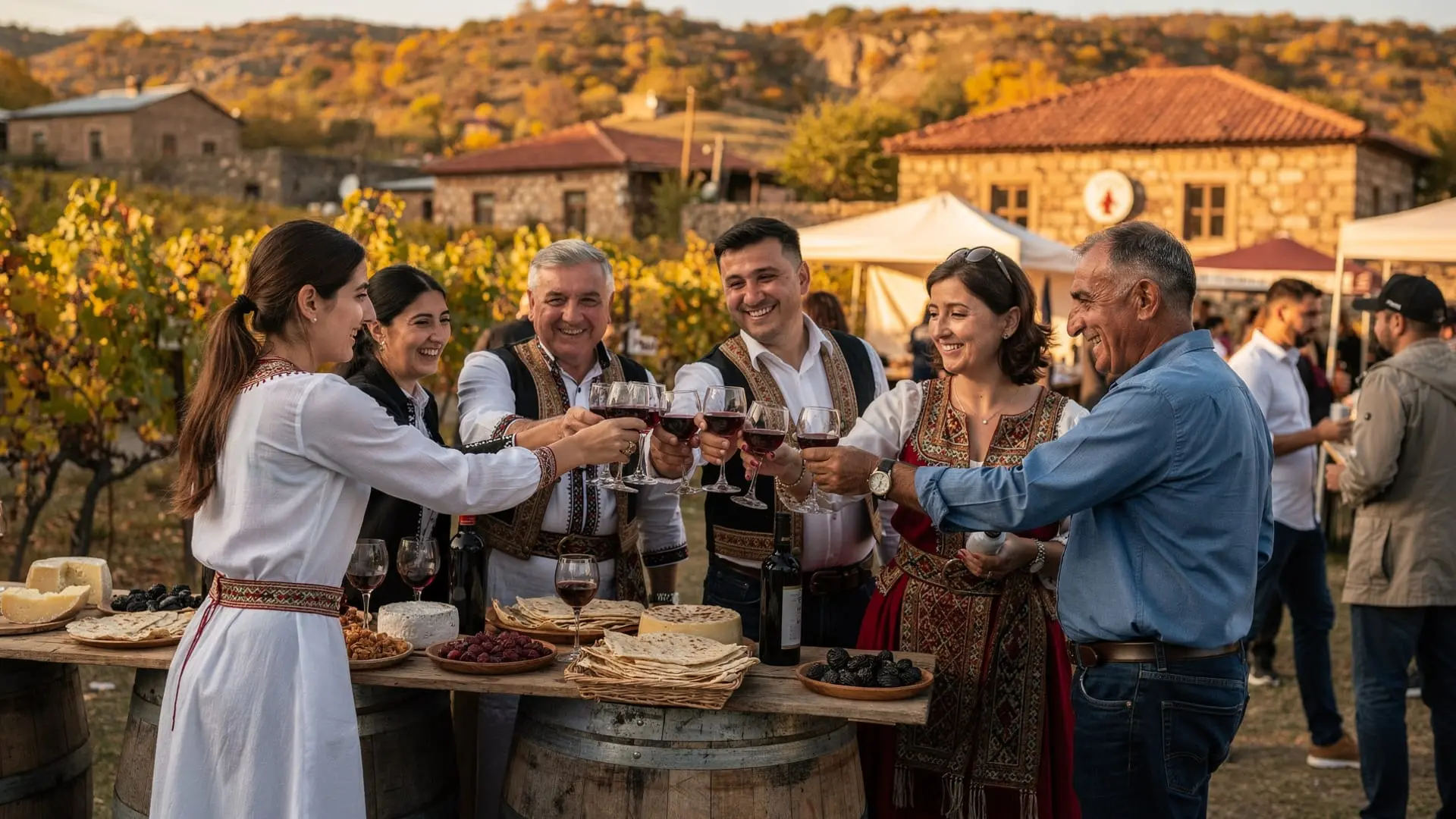
The Areni Wine Festival happens in early October, during the harvest, in and around Areni village at the entrance to the Amaghu gorge in Vayots Dzor province. I had been to Areni once before, briefly, in passing. This time I drove down from Yerevan specifically for the festival, leaving at 8 a.m. to get there before the first tours arrived.
| Where | Areni village, Vayots Dzor (2hrs south of Yerevan) |
| When | Early October, one weekend during the harvest |
| Cost | Entry is free; tastings and food are pay-as-you-go, from around 500 AMD |
| Highlights | Grape stomping, Hin Areni and Trinity Canyon tastings, lavash baking, duduk at dusk |
| Combine with | The Areni-1 cave, the world’s oldest known winery, ten minutes away |
The M2 highway south runs straight through the Ararat valley, and the drive to Areni takes about two hours in normal conditions. In October, the vines along the road are in full colour — yellow and red, the leaves loosened but not yet fallen, the bunches mostly harvested but a few clusters still hanging. The Ararat valley in October is the warm side of autumn: still 20-25°C during the day, the sky that particular blue that comes with the dry season.
I parked near the village and walked toward the festival ground, following the sound of amplified duduk. The duduk is the instrument Armenia uses for important occasions — the double-reed woodwind carved from apricot wood whose tone is low and reedy and unlike anything in the Western orchestral tradition. At a distance, through village streets, it sounds like the landscape itself producing music.
The grape stomping
The festival’s main attraction for tourists is the grape stomping. Large wooden troughs are filled with Areni Noir grapes — the indigenous variety that has grown in this valley for over 6,000 years, since the Areni-1 cave winery was operating — and visitors are invited to remove their shoes and do what has been done here since before anyone thought to record it.
I stomped grapes for about twenty minutes. The sensation is specific: the grapes are slightly cold at the bottom of the pile, warming as you go. They burst differently depending on the variety and the ripeness — some with a pop, others with a slow give. The juice is dark purple and stains everything. My feet were still faintly purple the next morning.
The woman managing the trough — a farmer from a village above Areni named Narine, in her sixties, in a traditional apron — watched the various tourists doing this with the expression of someone observing a thing they have watched hundreds of times. She was not dismissive; she was simply measured. When I stepped out and moved to the side, she said something in Armenian and a younger woman with her translated: “She says you were doing it right. Most people just jump.”
I took this as a compliment.
Hin Areni: the winery that made me take Armenian wine seriously
The festival has various producer stands set up on the village green and in the surrounding area. I made a point of getting to the Hin Areni table early, before the queue developed.
Hin Areni is one of the most respected names in Armenian wine, a producer that has been working with indigenous varieties — Areni Noir, Kangun, Voskehat — using minimal-intervention methods that have attracted attention from natural wine enthusiasts internationally. Their vineyard parcels are in the hills above the village, at elevations between 1,100 and 1,400 metres, on the volcanic soils that give Areni Noir its particular character. The full Hin Areni winery tour is worth booking separately from the festival if you want an unhurried, guided visit rather than a festival-day crowd.
The young winemaker who was pouring that day — I think his name was Artur, though I’m not certain — gave me a brief and unsolicited explanation of why the 2021 vintage was going to be interesting: a dry spring followed by a cooler-than-usual summer had concentrated the flavours without losing the freshness. He handed me a glass of the still-fermenting new juice alongside a glass of the 2019 aged wine, and the comparison was instructive. The 2019 was dark, structured, with dried cherry and a slight herbal note. The new must was fresh, almost violet, with tannins just beginning to develop.
I bought three bottles of the 2019 for about 12,000 AMD each and carried them back to my car at the end of the day with the care you give things that have made a specific impression.
Trinity Canyon Vineyards
Trinity Canyon Vineyards is the other major name in the Areni area — a larger operation with a more formal visitor facility and wines that reach a different market (export to Europe and the United States). Their festival presence was substantial: a well-organised tasting table with a full range of whites and reds, a proper wine educator doing structured tastings, and queue management.
I did the Trinity Canyon tasting on my second circuit of the festival. Their Areni Noir reserve is a different style from Hin Areni — more extracted, more obviously structured for international palates, with more new oak than the Hin Areni approach. This is not a criticism; it’s a different philosophy, aimed at a different export market. The wine is good. Their Voskehat white — from the indigenous white variety that produces crisp, mineral-driven wines from these high-altitude soils — was the surprise of my tasting: more character than most Armenian whites I’d had.
I had a long conversation with a French-speaking wine buyer from Lyon who was at the Trinity Canyon stand, tasting seriously and taking notes. She told me she’d been coming to Armenian wine festivals for three years and that the trajectory was striking — the quality had improved substantially and the variety of styles was broadening. “They’re figuring out what they have,” she said. “That’s the interesting moment.”
The brandy producers at the festival
The wine festival includes not just wine but the full range of Armenian fermented and distilled products. Several small brandy producers — cognac in Armenia is a complicated terminology issue, since true Cognac is geographically protected to the Cognac region of France, but Armenian brandy has been called “cognac” since the 19th century — had tables at the festival, offering tastings of their grape-based distillates at ages from three years to fifteen.
Armenian brandy at its best is one of the understated pleasures of the country. The best-known is the Yerevan Brandy Company’s Ararat range, but the small-producer category has grown significantly in recent years. At the festival, I tasted a 10-year brandy from a Vayots Dzor family producer whose name I didn’t catch but whose product had the specific dried-apricot, vanilla, and slight tobacco notes that good Armenian brandy at this age level develops. The price was about 15,000 AMD per bottle — significantly less than the commercial equivalent.
There was also mulberry vodka (oghi), which is the everyday spirit of the Armenian countryside: home-distilled, typically very strong, served in small glasses as an opener to every meal. Several vendors at the festival had oghi alongside the wine, and the taste was exactly what homemade grape-mulberry spirits taste like: raw, powerful, and somehow specific to the place.
Lavash and the outdoor kitchen
On the edge of the festival ground, several women were demonstrating traditional lavash baking on a tonir — the clay underground oven that is central to Armenian bread culture. Lavash is on UNESCO’s Intangible Cultural Heritage list, and the baking process — rolling the dough paper-thin, then slapping it onto the curved wall of the tonir interior, peeling it off seconds later — is one of those practical skills that becomes beautiful when performed by someone who has done it thousands of times.
I watched for a long time. The women worked in pairs: one rolling, one baking, neither looking at what the other was doing, the coordination completely natural. The finished lavash was handed to visitors on the spot — still warm, still slightly soft at the edges. With a piece of white cheese from the nearby vendor and a glass of the Areni Noir, it was a better lunch than most restaurants I have eaten in.
The Areni-1 cave: world record holder
A few kilometres up the road from the festival ground, the Areni-1 cave sits in a hillside above the Arpa River. The cave was excavated from 2007 onward by a joint Armenian-American-Irish team led by Boris Gasparyan, and what they found inside changed the understanding of winemaking’s origins: a complete winery dating to approximately 6,100 years ago, including a fermentation vat, pressed grape skins, seeds, pottery vessels, and a drinking cup. It is the oldest known winery in the world.
The site is open to visitors, and entering the cave — which is a working archaeological site, excavations still ongoing in deeper sections — gives you a specific physical relation to the history of what you’re drinking when you open a bottle of Areni Noir. The grape variety grown in this valley today is a direct descendant of the grape that fermented in this cave six millennia ago. The continuity is unusual enough to be worth standing in front of.
The cave also contains evidence of human habitation predating the winery: tools, animal bones, the remains of a woman (the “Lady of Areni”) in a burial that dates to around 5,000 years ago. The exhibition inside the cave entrance explains the layers in both Armenian and English.
Combining the cave visit with the wine festival is natural — the cave is ten minutes’ drive from the festival ground — and puts the wine you’re tasting in the longest possible historical context. The Areni destination guide covers the cave, the wineries, and the gorge monastery combination.
The duduk as the sun drops
By 5 p.m., the festival crowd had thinned. The tours had left, the professional buyers had moved on, and what remained was a more local atmosphere: Yerevan families, people from the surrounding villages, a few remaining tourists who had decided, like me, to stay past the official programme.
A duduk player had set up on a small stage near the village square. He was playing alone, without accompaniment — the traditional Armenian lament repertoire, pieces that are associated with loss and memory. In the evening light, with the gorge walls reddening behind the village and the harvest smell of grape on the air, the music was affecting in a way that felt almost unfair in its directness. An old man standing near me was weeping, quietly, not making any move to hide it. I didn’t ask him why.
This is what harvest festivals are for, at their core: not the grape-stomping or the wine tasting or the food stalls, but the moment when the year’s work is complete and the light is going and someone plays the music that connects the day to everything before it.
I drove back to Yerevan in the dark, the three bottles of Hin Areni on the back seat.
If you can’t time it for festival weekend
The festival itself is a single early-October weekend and easy to miss if your dates don’t line up. Outside that window, Areni and the wider Vayots Dzor wine route are still very much worth the drive — the wineries pour year-round, the Areni-1 cave is open regardless of season, and October generally (not just festival weekend) is the best month to see the vines in colour and the harvest in progress. If you specifically want the festival atmosphere, check the exact dates ahead of your trip since they shift slightly year to year, and treat the full guide to Armenia’s wine festivals as the reference for planning around it.
Areni winery tour combined with the Tatev cable carFAQ
Is the Areni wine festival worth visiting if I don’t particularly care about wine? Yes. The grape stomping, lavash baking, and live duduk music are the kind of hands-on cultural experience that works even without wine knowledge, and the festival atmosphere — village green, harvest smell, local families — is enjoyable on its own terms. Wine enthusiasts get more out of the producer tastings, but it’s not a wine-snob event.
How do I get to Areni from Yerevan without a rental car? The straightforward option is a guided day tour, which handles transport and usually includes tastings and the Areni-1 cave. Independent travel by marshrutka toward Vayots Dzor is possible but the connections aren’t built around the festival schedule, so most visitors without a car book a tour for festival weekend specifically.