The birthplace of wine, in practice
In 2011, archaeologists excavating the Areni-1 cave complex found a 6,100-year-old winemaking facility — a grape press, fermentation vats, storage jars, and a drinking cup — making it the oldest evidence of wine production anywhere in the world. Armenia’s claim to be the “oldest wine country” is not marketing hyperbole; it’s peer-reviewed archaeology published in the Journal of Archaeological Science.
| Where | Arpa River valley, Vayots Dzor, 125 km south of Yerevan |
| Cost | Cave ~1,500 AMD; winery tastings ~5,000–8,000 AMD |
| Time needed | 1 day (longer if combined with Noravank overnight) |
| Getting there | Car (~1h50 from Yerevan), marshrutka + taxi, or guided tour |
| Best time | Sep–Oct for harvest and the wine festival; Apr–Jun as a cooler alternative |
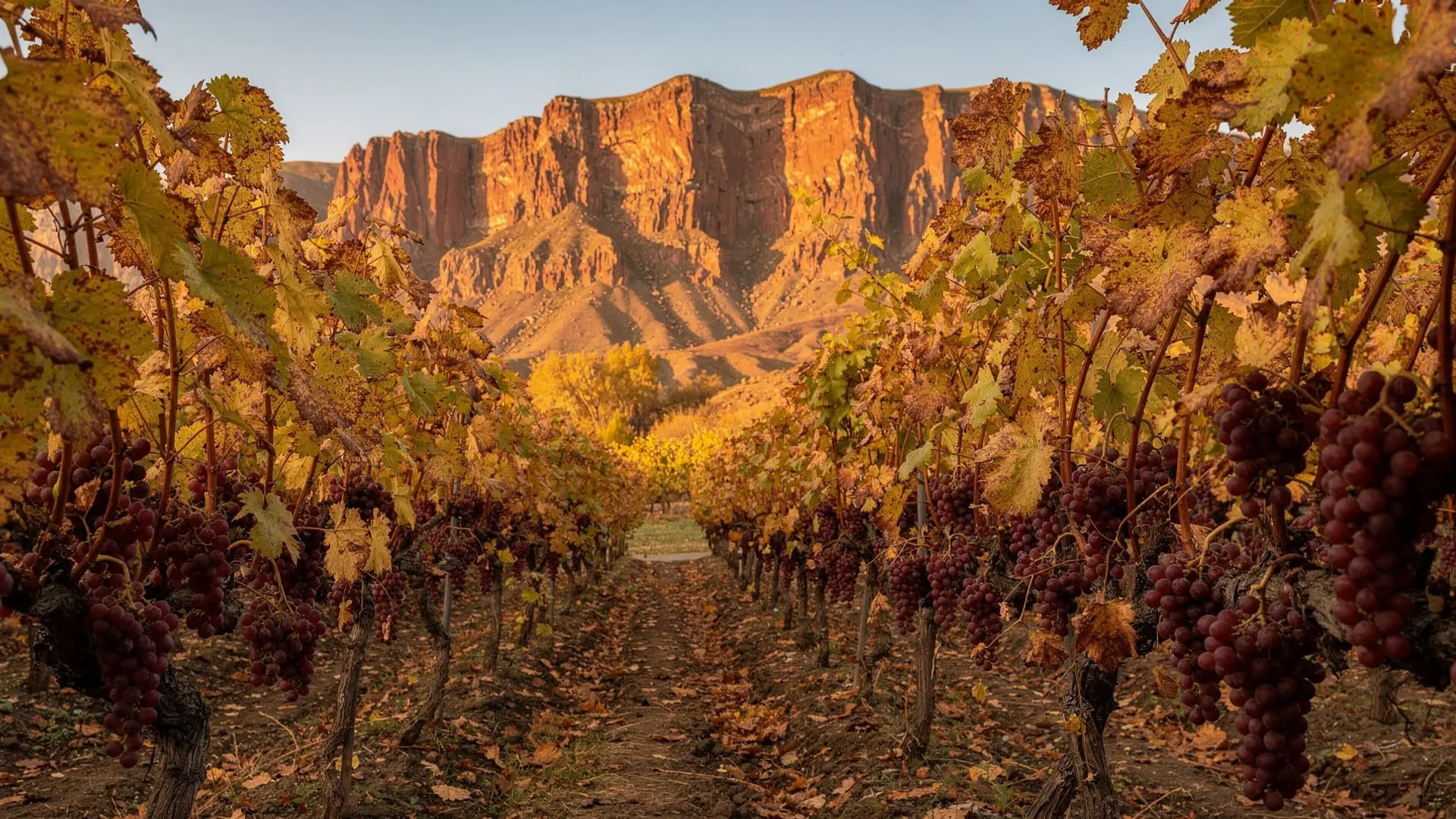
The village of Areni sits in the Arpa River valley in Vayots Dzor province, 125 km south of Yerevan, surrounded by limestone cliffs and canyon walls that turn blood-red in afternoon light. The valley has been producing wine continuously since at least those Chalcolithic vintners. Today, the Areni Noir grape — an ancient variety indigenous to this region — forms the backbone of Armenia’s most celebrated red wines, grown in terraced vineyards at 1,000–1,400 metres altitude.
This is not tourist wine country in the Napa sense: you won’t find tasting room design teams and Instagram-optimised barrel halls. Most wineries here are family operations with a few hundred hectares, a winemaker who also does the pruning, and a tasting that happens in an actual winery rather than a visitor centre. That honesty is part of the appeal.
Getting to Areni from Yerevan
By car: 125 km south via the M2 motorway through Yeghegnadzor. The drive takes 1 hour 45 minutes to 2 hours depending on traffic south of Yerevan. The road through Vayots Dzor is one of Armenia’s most scenic drives — the highway follows the Arpa River canyon.
By marshrutka: daily marshrutkas from Kilikia Station to Yeghegnadzor (1,200–1,500 AMD, about 2 hours). From Yeghegnadzor, local taxis or another marshrutka cover the 25 km to Areni (15–20 min). Return timing from Areni can be tricky — marshrutkas are infrequent in the afternoon. A taxi from Areni back to Yeghegnadzor for onward transport is the safer option.
By guided tour: the Khor Virap–Areni–Noravank circuit is one of the most popular southern Armenia day trips from Yerevan. This makes sense geographically — all three are in the same direction and can be visited comfortably in a day with an early start.
Harvest season note: in September and October, organised wine harvest tours depart from Yerevan specifically for the Areni area. Several tour operators offer a hands-on harvest experience (picking, pressing) at local vineyards, combined with a tasting dinner. Book ahead — these fill up fast.
What to see and do in Areni
Areni-1 cave (Birds Cave)
The cave complex where the 6,100-year-old winery was found is 2 km from Areni village, accessible via a marked road. The cave also yielded other extraordinary finds: the oldest leather shoe in the world (5,500 years old), a cache of Bronze Age women’s clothing, and several human skulls. The interior cave is accessible with a guide (tours organised from the entrance; guides speak basic English and Armenian; Russian guides are more fluent).
The cave system is genuinely impressive beyond its archaeology — enormous chambers, stalactites, and an underground stream. Allow 60–90 minutes.
Admission to the cave complex: approximately 1,500 AMD (~3.65 €).
Hin Areni Winery
One of Armenia’s best-regarded wine producers, Hin Areni (Old Areni) makes biodynamic wines from indigenous Areni Noir and Voskehat grapes. Tours of the winery include the vineyards, the underground fermentation cellar, and a tasting of 4–6 wines. The winemaking team speaks good English.
Tasting fee: approximately 5,000–8,000 AMD per person, deducted from any purchase. Book ahead via their website or through tour operators. Prices are among the lowest for comparable wine quality in the Caucasus region.
Trinity Canyon Vineyards
A newer winery with a striking glass-and-stone tasting room overlooking the canyon. The design is the most “designed” of the Areni area wineries — slightly more tourism-oriented than Hin Areni, but the wines are excellent and the terrace view over the red canyon walls is genuinely dramatic.
Areni Wine Factory (Areni Cooperative)
The village cooperative produces large volumes of Areni Noir and rosé. The quality is solid rather than exceptional, but the prices are the lowest in the region and the direct purchase from the cooperative gives a share back to local grape growers. Open for tastings and direct sales.
Noravank Monastery
20 km south of Areni, the 13th-century Noravank monastery sits in a canyon of impossibly red limestone cliffs. The monastery’s Church of Surb Astvatsatsin has an extraordinarily steep narrow staircase leading to the upper chapel — the architectural peculiarity of the building is part of its fame. Always combine with Areni. See our full guide at /destinations/noravank-monastery/.
Selim Caravanserai
On the road over the Selim pass between Vayots Dzor and Gegharkunik, the 14th-century Selim caravanserai is one of the best-preserved Silk Road way-stations in the Caucasus: a vaulted stone hall where merchants and their animals sheltered. About 35 km from Areni; worth the detour on a two-day Vayots Dzor circuit. Free.
Choosing between the Areni wineries
The three main options differ enough that it’s worth picking deliberately rather than trying to squeeze all three in:
| Winery | Style | Price level | Best for |
|---|---|---|---|
| Hin Areni | Biodynamic, indigenous grapes | Mid ($5,000–8,000 AMD tasting) | Wine-focused visitors wanting quality and story |
| Trinity Canyon Vineyards | Modern, glass-and-stone tasting room | Mid-high | Views over the tasting itself, photogenic stop |
| Areni Wine Factory (Cooperative) | Large-volume, everyday wines | Low | Budget tasting, direct-from-cooperative buying |
Two wineries in one afternoon is realistic; three starts to blur the tastings together. If you have to choose one, Hin Areni gives the fullest picture of what makes Areni Noir distinctive. For the broader picture of the whole region’s grape-growing, the Armenian wine grapes and Areni Noir guide goes deeper on the variety itself, and the Areni-1 cave and oldest winery guide covers the archaeology in more detail than fits here.
What an Areni winery tasting actually involves
Unlike large commercial tasting rooms elsewhere, an Areni tasting is typically a personal, low-key affair. Expect a short walk through the vineyard or cellar with someone directly involved in the winemaking — often the winemaker themselves at the smaller producers — followed by a seated tasting of 4–6 wines with explanation of each. Sessions run 45–75 minutes and are rarely rushed. Bring cash for purchases even where cards are accepted, since smaller producers sometimes have card-reader issues, and expect to be offered local cheese or bread alongside the wine rather than a formal food pairing menu. Groups larger than 8–10 should call ahead, as tasting rooms are small.
Where to stay in Areni
Guesthouse Areni (village centre) — the most-cited option for visitors overnight in the village. Family-run, home-cooked breakfasts, basic but clean rooms. Around 15,000–20,000 AMD per room.
Trinity Canyon Vineyards B&B — some of the winery’s properties include guestrooms above the tasting room. Check availability directly.
Yeghegnadzor (25 km north): the provincial capital has more accommodation choice including Hotel Anahit Yeghegnadzor and several guesthouses. A reasonable base for a multi-day Vayots Dzor circuit.
For luxury, it’s worth noting there is no top-tier accommodation in Areni as of 2026 — the nearest comfortable options are 2+ hours from Yerevan or further south in Goris.
Where to eat in Areni
Hin Areni winery restaurant — lunch is available with reservation, featuring seasonal dishes paired with their wines. The freshest ingredients come from the winery’s own garden and local producers.
Areni Wine Festival weekend (first Saturday/Sunday of October): the entire village becomes a tasting ground, with wineries open and local food vendors everywhere. This is the best single event to time a Vayots Dzor visit.
Local roadside restaurants in Areni village: basic but genuine — grilled meats, local bread, cheese, wine by the bottle from the cooperative. Under 4,000 AMD per person.
Tours and tickets
Areni is best visited as part of a structured southern Armenia day trip.
For combining Areni with Khor Virap and Noravank: Khor Virap, Areni winery, and Noravank tour — the essential southern Armenia one-day circuit.
For a cave-specific visit (Areni-1): entry ticket to Magellan cave near Areni — a short adventure into the cave system near the main archaeological site.
Our wine country overview guide: /guides/armenia-wine-country-overview/.
Group Tour: Hin Areni Wine factory, Shaki waterfall, TatevBest time to visit Areni
September–October: the best period by a significant margin. Harvest season runs late September to mid-October — many wineries offer harvest participation and the Areni Wine Festival falls on the first weekend of October. The canyon walls turn golden in the autumn light and temperatures are perfect (18–24°C).
April–June: excellent second choice. Wildflowers cover the canyon walls, the vine leaves emerge bright green, and tourist crowds are lighter than autumn.
July–August: hot and dry in the canyon (30–35°C+). The red cliffs at Noravank are at their most dramatic under summer sun but the midday heat is oppressive. Visit early morning.
November–March: quiet, some wineries reduce visitor hours. The canyon can be beautiful under light snow. The Areni-1 cave is accessible year-round.
Practical tips
- Wine purchasing: local cooperative and winery prices are significantly lower than Yerevan wine shops. Bring capacity (bubble-wrap bottles in clothing for the drive back).
- The festival: the Areni Wine Festival (first weekend October) draws large crowds — accommodation in the area books out weeks ahead. Plan early.
- Combine with Noravank: Noravank is 20 km south and always worth combining. See /destinations/noravank-monastery/.
- Currency: cash-only at most village restaurants and the cooperative. Card accepted at Hin Areni and Trinity Canyon.
- From Tatev: if you’re doing a southern Armenia loop, Areni + Noravank make a logical stop on the way to or from Tatev (Tatev is another 125 km further south through Yeghegnadzor and Goris).
- Vayots Dzor overview: for context on the wider province beyond Areni itself, see the Vayots Dzor region guide.
- Wine route planning: if Areni is one stop on a longer wine-focused trip, the Vayots Dzor wine route guide lays out a fuller multi-winery itinerary.
Frequently asked questions about Areni
Where is the world’s oldest winery?
The Areni-1 cave complex, 2 km from Areni village, yielded a 6,100-year-old winemaking facility excavated in 2011 — grape press, fermentation vats, and storage jars. This is the earliest direct evidence of wine production discovered anywhere.
What is Areni Noir wine like?
Areni Noir is an ancient indigenous variety producing red wines with medium body, pronounced acidity, dark fruit flavours (blackcurrant, dried cherry), earthy minerality, and distinctive floral notes. At its best, it recalls Pinot Noir in structural elegance rather than Malbec or Syrah in richness. Altitude-grown examples from 1,200–1,400 metres can be exceptional.
When is the Areni Wine Festival?
The festival is held on the first Saturday and Sunday of October each year in Areni village. Wineries from across Armenia open their doors, local food vendors set up, and grape harvest activities run throughout the weekend. It is the signature wine event in the Armenian calendar.
Can I visit Areni without a car?
Yes, but logistics are more complex. Marshrutka to Yeghegnadzor, then local taxi. Or book a guided tour from Yerevan that provides transport. Independent transport is significantly easier.
Is the Areni-1 cave worth visiting?
Yes, for the combination of extraordinary archaeology and impressive cave geology. The cave guide will explain the finds in context. Allow 60–90 minutes. If your primary interest is wine rather than archaeology, prioritise the wineries.
Do I need to book winery tastings in advance?
For Hin Areni and Trinity Canyon, booking ahead (a day or two, longer during the September–October harvest) is strongly recommended — both are working wineries, not walk-in tasting bars, and staff availability is limited. The Areni Cooperative is more casual and generally accepts walk-ins.
How does Areni compare to wine regions elsewhere in Armenia?
Areni is the historic and symbolic centre of Armenian wine, but it isn’t the only wine-producing area — the Ararat plain around Yerevan and the lowlands near Ashtarak (Voskevaz winery) also produce well-regarded wine, generally at lower altitude with a different, softer style. Areni’s high-altitude terraced vineyards (1,000–1,400 m) and indigenous Areni Noir grape give it a distinct identity that the flatter growing regions don’t share, which is why most focused wine trips still centre on Vayots Dzor. If you’re building a longer trip around Armenian wine specifically rather than treating Areni as a single stop, it’s worth allocating at least one overnight in the region — a rushed same-day round trip from Yerevan leaves little room for more than one tasting and the cave.
Areni in depth: the archaeology of wine, the Areni Noir grape, and the Vayots Dzor landscape
The Areni-1 discovery: what was actually found
The 2011 report in the Journal of Archaeological Science (led by Boris Gasparyan and Ron Pinhasi) describes the finds in technical detail. The winemaking installation dates to the Chalcolithic period, approximately 6,100 years ago (4100–3900 BC). The key finds:
A grape press made from a shallow clay basin, deliberately sloped to channel grape juice toward a vat. Two clay fermentation vats, each about 55 litres capacity, with dried grape residues still adhering to the interior walls (these residues were subject to chemical analysis confirming malvidin, a pigment specific to red grapes). A drinking cup and two pottery cups nearby. Grape seeds identified as Vitis vinifera (domestic grape, not wild).
This is the complete winemaking chain in one assemblage: press, ferment, store, drink. The chemical evidence for malvidin indicates red wine production specifically — not merely grape juice or other processing. The radiocarbon dates are robust (multiple dates, consistent results).
The cave also contained the world’s oldest leather shoe (5,500 years old, a different stratigraphic layer) and a cache of 3,000-year-old women’s skirts and grass shoes. The overlapping occupations demonstrate 6,000+ years of human use of this cave system.
The Areni Noir grape grown in Vayots Dzor today is genetically related to the ancient grape varieties of this region — not necessarily a direct descendant of the Chalcolithic wine grapes, but from the same regional genetic pool that has been cultivated here for millennia. Armenia’s claim to be the original wine country is based on this continuity of place and plant genetics.
The Areni Noir grape in detail
Areni Noir (Areni khanch in Armenian) is a grape variety with documented cultivation in the Vayots Dzor valley going back at least several centuries. Genetic analysis shows it is closely related to other ancient Caucasian varieties — the region around the Caspian basin is now understood to be one of the primary centres of grape domestication.
The grape produces wines with distinctive characteristics: high natural acidity, moderate tannins, dark fruit flavours (blackcurrant, dried plum, pomegranate), pronounced earthy and floral notes (particularly violet and dried rose at altitude), and a structural elegance that rewards aging.
At low yields on old vines at 1,200–1,400 metres, Areni Noir produces wines of genuine complexity. At high yields on young vines at lower elevation, it produces pleasant, lighter wines suitable for everyday drinking. The best examples come from Hin Areni, Zorah Wines, Yacoubian-Hobbs, and a handful of smaller producers — all of whom work with old-vine material and minimal intervention in the cellar.
The Vayots Dzor landscape
The valley of the Arpa River through Vayots Dzor is one of the most geologically and ecologically interesting in Armenia. The river runs through a sequence of volcanic rock types — alternating with limestone strata — that create the characteristic canyon scenery of Noravank, the Selim pass, and the Areni area. The red and ochre limestone at Noravank, the black basalt gorge walls near Yeghegnadzor, and the lighter tuff near Areni village are all part of this sequence.
The elevation range from the valley floor (around 900 metres near Areni) to the high pastures above the Selim pass (2,500+ metres) creates an extraordinary altitudinal diversity: vine country at the bottom, oak and beech forest in the middle zones, alpine meadows above. The Vayots Dzor ibex (bezoar goat) population is one of the larger surviving wild goat populations in Armenia; the mountainsides above the vine zone are their habitat.
Planning a two-day Vayots Dzor circuit
Day 1 (from Yerevan): Drive south via M2. Stop at Khor Virap (50 min from Yerevan) for the Ararat view and Gregory’s pit. Continue south to Areni (1h50 from Yerevan). Afternoon: Areni-1 cave and winery tasting at Hin Areni. Drive to Noravank (20 min from Areni) for sunset light in the canyon. Overnight at guesthouse in Areni or Yeghegnadzor.
Day 2: Morning at Noravank before tour groups arrive (08:30–10:00 is ideal). Drive southeast to Jermuk (60 km, 1h15): waterfall and mineral water gallery. Option: Selim caravanserai on the pass road. Afternoon return to Yerevan via Sevan (via Vardenis east shore road for a different route, 2h30).
This circuit covers the essential Vayots Dzor highlights without rushing. For a deeper immersion — adding more wineries, the Magellan cave, or the Azhdahak volcano detour — extend to three days. See /itineraries/armenia-wine-route-5-days/.