Gyumri's comeback: how Armenia's 2nd city is becoming cool again
| Where | Shirak province, ~120km / 3hrs from Yerevan by train |
| Time needed | 2 days recommended, 1 day minimum |
| Getting there | Train from Yerevan (scenic, comfortable) or marshrutka |
| Cost | Budget-friendly — noticeably cheaper than Yerevan for food and stays |
| Best time | Spring or early autumn for photography; summer for the Black Fortress evening gatherings |
Starting with the earthquake, because you have to
You cannot write about Gyumri without starting with the 1988 earthquake. This is not wallowing; it is the required context without which nothing else in the city makes sense. On December 7, 1988, a 6.8-magnitude earthquake struck Spitak in northern Armenia, with its effects extending devastatingly to Gyumri — then called Leninakan — and the surrounding region. The city lost between 17,000 and 25,000 people. Entire neighbourhoods collapsed. The infrastructure was destroyed.
What followed was one of the more complicated reconstruction stories in Soviet and post-Soviet history. International aid arrived immediately — this was Gorbachev’s glasnost period, and the Soviet Union accepted foreign help in an unusual departure from Cold War isolation. But the earthquake coincided with the first stirrings of independence movements in the Caucasus, the beginning of the Karabakh conflict, and then the collapse of the Soviet Union itself. Armenia became independent in 1991, the economy contracted severely, and the reconstruction of Gyumri proceeded slowly, inconsistently, and on terms that left much unfinished.
By the mid-1990s, a large portion of Gyumri’s population had emigrated — to Yerevan, to Russia, to the United States. The city shrank. The incomplete reconstruction left pockets of rubble and temporary housing that persisted for decades. In 2010, 22 years after the earthquake, there were still families living in domiks — the small corrugated-metal temporary shelters that were meant to be transitional.
This is the foundation on which the “cool Gyumri” story is built, and anyone telling that story without acknowledging the foundation is doing a disservice to the city.
What’s actually happened
In the past decade, something has been changing. It’s not dramatic — Gyumri has not become a hip destination in the way that some post-industrial cities get marketed — but it is real and it is interesting.
The change is partly demographic. Young Armenians who left the city or whose parents left are returning, or choosing Gyumri as an alternative to Yerevan’s increasingly expensive rents. Artists, designers, and small business owners who might previously have only considered Yerevan are finding that Gyumri offers cheaper space, a distinct architectural character, and a civic culture that is different from the capital in specific ways.
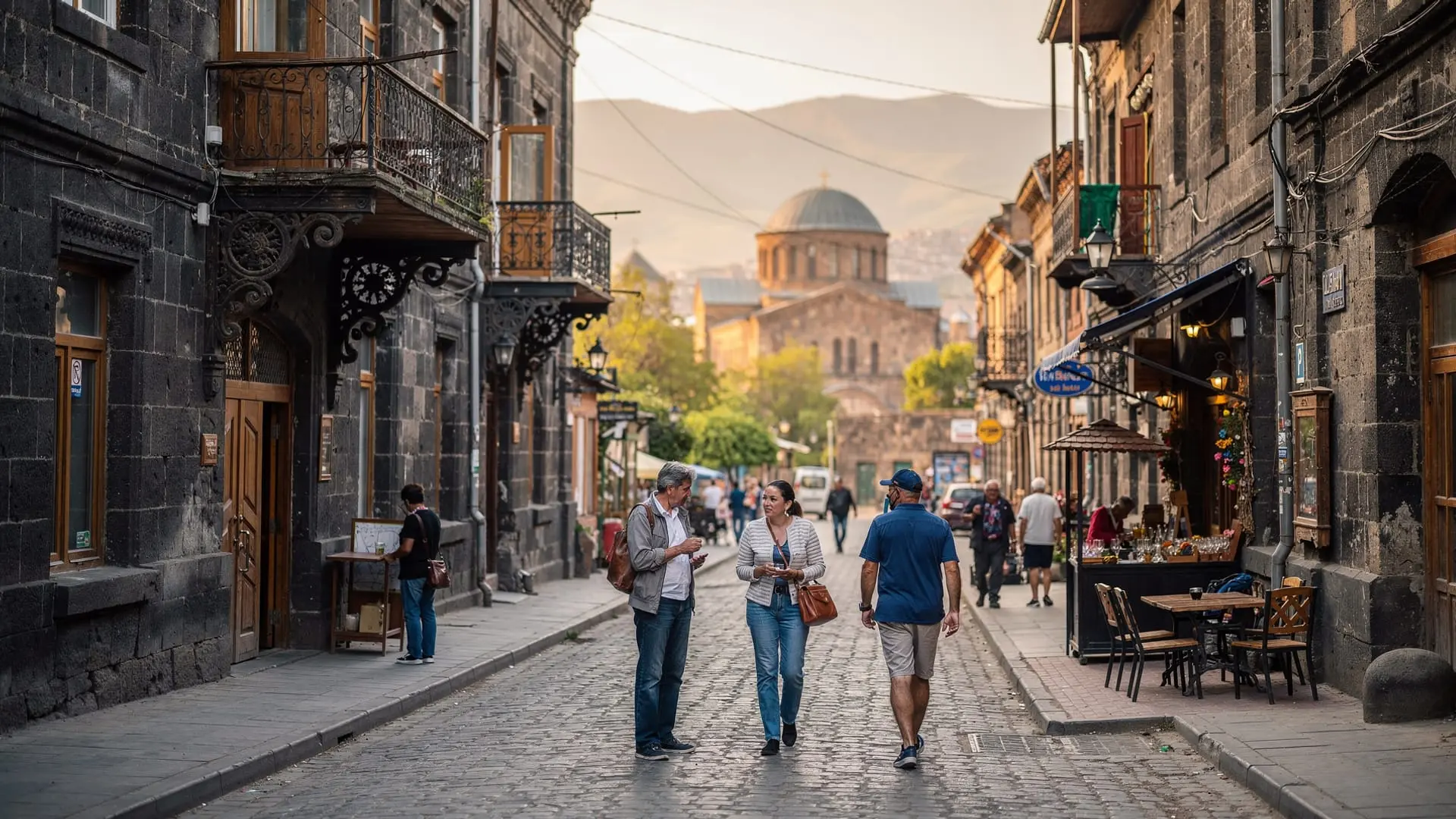
The architectural character deserves mention. Gyumri’s 19th-century core — the merchant-era buildings in black and red tuff, the ornate carved facades, the streets of the historic Kumayri quarter — is distinctive and in places beautiful. The city was, before 1988, the cultural capital of Soviet Armenia: it had theatres, conservatories, a strong tradition of craft and artisanship that expressed itself in the buildings as well as the products. Some of that physical character survived the earthquake. The Kumayri historic district was damaged but not destroyed, and the restoration work in recent years has progressed enough that walking these streets now gives you a sense of what the city was.
The Black Fortress
The one site that functions as shorthand for Gyumri’s identity — the image that appears on every tourism piece about the city — is the Sev Berd, the Black Fortress. The fortress stands on the edge of the Akhuryan River gorge to the north of the city, and it is exactly what its name suggests: a fortress built in black basalt, constructed in the 19th century by the Russian imperial administration as a fortification against Ottoman Turkey, with walls that are still mostly intact.
The setting is theatrical: the dark walls against the sky, the gorge below, the city visible in the distance. The interior is partly ruins and partly open space. On summer evenings, the fortress becomes a gathering point — young Gyumri residents and visitors come here as the sun goes down, and the combination of the dramatic architecture and the gorge views makes it easy to understand why.
I sat on the grass inside the fortress walls on a July evening and watched the light change over the plain. A group of students was playing music nearby — guitar, duduk, someone singing. The contrast between the fortress’s military purpose and its current use as a summer evening hangout is not ironic; it’s just the natural repurposing that happens when a city lives in its own historic fabric.
Cherkezi Dzor and where to eat
Gyumri has food worth going for, though the restaurant scene is not as developed as Yerevan’s. Cherkezi Dzor is the city’s most celebrated restaurant — located in a wooden building in a gorge outside the city centre, specialising in freshwater fish from the Akhuryan River. The main dish is ishkhan-style trout cooked over charcoal. You reach it by a short drive from the city and walk down a path to the gorge-side location. In summer, the terrace above the water is one of the better places to have lunch in Armenia.
The food in the market area of Gyumri — the GUM equivalent, the covered bazaar near the main square — is the other thing worth seeking out: fresh lavash, local cheeses, preserved vegetables, and the specific regional matsun (yoghurt) that has a slightly sharper character than the Yerevan version.
There is also, now, a small cluster of cafés in the historic district that have the quality of genuine cultural spaces: places where local artists and designers actually gather, where the coffee is good, and where the furniture is something other than standardised hotel lobby.
Harichavank and the hills above the city
Nine kilometres north of Gyumri, up a road that climbs through open steppe into the foothills of the Javakheti plateau, sits Harichavank Monastery. The complex dates from the 7th century, with substantial additions in the 13th, and the main church — Surb Astvatsatsin — is one of the architectural landmarks of Shirak province: large, precisely built in the warm tuff of the region, with an impressive gavit (narthex) connected to the main body of the church.
Harichavank is less visited than the canonical day-trip monasteries from Yerevan, which means it retains a quality of unmediated encounter that Geghard and Khor Virap can’t always deliver in summer. On my visit — a weekday morning in July — there were two other visitors and a monk who walked through the outer courtyard without acknowledging any of us, which felt like a form of welcome.
The monastery complex includes several khachkars of the 13th-century period, carved in the workshop style associated with the local school — intricate, geometrically disciplined, the pomegranate and vine motifs repeated in variations that reward prolonged looking. The combination of Harichavank with the Black Fortress in a single morning makes for a coherent half-day that encompasses Gyumri’s full geographical range.
The Dzitoghtsyan museum and what it preserves
The Dzitoghtsyan Museum of Social Life and National Architecture occupies one of the restored 19th-century merchant houses in the Kumayri quarter. Its collection is ethnographic — the domestic material culture of pre-earthquake Gyumri: furniture, textiles, tools, photographs, reconstructed interiors of merchant family houses.
What it preserves is a visual record of what the city was before December 1988. The photographs are particularly striking: streets and buildings that were destroyed in the earthquake, documented from the 1940s through the 1980s by photographers who were simply recording daily life. The museum doesn’t frame this as tragedy, but the knowledge of what came after hangs over every photograph.
The museum staff are knowledgeable and, given adequate advance notice, can provide guided tours in English or Russian. It’s worth the 90 minutes.
The photography question
Gyumri has become, in recent years, a subject of significant photographic attention from both Armenian and international photographers. The Kumayri quarter, with its black-tuff buildings and carved wooden balconies, is visually distinctive enough to attract people specifically for its architectural character. The contrast between the 19th-century merchant-house aesthetics and the more utilitarian Soviet-era blocks that fill the rest of the city creates a visual tension that photographs well.
The result is a form of attention that the city receives ambivalently. The photographers tend to focus on surfaces — the beautiful facades, the peeling paint in the older buildings, the photogenic poverty of certain neighbourhoods. The residents of those neighbourhoods are sometimes less enthusiastic about being picturesque.
I mention this because it’s worth being a self-aware visitor in Gyumri. The city is not a set. The buildings that look beautiful in photographs are also people’s homes, often still marked by the earthquake in ways that are visible in the structure. Walking the Kumayri streets with a camera is a legitimate thing to do — but doing it with attention to what you’re pointing at, and how, seems like the minimum courtesy.
The Black Fortress is the easiest subject, because it is unambiguously a monument rather than a domestic space. The hillside above the Akhuryan River gorge offers the best angles: long light in the evening, the walls dark against the sky, the gorge visible below. The fortress is also, for photographic purposes, at its best in early autumn and late spring, when the grass around it is green and the skies are variable. July, when I visited, was correct in terms of light but the landscape was dry-summer brown, which reduced the visual contrast.
An honest opinion
Gyumri in 2022 is not a place I would describe as fully arrived at whatever its next phase is. The reconstruction is still incomplete in corners of the city. The population is still smaller than it was before 1988. The economic conditions that enabled the pre-earthquake cultural life have not been replaced.
But there is something happening. The young woman who opened a ceramics studio in a restored Kumayri building, the architect who chose to base his practice here rather than Yerevan, the café owner who sources from local farmers and hosts readings on Friday evenings — these are not marketing-speak. They are evidence of a city that is, slowly and on its own terms, finding its way back.
Gyumri is worth more than a day trip from Yerevan, which is the standard itinerary. The 3-hour train from Yerevan is comfortable and scenic through the Ararat valley. Spending two nights here — one for the historic centre and Black Fortress, one for Harichavank Monastery in the hills above the city and a proper lunch at Cherkezi Dzor — gives you access to a version of Armenia that the main tourist circuit doesn’t reach.
For logistics, the Gyumri destination guide has the full detail on getting there, where to stay, and what to see.
Getting there and getting around
The train from Yerevan is the recommended way in: about three hours through the Ararat valley and into the Shirak plateau, more comfortable than the marshrutka and considerably more scenic. The Gyumri by train guide has current schedules and ticket details. Once in the city, the historic core is entirely walkable, but the Black Fortress and Harichavank both require a short taxi ride or a car — Gyumri taxis are inexpensive by any standard, so this isn’t a significant budget concern.
Combining Gyumri with a wider northern loop
Gyumri pairs naturally with a broader look at northern Armenia rather than standing alone. Travellers continuing toward Georgia sometimes route through Shirak and Tavush province on the way, and those with more time can combine a Gyumri stop with Dilijan for a genuinely different, greener side of the country before returning to Yerevan. If your itinerary is Yerevan-centric, the best day trips ranked guide puts Gyumri’s distance and time cost in context against the closer options.
Gyumri private walking tour with a local guideFrequently asked questions
Is Gyumri worth visiting if I only have a few days in Armenia total? If your trip is under a week, Gyumri is a reasonable cut — Garni-Geghard, Khor Virap and Sevan will fill the essential circuit closer to Yerevan. With a week or more, Gyumri earns its place as the best alternative to the standard route, offering a genuinely different architectural and social texture.
Is the city recovered from the 1988 earthquake now? Not fully. Reconstruction has been slow and, in pockets, is still visibly incomplete decades later. The historic Kumayri quarter has been substantially restored, but visitors should understand the earthquake’s aftermath is still part of the city’s fabric, not a closed historical chapter.