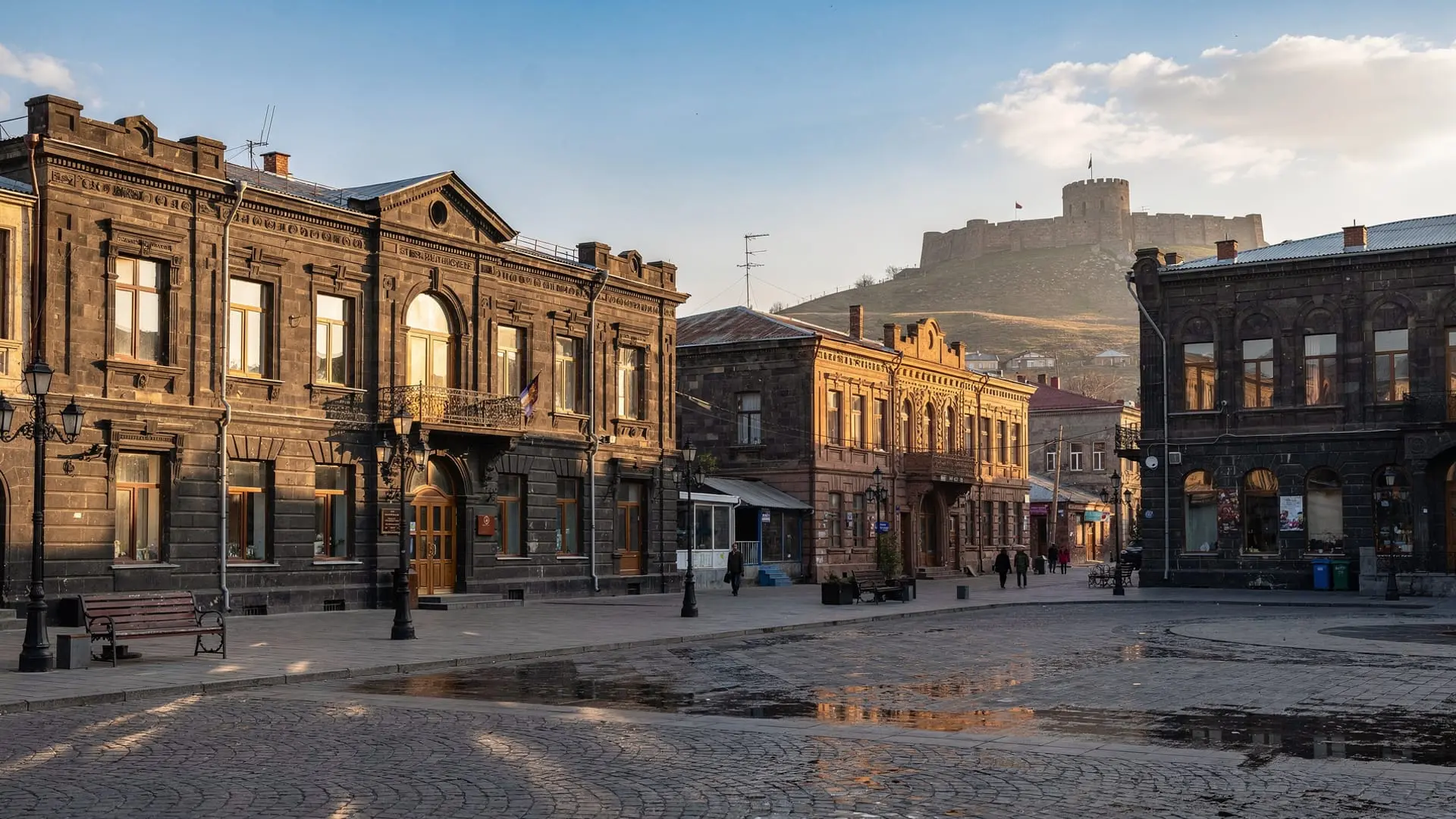
Armenia’s second city — unpolished, honest, worth the trip
Gyumri is not Yerevan. That is its greatest asset. Armenia’s second city (population around 120,000) has been a working urban centre since antiquity, was the cultural capital of the Russian Empire’s Transcaucasian territories in the 19th century, and was devastated by a 6.8-magnitude earthquake in December 1988 that killed an estimated 25,000 people and left more than 500,000 homeless. The scars of that earthquake are still visible in 2026: blocks of half-completed Soviet reconstruction housing, some still inhabited, stand alongside lovingly restored 19th-century stone townhouses.
This duality — surviving elegance and unresolved ruin — gives Gyumri a gravity and authenticity that Yerevan, increasingly polished for tourism, has lost. The old city centre around Vardanantz Square is genuinely beautiful: black and red-brown volcanic stone facades, carved wooden balconies, 19th-century churches, and covered bazaars that feel genuinely local rather than touristic.
| Where | Shirak plateau, 120 km northwest of Yerevan |
| Cost | Museum entries around 1,000–1,500 AMD; a day of food and admissions comfortably under 15,000 AMD |
| Time needed | Full day trip, or 1–2 days with an overnight |
| Getting there | Train (~3h, 700–900 AMD) or car/marshrutka (~2–3h) from Yerevan |
| Best time | May–September; snow-dusted stone architecture is dramatic in winter too |
The arts scene is historically significant — Gyumri produced a disproportionate share of Armenian painters, sculptors, photographers, and musicians. The Dzitoghtsyan Museum of National Architecture and Urban Life is one of the most underrated museums in the Caucasus. And the humour tradition of Gyumri — its residents are known throughout Armenia for dry wit and self-deprecating comedy — is a real cultural phenomenon that you’ll encounter in conversation.
Getting to Gyumri from Yerevan
By car: 120 km northwest on the M1 highway. The drive takes about 2 hours under normal conditions. The road is good quality for most of the route.
By train (recommended): the direct Yerevan–Gyumri train is genuinely one of the most pleasant ways to travel in Armenia. The journey takes about 3 hours, passes through varied landscapes including the Akhurian reservoir, and deposits you at the historic central station. Trains depart from Yerevan Sasuntsi David station; check the South Caucasus Railway schedule for current timetable (roughly 2–3 departures daily each direction). Fares: 700–900 AMD (~1.70–2.20 €) for the train. Bizarrely cheap. See /guides/armenia-train-network-guide/.
By marshrutka: regular marshrutkas from Kilikia Station, Yerevan (around 1,000–1,200 AMD, 2.5–3 hours). Faster than the train but less comfortable.
By guided tour: several operators offer Gyumri day trips from Yerevan, sometimes combined with Harichavank monastery or Marmashen.
What to see and do in Gyumri
Old town (Kumayri historic district)
The historic quarter of Gyumri — called Kumayri, the city’s older name — is centred on Vardanantz Square and the streets around it. The architecture is predominantly 19th-century Russian Imperial style adapted with Armenian volcanic stone: black tuff from quarries near Artik, red-brown from other local sources. The combination of colours is striking and unlike anything elsewhere in the country.
Walk Abovyan Street and the side lanes for the best-preserved facades. Many houses have been sensitively restored since 2010. Others remain earthquake-damaged. The contrast is part of the story.
Dzitoghtsyan Museum of National Architecture and Urban Life
One of the best museums in Armenia, housed in a 19th-century townhouse. The collection covers traditional Gyumri architecture, urban furnishings, textiles, and daily life objects from the 18th to early 20th centuries. Remarkably well-curated and undervisited. Admission: approximately 1,500 AMD. Open Tuesday–Sunday, 10:00–18:00.
Church of the Holy Saviour (Amenaprkich)
The most significant church in Gyumri — a large 19th-century structure that was severely damaged in the 1988 earthquake. The reconstruction is ongoing and partially complete: the exterior is largely restored but the interior is still partially ruined. The juxtaposition of new stone and earthquake-collapsed walls has become an intentional memorial. Worth visiting for its historical weight.
The Black Fortress (Sev Berd)
A 19th-century Russian military fortress on the hill above the city, well-preserved and offering panoramic views over Gyumri and the Shirak plateau. The defensive architecture is substantial — multiple bastions, moat remnants, underground galleries. Free to enter and explore. The walk up takes about 20 minutes from the city centre.
Gyumri Art Museum and the Mergelyan House-Museum
The city’s art collection is strong on 19th and 20th-century Armenian painters. The Mergelyan House-Museum (dedicated to mathematician Sergei Mergelyan, a Gyumri native) is more specialist but interesting for those curious about Soviet science history.
Harichavank monastery
20 km south of Gyumri, the 7th–13th-century Harichavank monastery is a well-preserved complex in open countryside. The main church has fine carved khachkars and the surrounding monastery walls are largely intact. Often combined with a Gyumri day trip. Drive 30 minutes from the city.
Marmashen monastery
14 km north of Gyumri (near the Turkish border), Marmashen is a 10th–11th-century monastery of three churches in a quiet valley of the Akhurian River. Less visited than Harichavank, and all the more atmospheric for it. The valley setting is gentle and rural; bring a picnic.
Where to stay in Gyumri
Berlin Hotel — a well-maintained hotel in the old city area, popular with independent travellers and those interested in architecture. Good location for walking the historic district. Around 25,000–35,000 AMD per room (~60–85 €).
Hotel Vlas — characterful, in a restored 19th-century stone building near Vardanantz Square. The rooms are atmospheric and the owners are knowledgeable about city history. Similar price range.
Artbridge Hostel — the city’s best hostel, popular with backpackers. Clean dorms and private rooms, common area with good travel advice. From 8,000 AMD per bed.
Family guesthouses: several local families in the old city rent rooms. Quality varies but prices are low (12,000–18,000 AMD per room) and the hospitality is genuine.
Where to eat in Gyumri
Karas Wine and Dine — the best restaurant in Gyumri proper: good wine selection, Armenian and Caucasian cuisine, attentive service. Not cheap by local standards but worth it for an evening meal. Mains from 4,000–8,000 AMD.
Calypso restaurant — popular with locals for weekday lunches: generous portions, very reasonable prices, no concessions to tourist tastes. The khorovats here is excellent.
Gyumri market (covered bazaar near centre) — for cheap, fast, authentic food: lavash wraps, grilled meats, fresh produce. A great way to eat as locals do.
Old Yerevan roadside style restaurants near the Black Fortress — a handful of semi-open-air restaurants serve traditional khorovats and Armenian salads with Shirak plateau views. Weekend afternoons fill with Gyumri families.
Day trip or overnight?
Both work, but they suit different travellers. Compare before you book transport:
| Day trip | Overnight | |
|---|---|---|
| Best for | Time-limited itineraries, first-timers | Photographers, GIFF visitors, slower travel |
| Covers | Old town, Dzitoghtsyan museum, Black Fortress | All of the above plus Harichavank, Marmashen, evening atmosphere |
| Pace | Tight but doable, 5–6 hours on the ground | Relaxed, with a proper Gyumri dinner and morning market visit |
| Cost impact | No accommodation cost | +8,000–35,000 AMD depending on hotel or hostel |
If you’re weighing Gyumri against Armenia’s other second-tier towns, see how it stacks up in our 7 vs 10 vs 14 day Armenia itinerary guide, or check the best day trips from Yerevan, ranked.
Shopping and crafts in Gyumri
Gyumri has a genuine craft tradition that’s easy to miss if you stick to the museums. Look for hand-carved wooden items and ceramics sold from small workshops near the old town — prices are honest and haggling is not really expected the way it might be at Yerevan’s Vernissage flea market. The covered bazaar is also the place to pick up dried fruit, honey, and Shirak-region cheeses to take back to Yerevan. If you’re building out a wider Caucasus itinerary, Gyumri’s train connections also make it a natural stop before continuing toward Georgia — see our overland guide to the Yerevan–Tbilisi route and, for the sleeper option, the Caucasus night train guide.
Tours and tickets
For the train-based option: Discover Gyumri by train — city of art and culture , which includes transport on the scenic Yerevan-Gyumri railway.
For a private Gyumri day trip from Yerevan: Yerevan day trip to Gyumri .
See our comparison guide /guides/yerevan-gyumri-day-trip-by-train/ for logistics.
Best time to visit Gyumri
May–September: best weather. Gyumri sits on the Shirak plateau at 1,500 metres and has a continental climate — warmer summers than Yerevan, but winters are harsh (-15°C possible in January–February).
June–August: peak season. The city is active, the outdoor café culture is at its best, and the Black Fortress offers long-day sunset views.
September–October: excellent. Comfortable temperatures, the harvest at Marmashen valley, quieter than summer.
November–April: cold, some guesthouses reduce hours, but the city is very local and the museums are open. The 19th-century stone architecture looks particularly dramatic against snow.
Gyumri for photographers
The combination of black-and-red volcanic stone facades, earthquake-scarred concrete, Soviet-era signage, and genuinely lived-in streets makes Gyumri one of the most photogenic cities in the Caucasus — and one of the least photographed by international visitors, since most itineraries skip it entirely. Golden hour on Abovyan Street picks out the texture of the tuff stone especially well. The covered bazaar rewards a longer lens and patience rather than a rushed pass-through. If your trip coincides with the Gyumri International Photography Festival in October, exhibitions spill into historic buildings and public squares across the city, and it’s worth building a full day around it rather than treating it as a stop on the way to somewhere else.
Getting around once you’re there
Gyumri’s centre is compact and walkable: the old town, Vardanantz Square, the Dzitoghtsyan museum and the covered bazaar are all within 15–20 minutes on foot of each other. The Black Fortress is a further 20-minute uphill walk from the centre — comfortable shoes help. For Harichavank or Marmashen, you’ll need a taxi (agree the fare before departure, typically 3,000–5,000 AMD round trip with waiting time) or a guided tour that bundles transport in. There’s no useful public bus network for visitors; taxis and walking cover everything you need.
Practical tips
- Earthquake memorial context: be sensitive about the 1988 earthquake. It remains a living trauma for many residents. Don’t treat the damaged buildings as urban ruin-porn without acknowledging what they represent.
- Language: Russian is more widely spoken here than in Yerevan. English is limited outside hotels. Armenian phrase book helps.
- Train scheduling: check current timetable before relying on the train. Schedules change seasonally. See Armenia train guide.
- Currency: cash-preferred in most local restaurants. ATMs at ACBA Bank near the main square.
- Combine with: Harichavank monastery (30 min south), Marmashen monastery (30 min north), and the Black Fortress in Gyumri itself for a full day’s content.
Frequently asked questions about Gyumri
What happened to Gyumri in 1988?
On December 7, 1988, a 6.8-magnitude earthquake struck the Shirak region, with Gyumri (then called Leninakan) as the epicentre. Approximately 25,000 people died and over 500,000 were left homeless. The scale of destruction exceeded the Soviet rescue infrastructure’s capacity; the response was widely criticised. Reconstruction has continued for over 35 years but remains incomplete, and some displaced families still live in temporary domiks (metal container housing) in 2026.
Is Gyumri worth visiting on a day trip from Yerevan?
Yes — easily. The old town, Dzitoghtsyan museum, and Black Fortress take 5–6 hours on the ground. With 2 hours of driving each way (or 3 hours by train each way), a day trip works well. An overnight stay gives you the evening atmosphere and time for Harichavank and Marmashen.
How do I get from Yerevan to Gyumri by train?
Trains depart from Yerevan’s Sasuntsi David station (metro: Sasuntsi David). Journey time: approximately 3 hours. Fare: 700–900 AMD (~1.70–2.20 €). Check the South Caucasus Railway timetable for current departures. The train experience itself — old Soviet rolling stock through varied landscape — is part of the attraction.
Can I combine Gyumri with a trip toward Georgia?
Yes. Gyumri sits on a natural route north, and travellers heading overland toward Tbilisi sometimes break the journey here rather than going straight from Yerevan. It adds a half-day but turns a long transfer into two manageable legs. See the Yerevan–Tbilisi overland guide for how the routes connect.
Gyumri in depth: culture, recovery, and what to expect
The 1988 earthquake: understanding the context
December 7, 1988 is a date every Armenian knows. The earthquake struck at 11:41 in the morning, when factories were running and schools were full. Gyumri (then Leninakan) sustained the most severe damage: much of the Soviet-era concrete panel housing (which had been built quickly and cheaply) pancaked. The death toll in the Shirak region reached approximately 25,000; more than 500,000 people were left homeless as winter approached.
The international response was significant by Soviet-era standards — it was one of the first disasters in the USSR where foreign aid teams were officially welcomed. The Soviet government response was inadequate to the scale of the catastrophe. Mikhail Gorbachev cut short a trip to New York to return; the image of him walking through Leninakan’s rubble was broadcast globally.
Recovery has been the defining project of Gyumri for 35 years. By 2026, the city has rebuilt substantially — the historic old town (which was stone-built rather than Soviet concrete) fared much better than the Soviet residential blocks, and the restoration of the Kumayri district has proceeded with genuine quality. But approximately 2,000–3,000 families in domiks (metal container temporary housing) remain as of 2026, three and a half decades after the earthquake. This is not a city that has put the earthquake behind it; it is a city still in the process of recovery.
For visitors, sensitivity is appropriate. The damaged areas are not tourist attractions; they are homes. Photographing damaged buildings or remaining domik areas without the permission of residents is poor form.
The artistic tradition of Gyumri
Before the earthquake, Gyumri (as Alexandropol and later Leninakan) was one of the cultural centres of Soviet Armenia. The city had a distinct comedy and satire tradition — Gyumri residents were known throughout the Soviet Armenian world for sharp wit and a particular brand of dark humour that resonated with their historically precarious position (a major city near the Turkish border, heavily damaged multiple times by earthquake and war).
The Gyumri dialect of Armenian is noticeably different from Yerevan Armenian — broader vowels, different intonation, some vocabulary differences. Locals are proud of it.
The visual arts tradition is substantial: the Gyumri School of painting produced significant work in the late 19th and early 20th centuries, and several nationally important Armenian artists were born here or trained here. The Dzitoghtsyan museum collection and the city’s art museum together give a reasonable overview.
The Gyumri International Photography Festival (GIFF), held annually in October, has become one of the more significant cultural events in the South Caucasus. International photographers exhibit alongside Armenian work; exhibitions are mounted in gallery spaces, historic buildings, and public spaces across the city. If your timing coincides, it is worth attending.
The Black Fortress: historical context
The Sev Berd (Black Fortress) was built by the Russian Empire in the 1830s–1850s as part of the fortification line along the Ottoman border. It was one of the primary defensive positions protecting the Russian Trans-Caucasian territory and remained militarily significant through the early 20th century.
The fortress is built from the same black basalt that characterises the region’s geology. The walls, bastions, and interior buildings are well-preserved and freely accessible. The views from the upper walls extend over the Shirak plateau — flat, agricultural, vast — with the Aragats massif visible to the southeast on clear days and the Turkish border mountains to the west.
The city takes its informal sobriquet “the Black City” partly from this fortress and partly from the dark volcanic stone used in the 19th-century vernacular architecture of the historic centre.
Where to find authentic local life
The best Gyumri experiences are not in the tourist infrastructure. They’re in:
The covered bazaar: near the city centre, this Soviet-era market hall continues to function as a genuine local market — produce, meat, dried goods, household items. A short walk from the historic quarter.
The neighbourhood bakeries: Gyumri has a strong bread culture, with several neighbourhood tonir bakeries producing traditional loaves and lavash. Find them by following the smell.
Sunday morning at the Church of the Holy Saviour: the partially restored church holds Sunday services; the congregation is local, genuine, and largely unaffected by tourist visits. Respectful visitors are welcome.
The park near the railway station: a Soviet-era park with an outdoor chess area where retired men play through the afternoon. More representative of daily Gyumri life than anything in the tourist district.
Why is Gyumri called the “cultural capital”?
Gyumri has historically produced an outsized share of Armenian painters, sculptors, musicians, and comedians. The city’s artistic tradition connects to its 19th-century role as a commercial and cultural hub under the Russian Empire, when it was wealthy enough to support arts patronage. The earthquake interrupted but did not erase this tradition — the Gyumri art scene has been rebuilding and the annual Gyumri International Photography Festival has become a significant cultural event.