Walking the swinging bridge of Khndzoresk in 2024
| Where | 15km / 25min from Goris, Syunik province |
| Cost | Around 1,000 AMD entrance fee; guided walks ~4,000–6,000 AMD/person |
| Time needed | 1.5–2 hours for the bridge and cave walk |
| Getting there | Self-drive, taxi from Goris, or a day tour combining Tatev |
| Best time | Early morning, especially in summer heat — the gorge faces east |
Arriving from Goris on a hot morning
The road from Goris to Khndzoresk takes about twenty-five minutes — fifteen kilometres on a reasonable road through a landscape that becomes increasingly dramatic as you approach the gorge. We left Goris at 8:30 a.m. on a Tuesday in mid-July, which was already the right decision: the gorge faces east and the morning light was doing something extraordinary to the cave openings in the opposite cliff face.
Khndzoresk is one of those places that sounds like a curiosity on paper — a former cave village with a modern swinging bridge — and turns out to be legitimately interesting in a way that surprises you. The site has layers: the medieval cave dwellings carved into soft volcanic rock, inhabited until the mid-20th century; the church and defensive structures on the canyon rim; and then the bridge, which was installed in 2012 as part of a plan to make the old cave section of the village accessible to visitors.
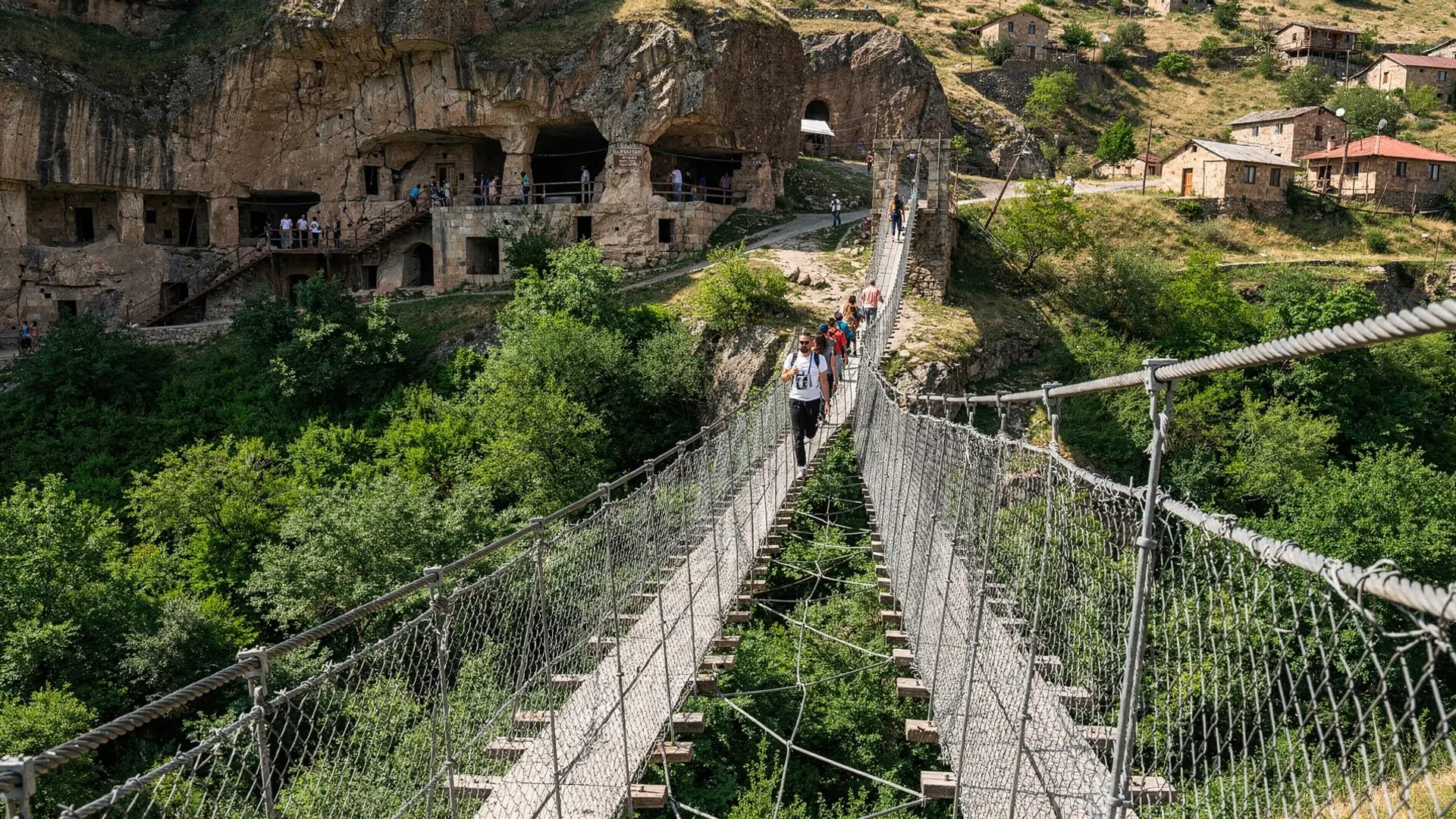
The bridge is 160 metres long and crosses the gorge at a height of roughly 63 metres above the canyon floor. It swings. Not alarmingly, but genuinely — a lateral sway that gets more pronounced toward the middle, combined with the vertical bounce from other people’s footsteps, creates an experience that will sort those in your group by their relationship with heights very efficiently.
The bridge crossing
I crossed the bridge four times in total that morning — twice on the way to the cave side, twice coming back — because my companion wanted to go back for photos and because, I’ll admit, I found the crossing enjoyable enough to repeat.
The bridge deck is metal grating with a non-slip coating. The handrails are solid wire cables. The overall engineering looks properly maintained: as of July 2024, no visible rust, no loose sections, the anchoring posts at both ends look solid. I don’t know the maintenance schedule but the structure didn’t feel old or neglected. A sign at the entrance says a maximum of fifteen people at a time, which the attendant enforces loosely — we had about twelve people when we crossed and it was fine.
The view from the middle is the point. Looking down the gorge, the layers of volcanic tuff form striped walls of pink, cream, and grey, studded with the dark openings of cave rooms at multiple levels. Some of these were inhabited well into the 1950s: the village at its peak in the 19th century had roughly two thousand residents living in these carved chambers, with a school, a church, and everything else a functioning community requires. Looking at the walls of cave openings from the bridge, trying to count the rooms, you start to understand the scale of what was here.
The cave village walk
Once across the bridge, a path descends steeply to the cave level and then continues along the cliff face, with cave entrances accessible at various points. Several rooms are open and you can walk in: they’re cool even in July, with stone-cut sleeping platforms and niches for lamps visible in the walls. The echo in the larger chambers is remarkable.
The walk from the bridge to the furthest accessible cave section and back takes about forty-five minutes at a relaxed pace. The path has some uneven sections and loose stone in places; I would not call it difficult, but it is definitely not stroller-accessible. Good shoes, plenty of water in July (the sun on the canyon walls makes the cave side warm by mid-morning), and sunscreen are all advisable.
The church on the cave side — Surp Hripsime, a small medieval structure — is worth the additional ten minutes to reach it. The interior is plain but the setting, carved into the cliff with the gorge visible through the door, is quietly impressive.
Guided day tour from Yerevan to Goris, Khndzoresk, and TatevPractical information for 2024
The site has a small entrance fee (1,000 AMD per person as of July 2024) collected at a booth near the car park. Parking is free and the lot has room for perhaps thirty vehicles — it was full when we arrived at 8:30 a.m. on a busy Tuesday, which gives you a sense of peak-season volumes.
There is a small cafe at the car park selling coffee, bottled water, and sandwiches. The coffee is instant and not very good. Bring your own from Goris if you care.
There are no facilities on the cave side of the bridge. The toilets are at the car park only.
Guided tours of the cave village are available through operators in Goris — typically 4,000-6,000 AMD per person for a two-hour walking tour with a local guide who can explain the history of the community. The context is genuinely interesting and I’d recommend taking one if you’re staying in Goris for a couple of days rather than just passing through.
The history of the cave village
The caves of Khndzoresk have been inhabited since at least medieval times, and possibly much earlier — the sheltering quality of the canyon walls and the defensible position of the site made it attractive to populations at multiple periods of Armenian history. The medieval and early modern village that developed here was substantially larger than the caves themselves: above the carved chambers, on the plateau, there were conventional stone-built houses, agricultural land, and a market. The cave section was the most densely inhabited part, with carved rooms serving as dwellings, storage, stables, and workshops.
The village had its own church, schools, and civic institutions by the 18th and 19th centuries, the period from which most of the surviving documents about the community date. At its peak, Khndzoresk was one of the larger settlements in Syunik province, with estimates of up to 8,000-15,000 inhabitants across the cave and plateau sections combined — figures that seem large until you count the cave openings in the canyon walls and begin to appreciate the density of occupation.
The Soviet relocation of 1951 was part of a broader programme of settling traditionally semi-mobile and cave-dwelling communities into planned villages with access to modern services. The new village of Khndzoresk on the plateau above is the result: functional, ordinary, connected to roads and electricity and schools. The old village below was not demolished; it was simply left. The caves have stood empty and slowly deteriorating since the last families moved out, which is why what you see now is simultaneously so atmospheric and so melancholy.
Khndzoresk in context
Khndzoresk is a natural pairing with Tatev Monastery — both are in Syunik, and many day trips from Yerevan cover both in a single long day. The logistics are tight (Yerevan to Tatev is around 250 kilometres and four hours each way) but feasible. If you have the choice, staying in Goris overnight is much more relaxed and gives you time to do both properly without the pressure of a single-day turnaround.
From Goris, Tatev is about 20 kilometres via the old road through the Vorotan gorge, or you can drive to Halidzor and take the Wings of Tatev cable car across — the more dramatic option and genuinely worth the 5,752-metre crossing over the gorge. The Khndzoresk destination page covers alternative walks in the canyon, and the Syunik province guide has the full regional overview including timing for the drive from Yerevan.
The scale of the old village
I want to come back to one thing that struck me, standing on that bridge in July. The cave village of Khndzoresk was not a collection of hermit cells or primitive shelters. It was a functioning community of several thousand people, maintained continuously for centuries, with a complex civic and religious infrastructure carved into living volcanic tuff. At its peak in the 19th century, the village numbered perhaps two thousand inhabitants living in hundreds of carved-rock chambers, with a church, a school, a market, defensive structures, and the full complexity of a working community. The last residents moved out in 1951 when the Soviet government relocated them to the new village on the plateau above.
The reason they left is not entirely clear from the sources I’ve read — some accounts suggest it was the government’s initiative as part of a broader modernisation drive, others that the practical difficulties of cave life in the 20th century (water supply, access, the absence of modern amenities) simply made the move attractive to residents. What you can say is that the village was inhabited until well within living memory, and that there are people alive in the village above who remember the cave side as a living community, not a ruin.
Standing in the middle of that swinging bridge in the morning light, looking at the canyon walls full of carved rooms, I found it easy to understand why people chose to live in dramatic landscapes. The alternative — the flat village on the plateau — is visible from the canyon rim. It is perfectly ordinary.
Combining Khndzoresk with the broader Syunik visit
Khndzoresk pairs naturally with Tatev Monastery as part of a Syunik circuit, and most visitors to the region combine both in some configuration. The cave village and the medieval monastery are complementary in character: one is vernacular and domestic, about how ordinary people lived in this specific landscape; the other is ecclesiastical and grand, about how the medieval church expressed its authority in stone.
From Goris, Tatev is about 20 kilometres via the road through the Vorotan gorge, or you can drive to Halidzor and take the Wings of Tatev cable car across — 5,752 metres over the gorge in about 12 minutes. The Wings of Tatev experience is one of the more extraordinary things you can do in Armenia; combined with a morning at Khndzoresk, it makes for a day that covers a remarkable range of what Syunik offers.
For those doing Syunik as a day trip from Yerevan — the drive is 250 kilometres, around four hours each way — the combination of Khndzoresk and Tatev is tight but possible if you leave by 5:00 a.m. Much more comfortable is staying a night in Goris. The town has grown into a reasonable overnight base in recent years, with a handful of guesthouses and small hotels that range from adequate to genuinely pleasant. The Mirhav Hotel is consistently recommended and the old town area has a few good restaurants serving the usual Armenian spread with some Syunik-specific variations.
The Syunik province guide covers the full scope of what’s available in the south, from Karahunj (the prehistoric stone circle known as the “Armenian Stonehenge”) to Kapan and the route toward the Iranian border. Shaki waterfall is an easy addition to a Khndzoresk-Tatev day — it sits about 10 kilometres northeast of Goris and takes thirty minutes to visit.
What I’d change about the visit
If I did it again, I’d time the arrival even earlier — 8:30 a.m. already meant a full car park and the beginnings of midday heat on the cave side. Going at 7:30, or staying overnight in Goris the night before specifically to catch first light, would give a genuinely quieter crossing and better photos of the striped canyon walls. I’d also budget more time for the cave rooms themselves rather than rushing back for a second bridge crossing — the echo chambers and the sleeping platforms carved into the rock reward slow looking more than the bridge does.
Frequently asked questions
Is the swinging bridge safe? Yes — as of the most recent visit the structure showed no visible rust or loose sections, the anchoring looked solid, and a capacity limit is loosely enforced by an attendant. It genuinely sways, which unsettles some visitors more than the engineering itself warrants; if you’re uneasy with heights, cross slowly and keep your eyes on the far side rather than straight down.
Can I visit Khndzoresk without a car? Yes, if you’re based in Goris — a short taxi ride covers the 15km easily, and several Goris-based operators run guided walking tours that include transport. Without a Goris base, it’s more practical as part of an organised day tour from Yerevan that also covers Tatev.
Is Khndzoresk suitable for children or older travellers? Older children generally manage the path fine with supervision, though the bridge’s sway and the uneven cave-side terrain mean it isn’t ideal for very young kids or anyone with significant mobility concerns. There’s no wheelchair or stroller access once you’re past the car park — the descent to the cave level is steep and stepped in places.
For a fuller regional picture, the Khndzoresk and Tatev southern loop guide covers how to sequence both sites, and the devil’s bridge natural wonder guide covers a lesser-known Syunik detour worth adding if you have an extra half-day.