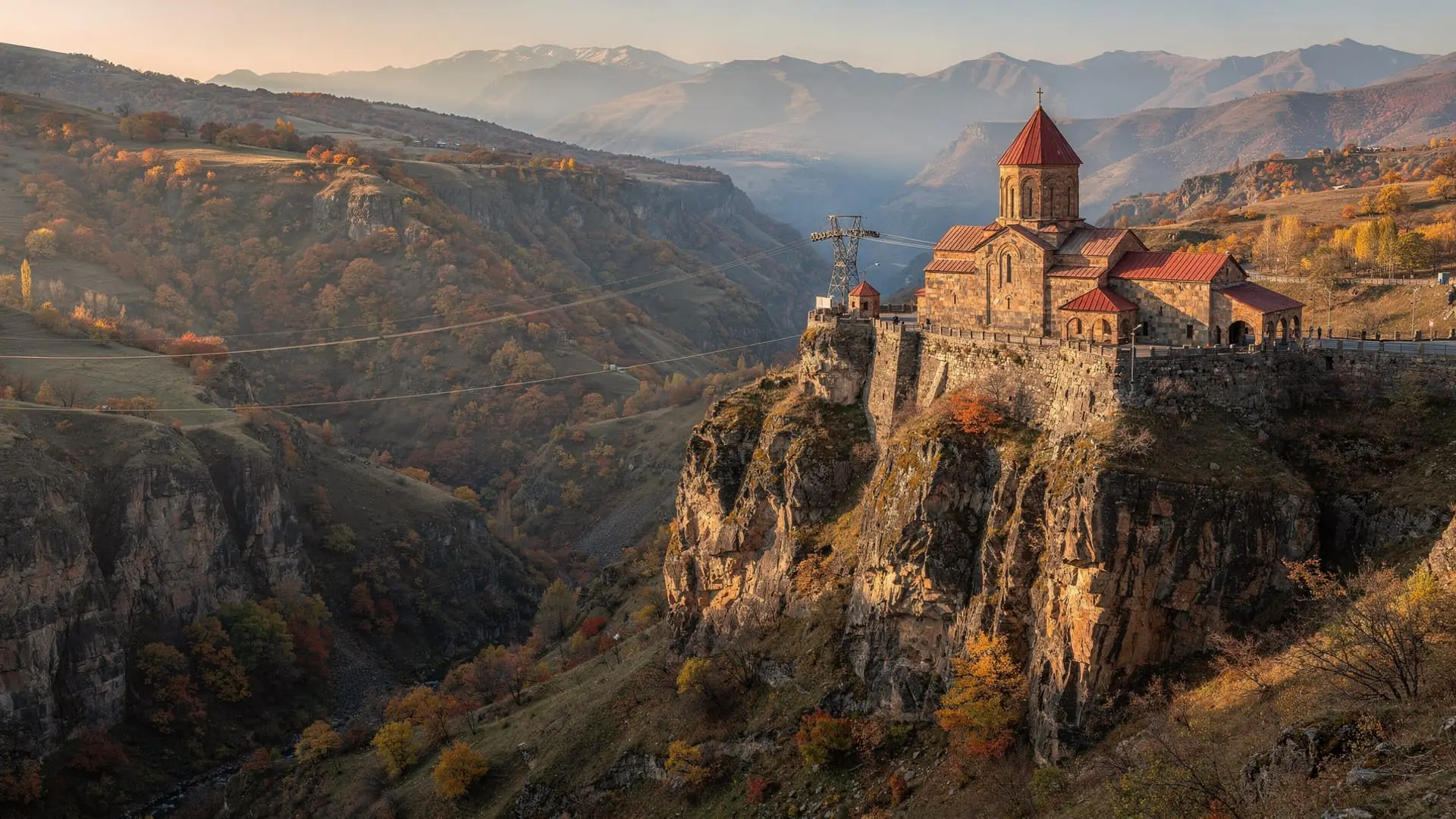
A monastery above the void — reached by the world’s longest cable car
Tatev is not a casual day trip from Yerevan. At 250 km and four hours of driving through increasingly dramatic mountain landscapes, it demands commitment. Most people who make that commitment come away calling it the highlight of their Armenia trip.
| Where | Vorotan Gorge, Syunik province, 250 km from Yerevan |
| Cost | Wings of Tatev ~6,000 AMD round trip; monastery entry free |
| Time needed | 1 day; overnight in Goris or Tatev village recommended |
| Getting there | ~4h drive, marshrutka to Goris + taxi, or guided tour |
| Best time | May–June or Sept–Oct; avoid Jul–Aug midday queues |
The monastery itself — a complex of churches, defensive towers, and the legendary “swaying pillar” (Gavazan Column, a 9th-century stone column on a hidden pivot that rocks to signal earthquakes) — perches on a narrow rocky promontory above the Vorotan Gorge, one of the deepest canyon systems in the Caucasus. On three sides, the cliffs drop 300–400 metres to the river below. The setting is genuinely vertiginous.
Since 2010, the Wings of Tatev cable car (Tatevi Tiravor) has provided access from the village of Halidzor, spanning 5.7 km across the gorge in 12 minutes. When it opened, it entered the Guinness World Records as the world’s longest non-stop double track cable car. It is a remarkable piece of infrastructure in its own right — the cabins glide over sections of the gorge where the cliffs fall 320 metres beneath the gondola floor.
Before the cable car, reaching Tatev required a winding 11 km mountain road. That road still exists and is used by private vehicles and those who prefer the drive.
Getting to Tatev from Yerevan
By car: 250 km, approximately 4 hours of driving. The route via Yeghegnadzor and Goris (M2 highway south) is well-paved. The final approach to Halidzor (cable car station) is via a decent road. From Goris, Tatev is 15 km (30 minutes on mountain roads). Plan for fuel in Yeghegnadzor or Goris — petrol stations are sparse in Syunik.
By marshrutka: Daily marshrutkas run from Yerevan’s Kilikia Station to Goris (around 4,500–5,000 AMD, 5–6 hours including stops). From Goris, a local taxi to the Halidzor cable car station costs about 3,000–5,000 AMD. Return marshrutkas from Goris to Yerevan depart early morning.
By guided tour (day trip): possible but gruelling — a 14-hour day. The trade-off: no driving fatigue and a guide who contextualises the monastery. Only viable if you’re comfortable with very long days and early starts (typically 05:30–06:00 departure).
Recommended: overnight in Goris or Tatev village: staying overnight makes the trip far more enjoyable. Arrive in the afternoon, take the cable car at golden hour, overnight locally, visit the monastery in the morning when groups haven’t arrived, then return at your pace.
Wings of Tatev cable car
The Wings of Tatev operates daily from approximately 09:00 to 18:00 (check current hours — extended in summer peak). Round-trip tickets cost 6,000 AMD (~14.60 €) per adult. One-way is available for those descending the mountain road instead.
Booking: no advance reservation system for individual tickets — you buy at the Halidzor station. In July–August, queues form and waits of 60–90 minutes are not unusual. Go in September–October or on weekdays if possible.
The ride: 12 minutes each way, cabins hold up to 25 people. The gondola descends steeply from Halidzor into the gorge, crosses the Vorotan River, then rises dramatically to the monastery platform. The views of the canyon walls and the monastery complex approaching are spectacular.
Maintenance: the cable car undergoes annual maintenance, traditionally in November. Check the official website before planning a November visit.
Cable car vs the mountain road
| Wings of Tatev cable car | 11 km mountain road | |
|---|---|---|
| Time | 12 minutes each way | ~30 minutes by car |
| Cost | ~6,000 AMD round trip | Free (own transport) |
| Experience | Aerial gorge views, Guinness record | Ground-level canyon scenery |
| Best for | First-timers, photographers | Drivers wanting to see the gorge floor, budget travellers |
Many visitors do one leg by cable car and the other by road for variety, since neither requires backtracking.
What to see at Tatev
The monastery complex
The main complex includes the Church of Saints Paul and Peter (895–906 AD), the Church of Saint Gregory (1295), and the refectory with its beautiful vaulted ceiling. The Gavazan Column — an 8-metre-high stone pillar on a concealed pivot mechanism — was designed to sway during earthquakes as an early warning system. It works: the column tilts noticeably when the ground moves.
The monastery was a major centre of learning in medieval Armenia, housing one of the great Armenian universities of the 14th–15th centuries (Tatev University, or the Gladzor-Tatev school), which produced some of the finest medieval Armenian manuscripts.
Allow 1.5–2 hours for a thorough visit of the complex.
Devil’s Bridge (Satanayi Kamurj)
A short drive (or 90-minute hike) from the monastery, this natural stone arch bridge spans the Vorotan River amid dramatic basalt formations. The name is local legend — a story about a pact with the devil to build the bridge overnight. The geological reality is an equally impressive story of volcanic activity and erosion. Check road conditions for the drive; the track is rough in places.
The Vorotan gorge
The gorge is extraordinary from every angle — monastery, cable car, roadside viewpoints. The Vorotan River cuts through alternating bands of volcanic rock and limestone, creating vertical cliff faces that change colour through the day. Golden hour (18:00–19:00 in summer, 17:00–18:00 in autumn) paints the canyon walls amber and copper.
Shaki waterfall
25 km from Tatev near the village of Shaki, a 18-metre waterfall drops into a pool in a narrow volcanic canyon. A 20-minute walk from the road. Easy to combine with the drive to or from Tatev. Free.
Photographing Tatev
The classic shot — monastery complex framed against the gorge — works best from the cable car itself on the approach, or from a small viewpoint near the Halidzor station looking across the canyon. Inside the complex, golden hour light (17:00–19:00 depending on season) catches the stone walls warmly; arrive for the 09:00 opening instead if you want the courtyards empty of tour groups. The Vayots Dzor wine route en route from Yerevan offers good vineyard-and-mountain photo stops if you’re driving rather than flying through on a tour schedule.
Suggested one-day plan for a Goris overnight
If you’re basing in Goris for a night rather than day-tripping from Yerevan, a well-paced Tatev day looks roughly like this: leave Goris early (around 08:30) to reach the Halidzor cable car station before the day-tour groups arrive from Yerevan, usually around 11:00. Take the first or second cable car crossing, allow 1.5–2 hours at the monastery complex itself, then either descend by cable car again or drive down the 11 km mountain road for a change of perspective. From the gorge floor, Devil’s Bridge is a short additional drive (or a 90-minute round-trip hike if you have the time and stamina) before heading back to Goris for the evening. This pace leaves the afternoon free for Khndzoresk’s swinging bridge and cave village, a 45-minute drive from Goris, rounding out a full but unhurried day that a single day trip from Yerevan simply cannot match.
For travellers without a car, the same plan works by combining a taxi from Goris to Halidzor with a pre-booked cable car crossing and a second taxi onward to Khndzoresk in the afternoon — arrange both through your guesthouse the evening before, since taxi availability in Goris can be limited during peak season weekends.
Where to stay near Tatev
Hotel Anahit (Tatev village) — the most-recommended option for the night before early monastery access. Rooms are basic but clean, the host family speaks some English, breakfast is home-cooked (lavash, fresh vegetables, honey, cheese). Prices around 20,000–25,000 AMD per room. Advance booking recommended May–October.
Old Wings Hotel (Halidzor, near cable car station) — convenient for an early start on the cable car. Similar price range to Anahit.
Goris options (15 km): Goris has more accommodation variety.
Mirhav Hotel (Goris) — the best-regarded option in Goris proper: clean rooms, helpful staff, good breakfast. Around 30,000–40,000 AMD per room.
Stone House Guesthouse (Goris) — popular with independent travellers, genuine family atmosphere, excellent home-cooked dinner if arranged in advance.
Where to eat near Tatev
The monastery site itself has a small café (open seasonally) and a vendor selling honey, dried fruit, and churchkhela. Basic.
Tatev village: a couple of family restaurants serving grilled meats, trout, and Armenian standards. Ask at Hotel Anahit for current recommendations.
Restaurant at Halidzor cable car station: tourist-priced but convenient. Grilled meats, soup, lavash.
Goris: considerably better options. Several restaurants on the main street serve solid Armenian food. The Mirhav Hotel restaurant is reliable.
Tours and tickets
Tatev is one of the most-booked destinations from Yerevan on GetYourGuide.
For a tour that also includes Khor Virap, Noravank, or Areni cave: Khor Virap, Noravank, Devil’s Bridge, and Tatev in one day — this is a very long day (15 hours) but covers the entire southern arc.
If you prefer a private guide for Tatev: private guided trip from Yerevan to Tatev gives flexibility on timing and stops.
For those combining with Jermuk waterfall: private Wings of Tatev and Jermuk waterfall tour .
Our companion guide with full logistical detail: /guides/tatev-monastery-complete-guide/.
Armenia: Noravank, Tatev, and Khndzoresk TourBest time to visit Tatev
May–June: ideal. Warm, gorge vegetation at its lushest, cable car running smoothly, crowds manageable.
September–October: arguably the finest period. The Vorotan gorge turns from green to gold and amber. October weekends can be busy with Yerevan day-trippers; weekdays are peaceful.
July–August: peak season. Wings of Tatev cable car queues can be 60–90 minutes on weekends. The monastery itself is very crowded mid-morning. If visiting in summer, go on weekdays or reserve an afternoon slot.
November–April: quiet. The cable car may be closed in November for maintenance. Check ahead. Winter visits are for the hardy — the road to Goris can be icy, and Syunik in December–February is cold (−5°C to −15°C in the gorge). But the monastery under snow is extraordinary and you’ll likely have it to yourself.
See also: Armenia in autumn: the case for September–October.
Whichever season you choose, check the Wings of Tatev operating hours the day before your visit rather than relying on printed schedules — they shift slightly between seasons, and the difference between a 09:00 and a 10:00 opening matters if you’re trying to beat the tour-group rush.
Practical tips
- Distance from Yerevan is real: 4 hours of driving. If you don’t want to drive, book a tour or overnight in Goris.
- Cable car timing: avoid 11:00–14:00 on summer weekends for the shortest waits.
- Fuel: fill up in Yeghegnadzor or Goris. Petrol in Syunik between these towns is limited.
- Combined with Khndzoresk: the cave village of Khndzoresk (35 km from Goris, famous for its swinging bridge over a canyon) fits naturally into a Syunik overnight trip — see /destinations/khndzoresk/.
- Currency: Goris and Tatev operate on cash. No reliable ATMs between Yeghegnadzor and Kapan. Withdraw enough AMD in Yeghegnadzor or before leaving Yerevan to cover accommodation, meals, and the cable car for your whole Syunik leg.
Frequently asked questions about Tatev
How long is the Wings of Tatev cable car?
5,752 metres — the world’s longest non-stop double track cable car when it opened in 2010, confirmed by Guinness World Records. The journey takes approximately 12 minutes at 37 km/h.
Can I reach Tatev without the cable car?
Yes. A 11 km mountain road ascends to the monastery from the Vorotan gorge floor. The drive is navigable by car (recommend high clearance in wet conditions). Some visitors drive up and take the cable car down, or vice versa.
Is Tatev worth the long drive from Yerevan?
For most travellers who make the journey, yes — it consistently ranks among their top Armenia experiences. The cable car, the gorge, the monastery’s medieval atmosphere, and the Syunik landscape together create something genuinely distinctive. If you have only 5 days in Armenia, include it; if you have 3 days, it may be harder to justify the logistics.
What is the Gavazan Column?
A 9th-century stone pillar inside the monastery complex, mounted on a pivot that allows it to rock. Scholars believe it served as an earthquake early warning system — the column tilts before tremors are felt. It also served as a signal column visible from the valley below. It’s a remarkable piece of medieval engineering.
What other sights are near Tatev?
Within a short drive: Khndzoresk cave village with its swinging bridge (35 km), Shaki waterfall (25 km), Devil’s Bridge near Tatev, Goris town. For a two-day Syunik circuit, add Karahunj (Armenian Stonehenge) near Sisian — see /destinations/karahunj-zorats-karer/.
Should I book the cable car ticket in advance?
There’s no advance online booking for individual tickets — you buy at the Halidzor station on arrival. In July–August, arrive well before 11:00 or plan for a 60–90 minute queue; September–October and weekdays are far less crowded. Guided tours that include Tatev typically handle ticketing as part of the group booking, removing the queue uncertainty.
The Syunik region around Tatev: planning a two-day circuit
Tatev deserves to be the centrepiece of a longer Syunik exploration. The province of Syunik is the southernmost arm of Armenia — a narrow corridor of mountains and gorges that runs to the Iranian border at Meghri. It is the least-visited region of Armenia by foreign tourists and, for that reason alone, one of the most rewarding for those who make the effort.
Goris: the gateway town
Goris (population ~20,000) is the logical base for exploring Tatev and the surrounding Syunik sites. It is a pleasant small town with a grid of 19th-century Russian-era stone houses, a tree-lined central avenue, and a surprisingly good restaurant and guesthouse scene that has developed in response to the growing Tatev tourist flow.
The drive from Yerevan to Goris (215 km, about 3.5 hours) follows one of the most scenic roads in Armenia: the highway descends through the Arpa River canyon in Vayots Dzor before climbing to the high Syunik plateau, passing through a landscape of bare volcanic ridges and deep gorges utterly different from the Ararat plain around Yerevan.
From Goris, Tatev is 15 km on a winding mountain road (30 minutes). The cable car departs from Halidzor, 5 km before the monastery.
Khndzoresk cave village
35 km from Goris (45 minutes on a rough road), Khndzoresk is one of the most extraordinary historical sites in Armenia. For centuries, the inhabitants of this village lived in natural and man-made caves carved into the sandstone cliff faces of a dramatic canyon — an entire medieval town honeycombed into the rock, visible from a viewpoint above. A modern swinging pedestrian bridge (140 metres long, suspended over the canyon) now connects the two sides of the Khndzoresk valley.
The cave village was inhabited until the 1950s when Soviet authorities resettled residents to the modern village above. You can walk down into the canyon and explore the cave dwellings on foot — some interiors retain painted walls and carved niches. Allow 2–3 hours. Free. See /destinations/khndzoresk/.
Shaki waterfall
25 km northeast of Goris, near the village of Shaki, an 18-metre basalt waterfall drops into a carved stone basin in a narrow volcanic canyon. A 20-minute walk from the road. The combination of hexagonal basalt columns (similar to the Symphony of Stones near Garni), rushing water, and deep canyon walls makes this one of the more photogenic natural sites in Syunik. Free.
Karahunj (Zorats Karer)
Near the town of Sisian (50 km north of Goris), Karahunj is a prehistoric standing stone monument — over 200 basalt megaliths, some with drilled holes that certain researchers claim were used for astronomical observation. Whether or not the astronomical interpretation is correct (it’s debated), the stones themselves are genuinely impressive: similar in visual impact to a smaller Stonehenge, set on a high plateau with views of the surrounding mountains. Free. See /destinations/karahunj-zorats-karer/.
Suggested two-day Syunik itinerary
Day 1: Leave Yerevan early morning. Stop at Areni cave and Noravank on the way south. Arrive Goris late afternoon. Check in to Mirhav Hotel.
Day 2: Morning cable car to Tatev (aim for 09:00 opening to beat the day-trip groups from Yerevan who arrive around 11:00). Explore the monastery. Afternoon: drive to Khndzoresk via Goris for the cave village and swinging bridge. Evening return to Yerevan via the main highway.
Extended option (3 days): Add Shaki waterfall and Karahunj on day 3, with a detour through Sisian.
See /itineraries/armenia-classic-7-days/ for a fuller itinerary framework.
The history of Tatev monastery
Tatev was founded in the late 9th century (895–906 AD) by the Armenian Bagratid kingdom, dedicated to the apostles Peter and Paul. Over the following centuries it grew into one of the most significant religious and intellectual centres in medieval Armenia.
The monastery’s university, functioning primarily in the 14th–15th centuries, was the last great Armenian monastic academy of the medieval period. Under scholars like Hovhannes Vorotnetsi and Gregory of Tatev, it produced major works of theology, philosophy, and natural science. The illuminated manuscripts created here are preserved in the Matenadaran in Yerevan and in collections worldwide.
The Gavazan Column — the seismic signal column installed in 904 AD — is unique in medieval engineering: a 8-metre pillar on a concealed ball-joint that rocks when the ground moves. It was both a warning system and a signal tower visible from the valley. It functions to this day.
Tatev suffered during the Mongol invasions of the 13th century, the Timurid campaigns of the 14th century, and the Ottoman-Safavid wars of the 16th–17th centuries. Each time, the monastery was restored by local benefactors. The current state of the complex reflects centuries of repair and rebuilding, though the core 9th–13th-century fabric remains substantial. Restoration work has continued into the 21st century, funded partly by the same tourism revenue the Wings of Tatev cable car now generates — a rare case of a modern attraction directly financing the preservation of the historic site it serves.
Wings of Tatev: engineering the impossible
The idea of a cable car connecting Halidzor to the Tatev monastery was proposed for decades before it became reality. The 5.7 km span across the Vorotan Gorge required engineering solutions that had not been attempted at this scale for a reversible gondola system.
Construction took three years (2007–2010). The cable car uses a bi-cable technology: one carrying cable and one haul cable, with the gondola gripping both. The support towers are sunk into the gorge walls with foundations requiring blasting through volcanic rock. The system can operate in winds up to 60 km/h and carries up to 25 passengers per cabin.
When it opened in October 2010, it immediately set the Guinness World Record for the world’s longest non-stop double track reversible cable car — a record it continues to hold.
The ride experience is genuinely spectacular: the gondola descends from Halidzor station, crosses a ravine where the cliffs drop 320 metres below the cabin, traverses the Vorotan River, then ascends to the monastery plateau with the ancient church towers visible ahead. In autumn, the canyon walls are layered with gold and amber foliage. The 12-minute journey is one of the finest short rides in the Caucasus.
Ticket prices: 6,000 AMD (~14.60 €) round trip. One-way also available. Even visitors who have ridden other long cable cars in the Alps or Andes generally rate the Wings of Tatev crossing among the most memorable, largely because the monastery emerging ahead through the gondola window is such an unexpected payoff at the end of the ride.