Riding the Wings of Tatev: world's longest cable car
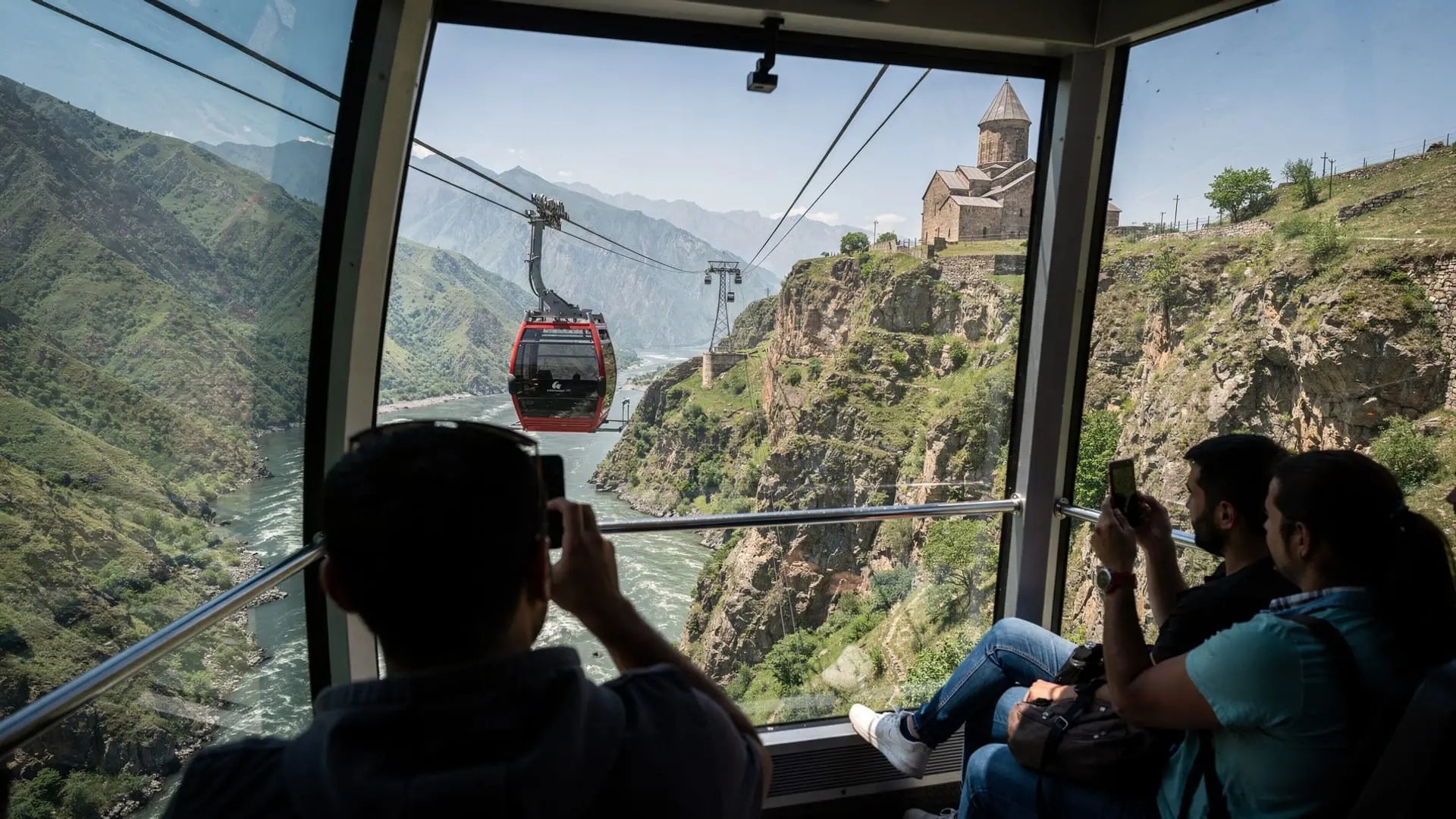
A first-person ride report on the world’s longest non-stop reversible cable car — the queue at Halidzor, the thirteen minutes over the Vorotan gorge, and what three hours at Tatev Monastery actually involves.
| Crossing | 5,752m, up to 320m above the gorge, 11–13 minutes |
| Cabin | 25 passengers, standing room, no numbered seats |
| Queue | 35–60 minutes in peak season; shorter early morning |
| Base | Goris, 20km from Halidzor, best overnight stop |
| Weather risk | Closes in high wind — check before a 4hr drive from Yerevan |
The queue at Halidzor
September is the right month to arrive at the cable car station having already made peace with the fact that there will be a queue. It was 9:15 a.m. when I pulled into the parking area above Halidzor — the small village that serves as the departure point for the Wings of Tatev — and roughly sixty people were already arranged in a zigzag of metal barriers. Some had arrived on tours from Yerevan. Others, like me, had spent the night in Goris specifically to be here early. A few were in walking shoes and clearly planning to hike back up the gorge path afterward.
The gondola cabins hold twenty-five people. They depart roughly every twenty minutes during peak season, which means in September on a clear Saturday, you might wait forty minutes to an hour. I waited about thirty-five. During the wait, I watched the cable car return from the far side — a slow silver box sliding across the gorge — and tried to identify the monastery from the departure platform. You can see the corner of a tower on the distant plateau if you know where to look.
The Wings of Tatev held the Guinness record for the world’s longest non-stop double-track cable car for several years after its 2010 opening. The full figure is 5,752 metres. The descent from Halidzor to the monastery plateau is 320 metres. The crossing takes between eleven and thirteen minutes depending on wind and load. I had read all of this before arriving and it had told me almost nothing about what the experience would be like.
Crossing the Vorotan gorge
The first thing you notice when the gondola leaves the platform is how quickly the ground drops away. The Vorotan gorge is not merely deep — it is a complex geological drama of layered stone, narrow at the river and widening as it rises into terraced walls of ochre and grey basalt. Within two minutes of departure, you are suspended over a river that looks, from this height, like a thread of silver. The gorge walls are close enough on both sides that you can make out individual trees clinging to the ledges.
I was standing at the front window of the cabin. A woman beside me, part of a French tour group, had pressed herself against the back wall in the first minute and was not looking at the view. The guide from her group was speaking to her quietly. This is not a cable car for people who are nervous about heights; there is no avoiding the fact of the altitude, and the floor-to-ceiling glass panels make the geometry very clear.
For those of us who were enjoying it: the crossing is one of the more disorienting travel experiences I’ve had in the Caucasus, which is saying something. The monastery plateau comes into view about halfway across — you begin to make out the dark rooftops of Tatev against the rock, the three main churches, the outer wall. Then the angle shifts and you’re descending toward it, the cable ahead of you angling down at a noticeable slope.
The gondola passes through a small intermediate station partway across, then continues to the arrival platform on the monastery side. When the doors open, you step out onto a terrace above the gorge with the monastery fifty metres uphill and the valley floor four hundred metres below.
Inside Tatev Monastery
Tatev Monastery is one of the largest monastic complexes in Armenia, which is a country that takes “large monastic complex” seriously. The core dates from the ninth and tenth centuries, though the site is older. The main cathedral — the Cathedral of Sts. Paul and Peter, dedicated in 895 — is the architectural anchor, a large basilica in dark-grey stone that feels proportionally grander than almost anything else I’d seen in Armenia.
What I hadn’t expected was the Gavazan — a free-standing column about eight metres tall that stands in the courtyard and swings when pushed. It was apparently designed as a seismic early-warning device: monks could watch it for movement during tremors. I spent several minutes pushing it gently and watching it return to vertical like a compass needle. An elderly man watching me do this said something in Armenian that I chose to interpret as approval.
The monastery complex also contains an oil press that dates from the ninth century, a refectory, and a small museum. The outer walls, partly ruined and partly intact, enclose a much larger area than the surviving buildings. Walking the perimeter, the views into the gorge are severe and beautiful in the way that high places often are when they force you to notice the space below.
I arrived at the monastery at roughly 10 a.m. and left at 1 p.m. Three hours felt right — enough time to walk everything, sit in the cathedral for a while, and eat a bowl of khash from the small canteen inside the complex. I was not in a hurry; the return cable car runs until 6 p.m. and the valley doesn’t care what time you leave.
The gorge path as an alternative
For the return trip, some visitors choose to walk the gorge path from the monastery down to the river and then up to Halidzor. The path takes roughly ninety minutes and drops steeply through the forest before levelling out along the Vorotan River. I had been told to expect good views of the monastery from below and was not disappointed. The basalt columns of the gorge walls are visible from the path in a way they aren’t from the cable car.
I should note that the path is not well signed and involves some scrambling on loose stone near the top. In September, in dry weather, it is manageable for anyone reasonably fit. In spring or after rain, I would skip it. Coming back up to Halidzor on foot is the harder direction — most people who walk do the descent and then take the cable car back up.
If you’re doing a day trip from Yerevan, the logistics of the gorge path become difficult: you’d need to add two hours to an already long day. For those spending a night in Goris, it’s a natural add-on.
| Month | Conditions | Notes |
|---|---|---|
| May–June | Green gorge, mild | Good light, moderate crowds |
| Jul–Aug | Warm, busiest | Longest queues; arrive by 8:30–9am |
| Sep–Oct | Clear air, best light | My preferred window; thinner crowds |
| Nov–Apr | Cold, maintenance closures possible | Check wind and closure schedule ahead |
What the record means in practice
The Wings of Tatev being the world’s longest cable car is a headline fact that appears in every piece of writing about it, including this one. I want to try to say what the record actually means experientially, since records are usually abstractions.
It means the crossing is long enough to have a structure. It has a beginning (the ground dropping away, the town of Halidzor receding), a middle (floating over the gorge with the river visible below and the walls on both sides), and an end (the monastery growing as you descend toward it). Shorter cable cars compress this into a single sensation. Thirteen minutes allows for something closer to a sustained experience — time to settle into the height, to look around, to notice the swallows, to change your mind about whether you’re enjoying it.
It also means that the engineering is visible in a way that shorter crossings don’t require you to think about. The support pylons are spaced far apart, and in the middle section there are none at all — just the cable, the cabin, and 300-plus metres of air. I’m not an engineer but I found myself thinking about the cables in a way that I don’t usually think about escalators or elevators. There is something about horizontal suspension over a large void that focuses the mind.
The monastery in the wider Syunik context
Tatev Monastery is the anchor of a broader region that rewards more time than a cable-car day trip allows. Syunik province — the southernmost province of Armenia, the narrow strip that connects the rest of the country to the Iranian border — is one of the least-visited areas by short-term tourists and one of the most interesting for those willing to extend their itinerary.
Goris, the provincial capital 20 kilometres from the cable car station, is a town of interesting 19th-century stone houses arranged on the slopes above the Goris River gorge. The old quarter is worth half a day. The town has adequate accommodation and serves as the practical base for everything in the south: Tatev, Khndzoresk, Karahunj, and the road south to Kapan and Mount Khustup.
Khndzoresk is 15 kilometres from Goris — a semi-abandoned cave village where people lived in rock-cut dwellings until the 1950s, now accessible via a swinging suspension bridge over the gorge. The combination of Tatev, Khndzoresk, and a night in Goris makes a highly satisfying 2-day Syunik itinerary.
Karahunj — the prehistoric stone circle sometimes called the “Armenian Stonehenge,” 20 kilometres from Goris — adds a different register to the trip entirely. The site predates Stonehenge and the Pyramids; the holes bored through some of the stones may have been used for astronomical observation, though the interpretation remains debated. In any case, it’s a field of upright stones on a basalt plateau with mountains in every direction, and it’s mostly empty of visitors.
Practical details
The cable car operates year-round with some exceptions: maintenance periods in autumn (usually November) and occasional closures for wind. Tickets in 2018 cost 3,500 AMD one way or 5,000 AMD return — expect minor price increases by the time you read this. The gondola cabin has standing room for 25 people and there are no numbered seats; the view from the front windows is better than from the sides.
Halidzor is about 20 kilometres from Goris by road. Goris is the nearest town with accommodation, and spending a night there makes the logistics much easier. The full Tatev guide covers timing, tickets, and the cable car vs hiking debate in detail.
One practical note: the cable car does not run during periods of high wind, which can be unpredictable in the gorge. If you’ve driven four hours from Yerevan specifically for this, check the weather before you go. A cloudless day in Yerevan can mean strong crosswinds at 1,200 metres above sea level. It would be a miserable thing to arrive at Halidzor to a closed sign.
September, as I said, is the right month. The air is clear, the light is good in the late afternoon, and the monastery is not yet in the grip of the October cold. Plan to be there for the whole morning if you can manage it.
For current fares and the most recent updates on hours and closures, see the Wings of Tatev anniversary and current-fares dispatch and the complete Tatev monastery guide.