An evening walking the Cascade in Yerevan
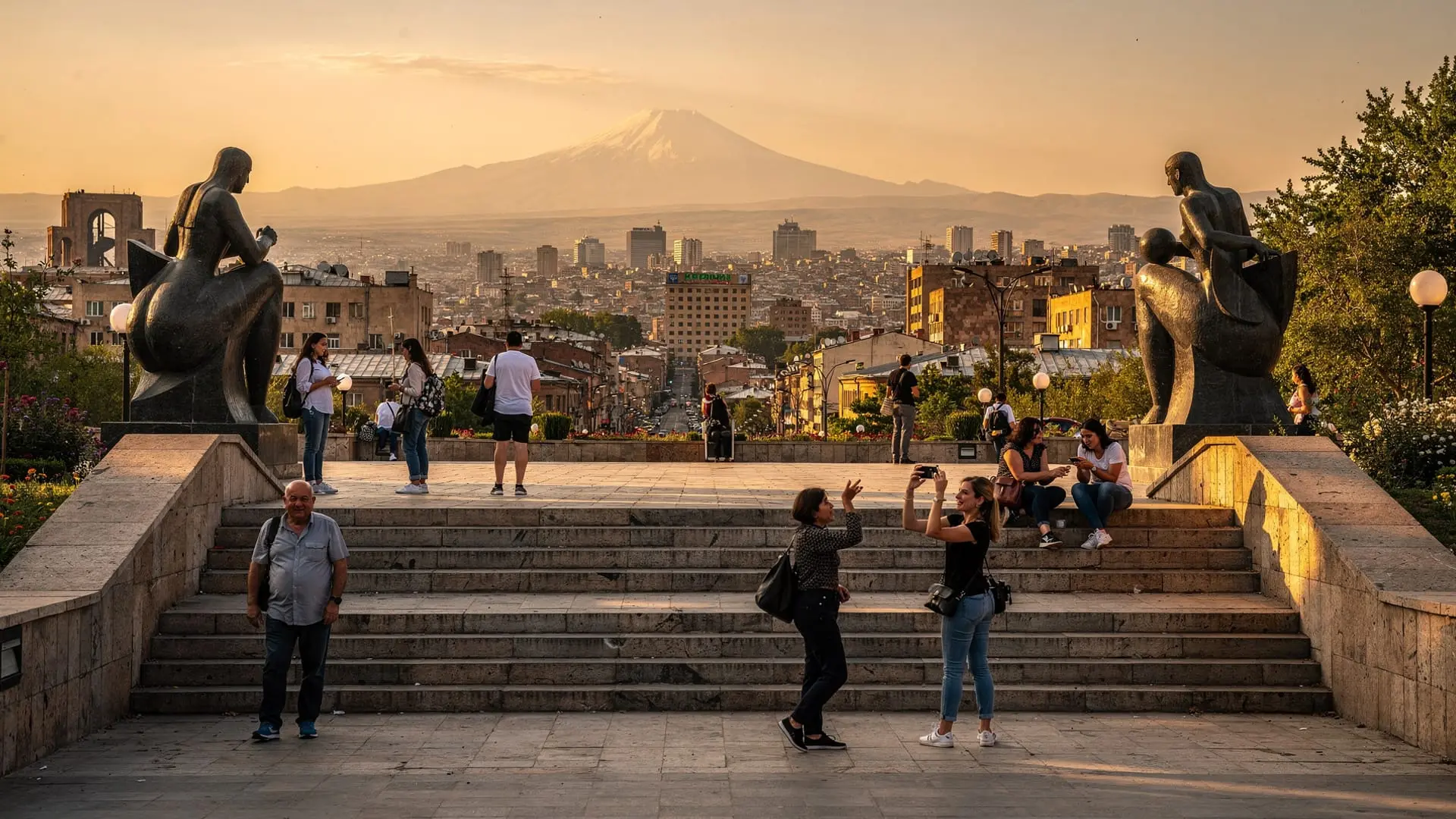
A slow evening walk up Yerevan’s Cascade stairway — the Botero cats, Jaume Plensa’s “Laura,” the Cafesjian galleries carved into the hillside, and the view of Ararat from the top terrace at sunset.
| Where | Foot of Tamanyan Street, central Yerevan |
| Steps | 572, or ride the interior escalators one way |
| Best time | Hour before sunset, autumn or spring |
| Cost | Free to climb; galleries free with donation, small fee for some exhibitions |
| Time needed | ~25 minutes to climb; 1–2 hours with galleries |
Starting at the bottom
There’s a particular hour in late October Yerevan — the sun dropping behind the western hills, the tuff buildings going amber, the air dropping ten degrees in twenty minutes — when the Cascade stairway becomes something close to magical. I found this out by accident. I had intended to go up at 4 p.m. and arrived at 5:30 instead, which turned out to be the correct mistake.
The Cascade is Yerevan’s great outdoor gathering point: a terraced stairway of granite and tuff that climbs 572 steps from the lower plaza at the foot of Tamanyan Street to an upper terrace from which you can see most of the city and, on clear days, both Ararat and Aragats. The project was begun in the 1980s but remained unfinished for decades after independence, finally completed in 2009 with funds from American-Armenian philanthropist Gerard Cafesjian, whose art collection now fills the interior galleries.
At the bottom of the steps, in the lower plaza, there is a large sculptural pool and, positioned around it, several of Fernando Botero’s trademark monumental bronze figures. A large cat — round and imperturbable in the way that all Botero animals are — anchors the south side of the plaza. When I arrived, a group of teenagers were taking photographs beside it, leaning against the smooth bronze flank. A security guard was watching this with the specific expression of someone deciding not to care.
The sculptures on the way up
The terraces between the steps hold a changing collection of outdoor sculptures, and wandering through them while climbing gives the ascent a gallery-visit quality that a plain stairway would lack. The artworks aren’t all great — some feel placed more than chosen — but the best of them earn their settings.
Jaume Plensa’s “Laura” is a large-scale portrait head in aluminium mesh that catches the light differently depending on the angle. It was installed in 2016 and has become one of the most photographed artworks in the city, which feels deserved. There is also a substantial Botero figure of a reclining woman — equally round, equally at peace with her own weight — on the third terrace, and a set of abstract bronzes near the top that I looked at for longer than I expected to.
Between sculptures, there are fountains, benches, and planters of autumn-flowering plants. In November, the trees along the terraces are bare but the tuff walls glow in the late light. The whole thing has been managed to feel like a park interrupted by stairs rather than stairs interrupted by a park.
Midway up, there’s an entrance into the interior galleries of the Cafesjian Center for the Arts. I stopped here for about forty minutes on my first visit, working my way through a floor of contemporary Armenian and international work. The gallery spaces are polished and well-lit, carved into the hillside with structural audacity. There’s a café on one of the interior floors, which is useful if you’re doing the ascent in stages.
The view from the top
The top terrace is not the formal end of the experience — there’s a bar and café up here, and a walkway that continues further up the hill toward the Matenadaran — but it’s where most people stop. The view is the reason.
From the upper terrace, Yerevan spreads out below in the specific arrangement that only this vantage point reveals: the Soviet grid of broad avenues and smaller streets, the clusters of tuff and concrete towers, the Opera House and its surrounding park visible to the right, Republic Square’s rectangular emptiness visible in the distance. On the horizon to the south: Ararat, or the space where Ararat would be if the haze allowed. On this particular November evening, the mountain was visible as a triangle of white against dark sky, clean and impossibly large.
A couple sitting beside me on the balustrade railing were drinking wine from plastic cups — the bar doesn’t bother with glass outdoors — and speaking to each other in Russian. Yerevan has a large Russian-speaking population, a mix of Armenian diaspora from Russia and, since 2022, a substantial number of Russians who relocated here. The couple looked at Ararat for a while without saying anything. I did the same.
The bar at the top serves local wine by the glass for reasonable prices. Areni Noir in November, when the harvest is just finished, is worth ordering. I had two glasses and watched the city’s lights come on below me.
Inside the Cafesjian galleries
If you visit the Cascade without going inside the galleries, you’re doing it partially. The Cafesjian Center for the Arts is a proper museum occupying multiple floors inside the hillside structure, with a collection that ranges from 20th-century European works to contemporary Armenian artists to decorative arts and glass.
The glass collection is the particular pleasure. Gerard Cafesjian was a serious collector of art glass, and the pieces displayed in the lower galleries include work that would look at home in a major European museum of decorative arts. The context — a hilltop gallery in Yerevan, surrounded by escalators and granite stairways — adds a layer of unreality that I found enjoyable.
The escalators themselves deserve a mention. The interior of the Cascade has three working escalators that take you from the bottom to the top without climbing a single step. They run alongside the galleries, meaning you pass artworks on both the ascent and descent. Going up by foot and down by escalator — or vice versa — is the ideal method: you control the pace in one direction and surrender to the machine in the other.
The galleries are free to enter with a donation requested; some temporary exhibitions have a small ticket price. Hours vary seasonally. The Yerevan guide has current opening hours, and the Cascade complex art guide covers the full sculpture collection terrace by terrace.
| Way up | Time | What you see |
|---|---|---|
| Climbing the steps | ~25 minutes | Outdoor sculptures, fountains, terrace views |
| Interior escalators | ~10 minutes | Cafesjian galleries on both ascent and descent |
| One up, one down | ~25–35 minutes | Both — the recommended approach |
The Yerevan Cascade art collection guide has more detail on individual pieces if you want to identify what you’re looking at before you climb.
What the Cascade is not
I should note what the Cascade is not, because the name sometimes creates expectations that the reality doesn’t match. It is not a waterfall. “Cascade” refers to the cascading architectural form — the terraces stepping down the hillside — not to water. When I mention this, some people find it obvious; others have genuinely arrived expecting a waterfall and been confused.
The Cascade is also not a park in the recreational sense. There’s no grass for picnicking, no playground, no open lawn. It’s an urban stairway with cultural programming — sculptures, galleries, a café — and the value is in the art and the view, not in the experience of outdoor space per se. For proper outdoor space, the park around the Opera House or the banks of the Hrazdan gorge serve better.
What it is, most usefully, is Yerevan’s main gathering point at the end of the day. People meet at the bottom to walk up together, or at the top with wine. It is the place where the city comes to be seen and to see, in the late-afternoon and evening hours, and it has been this for long enough that the habit feels organic rather than designed.
The Matenadaran connection
From the top of the Cascade, a short walk uphill on Mashtots Avenue brings you to the Matenadaran — the Mesrop Mashtots Institute of Ancient Manuscripts, one of the world’s great manuscript repositories. The building is Soviet monumental in scale: a broad stairway rising to a columned entrance, with statues of Armenian scholars and scribes ranged along the approach. The aesthetic is confident in its Soviet grandeur and, I think, earns it.
Inside, the permanent exhibition includes illuminated manuscripts from the 5th through 18th centuries — Armenian, Persian, Greek, Arabic, Hebrew, Ethiopian. The oldest and most important Armenian manuscripts include the Gospels of Queen Mlke (862 AD) and a 13th-century Gospel from Gladzor monastery with miniatures of such quality that you stand in front of them longer than you expect to. The overall collection runs to 23,000 manuscripts and 100,000 archival documents; the permanent exhibition shows a fraction of this.
I have been to the Matenadaran three times, each time spending two hours, each time leaving with the sense that I hadn’t finished. This is, I think, the correct relationship with a place of this depth. The Matenadaran manuscripts guide covers the collection and visit logistics in far more depth than a Cascade-evening detour allows.
After the Cascade
The natural continuation of a Cascade evening is dinner somewhere in the streets below. The neighbourhood around the Cascade — up the slope toward the Matenadaran and along the streets branching off Mashtots Avenue — has some of Yerevan’s best restaurants at a remove from the tourist scrum of Republic Square.
Tavern Yerevan does excellent khorovats (Armenian barbecue) in an interior that feels like a theatrical set from the 1960s — rough stone walls, low ceilings, candles in iron brackets — which is not a criticism. Lavash, also nearby, is the most celebrated contemporary Armenian restaurant and justifies the reputation: the menu rotates seasonally, the wine list takes Armenian producers seriously, and the room itself is handsomely done. Sherep, on the street behind the Opera House, is smaller and quieter and equally good. For a broader sense of how this scene keeps shifting, the Yerevan dining 2026 dispatch has current openings and closures.
If a full evening out fits your plans, the streets around the Opera House also hold Yerevan’s nightlife scene, and combining the Cascade with Republic Square or a look at the city’s Soviet modernist architecture makes for a fuller day of walking before the evening light arrives.
What I have learned from several visits is that the Cascade works at any time of day — morning coffee with a view, midday gallery visit, afternoon Botero browsing — but the hour before sunset in autumn or spring is when it earns the word “atmospheric” without embarrassment. The light on the tuff, the mountain on the horizon, the city below gradually illuminating: it is one of those reliable urban experiences that rewards showing up at the right hour.
For your first evening in Yerevan, or your last: go up the Cascade at sunset. It takes about twenty-five minutes to climb, less if you use the escalators, and what you find at the top is a view that explains why Armenians have been building this city, in this particular stone, in this particular light, for a very long time. The Yerevan destination guide covers the full range of city sights for those who want to plan deeper.