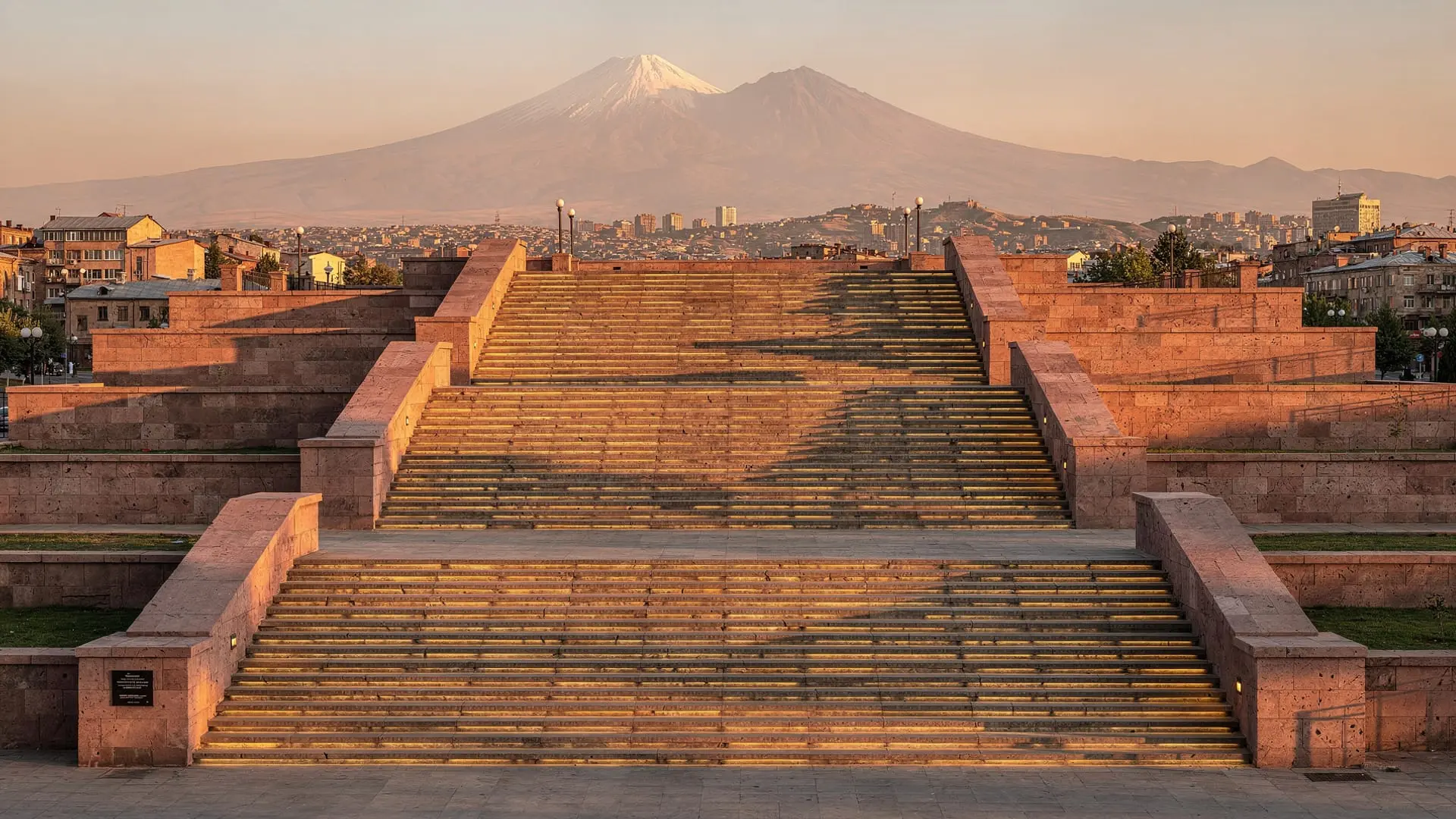
The pink city at the foot of Ararat
Yerevan is one of the world’s oldest continuously inhabited cities — its DNA runs from the Urartian fortress of Erebuni (782 BC) through Soviet urbanism to a booming café and startup scene that nobody predicted a decade ago. Stand on the roof of the Cascade at dusk with Mount Ararat glowing orange on the horizon and you understand why Armenians carry such fierce attachment to this place.
| Where | Central Armenia, on the Hrazdan river, 20 km from the airport |
| Cost | Budget from ~15,000 AMD/day; mid-range 30,000–50,000 AMD/day (lodging + food) |
| Time needed | 3–5 days as a base, more if using it as your only hub |
| Getting there | Zvartnots International Airport (EVN), 25 min by taxi from the centre |
| Best time | April–May and September–October |
The city is built from pink and honey-coloured tuff stone, which gives it a warmth unusual for a post-Soviet capital. Republic Square, flanked by muscular Stalin-era ministry buildings, fills with singing fountains on summer evenings. Yet two blocks away you can be in a courtyard where an old man plays backgammon and a grandmother hangs laundry — the city keeps its village texture beneath its metropolitan ambitions.
Yerevan is not merely a transit point for monasteries. For many travellers it becomes the highlight: the food scene has exploded, the coffee culture rivals Tbilisi, and the nightlife runs until 6 am on weekends. Budget three days minimum; most people wish they had five.
Why Yerevan deserves more than one night
The neighbourhoods
Republic Square and the centre is where you’ll arrive mentally if not physically. The travertine square, dancing fountains (May–October, evenings), History Museum, and National Gallery form a monumental core you’ll walk through repeatedly.
Cascade Complex — a giant staircase of tiered fountains and gardens rising from the centre toward the Cafesjian Art Museum — is the city’s social meeting point. Locals jog it, couples climb it for sunset views, and the sculpture garden at the base showcases Fernando Botero bronzes alongside contemporary works. Free to enter; museum inside has a small admission fee.
Northern Avenue (Hյusisayin Pasaj) is the pedestrianised artery connecting Cascade to the Opera House. Lined with cafés and boutiques, it’s where the city promenades on warm evenings.
Mashtots Avenue and Abovyan Street host the best independent restaurants, bookshops, and wine bars. The Vernissage flea market spreads across the adjacent park on weekends — more on that below.
Kond district — a hillside quarter of winding lanes, Soviet-era apartments, and century-old stone houses — is one of the most photogenic corners of the city. A guided walk here (several operators offer it) reveals how Yerevan looked before the grand Soviet rebuilding.
Arabkir and Nor Nork are residential neighbourhoods that give a truer picture of everyday Yerevan life if you venture beyond the centre.
The must-see sites
Matenadaran (Mesrop Mashtots Institute of Ancient Manuscripts) houses one of the world’s greatest collections of illuminated manuscripts — over 23,000 volumes including a 5th-century copy of the Gospels. The hillside building itself is a Soviet-era landmark, and the small museum inside is more accessible than you’d expect. Open Tuesday–Saturday, 10:00–17:00; admission around 3,000 AMD (roughly 7 €).
Erebuni Museum and Fortress — Yerevan was founded by Urartian king Argishti I in 782 BC, and the hilltop citadel survives with astonishing completeness: painted murals, wine vessels, arrowheads. The museum at the base is required reading before the climb. Admission ~2,500 AMD; a 25-minute taxi from the centre.
Tsitsernakaberd (Genocide Memorial) is a profoundly moving hilltop monument — twelve basalt slabs encircling an eternal flame, paired with the Armenian Genocide Museum tracing the events of 1915. Allow 90 minutes minimum. Free. Open daily except Monday; the museum is closed on Armenian public holidays. Visit with respect: this is sacred ground for the diaspora and the nation. See our guide at /guides/tsitsernakaberd-genocide-memorial/.
Yerevan Brandy Company (Ararat) — the legendary Ararat brandy is made in a Soviet-era factory overlooking the Hrazdan gorge. The tour covers the oak barrel cellars, the private reserve “Paradise” warehouse, and ends with a tasting. Book ahead (tours fill fast April–October). See /guides/yerevan-brandy-company-tour/.
GUM Market — the Soviet-era indoor market near Mashtots Avenue is pure sensory overload: dried apricots, walnut-stuffed figs, heaps of dried lavash, jams, churchkhela (walnut-and-grape-must sausages), and fresh herbs. Arrive hungry. See /guides/yerevan-best-restaurants-2026/.
Vernissage flea market — held on weekends near Republic Park, this is Yerevan’s famous open-air bazaar for paintings, carpets, Soviet memorabilia, khachkars, and jewellery. Important caveat: the “cognac” sold here in ornate bottles is frequently counterfeit Ararat. If you want authentic Ararat brandy, buy at the Yerevan Brandy Company shop or in SAS or Yerevan City supermarkets. Same goes for Armenian carpets — authentic hand-knotted rugs are at the Megerian Carpet Factory or Yerevan Carpet workshop, not at tourist stalls.
Getting around Yerevan
Yerevan has a single-line metro (useful for reaching the suburbs) but the centre is compact enough to walk. For taxis, use GG Taxi — the local ride-hailing app equivalent to Uber. Never take an unmarked taxi from outside tourist spots without negotiating a firm price first; the rack rate for a 10-minute centre ride should be under 600 AMD (1.5 €). See our guide to GG Taxi for setup instructions.
Marshrutkas (shared minibuses) depart from Kilikia Bus Station for day trips to Garni, Geghard, Sevan, and Etchmiadzin. They’re cheap (200–500 AMD) but have no fixed departure times — they leave when full.
Day trips from Yerevan
Yerevan’s greatest strength is proximity to almost everything worthwhile in Armenia. Within 1 hour you can reach:
- Garni Temple and Geghard Monastery (40 min + 15 min) — see our full guide and Geghard guide
- Khor Virap Monastery (50 min) — dramatic views toward Mount Ararat, see guide
- Etchmiadzin (30 min) — UNESCO-listed mother church of Armenia, see guide
- Lake Sevan (1h15) — turquoise high-altitude lake, see guide
Within 2 hours: Dilijan, Gyumri, Noravank, Mount Aragats. See our complete day trips guide for ranked options by traveller type.
For a structured overview of how to combine these, the Armenia classic 7-day itinerary is a good starting point.
Where to stay in Yerevan
Luxury and upper mid-range
Marriott Armenia Yerevan (Republic Square) — the address on the square, with rooms looking directly at the dancing fountains. Rates from around 120–180 € per night. Service is professional and consistent.
Republica Hotel (Northern Avenue area) — boutique 5-star with design interiors, rooftop bar with Ararat views, and a restaurant that takes Armenian cuisine seriously. Often better value than the Marriott in shoulder season.
Tufenkian Avan — the Tufenkian group runs several properties in Armenia; their Yerevan option combines genuine Armenian hospitality with craft interiors using traditional materials. A good mid-luxury choice for those who want character over international-chain consistency.
Mid-range
Hotel Ani Plaza (Saiat Nova Avenue) — solid Soviet-heritage hotel that has been substantially renovated. Central location, reliable, decent breakfast.
Congress Hotel — large, professionally managed, popular with business travellers and tour groups. Prices are fair and it’s reliably comfortable.
Ibis Styles Yerevan Centre — reliable mid-range option if you want predictable international-chain standards without splashing out.
Budget
Envoy Hostel — the city’s best-regarded hostel, with private rooms and dormitories, a ground-floor café, and a consistently helpful team who are good at giving practical city advice.
Kantar Hostel — smaller, more social atmosphere, popular with solo travellers aged 25–40.
Where to eat in Yerevan
Yerevan’s restaurant scene has matured significantly since 2020 and now rivals Tbilisi for quality-to-price ratio. Avoid the tourist-trap restaurants with white tablecloths on Republic Square — they charge 3–5× more for mediocre food.
Lavash (Tumanyan Street) — widely considered the best traditional Armenian restaurant in the city. Dishes like khorovats (barbecue), stuffed peppers, and manti (tiny dumplings) are executed with genuine care. Busy every night; reserve ahead.
Sherep (Abovyan Street) — slightly more upscale, with a menu that interprets Armenian classics through a modern lens. The wine list is strong on Armenian labels.
Sayat-Nova — classic, unpretentious neighbourhood restaurant; the kind of place where you’ll sit next to a family celebrating a birthday and a couple on a first date. Good value, authentic flavours.
Tavern Yerevan — stone-vaulted interior, traditional decor, reliable meze platters and grilled meats. Popular with groups.
Gusto — the place for wood-fired pizza and casual Italian-influenced dining. Yes, really — Yerevan has good pizza. The crowd is young, the atmosphere loud, and the prices reasonable.
Achajour — garden setting, excellent dolma and barbecue, popular for long Sunday lunches. Slightly outside the centre in the Arabkir district; worth the taxi.
GUM Market food stalls — for the best quick lunch in Yerevan, buy fresh lavash and stuff it with herbs, cheese, and cured meats from the market vendors. Under 500 AMD.
For a deeper overview, read our guide to the best restaurants in Yerevan 2026.
Tours and tickets
Whether you want a structured walking tour of the city or a combined day trip, Yerevan’s tour market is well-developed. Group tours are cheap (8–15 € per person) while private options run 50–120 € for a full day.
For a classical city overview, the local-guide city tour is one of the most-booked options and gives good contextual storytelling.
If you’re interested in the Soviet architectural heritage — and Yerevan has extraordinary examples of Armenian Soviet modernism — the Soviet-era ghosts modernism tour is genuinely niche and fascinating.
For day trips, see individual destination pages. The GYG platform lists a good range of combined itineraries departing daily from Yerevan. For the Garni–Geghard combo (the most popular day trip), see our dedicated guide.
Yerevan’s day trips compared
Nearly every traveller staying three or more nights in Yerevan adds at least one day trip. Here’s how the most popular options compare, so you can prioritise based on time and interest rather than trying to do all of them.
| Day trip | Round-trip time | Best for | Guide |
|---|---|---|---|
| Garni & Geghard | 2h | Pagan temple + cave monastery in one loop | Garni · Geghard |
| Khor Virap | 1h40 | Best Mount Ararat views, easy half-day | Khor Virap |
| Etchmiadzin & Zvartnots | 1h | Cathedral heritage, near the airport | Etchmiadzin |
| Lake Sevan | 2h30 | Beaches, monastery, trout lunch | Lake Sevan |
| Dilijan | 3h30 | Forest towns, hiking, a slower pace | Dilijan |
| Gyumri | 4h (or train) | Second city, Gyumri architecture | Gyumri |
| Tatev (overnight recommended) | 8h round trip | Longest cable car, dramatic monastery | Tatev |
If you only have time for one, Garni and Geghard together give the best return on a half day. If Mount Ararat is the priority, Khor Virap is unbeatable value for the short drive.
Nightlife and evenings in Yerevan
Yerevan’s nightlife runs later than most European capitals — bars on Saryan Street and around the Cascade fill from 22:00 and stay busy well past 2 am on weekends. Beyond Malkhas Jazz Club, Saryan Street has become the informal bar-hopping strip, with a dense run of wine bars, craft cocktail spots, and terraces that spill onto the pavement in summer. Calumet and In Vino are reliable wine-bar stops if you want to taste Armenian labels by the glass rather than commit to a bottle. For a fuller rundown of where locals actually go after dinner, see our Yerevan nightlife guide.
If you prefer a quieter evening, the Opera House square and the Cascade steps are pleasant for an after-dinner walk, and the Republic Square fountain show (summer evenings) works as a low-key finale even if you’ve seen it before.
Yerevan has also become a genuine short-stay hub for remote workers over the past few years, thanks to fast, cheap fibre internet, a growing co-working scene around Northern Avenue and Republic Square, and a cost of living that undercuts most European capitals by a wide margin. If you are staying two weeks or longer rather than doing the standard three-to-five-day loop, it’s worth renting a short-term apartment near Cascade or Kentron rather than a hotel — the neighbourhood cafés double as reliable daytime workspaces, and several have back rooms specifically set up for laptop use during quieter weekday mornings.
Museums beyond the big three
Matenadaran, Erebuni, and the Genocide Museum get most of the attention, but Yerevan has a denser museum scene than its size suggests. The National Gallery of Armenia, on Republic Square, holds Aivazovsky seascapes and a solid modern Armenian collection, often overlooked because it sits inside the same building as the History Museum. The Cafesjian Center for the Arts, at the top of the Cascade, rotates contemporary exhibitions and is worth combining with the Cascade climb itself. The Charents Museum and the smaller House-Museums scattered through Kentron (dedicated to individual Armenian writers and artists) reward slow, curious travellers more than they do a checklist approach — few tourists visit them, which usually means a quiet room and a docent happy to talk at length. For a full ranking with visit-time estimates, see our best museums in Yerevan guide.
Best time to visit Yerevan
April–May is the finest window: temperatures of 15–22°C, apricot trees in blossom on the outskirts, the city not yet overrun with summer crowds. May is particularly good.
June is still pleasant (20–25°C) but the heat begins building.
July–August: Yerevan is hot (regularly 33–38°C) and the city empties as locals migrate to Sevan, Dilijan, and Tsaghkadzor. If you visit in this period, arrive early at tourist sites and plan day trips to cooler areas. The city itself is quieter and hotel prices drop.
September–October: arguably the best period of the year. The heat breaks, the vineyards in Areni are harvesting, and the golden light over Ararat is exceptional. One of us visited in late September and found the city at its most itself — warm but not sweltering, locals back from their summer places, terraces full until midnight.
November–March: cold (−2°C to 10°C in January), some museums reduce hours, but flights and hotels are cheap and the monasteries are yours alone in winter light. For skiers, Tsaghkadzor is 1h away and operating December–March.
See our full guide: best time to visit Armenia.
Practical tips
Currency: Armenian Dram (AMD). ~410 AMD = 1 EUR (April 2026). Mastercard and Visa are widely accepted in central Yerevan. ATMs from Inecobank, Ameriabank, and ACBA have reasonable fees.
Language: Armenian. Russian is widely understood by older residents. English is spoken at hotels, most restaurants, and by tour guides — less so in markets and with taxi drivers. Download Google Translate Armenian offline.
SIM card: buy at the airport (Ucom, VivaCell-MTS, or Team Telecom); 10-day tourist SIM with data costs around 3,000–5,000 AMD. Alternatively, get an eSIM — see our eSIM guide.
Visa: most Western European, North American, and Australian nationals enter visa-free for 180 days in any 365-day period. Check our Armenia visa guide for your nationality.
Safety: Yerevan is one of the safest capitals in the region. Petty theft is rare. The main hazard is traffic — jaywalking is an extreme sport.
Tipping: not mandatory but appreciated. 10% in restaurants is the norm among middle-class Armenians and tourists. See our tipping guide.
Electricity: 220V, Type C/F plugs (European standard).
Frequently asked questions about Yerevan
How many days do I need in Yerevan?
Three days lets you see the main sites (Republic Square, Cascade, Matenadaran, Erebuni, Tsitsernakaberd, a wander through GUM Market and Vernissage) plus one day trip. Five days gives you time to exhale — morning coffees, the brandy factory, Kond district, evening jazz at Malkhas, and a second day trip.
Is Yerevan safe for solo travellers?
Yes, very. Yerevan regularly features on lists of the safest capitals in the region. Solo female travellers report feeling comfortable even late at night in central areas. Standard city caution applies — keep valuables discreet, use GG Taxi rather than unmarked taxis.
What is the best neighbourhood to stay in?
The area between Republic Square, Abovyan Street, and Northern Avenue puts you within walking distance of most attractions and the best restaurants. The Cascade neighbourhood is slightly quieter and well-positioned.
Can I use euros or dollars in Yerevan?
Not generally. Change euros or dollars at exchange offices (found on every major street) or withdraw AMD from ATMs. Exchange rates at airport banks are poor — wait until you’re in the city.
Is Mount Ararat visible from Yerevan?
Yes, on clear days — and the sight is genuinely extraordinary. The best visibility is typically early morning in spring and autumn. Summer haze often obscures the view from mid-morning onwards. The mountain is in Turkey; it was part of historical Armenia and remains the national symbol. See Khor Virap for the closest viewpoint.
What is the Vernissage market and should I buy there?
The Vernissage flea market (weekends, near Republic Park) sells paintings, carpets, Soviet memorabilia, khachkars, and souvenirs. It’s worth visiting for atmosphere and browsing. Caveats: the “Ararat cognac” sold in ornate bottles is frequently counterfeit — buy brandy only at official shops. Hand-woven carpets here are mostly machine-made imitations; for authentic pieces, visit Megerian Carpet or Yerevan Carpet directly.
Do I need a guide for Yerevan?
Not strictly, but a half-day guided walk (especially in Kond quarter or on a Soviet modernism theme) adds substantial depth. Self-guided audio tours are also available via the GetYourGuide audio tour if you prefer independence.
Beyond the postcard: what Yerevan actually feels like
Most travel writing about Yerevan covers the monuments. What it often misses is the texture of daily life that makes the city worth lingering in.
The coffee culture: Yerevan’s specialty coffee scene matured remarkably between 2018 and 2026. On Abovyan Street, Pushkin Street, and the lanes between, you’ll find roasters operating light-roast single-origin programmes, third-wave cafés with pour-over bars, and a generation of baristas who trained in Tbilisi, Istanbul, and Vienna before returning home. The café at Matenadaran’s entrance, the Jazzve chain for traditional Armenian soorj (Armenian coffee, served thick in a small pot), and several independent spots on Northern Avenue cover the spectrum from traditional to contemporary. See Armenian coffee guide for more.
The brandy question: Armenia produces what is called “brandy” internationally (the Cognac designation being legally reserved for France’s Charente region). The Ararat range from the Yerevan Brandy Company is the most famous label — aged in Limousin oak, the 5-year, 10-year (Akhtamar), and rare 30-year (Nairi) expressions are genuine quality products. Buy at the factory shop on Admiral Isakov Avenue, at the airport duty-free, or at SAS and Yerevan City supermarkets. The “Ararat cognac” in decorative bottles at Vernissage is almost certainly not the real product. The factory tour is one of the best afternoon activities in the city.
The music scene: the Yerevan Opera and Ballet Theatre stages a full season September–June. Tickets are affordable by European standards (5,000–25,000 AMD), the ensemble is professional, and the Soviet-era theatre interior is beautiful. For live jazz, Malkhas Jazz Club (named for the legendary Malkhas Malkhasyan) on Mashtots Avenue is an institution — performances most evenings, small cover charge, see /guides/malkhas-jazz-club-yerevan/.
The Genocide Memorial: Tsitsernakaberd (the memorial and museum on the hill west of the city) cannot be mentioned as an afterthought. For Armenian diaspora visitors it is often the primary reason for the trip; for first-time tourists from Europe and North America it is frequently the most emotionally profound site they visit in Armenia. The 1915 Armenian Genocide — the systematic destruction of the Armenian population of the Ottoman Empire — is acknowledged by most historians and many governments as genocide. The museum presents the events factually and without sensationalism. Allow 90 minutes and go with the openness to be moved. For full guidance: /guides/tsitsernakaberd-genocide-memorial/.
The Parajanov Museum: Sergei Parajanov was a Soviet-Armenian filmmaker (The Colour of Pomegranates, Shadows of Forgotten Ancestors) who spent years imprisoned on fabricated charges for his refusal to make ideologically acceptable films. The museum in his former house in the Kond quarter is a shrine to outsider art: collages, assemblages, and ceramics made partly from prison scraps. One of the most remarkable small museums in the Caucasus. See /guides/parajanov-museum-yerevan/.
Republic Square fountains: the dancing fountains on Republic Square run approximately 21:00–23:00 on summer evenings (check current schedule — they are not daily in shoulder season). The choreography is actually rather good and the square fills with couples, families, and tourists. It is unapologetically tourist-facing and also genuinely enjoyable. Don’t feel guilty about going.
Yerevan for different traveller types
First-time visitors (3 days): Day 1 — Republic Square, Cascade, Northern Avenue, Vernissage market; Day 2 — Matenadaran, Tsitsernakaberd, Erebuni museum, dinner at Lavash; Day 3 — Garni and Geghard day trip (see day trip guide).
Food and wine travellers: Add GUM Market, Yerevan Brandy Company tour, the In Vino wine bar for a tasting of Armenian labels, and a dinner at Sherep. See best restaurants guide.
Architecture enthusiasts: Focus on Soviet modernism (the Ministry of Foreign Affairs, the Cascade, the Matenadaran exterior, the circular building at Azatutyan Avenue) with the Soviet modernism tour, plus the Opera House and the old stone streets of Kond quarter.
Diaspora visitors: Tsitsernakaberd first, then Matenadaran (the manuscript collection holds some of the oldest surviving Armenian texts), then a Genocide Museum evening programme if running. For a deeper planner: Armenia diaspora heritage guide.
Families with children: The Cascade has outdoor sculpture and space to run. The Children’s Railway park near the Hrazdan gorge is worth 90 minutes. The natural history museum near the Yerevan Zoo. For more: Yerevan with kids guide.
Getting between Yerevan and the rest of Armenia
Yerevan is the only practical hub for exploring the country. All roads lead from here:
- Garni and Geghard — 40 min east
- Khor Virap — 50 min south
- Etchmiadzin — 30 min west
- Lake Sevan — 1h15 east (via M4)
- Dilijan — 1h45 (via Sevan tunnel)
- Gyumri — 2h northwest (or 3h train)
- Tatev — 4h south (overnighting in Goris recommended)
- Noravank and Areni — 1h50 south (day trip or combine with Tatev overnight)
For full planning, use our 7-day Armenia classic itinerary as a starting framework and adjust based on your interests.
For transport details — airport transfers, marshrutka stations, GG Taxi — see getting around Armenia.