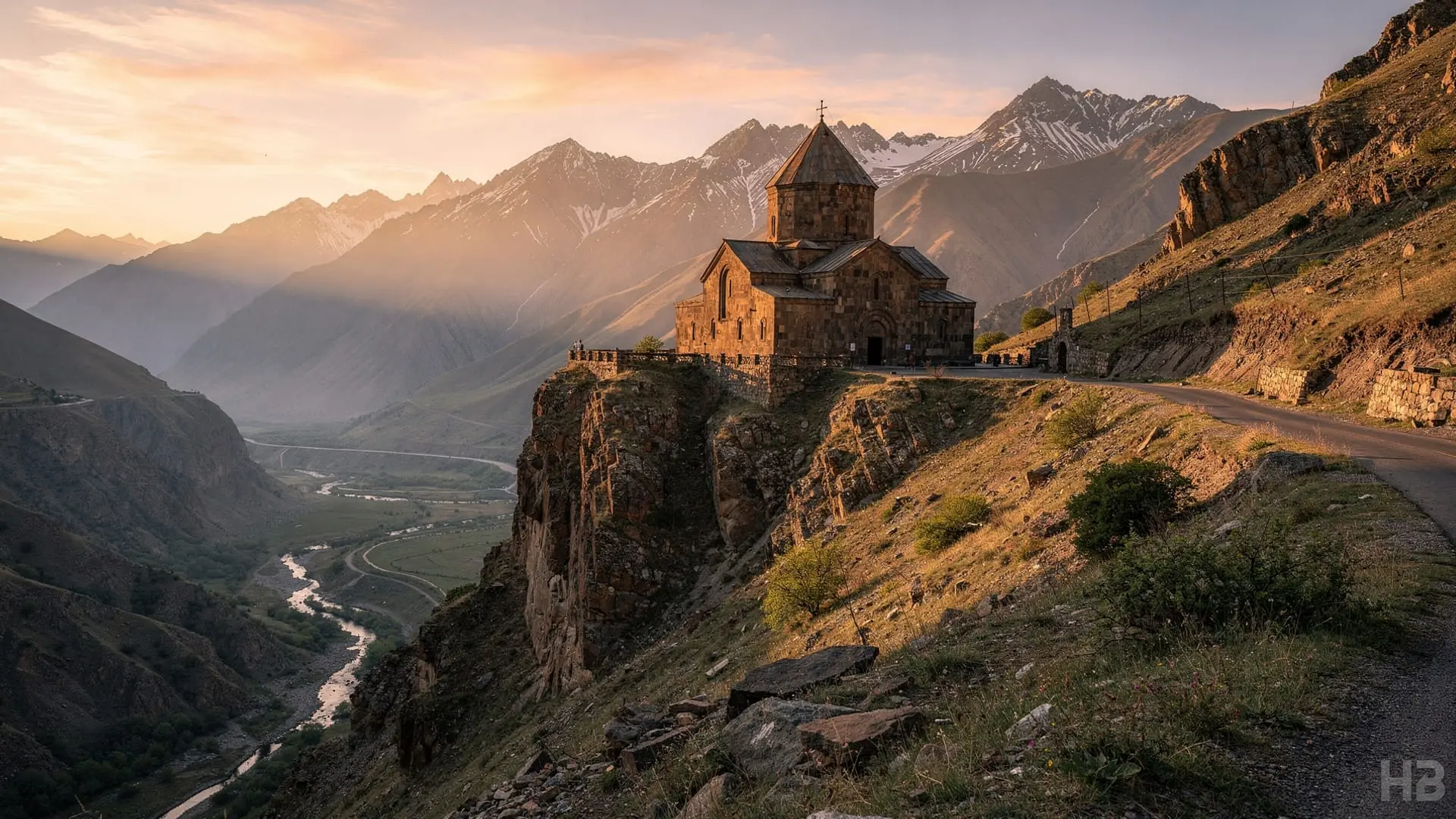
The spiritual heart of Armenia — and where it nearly ended
Armavir is the smallest and westernmost of Armenia’s provinces, occupying a flat agricultural plain between Yerevan and the closed Turkish border. The province contains two of the most significant sites in Armenian history — one still active at the centre of the nation’s spiritual life, the other in magnificent ruins — and a memorial to one of Armenia’s greatest military victories.
| Where | West of Yerevan, Ararat plain toward the Turkish border |
| Cost | Free entry at Etchmiadzin grounds and Zvartnots; Treasury museum small fee |
| Time needed | Half day to 1 full day |
| Getting there | Marshrutka, taxi, or guided tour from Yerevan (~30 min to Etchmiadzin) |
| Best time | Apr–Jun and Sep–Oct; Sunday mornings for cathedral liturgy |
Etchmiadzin (the city also known by its older name Vagharshapat) is the seat of the Catholicos of All Armenians — the head of the Armenian Apostolic Church. The cathedral of Holy Etchmiadzin, first built in 303 AD and continuously expanded over sixteen centuries, is the oldest national cathedral in the world according to the Armenian Apostolic Church’s own reckoning. It is on the UNESCO World Heritage List. A pilgrimage to Etchmiadzin is for many Armenians of the diaspora the primary purpose of visiting Armenia.
Twenty kilometres from Etchmiadzin, the ruins of Zvartnots Cathedral (7th century, also UNESCO listed) rise from the Ararat plain in a state of atmospheric collapse — enormous circular drum remains, carved capitals, and the suggestion of what must have been one of the most extraordinary ecclesiastical buildings in the medieval world.
And at Sardarapat, an hour’s drive from Etchmiadzin, the memorial to the 1918 battle where Armenian volunteers stopped the Ottoman army stands in open countryside — a muscular monument to the moment Armenia chose not to disappear.
Geography and getting there
By car: Vagharshapat/Etchmiadzin is 25 km from Yerevan, 30 minutes on the main westbound highway. Zvartnots ruins are 12 km from Etchmiadzin (near Zvartnots Airport). Sardarapat is approximately 50 km west of Yerevan, 1 hour.
By bus/marshrutka: regular minibuses from Yerevan to Vagharshapat (several departures per hour from Yerevan’s Western Bus Terminal, approximately 300–500 AMD). Zvartnots and Sardarapat require a taxi from Vagharshapat or a private vehicle.
By tour: Etchmiadzin and Zvartnots are among the most-covered sites on guided day tours from Yerevan — typically combined as a half-day (2–3 hours for both).
What to see in Armavir
Etchmiadzin (Holy Mother of God Cathedral)
The UNESCO-listed cathedral and its associated churches (St Hripsime, St Gayane) constitute the heart of Armenian Christianity. The main cathedral (4th–17th century) contains relics and treasures of the Armenian Apostolic Church including the Holy Lance (the spear said to have pierced Christ at the crucifixion) and a fragment of Noah’s Ark (from Mount Ararat). The Treasure Museum on the grounds displays further relics, illuminated manuscripts, and embroidered vestments.
Allow 2–3 hours for the cathedral complex, treasury, and the garden surroundings. Modest dress required. See /destinations/etchmiadzin/.
Zvartnots Cathedral ruins
Built by Catholicos Nerses III in the 640s–650s AD, Zvartnots (meaning “celestial angels”) was one of the grandest churches in the medieval Near East — a triple-tiered rotunda approximately 35 metres in diameter. It collapsed in the 10th century (earthquake) and was buried until 20th-century excavations revealed the remarkable survival of its carved lower sections. The ruins, set on the Ararat plain with both Ararat and Aragats visible on clear days, are among the most evocative archaeological sites in Armenia. UNESCO listed. See /destinations/zvartnots-cathedral/.
Sardarapat memorial
In May 1918, Armenian volunteer forces and civilians defeated an Ottoman army at Sardarapat (now Armavir) in a battle that preserved the existence of a recognisably Armenian-populated territory. The memorial, built in the 1960s–70s, is a striking piece of Soviet-era monumental architecture: twin walls carved with Armenian imagery, flanked by basalt eagle sculptures and a museum of ethnography and military history. Worth a visit for the memorial’s emotional impact and the museum’s display of traditional Armenian crafts and culture.
Metsamor archaeological site
Near the village of Metsamor, excavations have revealed an urban complex inhabited from approximately 4000 BCE through the 1st century AD — including an ancient observatory. Finds are in the on-site museum and in Yerevan’s History Museum.
How Armavir’s sites compare
| Site | Type | Time needed | Priority |
|---|---|---|---|
| Etchmiadzin cathedral | Active pilgrimage site | 2–3 hours | Essential |
| Zvartnots ruins | Archaeological/UNESCO | ~1 hour | Essential, easy add-on |
| Sardarapat memorial | 20th-century history | 1–1.5 hours | Worthwhile if time allows |
| Metsamor | Archaeological site | 45 min–1 hour | Only for specialists |
For most first-time visitors, Etchmiadzin and Zvartnots together make the core visit; Sardarapat is the natural third stop if you have the afternoon free. For the cathedral itself in more depth, see the Etchmiadzin mother cathedral guide, and for a combined route, the Etchmiadzin and Zvartnots day trip guide.
Best base
Yerevan is the obvious and practical base — Etchmiadzin is 30 minutes away, Zvartnots 40 minutes. There is no particular reason to overnight in Armavir province unless you are attending a major church festival at Etchmiadzin.
How long to spend
Half to one full day covers the main sites. Etchmiadzin cathedral (2 hours) + Zvartnots ruins (1 hour) = a solid half-day from Yerevan. Adding Sardarapat makes a full day.
Sample 1-day plan from Yerevan
- Morning: Etchmiadzin cathedral complex and Treasury (2.5 hours)
- Lunch: Vagharshapat — several restaurants near the cathedral
- Afternoon: Zvartnots ruins (1 hour) → Sardarapat memorial and ethnography museum (1.5 hours) → return Yerevan
Tours covering Armavir
For Etchmiadzin, Zvartnots, and Khor Virap combined: Khor Virap, Etchmiadzin, and Zvartnots private tour .
For a group tour covering the UNESCO churches: Etchmiadzin, Hripsime, Gayane, and Zvartnots temple tour from Yerevan .
Practical tips
Dress code: Modest dress is required at Etchmiadzin and the associated churches — shoulders and knees covered for both men and women; headscarves are appreciated for women but not always strictly enforced for visitors. See the Armenian Christmas and church customs guide for broader context on Armenian church etiquette if you’re visiting during a festival period.
Combining with the airport: Zvartnots is next to Yerevan’s international airport, which makes Etchmiadzin and Zvartnots a logical stop on arrival or departure day if you have a few spare hours and checked luggage isn’t an issue.
Currency: Cash is preferred at the smaller restaurants in Vagharshapat; the Treasury museum and larger cafés near the cathedral generally accept cards.
Frequently asked questions about Armavir province
Is Etchmiadzin the world’s oldest cathedral?
The Armenian Apostolic Church dates Holy Etchmiadzin’s founding to 303 AD, making it a strong claimant to the title of oldest national cathedral in continuous use. The claim is contested — several other early Christian sites make similar arguments — but the building’s continuous significance as the seat of the Catholicos since at least the 5th century AD is well-documented.
What is the difference between the Armenian Apostolic Church and the Catholic or Orthodox churches?
The Armenian Apostolic Church is one of the Oriental Orthodox churches — separate from both the Eastern Orthodox (e.g., Russian, Greek) and Roman Catholic traditions. The Armenian church rejected the Council of Chalcedon in 451 AD, which defined Christ’s nature differently from the Armenian position. It has its own patriarch (Catholicos), its own liturgical language (Classical Armenian, Grabar), and its own calendar. It is not in communion with Rome.
Can tourists attend services at Etchmiadzin?
Yes — services at the main cathedral and the associated churches are open to visitors. The main Sunday liturgy (typically at 10:00) is the most atmospheric. Photography is generally permitted outside services; be discreet inside.
Is Sardarapat worth visiting for non-Armenian visitors?
Yes, particularly for anyone interested in 20th-century history. The 1918 battle was one of the founding events of the short-lived First Republic of Armenia (1918–1920). The memorial is architecturally impressive and the ethnography museum provides one of the better overviews of traditional Armenian material culture outside of Yerevan.
Can Armavir be combined with a wine visit?
Not directly at the main sites, but the province borders Armenia’s western wine and orchard belt, and some tours pair Etchmiadzin/Zvartnots with a winery stop near Yerevan on the return leg. It’s less established than the Areni or Aragatsotn winery circuits, so check the specific tour itinerary rather than assuming it’s included.