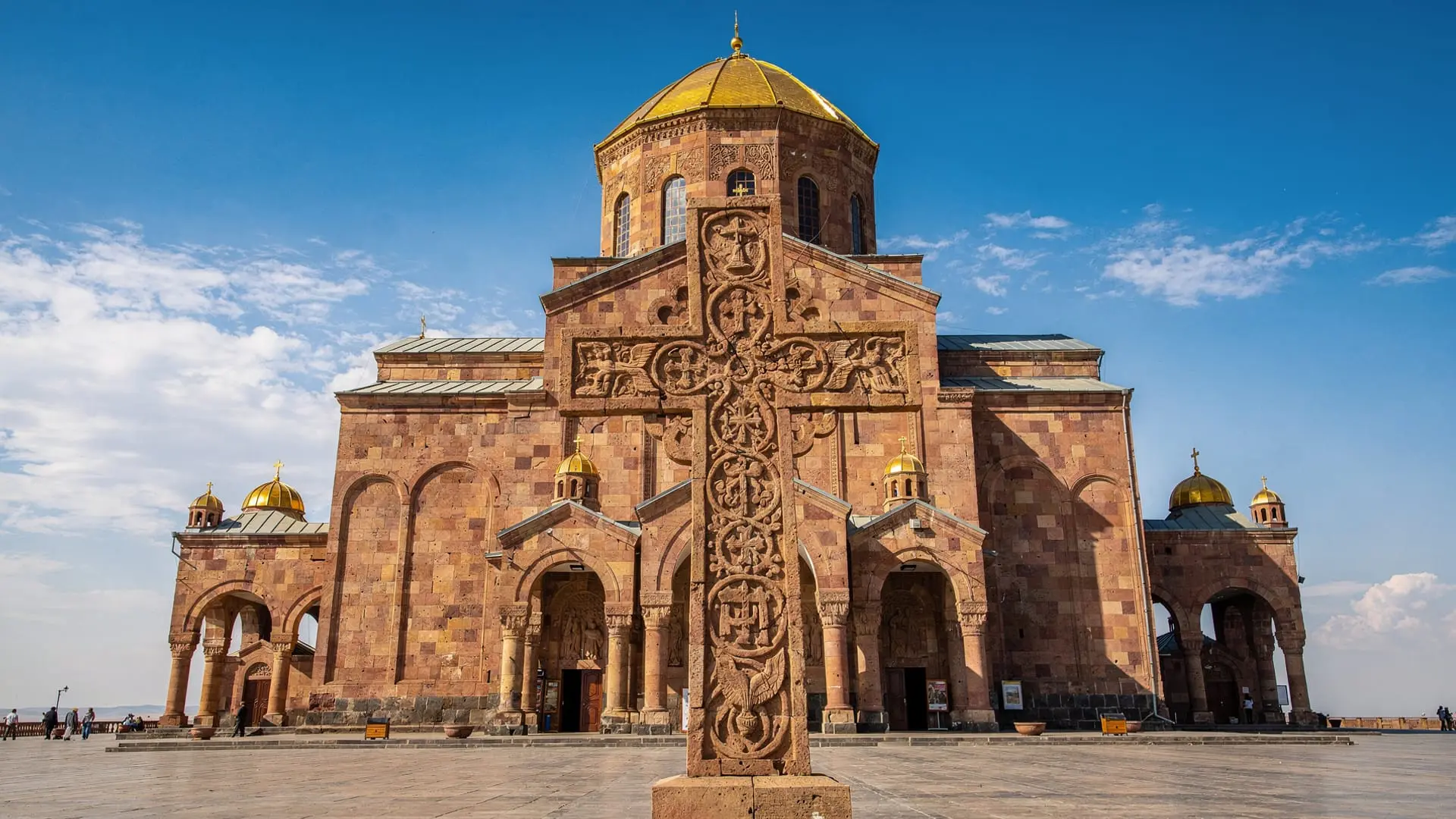
The mother church of the world’s oldest Christian nation
Etchmiadzin is not a tourist attraction. It is the seat of the Armenian Apostolic Church — the catholicos, the highest religious authority in Armenian Christianity, lives and works here. The 4th-century cathedral at its centre is widely claimed to be the oldest national cathedral in the world, built between 301 and 303 AD by Gregory the Illuminator on the site where, according to tradition, Christ himself descended and struck the ground with a golden hammer, indicating where to build.
That story is, of course, theological rather than historical. But the cathedral standing today is genuinely ancient — the oldest fabric dates to the 4th to 7th centuries — and the complex around it has been continuously active for 1,700 years. This is not a monument maintained for tourists. It is a living institution.
The official name of the city is Vagharshapat, though almost everyone uses the ecclesiastical name Etchmiadzin (also spelled Echmiadzin; both are accepted). It sits 25 km west of Yerevan in the Armavir province, easily reached in half an hour and best combined with the nearby Zvartnots Cathedral ruins.
A note on denomination: the Armenian Apostolic Church is Oriental Orthodox, not Eastern Orthodox, and has no communion with Rome. It is one of the most ancient Christian churches in existence, theologically distinct from both the Catholic and Russian Orthodox traditions. Visitors with a background in Western Christianity will find the liturgy and iconography genuinely different.
| Where | Vagharshapat, Armavir province, 25 km west of Yerevan |
| Cost | Grounds free; Treasury Museum ~3,000 AMD; Zvartnots ~3,500 AMD |
| Time needed | Half day (3–4h with Zvartnots, Hripsime and Gayane) |
| Getting there | Marshrutka from Kilikia (~30–40 min) or taxi/tour (~25 km) |
| Best time | Apr–Jun and Sep–Oct; feast days for atmosphere, expect crowds |
Getting to Etchmiadzin from Yerevan
By bus/marshrutka: Minibuses to Etchmiadzin depart approximately every 20–30 minutes from Yerevan’s Kilikia (Gai) Bus Station. Journey time: 30–40 minutes. Fare: around 200–250 AMD. Return buses operate until evening.
By car or taxi: 25 km along the main westward highway. A taxi return trip costs 7,000–10,000 AMD. GG Taxi is reliable for this route.
By guided tour: many half-day tours from Yerevan combine Etchmiadzin with Zvartnots Cathedral (7 km away). Some extend to include Khor Virap or Garni/Geghard. See tour section below.
From the airport: Etchmiadzin is only 10 km from Zvartnots International Airport (EVN) — easily combined with an arrival/departure if you have a few hours.
What to see in Etchmiadzin
Mother Cathedral (Surb Etchmiadzin)
The cathedral is undergoing careful phased restoration as of 2026 — some exterior facades may be scaffolded. Check current status. The interior retains its essential character: a cruciform plan with a central dome, muted frescoes (many 18th-century), and the altar area where liturgies are held daily.
The Treasury Museum, a separate building within the complex, houses the most significant relics: the spear of Longinus (supposedly the spear of Khor Virap legend), a fragment of Noah’s Ark, a piece of the True Cross, and the 5th-century Echmiadzin Gospel. The museum is small but contains genuinely extraordinary artefacts. Admission: 3,000 AMD (~7.30 €).
Church of Hripsime
A short walk from the main cathedral, this 7th-century church (618 AD) is one of the finest examples of Armenian ecclesiastical architecture in existence. Built over the tomb of Hripsime, a Christian martyr who fled persecution in Rome and was killed by King Tiridates, it has a clean geometric exterior and an interior of exceptional spatial intelligence. Admission free.
Church of Gayane
600 metres from Hripsime, this 630 AD church marks the tomb of another martyr, Gayane. Smaller and less visited, it is extraordinarily preserved — the original carved decoration on the stone door frames survives intact. Worth 20 minutes of your time.
Zvartnots Cathedral ruins
7 km east of Etchmiadzin (back toward Yerevan), the ruins of Zvartnots are a UNESCO World Heritage site in their own right. This 7th-century centrally-planned cathedral was one of the most ambitious structures in the early medieval Caucasus — about 35 metres high when complete, it collapsed in an earthquake around 930 AD. The excavated ruins and on-site museum convey the cathedral’s extraordinary scale. Admission: 3,500 AMD. Open daily except Monday.
Always combine Etchmiadzin and Zvartnots on the same trip — they are 15 minutes apart and complement each other beautifully.
Where to stay in Etchmiadzin
Etchmiadzin is a standard day trip from Yerevan. There is no compelling reason to overnight here. The city has a couple of basic hotels and a guesthouse near the cathedral, but Yerevan is 25 km away and has all price ranges.
Where to eat in Etchmiadzin
The city is a regional commercial centre and has several unpretentious local restaurants along the main avenue (Vagharshapati avenue) near the cathedral complex. These serve Armenian standards at lower prices than Yerevan restaurants.
Ararat Restaurant (near the cathedral) — the most-visited option for tour groups, decent quality, predictable menu.
For a better meal, eat at one of the small family restaurants on the back streets, where you’ll pay 2,500–4,000 AMD for a full lunch with drinks. Ask at your hotel or tour guide for a current recommendation.
Tours and tickets
Cathedral and complex: entry to the cathedral grounds is free. The Treasury Museum costs 3,000 AMD (~7.30 €). Zvartnots Cathedral ruins cost 3,500 AMD separately.
For a group-rate option that also includes a cooking class: Etchmiadzin tour with cooking class combines the UNESCO sites with an afternoon of traditional cuisine.
If you want to extend to Khor Virap on the same day: Khor Virap, Etchmiadzin, and Zvartnots private tour .
See our detailed guide /guides/etchmiadzin-mother-cathedral/ for the full theological and historical background.
Garni, Geghard, Echmiadzin and Zvartnots Private TourBest time to visit Etchmiadzin
April–June: excellent. Spring makes the walled garden of the cathedral complex beautiful, and the light on the pale stone facades is soft.
September–October: the best overall. Clear skies, lower crowds than summer.
Religious festivals: the most atmospheric times to visit are during major Armenian Apostolic feast days — Navasard (Easter, date varies), the Blessing of Grapes (Khaghoghapetoum, mid-August), and the Feast of the Holy Cross (Khachverats, mid-September). Pilgrims from the diaspora arrive in large numbers; the liturgies are elaborate and moving. The cathedral will be very crowded but the atmosphere is extraordinary.
July–August: hot and busy. The main season for diaspora pilgrimage.
Winter: quiet, few tourists. The cathedral is always open for worship.
| Time to visit | Atmosphere | Crowds |
|---|---|---|
| Regular weekday | Calm, contemplative | Minimal |
| Sunday liturgy (10:00–13:00) | Full congregation, elaborate ritual | Moderate |
| Feast days (Easter, Aug, mid-Sep) | Extraordinary, diaspora pilgrims | Heavy — book nearby accommodation ahead |
| Winter (Nov–Mar) | Quiet, cathedral always open | Lowest |
Practical tips
- Dress code: this is an active place of worship. Both men and women should cover shoulders; women are expected to cover their heads (scarves available at the entrance). Shorts are not appropriate.
- Photography: permitted in the grounds and exterior. Inside the cathedral, follow the guidance of clergy present — during services, avoid flash photography.
- Sunday services: the main liturgy on Sundays runs approximately 10:00–13:00. The cathedral fills with worshippers; visiting tourists are welcome but should behave accordingly (silence, no walking between groups of worshippers during the service).
- Combine with Zvartnots: always. 15 minutes by car, 3,500 AMD admission. The contrast between the intact UNESCO complex and the spectacular ruined one makes both more meaningful.
- Getting back from Etchmiadzin: the marshrutka to Yerevan departs from the main road near the cathedral until approximately 20:00.
See also: Etchmiadzin & Zvartnots day trip guide.
Frequently asked questions about Etchmiadzin
Is Etchmiadzin the oldest church in the world?
This is contested. The cathedral claims to be the oldest national cathedral and the oldest Christian cathedral in the world. Other contenders include churches in Syria, Jordan, and Egypt. What is certain is that continuous Christian worship has occurred on this site since 301–303 AD, making it one of the most historically significant Christian sites anywhere.
Is the Armenian church Catholic or Orthodox?
Neither, exactly. The Armenian Apostolic Church is Oriental Orthodox — one of the pre-Chalcedonian churches that split from both Catholic and Eastern Orthodox traditions after the Council of Chalcedon in 451 AD. It is autocephalous (self-governing), headed by the Catholicos of All Armenians based in Etchmiadzin. It is not in communion with Rome or Constantinople.
What are the relics in the Etchmiadzin treasury?
The Treasury Museum holds the Spear of Longinus (the lance of Khor Virap legend, possibly 4th century), a fragment of the True Cross, a piece of the Ark (tradition places Noah’s landing on Mount Ararat), and the Echmiadzin Gospel (5th century, one of the oldest illustrated Armenian manuscripts). The spear is particularly significant to Armenian Christians.
How long does a visit to Etchmiadzin take?
A thorough visit to the cathedral complex, Hripsime, Gayane, and Zvartnots takes 3–4 hours. If you include a lunch break, plan 5 hours from Yerevan return.
Can I attend a service at Etchmiadzin?
Yes. Daily services are held in the cathedral, with the main Sunday liturgy running from approximately 10:00–13:00. Visitors are welcome to attend as observers. Sunday morning brings the largest congregation and the most elaborate ritual.
Do I need to be religious to get something out of visiting?
No. The architecture, the Treasury Museum’s relics, and the sheer historical continuity of the site are compelling on secular grounds alone. Many visitors treat Etchmiadzin as a world-heritage architecture visit first and a religious site second — both approaches are welcome, provided you respect the dress code and behave quietly during active services.
Understanding Armenian Christianity: what Etchmiadzin represents
Etchmiadzin is not simply the headquarters of a church. It is the institutional embodiment of Armenian national and religious identity — the one continuous institution that survived the Mongol invasions, the Ottoman period, the Safavid wars, the Soviet era, and the Genocide. Understanding what that continuity means helps visitors engage with the site beyond the level of “nice old cathedral.”
Armenia’s claim to being the first Christian nation
Armenia converted to Christianity in 301 AD under King Tiridates III, through the ministry of Gregory the Illuminator. This makes Armenia the world’s first country to adopt Christianity as a state religion — about a decade before Constantine’s Edict of Milan in 313 AD (which legalised Christianity in the Roman Empire) and long before Europe’s broad Christianisation.
The claim is based on the royal adoption of Christianity as the official state religion, not merely its practice by a minority. The accuracy of the 301 AD date is broadly accepted by historians, though some scholars debate whether the process of Christianisation was as instantaneous as the tradition suggests.
For Armenians, this historical precedence is genuinely important — it is a foundation of national identity, particularly given the country’s subsequent history of persecution. The first Christian nation being subjected to genocide in the 20th century carries a specific theological and existential weight.
The Armenian Apostolic Church: doctrine and practice
The Armenian Apostolic Church follows Miaphysite Christology — the theological position that Christ has one unified divine-human nature, rather than the two natures (divine and human) affirmed by the Council of Chalcedon in 451 AD. This distinction separated the Armenian church from both the Eastern Orthodox and (later) Catholic traditions. The break with Chalcedonian Christianity was not merely theological — it was also connected to Armenian political circumstances in the 5th century, when Armenia was divided between Byzantine and Sassanid spheres of influence.
Practically for visitors: the liturgy is conducted in Classical Armenian (Grabar), which most modern Armenians cannot understand either. The priest faces the altar rather than the congregation for much of the service. Candles play a significant role. The music — traditionally chanted, with distinctive modal harmonics — is unlike anything in Catholic or Eastern Orthodox practice.
The church has approximately 9 million members worldwide, the majority being diaspora Armenians. It manages an extensive educational and charitable network globally.
The Catholicos: leader of the global Armenian church
The Catholicos of All Armenians, based in Etchmiadzin, is the supreme spiritual head of the Armenian Apostolic Church. The current Catholicos is Karekin II (elected 1999). A second Catholicos, based in Antelias (Lebanon), leads the Catholicosate of Cilicia — a historically parallel seat of Armenian church authority whose origins lie in the medieval Armenian kingdom of Cilicia (present-day southern Turkey). The relationship between the two Catholicosates is complex and reflects the diaspora’s divided geography.
Pilgrimage and diaspora tourism
Etchmiadzin is a pilgrimage destination for Armenian Christians worldwide, and the largest flows coincide with the Vardevar festival (mid-July, a water festival with ancient pagan origins), the Assumption of Mary (Astvatsatsin, August), and the Feast of the Holy Cross (Khachverats, September). During these festivals, diaspora Armenians from the United States, France, Lebanon, Syria, Russia, and elsewhere converge on Etchmiadzin. The city transforms. Accommodation within 30 km books solid.
For diaspora visitors, the visit to Etchmiadzin is often emotionally charged in ways that purely secular tourism cannot anticipate. For non-Armenian visitors, the diaspora pilgrimage periods offer a window into the living practice of the church that is more revealing than any typical tourist visit. See our diaspora heritage trip guide.
Zvartnots: the fallen cathedral
The Zvartnots Cathedral ruins, 7 km east of Etchmiadzin, deserve more than a brief paragraph. This was one of the most ambitious architectural projects of the early medieval Caucasus — a centrally-planned circular structure approximately 35 metres high (taller than most contemporary European churches), built between 643 and 652 AD by Catholicos Nerses III “the Builder.”
The technology was extraordinary: the central rotunda rose on a circle of columns, with a complex arrangement of galleries and staircase towers around it. The sculpted decoration on the surviving capitals and column bases shows influences from the Byzantine, Sasanian, and local Armenian traditions simultaneously.
An earthquake around 930 AD destroyed the cathedral. It was buried under its own rubble for nearly a millennium before 20th-century excavations revealed its plan. The on-site museum reconstructs the cathedral in model form and explains the archaeology. Walking through the cleared excavation — massive column drums, carved capitals, architectural fragments — gives a visceral sense of what was lost.
Admission: 3,500 AMD. Open daily except Monday. Always include it with Etchmiadzin.
Getting oriented within the walled complex
First-time visitors sometimes find the layout confusing on arrival, since the cathedral, Treasury Museum, seminary buildings, and Catholicos’s residence all sit within the same walled precinct without obvious signage distinguishing public from restricted areas. The practical approach: enter through the main gate facing the cathedral’s west front, visit the cathedral interior first (free), then the Treasury Museum (separate ticket, entrance on the south side), and finish with the walled garden between the cathedral and the outer wall — a quiet spot that many visitors miss entirely because it isn’t part of the standard tour route.
The Sardarapat Memorial
40 km east of Etchmiadzin near Armavir town, the Sardarapat Battle Memorial commemorates the May 1918 battle in which Armenian forces defeated a much larger Ottoman force, preventing the complete destruction of the remaining Armenian population of Eastern Armenia and making possible the short-lived First Republic of Armenia (1918–1920). The memorial itself — a pair of enormous winged bulls framing an axis leading to a bell tower — is monumental and impressive. The adjacent ethnography museum houses a surprisingly good collection of Armenian folk art, textiles, and material culture. A worthwhile 45-minute extension to an Etchmiadzin day trip. Admission: approximately 2,000 AMD.
What to buy in Etchmiadzin
The shops around the cathedral complex sell religious items (khachkars, crosses, candles, prayer beads), as well as the usual tourist souvenirs. Quality varies. For authentic craft items, the inside of the Etchmiadzin cathedral gift shop (run by the church) is more reliable than the street vendors outside the complex. Prices are modest.
Armenian cognac/brandy is also sold at shops near the complex — see the caveats in the Yerevan guide about counterfeit Ararat. Buy brandy at the Yerevan Brandy Company or in major supermarkets.
Etchmiadzin for non-religious visitors
Not every visitor comes for the theology, and that’s fine — Etchmiadzin rewards a purely secular visit too. The architecture spans nearly the entire history of Armenian church building, from the 4th-century core to 18th-century frescoes and modern restoration work, making it a useful crash course in Armenian ecclesiastical style before visiting more remote monasteries like Geghard or Haghpat. The Treasury Museum’s relics are genuinely remarkable objects regardless of belief, and the walled gardens between the churches are simply pleasant places to sit. Approach the site as you would any major world-heritage complex: respectful of active worship, but under no obligation to share the faith to appreciate what’s here.
Combining with the airport or a wider Armavir loop
Because Etchmiadzin sits only 10 km from Zvartnots International Airport, it works well bookending a trip — a few free hours before a late departure or after an early arrival are enough for the cathedral complex and Zvartnots ruins together. For those with a full day and a car, the wider Armavir province loop adds Zvartnots Cathedral, the Sardarapat Memorial, and — with more time — a detour toward Khor Virap for the classic Mount Ararat view, turning a half-day religious visit into a full day covering some of Armenia’s most historically significant sites in one province.