Lake Sevan’s quieter monastery
Most visitors to Lake Sevan go to Sevanavank, the monastery on the dramatic peninsula just above Sevan town. A smaller number make the short detour south along the western shore to Hayravank — and those who do generally find it a more atmospheric, less crowded experience.
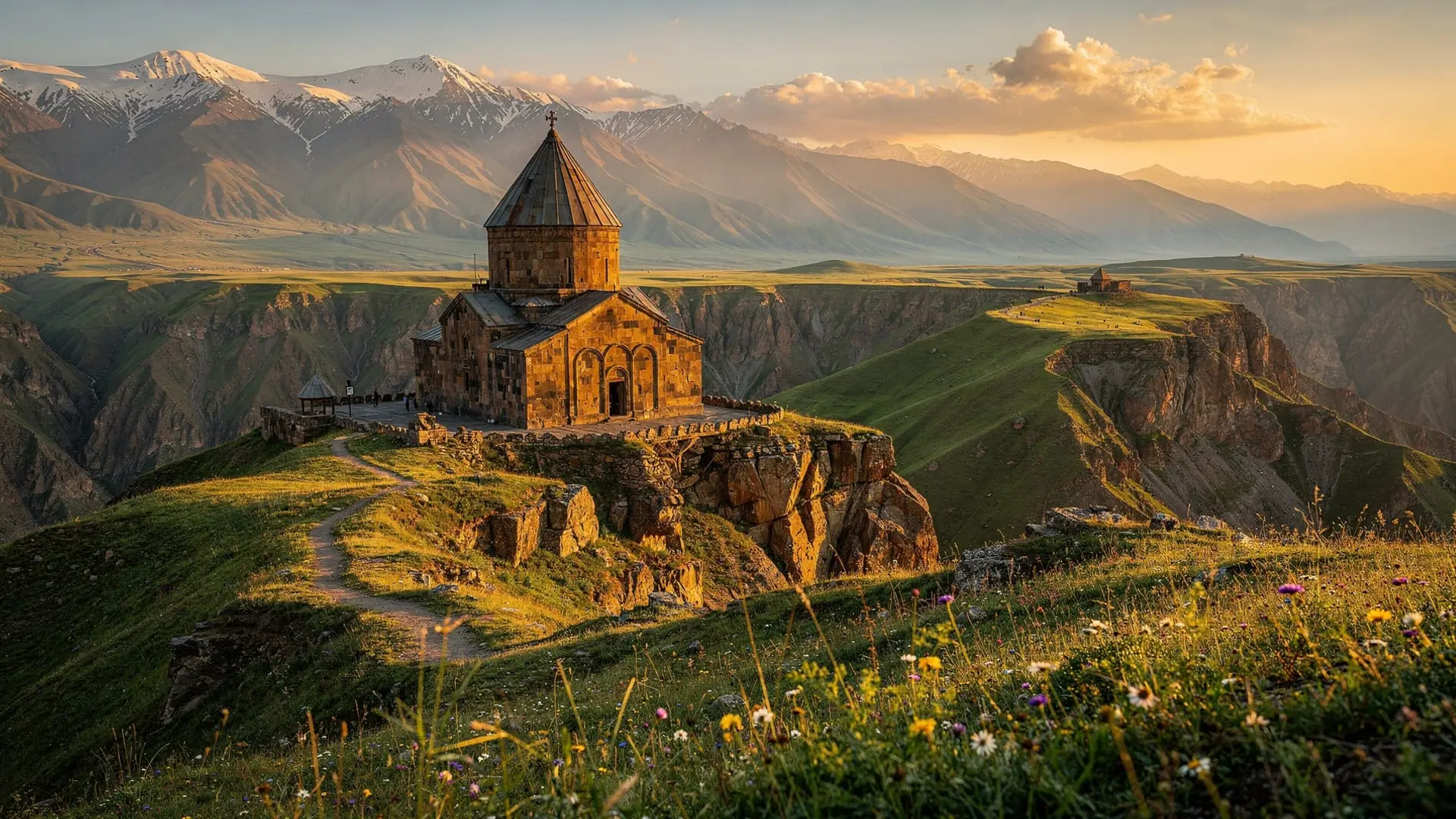
Hayravank monastery sits directly on the lakeshore about 25 km south of Sevan town, in the Gegharkunik province. The main church dates from the 9th century, making it one of the older surviving monastic structures on the lake. The setting is beautiful: the low stone buildings nestle against a hillside, with Lake Sevan filling the view below and the high mountains of the eastern shore visible across the water.
Where Sevanavank commands its peninsula with theatrical confidence, Hayravank is quieter and more intimate — a genuine monastic place rather than a tourist destination.
| Where | Western Lake Sevan shore, Gegharkunik province |
| Cost | Free admission |
| Time needed | 30–45 minutes at the site, 1.5 hours with the hillside walk |
| Getting there | Car (~1h20 from Yerevan) or taxi from Sevan town |
| Best time | May–October; mornings for the clearest lake light |
Getting there from Yerevan
By car: From Yerevan, take the M4 highway east (65 km, about 1 hour 15 minutes) toward Sevan town, then continue south on the M10 lakeshore road. Pass Noratus cemetery (10 km south of Sevan town) and continue another 10–15 km to Hayravank village and the monastery. Total from Yerevan: approximately 90 km, about 1 hour 20 minutes.
From Noratus: Hayravank is about 15 km south of Noratus cemetery. The two are almost always visited together on the same lakeshore day.
By marshrutka and taxi: Take a marshrutka from Kilikia station in Yerevan to Sevan town (600–800 AMD, 1–1.5 hours), then a local taxi south along the lakeshore. A taxi from Sevan town to Hayravank and back (with waiting time) costs approximately 4,000–6,000 AMD.
By guided tour: Hayravank is included in some extended Lake Sevan tours, particularly those that specifically mention the western lakeshore circuit. Confirm with operators.
What to see
The 9th-century church
The main church at Hayravank is a single-nave basilica typical of early Armenian ecclesiastical construction — compact, solid, with the characteristic cylindrical drum and stone cone roof of the period. The exterior stonework is simple and worn with age; the interior retains fragments of medieval fresco in the apse. The proportions are satisfying and the scale is intimate compared to the grander 13th-century monasteries elsewhere in Armenia.
Several khachkars stand against the church exterior wall — modest examples compared to Noratus, but authentic medieval carvings.
The lake panorama
The monasteries position on the hillside above the lakeshore gives an unobstructed panorama of Lake Sevan to the north, east, and south. On clear days the entire eastern shore mountain range — the high ridges of the Vardenis range — is visible across the water. The altitude at Hayravank is around 1,900 metres; the air is typically clear and the light on the lake brilliant in the morning.
This is one of the best vantage points on the western shore for lake photography, less frequented and therefore less likely to have tourist infrastructure cluttering the foreground.
The surrounding hillside
Above the monastery, a rough path climbs the hillside through dry grass and rock. A 20-minute walk up gives an even higher viewpoint over the monastery and the lake. This is not a formal hiking trail — it requires scrambling over loose stone — but it is accessible to reasonably fit visitors and the views repay the effort.
Hayravank versus the busier Sevan sites
If Hayravank is your first Sevan stop, it helps to know how it compares to the more visited spots on the lake. Our Lake Sevan complete guide covers the whole shoreline in depth, and the dedicated Sevanavank monastery guide explains why that peninsula site draws the crowds Hayravank avoids. For swimming rather than sightseeing, the best beaches on Lake Sevan guide points you toward quieter stretches of shoreline further from the tour-bus circuit — useful if you want to pair Hayravank with an afternoon swim.
Food is worth planning for too: Lake Sevan’s ishkhan trout is a genuine regional speciality, and a few lakeside restaurants near Sevan town and Martuni do it well. See our Sevan trout guide for where to eat it without paying tourist-trap prices.
How long to spend
Hayravank monastery takes 30–45 minutes to explore. Combined with the drive and a walk above the monastery, allow 1.5 hours. Combined with Noratus cemetery (15 km north) and Sevanavank (25 km north), the full western Sevan shore circuit makes a comfortable half-day from Sevan town or a full day from Yerevan.
Combining with other sites
Noratus khachkar cemetery (15 km north): Always combine Hayravank with a stop at Noratus cemetery — they are 15 km apart on the same road and the contrast (medieval carved stones at Noratus, lakeside monastery at Hayravank) gives the day good variety.
Sevanavank monastery (25 km north): The most famous Lake Sevan monastery is worth including for context — the two sites show very different aspects of Armenian monastic tradition. See the Gegharkunik province guide.
Selim Pass and caravanserai (40 km south): For those continuing inland, the Selim caravanserai (14th century, excellent condition) lies 40 km south over the Selim Pass — a dramatic mountain road that connects the Sevan basin to the Vayots Dzor wine region.
Jermuk (90 km south): Jermuk spa town is reachable in about 90 minutes south through Vardenis and over the mountains — a full-day addition for those with a car and time.
Tours and tickets
Entry to Hayravank monastery is free.
For the longer southern Sevan and Jermuk circuit: this group tour combines Hayravank, Noratus, the Selim caravanserai, a winery visit, and Jermuk waterfall — a long day that covers both the lake and the Vayots Dzor region.
To combine Lake Sevan with Dilijan in a northern arc from Yerevan: this full-day Lake Sevan and Dilijan group tour covers the northern lake and forest zone, and can be extended south to Hayravank with a car.
Practical tips
- Combination logic: always pair Hayravank with Noratus — they are 15 km apart and together give the best overview of the western Sevan shore in minimal driving time
- Entry: free and accessible at all times; the church may be locked but the grounds and khachkars are always visible
- Dress: modest clothing required for the church interior; bring a headscarf
- Road quality: the M10 lakeshore road between Sevan town and Hayravank is paved but may have sections under repair; allow extra time if conditions are unknown
- Facilities: no café or toilets at the monastery; Martuni town (8 km south) has basic services
- Photography: morning light (the monastery faces roughly east toward the lake) gives the best illumination on the stonework; the lake reflects light beautifully in morning and late afternoon
Frequently asked questions about Hayravank monastery
How old is Hayravank monastery?
The main church dates from the 9th century AD, making it older than most of the monasteries more commonly visited in Armenia (Geghard, Saghmosavank, and Hovhannavank are all 13th century). The site has been a place of worship for over 1,100 years.
Why is Hayravank less visited than Sevanavank?
Primarily because of geography. Sevanavank sits on a prominent peninsula directly above the main road from Yerevan, making it an unavoidable landmark. Hayravank requires a deliberate detour south along the lakeshore. Tour buses rarely go this far south on a standard Lake Sevan day trip. This is exactly what makes it more rewarding for independent travellers.
Is Hayravank an active monastery?
Services are held periodically, particularly on the feast day of the monastery’s dedication, but it is not a resident monastic community. The Armenian Apostolic Church administers the site.
Can I swim at Lake Sevan near Hayravank?
The lakeshore near Hayravank is accessible for swimming in summer (July–August, when water temperatures reach 18–22°C). The western shore around this area is less crowded than the beaches near Sevan town. There are no formal beach facilities.
How far is Hayravank from Yerevan?
Approximately 90 km, about 1 hour 20 minutes by car via the M4 highway and the M10 lakeshore road. It is a feasible half-day from Yerevan if combined with Noratus cemetery.
Is Hayravank a good stop with children?
Yes, in moderation — the monastery itself is small enough not to overwhelm young kids, and the lakeside setting gives them room to run around outside. The hillside scramble above the monastery is better suited to older children who can manage loose stone safely. For a fuller family-oriented plan around the lake, see our Lake Sevan with kids guide.