Tatev monastery & Wings of Tatev: complete guide
Why the journey to Tatev is half the experience
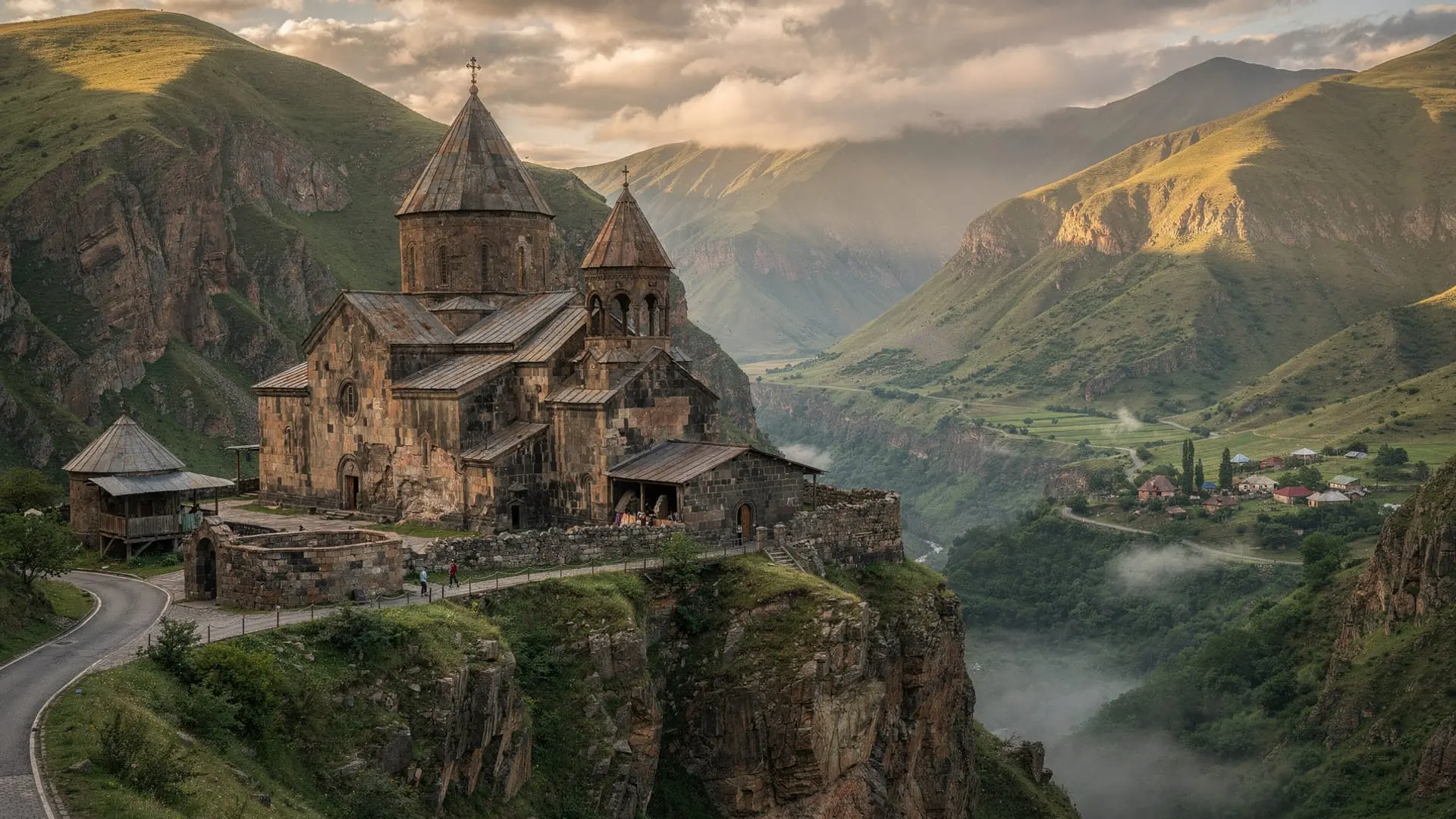
Tatev monastery sits on a basalt promontory above the Vorotan gorge in the deep south of Armenia, 250 km from Yerevan. Getting there takes the better part of a day, but that distance is the whole point. The monastery feels genuinely remote — a medieval university perched where the plateau simply stops, with sheer cliffs on three sides and an unbroken view across Syunik province. The Wings of Tatev cable car, which opened in 2010 and held the Guinness World Record for the longest non-stop reversible double-track cable car in the world, adds a theatrical modern layer to an ancient pilgrimage. Together, monastery and gondola form the single most visited site in southern Armenia.
| Where | Tatev village, Syunik province, 250 km south of Yerevan |
| Cost | Monastery free (donation customary); cable car around 7,000 AMD return |
| Time needed | 3–4 hours on site, including the cable car and Devil’s Bridge |
| Getting there | Car via Goris (4h from Yerevan) or organised day tour |
| Best time | May–October; arrive before 9:30am to beat cable car queues |
Why this monastery matters
Tatev was founded in the early 9th century and reached its zenith between the 10th and 14th centuries as the seat of the Syunik Catholicosate. At its peak it was home to more than 1,000 monks and functioned simultaneously as a religious centre, a fortress, a scriptorium, and the most important university in the medieval Caucasus. The philosopher-mathematician Hovhannes Vorotnetsi (1315–1388) and his student Grigor Tatevatsi (1346–1409) ran what historians call the Tatev University here — copying manuscripts, advancing Armenian scholasticism, and training clergy from across the Christian East.
The monastery is dedicated to Saints Paul and Peter (Poghos and Petros in Armenian). It belongs to the Armenian Apostolic Church, which is an Oriental Orthodox church — distinct from both Roman Catholicism and Eastern Orthodoxy, tracing its theological roots to the Council of Ephesus (431 AD) and the miaphysite Christology affirmed at Chalcedon (451 AD). Understanding this context matters: the monks at Tatev were not Orthodox in the Byzantine sense, nor Catholic — they maintained a separate apostolic tradition.
The location also served a strategic purpose. Tatev controlled the trade routes through the Vorotan Pass and acted as a refuge against Arab, Seljuk, and Mongol incursions. It was damaged multiple times and partially collapsed in the 1931 earthquake; restoration work continued through the Soviet period and accelerated after independence.
History in brief
- 895–906 AD: Construction of the Cathedral of Saints Paul and Peter under Prince Ashot II of Syunik. The main gavit (vestibule-hall) was added in the 10th century.
- 10th–14th centuries: Golden age. The library accumulated thousands of manuscripts. The Syunik Catholicosate operated here, separate from the main Catholicosate at Vagharshapat (Etchmiadzin).
- 1220s: Mongol raids damage the complex; monks flee briefly.
- 1344: The Gavazan Column — a 9-metre octagonal stele on a spherical base that pivots when pushed — is erected. It functioned as a seismic early warning system and as a signal tower.
- 14th–15th centuries: Hovhannes Vorotnetsi and Grigor Tatevatsi establish the university, writing prolific commentaries on Aristotle, theology, and natural philosophy.
- 1931: A major earthquake collapses part of the gavit and damages several structures.
- 2006–2010: The Wings of Tatev cable car project is engineered. The gondola opens on 16 October 2010 and immediately claims the Guinness World Record.
What to see at the site
Cathedral of Saints Paul and Peter: The oldest and largest structure (895–906 AD), built in classic Armenian basilica style using dark volcanic tuff. The khachkars embedded in the exterior walls date from the 12th to 14th centuries. Inside, look for the carved throne and the traces of original frescoes near the apse.
Church of Saint Gregory the Illuminator: A smaller, single-nave church to the north of the main cathedral, 11th century. Noteworthy for its proportional elegance and the carved decoration around the entrance.
Gavazan Column (Pap Gamach): The swivelling stele in the courtyard is one of the strangest and most photographed objects in all Armenian religious architecture. Push it gently — it actually moves, designed to rock with seismic tremors as an alarm. The inscriptions record donations and dedications from Syunik nobility.
The Oil Press Building: A partially restored medieval oil press in the northwest corner of the compound. It gives a sense of the monastic economy — Tatev was not only a place of prayer but a working agricultural institution.
Fortification walls: The monastery is enclosed by thick defensive walls, with one edge overhanging the gorge directly. Walk the inner perimeter for the vertiginous view into the Vorotan canyon some 300 metres below.
Devil’s Bridge (Satani Kamurj): A 15-minute drive from the upper cable car station, this natural stone bridge over a sulphurous stream is included in most organised tours. The sulphur-tinged water turns the travertine deposits bright yellow and orange — genuinely otherworldly.
Wings of Tatev lower station (Halidzor): The cable car departs from the village of Halidzor. The lower station has a café and a small exhibition about the engineering project. The ride itself is 12 minutes, at speeds up to 37 km/h, crossing towers above a 1,000-metre-deep gorge.
How to get there
By organised tour: Most visitors arrive on a day tour from Yerevan — a long day (13–15 hours), but the most practical option without a car. Expect to stop at Khor Virap, Noravank, and sometimes Areni winery en route.
Full-day Tatev monastery and Wings of Tatev tour from Yerevan From Yerevan: Full-Day Tatev Monastery Complex TourBy car: From Yerevan, take the M2 south to Goris (220 km, about 3h 30min). From Goris, it is 35 km to Halidzor and the lower cable car station (40 min). Total: roughly 4 hours driving. The Goris-Kapan highway was upgraded in recent years and is in reasonable condition. Fill up in Goris — petrol stations are sparse beyond.
By marshrutka: A daily marshrutka leaves from Yerevan’s Kilikia bus station to Goris (around 2,500 AMD, 5–6 hours). From Goris, share taxis or infrequent local marshrutkas run to Halidzor. Budget the whole day for onward logistics. Returning the same day from Goris by marshrutka is possible but tight — the last departure is usually around 16:00.
Cable car timetable and prices: The Wings of Tatev runs daily 09:00–18:00 (to 19:00 June–September). Closed for maintenance in November–early December (verify exact dates at the ticket office in Halidzor). Round-trip ticket: AMD 7,000 (approx. EUR 17). One-way: AMD 4,000 (approx. EUR 10). Children under 3 are free. The cable car can be closed by strong winds — inquire locally in advance.
Honest note on peak-season crowds: July and August bring heavy tourist traffic. The cable car loading area at Halidzor can have 45–60 minute queues from 10:00 to 14:00. Arrive before 09:30 or after 15:00, or visit in May, September, or October when the monastery is far less crowded and the light is better.
Photography and best light
Tatev faces roughly northeast, which means the monastery facade catches excellent light in the morning (08:00–11:00). The iconic shot of the cable car gondola crossing the Vorotan gorge with the monastery beyond is best from a viewpoint just below the upper station — ask the cable car staff where to walk. Golden hour light in September-October turns the basalt walls amber and the canyon walls copper-red.
For the interior, bring a wide-angle lens: the gavit space is low and dim. No tripod restrictions are enforced inside the monastery, though flash is considered disrespectful.
The lower gorge walk to Devil’s Bridge works well in any flat light; the sulphur pools are vivid regardless of sun angle.
Combining with other sites
Tatev fits naturally into a southern Armenia loop:
- Khor Virap (on the way south, ~50 min from Yerevan) — see Khor Virap monastery: views of Mount Ararat
- Noravank (2h from Halidzor) — see Noravank monastery: the red-cliff jewel
- Areni-1 cave and wineries (Vayots Dzor) — see the Areni destination guide
- Khndzoresk cave village (20 min from Goris) — the swinging bridge and cave dwellings make a striking pair with Tatev
- Shaki waterfall (45 min from Halidzor) — a 20-metre cascade near the Arpa river, uncrowded and photogenic
For a two-day southern loop, stay overnight in Goris. The town has solid guesthouses and one standout hotel — Hotel Mirhav, well-reviewed for clean rooms and a hearty breakfast. This allows a relaxed morning at Tatev before driving back north via Noravank and Areni.
See the Armenia classic 7-day itinerary which covers the full Yerevan–Tatev–Noravank loop.
Practical visit info
Entry to the monastery: Free for the monastery grounds. A small donation box is present near the main cathedral entrance — AMD 500–1,000 is customary.
Wings of Tatev cable car: AMD 7,000 return (EUR 17), AMD 4,000 single (EUR 10). Pay at the lower station ticket desk; card payment accepted.
Opening hours: The monastery itself is open daily from dawn to dusk. No fixed closing time — monks and visiting clergy set an informal rhythm. Best times are mornings and late afternoon. The cable car runs 09:00–18:00 daily (extended to 19:00 in summer).
Dress code: As an active monastery, modest dress is required. Shoulders and knees must be covered for both men and women. Headscarves for women are expected inside the cathedral; disposable scarves are available at the entrance gate. Loud noise is unwelcome during services (Sundays, 09:00–11:00 approximately).
Facilities: A small café operates at the upper cable car station. Basic toilets are available at both stations. No ATM at Halidzor — withdraw cash in Goris beforehand.
Accessibility: The monastery grounds are relatively flat but unpaved in places. The cable car itself is accessible for wheelchairs (the gondola has a ramp). The walk to Devil’s Bridge involves uneven terrain and is not accessible for wheelchairs.
Best season: May–October. November–March is possible (the monastery is especially atmospheric in snow), but road conditions between Goris and Halidzor can deteriorate in deep winter. Verify cable car operation before traveling in November.
Where to eat near Tatev
Dining options are limited around Tatev itself, which is part of why most visitors plan their main meal in Goris rather than at the site:
Halidzor (lower cable car station): A small café serves basic grills, khorovats, soup, bread, and cold drinks. Adequate for a quick lunch before or after the cable car, not a destination in itself.
Tatev village (on the plateau, above the monastery): A handful of family-run guesthouses serve home-cooked meals to guests and sometimes to passing visitors with advance notice — genuine southern Armenian cooking, simple and hearty.
Goris: The better option for a proper meal. Several restaurants in town serve regional specialities — grilled meats, khash in winter, the sour plum sauces distinctive to Syunik cuisine — at reasonable prices. Planning lunch or dinner in Goris rather than rushing a meal near the monastery makes for a more satisfying day overall — it also means you are not depending on the limited Halidzor café being open or well-stocked on a quiet day, which does occasionally happen outside peak season.
Syunik province: the deep south
Tatev is the anchor of Syunik province, the southernmost part of Armenia, and the visit there is also an introduction to the distinctive character of the region. Syunik (historically Zangezur) is the narrowest part of Armenia — a corridor of mountains and gorges that nearly separates Azerbaijan’s Nakhchivan exclave from the main territory of Azerbaijan, and through which the M2 highway provides Armenia’s only land connection to Iran.
The province capital is Goris, a pleasant town of 20,000 people with basalt-paved streets, a functioning civic centre, and a growing guesthouse scene. It is the natural base for exploring Tatev, Khndzoresk, and the Vorotan gorge area. The drive south from Yerevan passes through progressively more dramatic landscapes — the Vayots Dzor canyon country, the Jermuk highlands, and then the Syunik plateau with its bold volcanic ridges and deep gorges.
Syunik has the lowest tourist density of any region in Armenia outside the far north. Even in August, the roads are quiet compared to the Khor Virap-Noravank corridor. This sense of remoteness is a feature, not a bug.
Goris and accommodation options
Goris is 35 km from the Wings of Tatev lower station (Halidzor) and the most practical overnight base for a Tatev visit. Accommodation options:
- Hotel Mirhav (Komitasi 1, Goris): The most reviewed mid-range option. Clean rooms, reliable hot water, good breakfast, English-speaking staff. AMD 20,000–30,000 per night (EUR 49–73).
- Hotel Old Goris: A smaller guesthouse in the older part of town. AMD 15,000–20,000 per night.
- Guesthouses in Goris: Several family-run guesthouses offer rooms for AMD 10,000–15,000 per night with home-cooked dinner available for an extra AMD 2,000–3,000. Ask at the tourist information office.
Staying in Goris allows a morning departure to Tatev (arriving at Halidzor before the queue builds) and a relaxed afternoon return via Khndzoresk.
The Vorotan gorge and Devil’s Bridge
The Vorotan river flows through one of the deepest gorges in the South Caucasus before joining the Arpa. The Wings of Tatev cable car crosses this gorge; the experience of hanging above a 300-metre drop of sheer basalt while watching the river below is part of what makes the cable car more than just convenient transport.
Devil’s Bridge (Satani Kamurj) is a natural stone arch over a sulphurous stream about 15 minutes’ drive from the upper cable car station. The geological process that created it — calcium carbonate precipitation from the mineral-rich water — has also deposited bright yellow and orange travertine formations around the stream. The smell of sulphur is immediate on arrival. The site is included on most tour itineraries to Tatev; if you have independent transport, it is a self-guided 30-minute stop.
What surprises first-time visitors
A few details that don’t always make it into pre-trip research, gathered from repeated visits:
The scale is bigger than photos suggest. Most images of Tatev focus on the cable car crossing or a single church facade, which undersells how large the full complex is — multiple churches, a refectory, an oil press, defensive walls, and open courtyard space that together take genuine time to explore properly.
The wind on the plateau is a real factor. Tatev sits exposed at the edge of a cliff, and even on a calm Yerevan day the plateau can have a stiff, cold wind. Bring a layer regardless of season.
The cable car ride itself is not for everyone. The gondola sways noticeably over the gorge, and the 320-metre drop below is fully visible through the windows. Visitors with a strong fear of heights should know this in advance — there is no alternative seating position that avoids the view.
Sunday mornings mean an active service. Because Tatev remains a functioning monastery, arriving during the roughly 09:00–11:00 Sunday liturgy means sharing the cathedral with worshippers. Many visitors find this adds rather than detracts from the visit, provided they stay quiet and respectful, but it is worth knowing if you specifically want an empty church for photographs.
The Wings of Tatev cable car: engineering notes
The Wings of Tatev was engineered by Doppelmayr, the Austrian cable car manufacturer that builds most of the world’s significant gondola systems. Its vital statistics:
- Total length: 5,752 metres
- Height difference: 320 metres (upper station to lower station)
- Maximum speed: 37 km/h
- Travel time: approximately 12 minutes one way
- Capacity: 25 people per cabin
- Number of cabins: 2 (one going each direction)
- Towers: 3 intermediate towers
At peak season (July–August), each cabin makes approximately 12–14 round trips per day. With 25 passengers per cabin, the theoretical maximum daily capacity is around 700 one-way journeys. On busy Saturdays, this capacity is reached quickly — hence the queues.
The cable car is certified to continue operating in winds up to 50 km/h. In stronger winds, operations are suspended for safety. The route across the gorge is exposed; weather conditions can change rapidly.
Frequently asked questions about Tatev
How long should I budget for Tatev monastery?
Allow a minimum of 2 hours at the monastery once you arrive. Add 25 minutes for the cable car ride (each way). Factor in time for Devil’s Bridge (30 min) and the gorge viewpoints. In total, plan 3–4 hours on site. Combined with the drive from Yerevan, a Tatev-only day is a long 13–15 hour commitment.
Can I visit Tatev without taking the cable car?
Yes. A road winds down into the Vorotan gorge from the village of Tatev and back up to the monastery — about 8 km of switchbacks. In summer, shared taxis make this run. The road is rough but passable for most vehicles. However, the cable car ride itself is a significant part of the Tatev experience, and missing it to save AMD 7,000 is false economy.
Is there accommodation near Tatev?
The village of Tatev (above the monastery, on the plateau) has a small guesthouse (Hotel Anahit Tatev) and a few homestays. Goris, 35 km away, has more options including Hotel Mirhav and several guesthouses around AMD 15,000–25,000 per night (EUR 37–61). Staying overnight in Goris is the most practical base for an unhurried visit.
What is the Gavazan Column actually for?
The 9-metre Gavazan Column (literally “staff”) was erected in 1344 and serves a dual purpose. Its pivoting base detects earth tremors — the column visibly sways during seismic events, alerting monks. It also functioned as a signal beacon: pushing it hard enough would dislodge the oil lamp at its summit as a warning against approaching enemies. Modern visitors can push it and feel the pivot — it is not as fragile as it looks.
When was the Wings of Tatev cable car built and why?
Construction began in 2007 as part of a government-backed initiative to boost tourism in remote Syunik. The engineering was led by Austrian firm Doppelmayr. It opened on 16 October 2010 and entered the Guinness World Records that same day. Before the cable car, reaching Tatev required a rough road descent into the gorge that was impassable in winter — the cable car gave the monastery a reliable year-round access route and transformed visitor numbers almost overnight.
Is Tatev monastery still active?
Yes. A small community of monks and priests serves the cathedral. Regular liturgies are held on Sundays and feast days. The monastery is administered by the Diocese of Syunik of the Armenian Apostolic Church. Visitors are welcome but should behave with appropriate reverence during services.
How does Tatev compare to Geghard or Noravank?
Tatev is larger, more remote, and more historically significant as an institution. Geghard impresses with its rock-cut chambers and proximity to Yerevan. Noravank stuns architecturally with its double-staircase facade against red cliffs. For first-time visitors with one southern day, the Tatev–Noravank combination is hard to beat. For those with more time, all three reward individual visits. See Tatev vs Noravank: which monastery? for a direct comparison.
Is Tatev worth it if I can only spare one day from Yerevan?
Yes, but go in with realistic expectations about pacing — see the dedicated Tatev day trip from Yerevan guide for the full logistics of doing it in a single (long) day versus splitting it over two.
What should I wear inside the monastery?
Modest dress is expected at all times, not just during services: shoulders and knees covered for everyone, and a headscarf for women inside the cathedral (disposable scarves are provided at the gate if needed). Combine this with a warm layer for the plateau wind — the two requirements are easy to satisfy with the same light jacket or shawl.