Armenian dram (AMD): currency and money guide
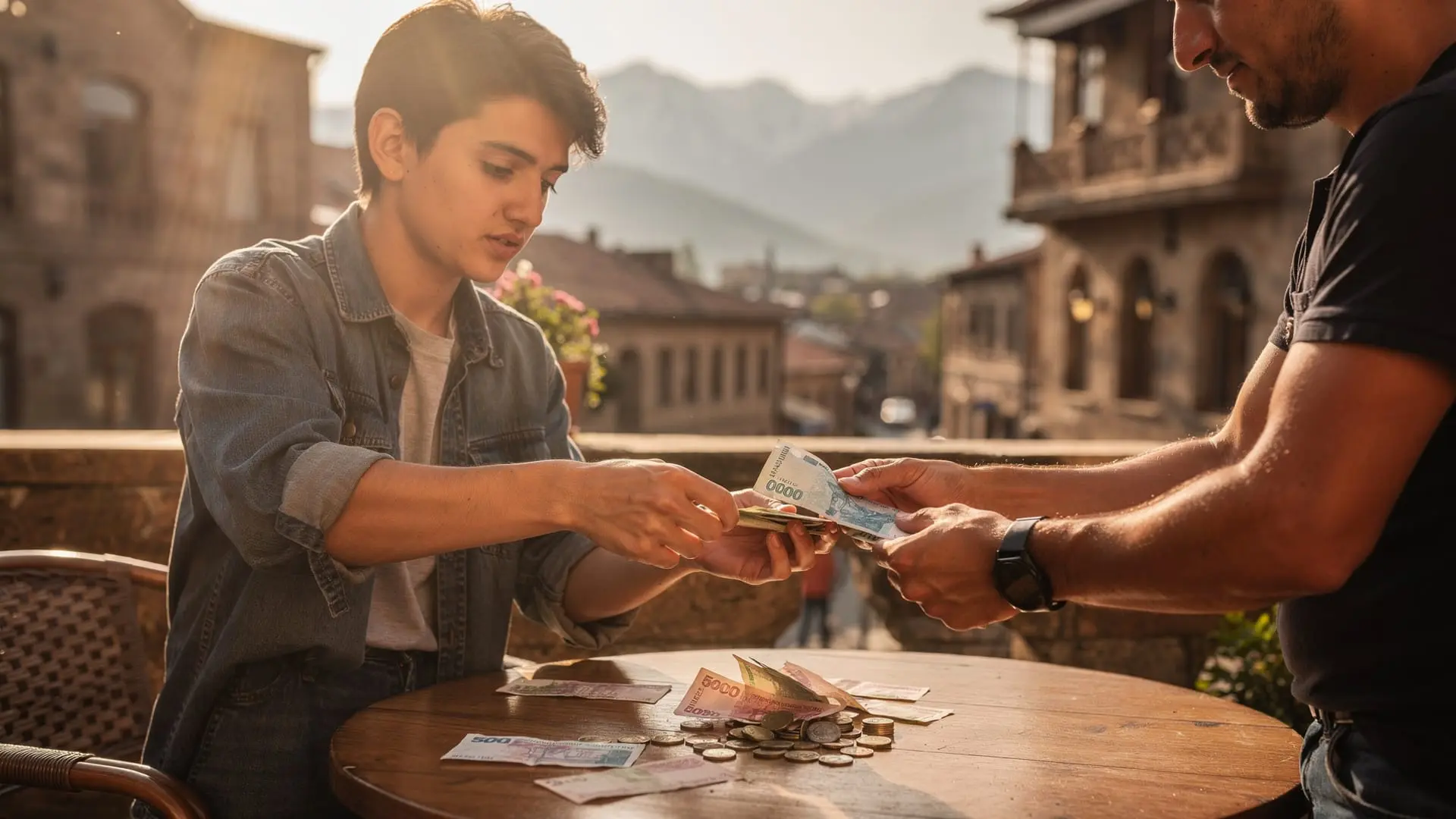
The Armenian dram: basics
The Armenian dram (symbol: ֏, ISO code: AMD) is the sole legal currency of the Republic of Armenia. It has been in use since 1993, replacing the Soviet ruble after independence.
Current exchange rate (April 2026 snapshot):
- 1 EUR = approximately 410 AMD
- 1 USD = approximately 385 AMD
- 1 GBP = approximately 490 AMD
- 1 CHF = approximately 430 AMD
These rates are snapshots and fluctuate. For the latest rate before your trip, check the Central Bank of Armenia (cba.am) or a reliable financial data source. The AMD has been relatively stable against the EUR and USD over the past two years but has experienced some volatility linked to regional factors.
Banknotes in circulation: 1,000 — 2,000 — 5,000 — 10,000 — 20,000 — 50,000 AMD
Coins: 10, 20, 50, 100, 200, 500 AMD (coins are rarely used in daily transactions above 500 AMD)
| Where | Bank branches and licensed counters in central Yerevan |
| Cost | ATM fees around 500–800 AMD/withdrawal at named banks |
| Time needed | 5–10 minutes at a bank or ATM; avoid airport queues |
| Getting there | Withdraw or exchange in the city, not at Zvartnots Airport |
| Best time | On arrival in Yerevan, before heading to rural areas |
Where to exchange money in Yerevan
Bank branches (best rates, safest)
Armenian banks offer the best exchange rates with no commission. The most traveller-friendly branches:
- Inecobank — multiple branches in Yerevan, including near Republic Square and Northern Avenue. English-speaking staff at main branches.
- Ameriabank — excellent rates, modern branches, widely distributed.
- ACBA Bank — strong rates, good ATM network.
- VTB Bank Armenia — convenient for those with VTB accounts, but available to anyone for cash exchange.
Bank hours are typically Monday–Friday 09:00–17:00, some Saturday until 14:00. Banks are closed on Armenian public holidays. Bring your passport — it is required for currency exchange.
Licensed exchange counters (“Match” and similar)
Yerevan has dozens of licensed private exchange counters. The “Match” brand is one of the most visible, with booths near Northern Avenue, Abovyan Street, and the metro stations. These are legal and generally offer rates very close to bank rates — the spread (difference between buy and sell) is how they earn their margin. Check the posted rate board before exchanging.
Rule of thumb: If the rate seems suspiciously good (more than 5–10 AMD per EUR better than competitors), ask for a full transaction receipt before handing over cash.
ATMs (most convenient)
ATMs are the simplest option for most travellers. Always use ATMs attached to named Armenian banks rather than standalone third-party machines, which charge higher fees. The following bank ATMs are recommended:
- Inecobank ATMs — low fees (typically 500–1,000 AMD per withdrawal), good rates
- Ameriabank ATMs — similar fee structure, widely available
- ACBA Bank ATMs — reliable, found in many commercial districts
ATM network coverage: Good in Yerevan and regional capitals (Gyumri, Vanadzor, Goris). Patchy in smaller towns. Non-existent at remote monasteries and villages. Always carry cash when leaving urban areas.
What to avoid
Zvartnots Airport exchange desks: The desks in the arrivals hall are convenient but typically offer rates 5–10% worse than city banks. Exchange only a small amount at the airport — enough for your taxi to the hotel — and get proper rates once in the city.
Street money changers: Unlicensed changers occasionally approach tourists near the Vernissage market or central streets. Never exchange money on the street. Counterfeit AMD banknotes have been reported in these transactions.
How to pay: cards vs. cash
Where cards work
Mastercard and Visa are widely accepted at:
- 3-star and above hotels in Yerevan
- Most restaurants and cafés in Yerevan’s tourist areas
- Supermarkets (SAS, Yerevan City)
- Larger shops
- Some tour operators
- Zvartnots Airport shops and restaurants
American Express is accepted at some premium hotels but is not reliable elsewhere.
Where you need cash
Cash (AMD) is essential for:
- Marshrutkas (all routes)
- Taxis (if not using GG Taxi app with card payment)
- Market vendors (Vernissage, GUM market)
- Village guesthouses and rural accommodation
- Church entrance fees where charged
- Monastery shops and gift stalls
- Small local restaurants outside Yerevan
- Petrol stations in rural areas
Practical rule: Withdraw sufficient cash for multi-day excursions away from Yerevan. Lake Sevan, Dilijan, and Goris have ATMs, but coverage becomes unreliable further south in Syunik or in Aragatsotn.
Contactless and mobile payments
Contactless (NFC) card payments are accepted at the same locations as chip-and-PIN. Apple Pay and Google Pay are increasingly accepted at Yerevan shops and restaurants that display the contactless symbol. This is expanding but not yet universal.
Sending money and remittances
Armenia has one of the highest remittance-to-GDP ratios in the world — a large diaspora sends money home regularly. Western Union, MoneyGram, and local services like IDram and Arca are available. For travellers, this is rarely relevant, but if you run short of funds, a Western Union transfer from home to a Yerevan branch can be received within minutes.
IDram is Armenia’s leading digital wallet, but it requires an Armenian bank account and phone number — not accessible to tourists without local setup.
Tipping and small change
Small denomination AMD notes (1,000 and 2,000 AMD) are useful for tips, small purchases, and buses. When receiving change at local shops, you may receive fewer small coins than expected — rounding is common. A 1,000 AMD bill (approximately 2.44 EUR) is a practical unit for daily transactions.
For the full tipping etiquette guide, see Tipping in Armenia: when, how much, and why.
Currency at borders
Crossing from Georgia (Bagratashen)
The Georgian lari (GEL) is the currency in Georgia. At the Bagratashen–Sadakhlo border crossing, there are often informal exchange booths on both sides. Rates at borders are typically worse than in cities. Georgian ATMs are available in Sadakhlo. If crossing into Armenia, change your GEL at a Yerevan bank rather than at the border.
What currency to bring from home
Euros and US dollars are the most practical foreign currencies to bring to Armenia. They are accepted at all exchange counters and banks without issues. British pounds are accepted at most banks but less widely at smaller counters. Other currencies (CHF, JPY) are generally exchangeable at main bank branches but not at all exchange counters.
Budgeting tips for different travel styles
Backpacker tip: Withdraw a larger sum at once to minimise ATM fees. The per-transaction fee at Inecobank is typically 500 AMD regardless of the amount — withdraw 100,000 AMD (244 EUR) rather than 20,000 AMD five times.
Mid-range tip: Keep a mix of card (for hotels and restaurants) and cash (for transport and markets). A daily cash float of 15,000–25,000 AMD is practical.
Luxury tip: Premium hotels and private guides can be paid by card. However, always have AMD cash for tips — guides and drivers strongly prefer cash tips over card gratuities.
For the full daily cost breakdown, see our Armenia budget travel guide.
Spending patterns in Yerevan vs rural Armenia
Understanding where cash is truly essential vs. where cards work helps you plan withdrawal strategy:
Yerevan card-friendly zones (carry 5,000–10,000 AMD as backup):
- Hotel payment at 3-star and above
- Restaurant payment in tourist areas (Northern Avenue, Cascade vicinity)
- SAS and Yerevan City supermarkets
- Northern Avenue shops and boutiques
Always use cash:
- Kilikia marshrutka station and marshrutka fares
- Vernissage and GUM market
- Monastery gift shops
- Village guesthouses and local restaurants outside Yerevan
- Any site more than 50 km from Yerevan centre
Cash cash cash (no card infrastructure whatsoever):
- Mountain trails, hiking starting points
- Remote monastery car parks
- Village wells, fruit sellers on the road
Dealing with large bills
A 50,000 AMD note (approximately 122 EUR) is a real inconvenience at a market stall or local café. When withdrawing from ATMs, try to get a mix of denominations. Some ATMs allow you to specify the denomination mix; others default to the largest notes available. If you receive large notes, break them at a SAS supermarket or larger restaurant before heading to markets.
Coin etiquette: Coins are technically in use but rarely encountered. Prices are routinely rounded to the nearest 100 or 500 AMD. Do not worry about coins — you will rarely see them in daily transactions.
AMD exchange rate history 2020–2026
Understanding how the Armenian dram has moved over the past six years gives context for the current rate and helps you assess whether a quoted rate is reasonable.
| Year | AMD per 1 EUR (approx) | Notable driver |
|---|---|---|
| 2020 | 530–560 AMD | COVID impact on remittances; regional uncertainty |
| 2021 | 520–540 AMD | Gradual recovery; 44-day Karabakh war created brief depreciation |
| 2022 | 390–450 AMD | Large inflow of Russian capital and individuals (post-sanctions); AMD appreciated sharply |
| 2023 | 400–430 AMD | Russian inflow continued; AMD maintained post-2022 strength |
| 2024 | 400–420 AMD | Gradual stabilisation; Karabakh displacement impacts minimal on AMD |
| 2025 | 405–415 AMD | Continued stability; Armenia’s economic resilience confirmed |
| 2026 (Apr) | ~410 AMD | Current snapshot used in this guide |
Key observation: The most dramatic AMD movement was the appreciation of 2022, when AMD strengthened from ~540 to ~390 per EUR as capital and individuals relocated from Russia to Armenia following the Ukraine war sanctions.
What this means for 2026 travellers: The AMD is in a stable, stronger phase than pre-2022. Do not base your budget on rates from friends who visited before 2022 — Armenia is more expensive in EUR terms than it was in 2019–2021. The Central Bank of Armenia (cba.am) publishes the official reference rate daily; licensed exchange counters operate within 3–8 AMD of that rate.
ATM fees comparison: Inecobank, Ameriabank, ACBA
Not all Armenian ATMs charge the same fees. The breakdown for the three most traveller-recommended banks:
| Bank | Fee per withdrawal | Network | Notes |
|---|---|---|---|
| Inecobank | ~500 AMD flat | Yerevan + regional capitals | Best for large withdrawals; English ATM interface |
| Ameriabank | ~500–700 AMD flat | Wide Yerevan + good regional | Accepts Visa, MC, Maestro reliably |
| ACBA Bank | ~500–800 AMD | Strong in Ararat/Armavir rural areas | Good fallback outside main cities |
| Standalone (non-bank) | 1,500–3,000 AMD | Shopping centres, hotel lobbies | Avoid — fee is shown only after card insertion |
Practical withdrawal strategy: Make two large withdrawals rather than many small ones. At 500 AMD flat fee, withdrawing 100,000 AMD twice costs 1,000 AMD in fees; withdrawing 20,000 AMD ten times costs 5,000 AMD — a 4,000 AMD (9.75 EUR) difference. Always keep an emergency cash reserve for days when you are far from an ATM.
Exchange shops in Yerevan with best rates
Avoid the airport exchanges first
As noted elsewhere in this guide, the exchange desks inside Zvartnots Airport arrivals hall (including the “Unibank” and independent booths) offer rates that are typically 5–10% worse than city rates. This matters: at a 5% penalty on 500 EUR, you lose 25 EUR before you have even reached your hotel. Exchange only the minimum needed at the airport — 10,000–20,000 AMD for your taxi — and get proper rates in the city.
Best exchange options in Yerevan
Bank branches (best rates): Inecobank on Northern Avenue, Ameriabank near Republic Square. Bring your passport — required by law for cash exchange.
“Match” exchange chain: Most visible licensed exchange chain in central Yerevan (booths near Northern Avenue metro, Abovyan, the Opera). Rates are 2–5 AMD per EUR below bank rates — acceptable for convenience. Avoid Match booths near Zvartnots Airport; these apply airport-level rates despite the city branding.
Cascade area exchange counters: Booths near the Cascade compete for tourist traffic and generally offer better rates than Vernissage-area vendors.
What to compare: Look at the “buy” rate for the currency you are selling. A 5 AMD difference per EUR on a 500 EUR exchange is 2,500 AMD — worth a five-minute walk.
USD, EUR, and RUB acceptance: the reality
USD and EUR
Widely accepted at Armenian exchange counters and banks. Both currencies trade easily anywhere in Yerevan. EUR is slightly preferred due to the large European tourism market; USD is equally accepted everywhere. Both are fine to bring from home.
Russian ruble (RUB)
The situation since 2022 has shifted dramatically. Before 2022, RUB was not commonly exchanged in Armenia. The Russian migration wave of 2022–2023 created a substantial demand, and licensed exchange counters in Yerevan now offer RUB exchange, sometimes at competitive rates. By 2026, RUB exchange remains available at most Yerevan bank branches and larger exchange counters. For travellers from Russia or with RUB savings, this is practical.
Caveat: Do not count on RUB exchange outside Yerevan. In smaller towns, RUB acceptance varies and rates outside the capital may be unfavourable.
Other currencies
- GBP: Accepted at banks and most exchange counters in Yerevan; less reliably at smaller booths. Bring EUR or USD as primary.
- CHF: Accepted at main bank branches; not universally available at exchange counters.
- JPY, CAD, AUD, NOK, SEK: Exchange possible at Inecobank and Ameriabank main branches, not at exchange counters. Plan accordingly — convert to EUR or USD before arriving in Armenia.
Contactless and POS adoption in 2026
Armenia’s contactless payment adoption has accelerated significantly since 2022. The general picture:
Yerevan tourist areas: Contactless via Mastercard or Visa works reliably at 3-star+ hotels, upscale restaurants, Northern Avenue shops, SAS and Yerevan City supermarkets, and many cafés. Apple Pay and Google Pay are functional where the NFC symbol is displayed.
Mid-range Yerevan restaurants and cafés: Card acceptance is near-universal; contactless is common but chip-and-PIN remains the reliable fallback if a tap fails.
Regional cities (Gyumri, Goris, Dilijan): Card terminals exist at hotels and better restaurants. Contactless less reliable. Cash increasingly necessary as you move from the restaurant sector to transport and local shops.
Rural and mountain areas: Cash only. No exceptions. Do not go to Tatev, Haghpat, or a village guesthouse without cash.
POS adoption at tourist sites: Some major sites (Wings of Tatev cable car, some Geghard area shops) now have card terminals. Others (many monastery gift shops, road-side vendors) are cash-only. Do not assume card acceptance at sites; carry 10,000–15,000 AMD minimum on day trips.
What to do with leftover AMD before departure
AMD is not convertible outside Armenia — the Central Bank of Armenia does not operate a significant international market, and foreign banks and exchange bureaus rarely hold AMD. Plan your withdrawals to minimise AMD surplus at departure.
If you have leftover AMD:
Re-convert at Yerevan: Inecobank and Ameriabank exchange AMD back to EUR or USD at current rates. Do this before heading to Zvartnots — airport booths offer worse rates.
Spend it strategically: The airport has SAS-branded shops and a duty-free where AMD is accepted. A final meal or a bottle of Armenian cognac can absorb 10,000–30,000 AMD of surplus.
Coins and small bills: Essentially useless outside Armenia. Spend at a supermarket or leave as housekeeping tips on your last morning.
Donating: Some NGOs at the airport collect AMD. A dignified option for small surpluses.
How to detect counterfeit AMD
Counterfeit AMD is uncommon from ATMs but does occur in informal street transactions. Key checks:
- Paper feel: Genuine AMD notes have a distinctive crisp texture; counterfeits feel slightly softer.
- Watermark: All notes above 1,000 AMD have watermarks visible when held to light.
- Security thread: A metallic thread embedded in the note appears as a dark line under light.
- Colour-shifting ink: The denomination numeral on 10,000 and 20,000 AMD notes shifts from gold to green at an angle.
- UV features: Fluorescent patterns appear under UV light; larger shops and banks keep UV lamps for this purpose.
All cash from Inecobank, Ameriabank, or ACBA ATMs is safe. Only check informal transactions.
Yerevan Brandy Factory: Armenian Brandy Tasting TourFrequently asked questions about Armenian currency
Can I use euros or dollars directly in Armenia?
In practice, some larger hotels and tour operators quote prices in EUR or USD and accept them directly. However, change is given in AMD at whatever rate the vendor sets (often unfavourable). For day-to-day transactions, AMD is what you need.
Is it better to exchange money before arriving in Armenia?
Not necessarily. AMD is not widely available outside Armenia, so you would typically exchange a foreign currency anyway. Bringing EUR or USD from home and exchanging at an Yerevan bank is the standard and most practical approach.
Are there any limits on how much cash I can bring into Armenia?
You may bring up to $10,000 USD equivalent in cash without declaration. Amounts above this must be declared at customs on arrival. There is no limit on how much you can withdraw from ATMs during your stay.
Is the Armenian dram worth anything outside Armenia?
Very little. Exchange your remaining AMD back to EUR or USD before leaving at an Armenian bank. Leftover AMD is difficult to exchange elsewhere. Keep this in mind and plan your cash withdrawals to avoid a large surplus at departure.
Can I get AMD at an international airport in my home country?
Most international banks and airports do not stock AMD. You will need to exchange on arrival in Yerevan or withdraw from an ATM there. This is perfectly practical — Inecobank and Ameriabank ATMs are in the arrivals area at Zvartnots Airport.
Does Armenia have a black market for currency?
No meaningful black market exists. The official rate at licensed exchange counters is competitive, and there is no gap wide enough to make unofficial exchange worthwhile. Stick to banks and licensed counters.
How much cash should I carry for a day trip outside Yerevan?
A practical minimum is 10,000–15,000 AMD for a standard day trip (Garni, Etchmiadzin, Khor Virap), and 20,000–30,000 AMD or more for a longer excursion to Tatev, Dilijan, or the Aragats highlands where ATMs thin out and guesthouses or rural restaurants may only take cash. See the Armenia budget travel guide for how this fits into your overall daily spend.
What’s the difference between paying a guide or driver in cash versus by card?
Guides and private drivers strongly prefer cash, and many independent operators have no card facility at all. If you’ve booked a tour through GetYourGuide or a similar platform, the tour cost itself is already settled by card at booking — but any tip, extra stop, or informal add-on requested on the day will need AMD cash.
Currency questions specific to a Georgia-Armenia trip
Travellers combining Armenia with Georgia in a single overland trip need to plan for two separate currencies with no meaningful crossover. Georgian lari (GEL) is not accepted in Armenia beyond informal border-crossing exchange, and Armenian dram is equally unusable once you’re in Georgia. The practical approach for a two-country trip is to withdraw local currency in each country as you arrive rather than trying to carry a surplus across the border, since the cross-border exchange booths at Bagratashen and other crossings offer noticeably worse rates than either country’s city banks. If your route runs Yerevan to Tbilisi or the reverse, budget a final AMD or GEL spend-down in the last city before crossing, and see the Yerevan to Tbilisi overland guide for the fuller border-crossing logistics beyond money alone.
Money logistics for a first-time visitor: a simple sequence
For travellers unsure where to start, the most reliable sequence is: withdraw a modest amount (20,000–30,000 AMD) from an Inecobank or Ameriabank ATM at Zvartnots Airport just to cover your taxi and first evening, then make a larger withdrawal (80,000–100,000 AMD or more) from a city-centre ATM the next day once you’ve settled in. This two-step approach avoids both the inconvenience of arriving with zero local cash and the higher per-transaction fee burden of many small withdrawals. Keep your passport handy for the rare occasion a bank requires it even for an ATM-adjacent counter transaction, and note your bank’s daily withdrawal limit before travelling, since some home banks cap international ATM withdrawals lower than Armenian ATMs will dispense.