Armenian Christmas (January 6): traditions for travelers
The date that sets Armenia apart
For most of the world, December 25 is Christmas. For Armenians, it is an ordinary day — perhaps marked by some shopping and the presence of Western cultural Christmas decorations, but not a religious holiday. Armenian Christmas, Surb Tsnund (Սուրբ Ծնունդ — Holy Nativity), falls on January 6, and this is one of the most distinctive features of Armenian Christian identity.
Understanding why requires understanding the history of the early Christian church — and Armenia’s unique position within it.
| When | January 6 (Christmas Eve service on the evening of January 5) |
| Where | Etchmiadzin Cathedral (main service) or Yerevan churches |
| Cost | Free to attend; no tickets or registration required |
| Getting there | GG Taxi (~3,000–4,000 AMD from Yerevan), marshrutka 106, or private transfer |
| Best for | Travellers interested in living Armenian religious tradition — book accommodation 6–8 weeks ahead |
Christmas season at a glance
| Date | Name | What happens |
|---|---|---|
| Jan 1–2 | New Year | Major secular holiday, gift-giving, fireworks, family dinners |
| Jan 5 (day) | Khtum | Strict fast day, quiet preparation |
| Jan 5 (evening) | Khostan | Christmas Eve candlelight service |
| Jan 6 | Surb Tsnund | Christmas liturgy, Andin water blessing, family meal |
| Jan 7–13 | Avagandyak | Continued visiting, eating, and celebration |
The theology: why January 6?
The early Christian church celebrated Theophany (the manifestation of God) on January 6. This was a unified feast combining three events: the birth of Christ, the visit of the Magi, and the baptism of Jesus in the Jordan. The date January 6 appears in early Christian sources as the original celebration.
During the 4th century, the Western church (Rome and its sphere of influence) gradually moved the nativity celebration to December 25, likely to align with existing winter solstice festivals and to differentiate Christian observance from pagan Roman holidays. The Eastern church followed over time. January 6 in the Western calendar became focused exclusively on Epiphany — the visit of the Magi.
The Armenian Apostolic Church did not make this shift. The church, which has been the national church of Armenia since 301 AD when Armenia became the first country to officially adopt Christianity, maintained January 6 as the combined feast of nativity and baptism. This was not an error or a deviation — it preserved a theological tradition that the Western church had moved away from.
The Armenian Apostolic Church is an Oriental Orthodox church — distinct from both the Eastern Orthodox churches (Russian, Greek) and the Roman Catholic church. It is autocephalous (self-governing), with its Catholicos based at Etchmiadzin Cathedral near Yerevan. This theological independence is part of why Armenian Christianity maintained its own liturgical calendar.
The Christmas season: December 31 to January 6
New Year (January 1–2)
Armenian Christmas exists within a broader holiday season that begins with New Year. January 1 is the major secular celebration — more culturally prominent than Christmas itself in terms of family gatherings and festivities. New Year in Armenia involves elaborate family dinners, fireworks, the figure of Dzmer Papik (Winter Grandfather), and decorated New Year trees in homes and public spaces.
The period January 1–2 is a national holiday and effectively gives way to a continuous holiday week culminating in Christmas on January 6. Banks, government offices, and most businesses are closed across this period.
January 5: Khostan (Christmas Eve)
The evening of January 5 is Khostan — Armenian Christmas Eve. The most important ceremony of the evening is the candlelight service at churches across Armenia. At Etchmiadzin Cathedral (the mother church of the Armenian Apostolic Church, located 25 km from Yerevan in Vagharshapat), this service draws thousands of worshippers and is broadcast nationally.
The tradition of lighting candles symbolises Christ as the light of the world. Churches are dark before the service, then gradually filled with the warm light of thousands of individual candles. The incense, the ancient Armenian sharakan (hymns), and the candlelight create an atmosphere that is genuinely unlike any other liturgical event.
For travellers: The Etchmiadzin Christmas Eve service is open to visitors who dress and behave respectfully. The service runs 2–3 hours. Arrive early (by 18:00 for an 18:30–19:00 service start) for a position from which you can see the altar. Photography is generally permitted from the congregation area, but be discreet.
See our Etchmiadzin guide for visiting information.
January 6: Christmas Day (Surb Tsnund)
Christmas Day begins with morning church services. The main Etchmiadzin liturgy on January 6 is the most attended church service of the Armenian year — even people who rarely attend services make the journey for Christmas morning. The service is conducted in Classical Armenian (Grabar), the liturgical language of the church, which is distinct from modern Eastern Armenian.
After the service, Armenian families gather at home for the Christmas meal. The traditional table is a specific composition:
- Trout (ishkhan): The Sevan trout — Armenia’s emblematic fish — is the centrepiece of many Christmas tables. Historically, Christmas fell in winter when fresh fish was a luxury that marked the occasion.
- Rice pilaf with raisins: Sweet dried fruit in rice is a distinctly Armenian flavour combination, Middle Eastern in origin but deeply embedded in the country’s food traditions.
- Gata: The sweet bread of Armenian celebrations — a layered pastry enriched with butter, sugar, and sometimes walnuts. Made in enormous quantities for Christmas and shared with neighbours.
- Dried fruits and nuts: Apricot, raisin, walnut, and almond platters represent abundance.
- Red wine: Armenian wine — and at Christmas, often brandy — accompanies the meal.
The table is set generously; Armenian hospitality philosophy treats any celebration as an occasion to feed guests until they cannot eat more.
Experiencing Armenian Christmas as a traveller
Where to attend the Etchmiadzin service
Etchmiadzin Cathedral (Vagharshapat), 25 km west of Yerevan, is the canonical venue. The complex includes:
- The 4th-century Cathedral (possibly the oldest cathedral in the world in continuous use)
- Several accompanying churches on the UNESCO-listed site
- A museum of Armenian ecclesiastical art
For Christmas Eve and Christmas morning services, marshrutkas run from Yerevan (Gai station, minibus 106) to Vagharshapat. GG Taxi or a private car is more comfortable for late evening.
Alternative Yerevan churches: Saint Gregory the Illuminator Church (near Republic Square, the largest Armenian church in Yerevan) and Saint Anna Church also hold Christmas services and are closer for those based in the city.
The January 6 atmosphere in Yerevan
Yerevan on January 6 is quiet and domestic — a city in its living rooms. The main public gathering places are churches in the morning. By afternoon, families are home and the city has a peaceful, post-celebration stillness. Restaurants in tourist areas remain open.
The combination of New Year decorations still up from December 31 and the Christmas candles creates a particular January atmosphere in Yerevan that is distinct from any other time of year.
January 7 and the week after
The period January 7–13 is Avagandyak — a week of continued celebration in Armenian tradition, visiting relatives and continuing to eat, drink, and mark the season. By January 13–14 (Old New Year by the Julian calendar, celebrated by some), the holiday season definitively ends.
December 25 in Armenia: what happens
Western Christmas on December 25 is not a public holiday in Armenia. Life largely continues normally — offices and schools may run adjusted schedules around the period, and international hotels and restaurants cater to foreign guests with Christmas menus, but Armenian society does not mark December 25 as a significant date.
This can be disorienting for travellers from Western Europe or North America who arrive in Yerevan on December 25 expecting the atmosphere of Christmas. The city is animated but for its own calendar: preparations for New Year on January 1, the culmination of which is what Armenians consider the major winter celebration.
If you are specifically interested in attending Armenian Christmas services and celebrations, plan your trip around January 5–6, not December 25.
Practical travel planning for Armenian Christmas
Accommodation: Book accommodation 6–8 weeks ahead for the January 1–7 period. New Year bookings fill up first; Christmas week (January 3–7) is slightly easier to find, but good options go quickly.
Business closures: Banks, government offices, and many shops close across the January 1–7 period. Stock up on cash before December 31 — ATMs are accessible but banking operations are suspended.
Transport: GG Taxi and private transport operate year-round. Marshrutka schedules may be reduced on January 1 and 6. Plan accordingly.
Etchmiadzin on Christmas Eve and Christmas Day: Extremely crowded. Hundreds of thousands of people travel from Yerevan. If driving, leave very early. If using public transport (marshrutka), expect standing room in the vehicle.
Historical roots: the Julian calendar and the Theophany tradition
The January 6 date is sometimes explained by reference to the Julian calendar — as if Armenian Christmas is simply “Orthodox Christmas” a day earlier. This is a misunderstanding. The calendar shift is not the primary reason.
When most Eastern Orthodox churches (Russian, Serbian, Georgian, Bulgarian) celebrate Christmas on January 7, they are marking December 25 on the Julian calendar, which runs 13 days behind the Gregorian. The Armenian Apostolic Church’s January 6 has a different logic entirely. It is the original Theophany date preserved from the undivided early church — the feast that Rome later split into Nativity (December 25) and Epiphany (January 6) while the Armenian church kept the unified celebration intact.
The Armenian church formally adopted the feast calendar at the Council of Dvin in 506 AD, when Armenian bishops explicitly maintained January 6 as a point of theological distinctiveness, partly as a response to Byzantine pressure to conform to the Roman Christmas-date calendar. The decision was simultaneously liturgical and political — a marker of Armenian ecclesiastical independence that has been maintained for fifteen centuries.
The Andin (Blessing of the Waters)
One of the least-known but most beautiful traditions of Armenian Christmas is the Andin (Անդեն) — the blessing of waters performed on January 6. The Theophany feast celebrates not only the nativity but also the baptism of Christ in the Jordan River, and the Andin ritual connects these two events.
After the main Christmas liturgy, the Catholicos or a presiding bishop performs a public blessing of water — historically in rivers or fountains, now typically in the consecrated water used in church ceremonies. The blessed water (called andin djur or holy water) is distributed to the faithful and taken home for blessings throughout the year, used to consecrate new homes, bless the sick, and mark significant family events.
In Etchmiadzin, the Andin is performed with considerable ceremony on January 6 afternoon, following the morning liturgy. Visitors who arrive for the morning service and remain through the afternoon witness this distinct ritual as a second act of Christmas Day.
Traditional foods of Armenian Christmas
The Christmas table in Armenia is specific, and knowing what to expect helps travellers engage with Armenian hospitality at its most generous.
Anushabur (Christmas pudding): The most distinctively Armenian Christmas food — a wheat berry pudding sweetened with sugar and honey, topped with pomegranate seeds, raisins, walnuts, and dried apricots. The name means “sweet soup” in Armenian, and its texture is somewhere between porridge and dessert. Armenian grandmothers prepare enormous pots of it; it is shared with neighbours and visitors throughout Christmas week. No single dish more clearly marks the Armenian table as Middle Eastern-influenced: the combination of grain, dried fruit, and nuts echoes the ashoura of the wider region while being distinctly Armenian in its proportions and presentation.
Gata: Armenia’s celebratory pastry — a laminated, enriched flatbread or layered pastry made with butter and filled with a mixture of flour, sugar, and butter (khoriz). Different regions make gata differently; the Yerevan style tends to layered and rich, while Gyumri and Lori produce drier, biscuit-like versions. At Christmas, gata is made in large batches and given as gifts. Bakeries across Yerevan sell it from late December; the smell of fresh gata in a Yerevan market is one of the most immediately Armenian experiences available.
Harissa: The Armenian national dish — a thick porridge of wheat berries and shredded chicken or lamb, slow-cooked for hours until the grains dissolve into the meat. Harissa appears at almost all significant Armenian celebrations including Christmas, Easter, and commemorations. For the full food culture guide, see khorovats (Armenian BBQ) and the dolma tradition. It requires planning: the cooking process takes six to eight hours of stirring. At Christmas, harissa is often prepared communally, with families taking turns stirring through the night before Christmas Day.
Trout (ishkhan): Sevan trout (ishkhan) has been the prestige fish of the Armenian table for centuries. At Christmas — historically a winter fast-break occasion — serving ishkhan marked prosperity and celebration. Modern Armenian supermarkets carry it year-round; at Christmas the demand spikes and quality is highest.
How Yerevan and Etchmiadzin celebrate differently
The Christmas experience in Yerevan and Etchmiadzin is distinct enough that travellers should make a deliberate choice:
Etchmiadzin is the theological centre. The Cathedral of Holy Etchmiadzin (Surb Etchmiadzin), where the Catholicos presides, is the site of the most important ceremonial liturgy of the year. The Christmas Eve (Khostan) service and Christmas morning liturgy here are as close to unaltered ancient Armenian liturgy as any living tradition can be. The Cathedral fills with worshippers, bishops in elaborate vestments, the smell of incense, and the sound of the Etchmiadzin choral ensemble performing sharakan hymns — some of which have been in continuous use since the 5th century. The setting — a 4th-century cathedral that may be the oldest in continuous use anywhere in the world — amplifies everything.
Yerevan has a more urban, civic character to its Christmas. Saint Gregory the Illuminator Church (near Republic Square) and Surb Anna Church hold services that are more accessible in terms of crowd management. The streets of Northern Avenue and Republic Square retain New Year illuminations through January 6. Restaurants offer Christmas menus. The atmosphere is festive rather than exclusively devotional.
For travellers: If you can do one, do Etchmiadzin. The 30-minute taxi ride from central Yerevan is a small logistical step that produces a categorically richer experience. If mobility is limited or the crowd pressure of Etchmiadzin on Christmas Day feels daunting, Saint Gregory the Illuminator in Yerevan provides the same liturgical experience in a more manageable setting.
Can tourists attend the liturgy at Etchmiadzin?
Yes. The Armenian Apostolic Church welcomes visitors. No admission charges, no registration, no dress code beyond modest clothing (shoulders covered).
Photography: Permitted in the Cathedral during the service but requires judgment. Phone flashes off; video on silent in the back areas only. Do not move through the congregation for better angles while the liturgy is in progress.
Behaviour: The liturgy is in Classical Armenian (Grabar) and involves extended standing — the Cathedral has no pews in the main nave. Follow the congregation’s movements, remain quiet, and treat the service as an experience, not a spectacle. Duration: two to three hours.
January 5 fast (Khtum): The day before Christmas Eve is a strict fast day (no meat, no dairy for observant families). Visitors staying with Armenian hosts should expect a frugal January 5 meal. It is a day of quiet preparation.
Gift-giving traditions and New Year versus Christmas
Unlike Western traditions where Christmas is the primary gift-giving occasion, Armenian gift exchange happens primarily at New Year (January 1). Children receive gifts from Dzmer Papik (Winter Grandfather — the Armenian equivalent of Father Christmas) on the evening of December 31 or the morning of January 1. Christmas Day (January 6) is focused on family, liturgy, and food rather than presents.
This means that visiting Armenia in the week between December 31 and January 6 reveals an interesting layering: the secular, gift-giving, fireworks-and-music celebration of New Year at the start, giving way to the more devotional, food-centred, quieter celebration of Christmas at the end. Both are genuine, and the transition from one to the other across the holiday week is part of what makes an Armenian winter trip coherent.
Private Tour: Echmiadzin, Treasure museum & Zvartnots TempleThe broader significance: Armenia as the first Christian nation
Armenia’s declaration of Christianity as the state religion in 301 AD makes it the first country in the world to officially adopt Christianity — predating the Roman Empire’s conversion under Constantine by over a decade. This history gives Armenian Christianity a particular depth and distinctiveness that January 6 both symbolises and preserves.
Visiting Armenia at Christmas is visiting a country whose relationship with Christianity is not a recent import or a cultural overlay — it is an identity forged over 1,700 years, embedded in the alphabet (invented to translate the Bible), the monastery architecture (found in every province), and the January 6 liturgy that has been continuous since the 4th century.
For more on this heritage, see our Armenian Apostolic Church explained guide and the Etchmiadzin mother cathedral guide.
Christmas outside Yerevan: Gyumri and the regions
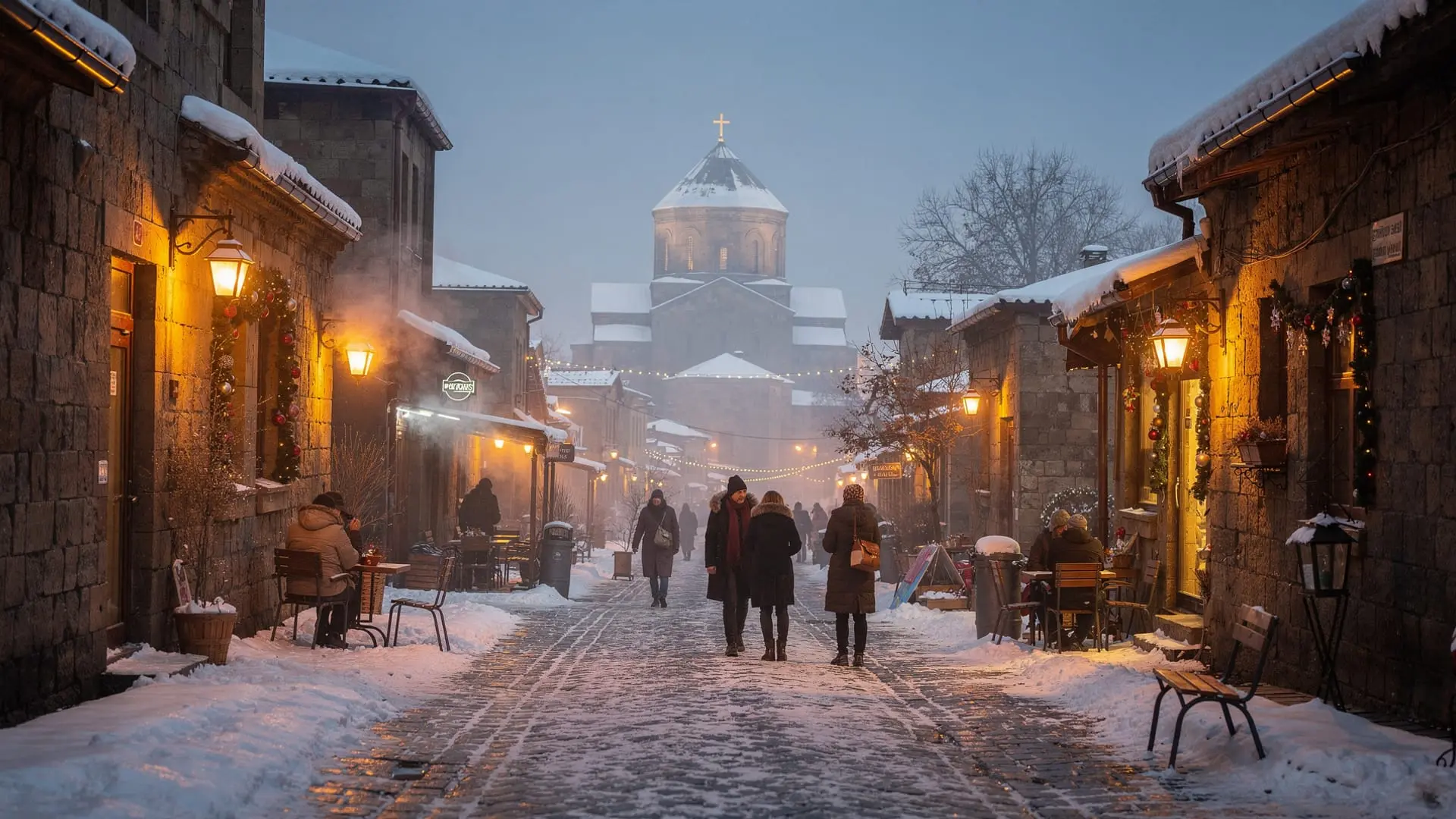
Yerevan and Etchmiadzin dominate most Christmas coverage, but Armenian Christmas has real regional character worth knowing about if your trip extends beyond the capital. Gyumri, Armenia’s second city and its acknowledged cultural capital, has its own distinct Christmas atmosphere — the 19th-century black-tuff architecture of the old town takes on a particular character under string lights and snow, and the city’s churches (several rebuilt after the devastating 1988 earthquake) hold their own well-attended services. Gata in Gyumri tends toward a drier, more biscuit-like style than the rich layered Yerevan version, and trying both across a single trip is a small but genuine way to taste regional variation in a single national tradition. Families in Lori and Tavush provinces, closer to the forested north, often extend the Avagandyak visiting week with more home-to-home visiting than is typical in the capital, reflecting a village social structure where everyone genuinely knows their neighbours.
Armenian Christmas in the diaspora
For the estimated 8–10 million ethnic Armenians living outside Armenia, January 6 is celebrated with notable consistency across very different countries — Armenian Apostolic parishes in Los Angeles, Beirut, Buenos Aires, Paris, and Moscow all hold Khostan and Christmas Day liturgies on the same dates as Etchmiadzin, often coordinated loosely with the mother church’s calendar. Anushabur, gata, and the trout-and-rice table appear on diaspora tables just as they do in Armenia, frequently prepared by families who have never visited the country but maintain the recipes as a form of cultural transmission. For travellers of Armenian descent, timing a first visit to Armenia around January 6 can be a particularly resonant choice — attending the liturgy that grandparents or great-grandparents once attended before emigration adds a dimension that a summer sightseeing trip does not replicate.
Pairing a Christmas visit with Armenian food culture
A Christmas trip is, among other things, one of the best possible introductions to Armenian food, since the holiday table concentrates so much of the country’s culinary identity into a single week. If the anushabur, gata, and harissa described above whet your appetite, the Armenian food essential dishes guide is the natural next stop for a fuller picture of the cuisine beyond the holiday table. Christmas morning in Armenian households is also, invariably, accompanied by strong Armenian coffee served after the meal — see the Armenian coffee (soorj) tradition guide if the ceremony and etiquette around it interest you, since it differs meaningfully from Western or Italian coffee customs and is worth understanding before you’re handed a cup at someone’s table.
Frequently asked questions about Armenian Christmas
Do Armenians exchange gifts on January 6 or January 1?
Gift-giving in Armenia is primarily associated with New Year (January 1) rather than Christmas (January 6). Children receive gifts from Dzmer Papik on New Year’s Eve or morning. Christmas Day is more about family, food, and church than about presents.
Is Armenian Christmas the same as Orthodox Christmas (January 7)?
No. Russian Orthodox, Serbian Orthodox, Georgian Orthodox, and other Eastern Orthodox churches celebrate Christmas on January 7 (as December 25 on the Julian calendar). Armenian Christmas is January 6 — a different date and a different theological basis (Theophany combining nativity and baptism, not just nativity).
Can I celebrate both Western Christmas and Armenian Christmas if visiting Armenia in late December and January?
Yes. Arriving around December 28–31 lets you experience the New Year celebrations; staying through January 6 includes Armenian Christmas. This 10-day window covers the peak of the Armenian winter holiday season.
Are there public decorations for Armenian Christmas?
Yerevan’s Christmas decorations — lights on Northern Avenue, tree on Republic Square, festive shopfronts — go up in mid-December and are primarily associated with New Year rather than specifically with January 6. They remain up through the entire holiday season.
Is January a good time to visit Armenia for a non-religious traveller?
Yes. Even without attending services, Yerevan in January has its own appeal: low prices, no tourist crowds, festive atmosphere in early January, good restaurants, and the distinctive experience of seeing the city in its most local mode. The cold requires preparation but is manageable with proper clothing.
Should I book a guided tour for the Christmas services, or go independently?
Both work. Going independently by taxi is straightforward and lets you set your own timing, particularly for the less crowded January 6 morning liturgy. A guided tour, such as a private Etchmiadzin visit, adds context on the theology and architecture that is easy to miss without a knowledgeable guide, and takes the logistics off your hands on what can otherwise be a stressful, high-traffic day.
What is the Andin ceremony?
The Andin is the blessing of waters performed on January 6, marking the baptism of Christ in the Jordan River — the second event commemorated by the Theophany feast. Holy water blessed during the ceremony is distributed to the faithful for use throughout the year. The ceremony follows the morning liturgy at Etchmiadzin and at churches across Armenia.
What is anushabur and where can I try it?
Anushabur is a sweet wheat berry pudding topped with pomegranate seeds, raisins, walnuts, and dried apricots — the most distinctively Armenian Christmas dessert. Armenian families make it at home in December–January. During Christmas week, some traditional restaurants in Yerevan and cafés near Etchmiadzin serve it; asking at traditional family-style restaurants (like Tavern Yerevan or Lavash) in early January is the best approach.
How do I get from Yerevan to Etchmiadzin for Christmas services?
GG Taxi from central Yerevan to Etchmiadzin takes 30–40 minutes and costs approximately 3,000–4,000 AMD (7–10 EUR). Marshrutka 106 from Gai station runs to Vagharshapat (Etchmiadzin) and costs around 200–300 AMD but operates on a reduced schedule on public holidays. For Christmas Eve (January 5 evening), GG Taxi is the reliable option. Book a return ahead of time — demand is very high at Christmas.
Is Christmas a good time to visit Gyumri as well as Yerevan?
Yes, if your trip allows the extra day. Gyumri’s Christmas atmosphere is quieter and more local than Etchmiadzin’s, and the city’s 19th-century architecture (see the Gyumri architecture and cultural capital guide) is genuinely beautiful under snow and string lights. It works well as a day trip by train from Yerevan or as an overnight extension for travellers with 7 or more days over the holiday period.