Etchmiadzin: the mother cathedral of Armenia
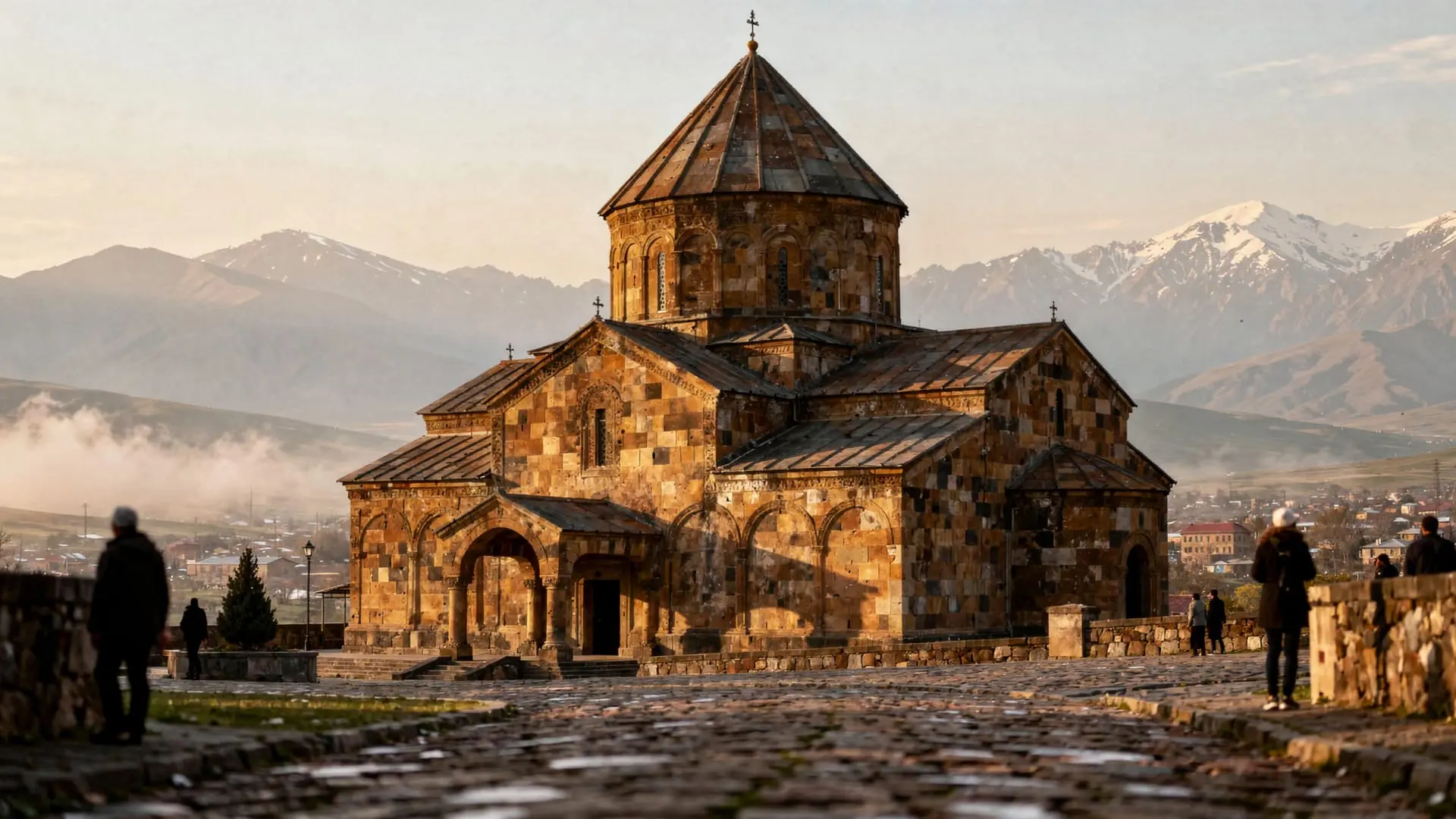
The spiritual capital of the world’s first Christian nation
| Where | Vagharshapat, 25 km west of Yerevan |
| Cost | Cathedral free; Treasury Museum ~1,500 AMD |
| Time needed | 2–3 hours for the full UNESCO complex |
| Getting there | Marshrutka from Sakharov Square (~150–200 AMD) or taxi (~1,500–2,000 AMD) |
| Best time | April–May (apricot blossom) or September; dress code enforced year-round |
Etchmiadzin — officially Vagharshapat, though the religious name dominates in all practical contexts — sits 25 km west of Yerevan in the Ararat plain. It is the seat of the Supreme Patriarch and Catholicos of All Armenians, the spiritual leader of the Armenian Apostolic Church worldwide, and the equivalent, in function if not in politics, of the Vatican for Armenian Christians. The cathedral was built in 301–303 AD, shortly after Armenia became the first officially Christian country in the world. Whether one accepts the “world’s oldest cathedral” claim precisely or not, the fact of more than 1,700 years of continuous use by a living church community makes Etchmiadzin extraordinary.
The site was inscribed as a UNESCO World Heritage property in 2000, together with the Zvartnots cathedral ruins and the churches of Hripsime and Gayane — collectively titled “The Cathedral and Churches of Etchmiadzin and the Archaeological Site of Zvartnots.”
Why Etchmiadzin matters
Understanding Etchmiadzin requires knowing what the Armenian Apostolic Church is. It is an Oriental Orthodox church — not Roman Catholic, not Eastern Orthodox (Greek or Russian). It separated from the broader Christian world at the Council of Chalcedon in 451 AD over Christological questions, adopting a miaphysite position: Christ has one united nature (divine and human together), rather than the two-nature formula of Chalcedonian Christianity. This is the same position held by the Coptic Church of Egypt, the Ethiopian Orthodox Church, and the Syriac Orthodox Church. Etchmiadzin has been the see of the Catholicos since 303 AD, with some interruptions during periods of conquest.
The church is not merely a national heritage institution — it is a functioning global religious authority with parishes in dozens of countries, serving an Armenian diaspora of around 7–8 million people worldwide (versus approximately 3 million resident in Armenia). Visiting Etchmiadzin is, in this sense, visiting not a ruin but a living headquarters.
History
- 301 AD: King Tiridates III converts to Christianity under the influence of Gregory the Illuminator. Armenia declares Christianity the state religion — the first country to do so.
- 301–303 AD: Gregory the Illuminator constructs the first cathedral, reportedly guided by a vision of Christ descending to strike the earth at the location — hence “Etchmiadzin,” meaning “the Only Begotten descended here.”
- 5th century: Catholicosate established here as the supreme see of the Armenian Church.
- 7th century: Major reconstruction by Catholicos Nerses III. The tetrahedral dome becomes the defining architectural form.
- 1441: Following the fall of Cilicia, the Catholicosate returns to Etchmiadzin from Sis.
- 17th–18th centuries: Extensive rebuilding under Catholicos Nahaped I and subsequent holders.
- 1868: The bell tower at the main gate, now the most photographed single element, is completed.
- 2001–2003: Restoration programme for the 1700th anniversary of Armenian Christianity.
What to see at the site
The mother cathedral (Surb Etchmiadzin): The central building — originally 4th century, repeatedly rebuilt — follows the Armenian cross-dome plan. The dome drum bears 12th-century carvings. The interior contains remarkable frescoes from the 17th and 18th centuries, commissioned by Catholicos Simeon I. The altar section is typically closed to lay visitors during services; on ordinary days, you can view the interior freely.
The Treasury Museum: One of the most important collections in the Christian world, housed in a modern building adjacent to the cathedral. It holds:
- The Holy Lance of Longinus (the spear said to have pierced Christ at the Crucifixion, brought from Geghard in 1441)
- A fragment said to be from Noah’s Ark, preserved in a silver reliquary
- 4th–18th century relics, vestments, illuminated manuscripts, and liturgical objects
Entry to the Treasury is separate from the cathedral grounds: AMD 1,500 (approx. EUR 4). Photography is not permitted inside the Treasury. The collection rewards slow, attentive examination.
Church of Saint Hripsime: 7 km east of the cathedral, a short drive or taxi ride. Built in 618 AD under Catholicos Komitas, it is one of the finest examples of early Armenian ecclesiastical architecture, perfectly preserved. Hripsime was a Christian martyr killed by Tiridates III; Gregory the Illuminator’s healing of the king is partly attributed to her intercession. The church’s interior is austerely beautiful — bare stone, filtered light, total silence.
Church of Saint Gayane: 300 m south of the cathedral, also 630 AD. Smaller than Hripsime but equally elegant. The stone carving above the entrance portal is exceptional.
Zvartnots cathedral ruins: 10 km east of Etchmiadzin (towards Yerevan), reachable in 15 minutes by car. Built in 643–661 AD by Catholicos Nerses III, it was arguably the most ambitious Armenian religious building of the early medieval period — a vast three-storey rotunda that collapsed in an earthquake around 930 AD. The UNESCO-listed ruins and on-site museum are worth 45 minutes. See the Zvartnots cathedral destination guide.
Etchmiadzin main gate and bell tower: The 1868 bell tower is the entry point to the cathedral complex and appears on innumerable postcards. In spring, the adjacent park is lined with flowering apricot trees.
How to get there
By taxi or car: From Yerevan, take the H1 highway west toward Vagharshapat. Total distance 25 km, about 30 minutes. A GG Taxi from central Yerevan costs AMD 1,500–2,000 one way.
By marshrutka: Marshrutkas from Yerevan (from the Sakharov Square area in the west of the city) run to Vagharshapat/Etchmiadzin regularly (AMD 150–200, 35–40 minutes). Ask for “Vagharshapat” or “Etchmiadzin.” The marshrutka drops you in the town centre, a 10-minute walk from the cathedral.
By tour: Etchmiadzin is frequently combined with Zvartnots ruins and sometimes Khor Virap as a half-day or full-day excursion.
Private day trip to Etchmiadzin and Zvartnots (UNESCO heritage) From Yerevan: Etchmiadzin, Hripsime, Gayane, and Zvartnots Temple TourPhotography and best light
The cathedral faces east. Morning light (08:00–10:00) falls directly on the entrance facade. The bell tower and main gate are best photographed from the square outside, which offers an unobstructed view.
Inside the cathedral, the 17th-century frescoes reward a telephoto or macro lens — the painted details are remarkable but distant from the nave floor. Photography of services is not appropriate; priests will usually indicate if photography is unwelcome.
For the surrounding UNESCO complex, the Churches of Hripsime and Gayane are best in diffused morning or afternoon light; both are small enough that interior photos with a fast prime lens (f/1.8, ISO 3200) are possible without flash.
Combining with other sites
Etchmiadzin pairs naturally with:
- Zvartnots ruins (10 min by car): half-day UNESCO double — see the Etchmiadzin and Zvartnots day trip guide
- Khor Virap (30 min south): for a morning Ararat view and then the mother cathedral — see Khor Virap monastery: views of Mount Ararat
- Sardarapat memorial (25 km northwest): the 1918 battle memorial and ethnographic museum — compact and powerful companion to Etchmiadzin
- Full itinerary context: Armenia monastery pilgrimage: 5-day spiritual route
Practical visit info
Cathedral entrance: Free. Open daily 08:00–18:00 (approximately; no rigid closing time on non-service days).
Treasury Museum: AMD 1,500 (approx. EUR 4). Open Tuesday–Sunday 10:00–17:00. Closed Mondays. No photography inside.
Dress code: Strict. Men must remove hats; women must cover their heads and wear skirts or long trousers — no shorts. The dress code is enforced at the entrance; free scarves and covers are available for those who need them. The standard is more formal here than at smaller monasteries.
Church services: Sunday liturgy at approximately 10:30. Major feast days include Easter, Vardavar (July), the Transfiguration, and the Feast of the Assumption of the Virgin (last Sunday of August, particularly celebrated at Etchmiadzin). During major services, tourist access to the interior is restricted.
Facilities: Toilets and café within the cathedral complex grounds. Several restaurants and cafes in Vagharshapat town. The Khaghoghamerg café near the main gate is a reliable option for lunch.
Best time to visit: Year-round. April and May (spring, apricot blossom) and September (harvest season, warm light) are particularly beautiful. Avoid arriving on a major feast day if you want uncrowded access to the Treasury Museum.
Vagharshapat: the city beyond the cathedral
Most visitors treat Etchmiadzin purely as a cathedral visit, drive in, photograph the bell tower, and leave. The city of Vagharshapat deserves more. It is a small town of about 50,000 people with a quiet provincial character, a grid of tree-lined streets, and several significant sights beyond the UNESCO complex.
Sardarapat memorial (25 km northwest): The 1918 Battle of Sardarapat was the decisive Armenian victory against the Ottoman advance that saved what would become the Armenian Republic. The memorial — angular basalt wings, a museum of ethnography, and an open-air statue complex — is sobering and impressive. The ethnographic collection inside documents traditional Armenian village life with unusual completeness.
Yerevan to Etchmiadzin to Sardarapat route: This triangle makes a productive half-day or full day — combining the earliest Christian heritage with the most recent moment of national survival. The contrast between the 4th-century cathedral and the 1918 memorial says something important about Armenian history’s peculiar temporal compression.
Etchmiadzin in the Armenian liturgical calendar
The cathedral is not merely a historic building — it is the living centre of one of the world’s oldest continuously functioning churches. Several feast days make an Etchmiadzin visit particularly significant:
Armenian Christmas (January 6): The Armenian Apostolic Church uses the old calendar and celebrates Christmas on January 6 rather than December 25. The Christmas liturgy at Etchmiadzin is celebrated with full ceremonial and draws large numbers of pilgrims.
Easter (Zatik): The major feast of the liturgical year. Easter at Etchmiadzin involves an all-night service ending at dawn — one of the most spiritually intense experiences in Armenian public religious life.
Feast of the Assumption of the Holy Virgin (August, last Sunday): The largest annual pilgrimage to Etchmiadzin. Hundreds of thousands of Armenians and diaspora visitors travel here. The service moves partly outdoors; the atmosphere is a combination of religious solemnity and folk festival.
Vardavar (approximately 98 days after Easter): An ancient festival of water, originally pre-Christian, now incorporated into the Armenian church calendar as the Feast of the Transfiguration. People pour water on each other in the streets. At Etchmiadzin, a service precedes the water-throwing; it is an unusual and exuberant combination of medieval Christianity and prehistoric tradition.
The Matenadaran and manuscript culture
Etchmiadzin’s role as the principal scriptorium and manuscript repository of the Armenian church through much of medieval history means that many of the greatest surviving examples of Armenian manuscript art were produced or held here. The manuscripts are now concentrated at the Matenadaran in Yerevan — the national repository on Mashtots Avenue.
Visiting the Matenadaran before or after Etchmiadzin gives the cathedral’s intellectual and cultural history a visual anchor. The illuminated manuscripts of Toros Roslin (13th century), the carved wooden book covers, and the papyrus fragments in the Matenadaran collection are among the finest objects of medieval Armenian civilisation. Entry is AMD 1,500; the permanent exhibition is excellent and explanatory panels are in English. See the Matenadaran manuscripts visitor guide.
Etchmiadzin and the diaspora
For diaspora Armenians visiting the homeland, Etchmiadzin carries particular weight. The Catholicosate at Etchmiadzin is the spiritual authority for most Armenian Apostolic communities worldwide, including those in Lebanon, Syria, France, the United States, Argentina, Australia, and elsewhere. For diaspora visitors who grew up attending an Armenian church, the sight of the mother cathedral can be unexpectedly affecting — the same liturgy, the same language, the same incense, but in the physical source.
The relationship between the Catholicosate at Etchmiadzin and the diaspora communities is complex and occasionally politically fraught, but the pilgrimage impulse is genuine and deep. Many diaspora Armenians who visit Armenia include Etchmiadzin as their first or second stop. The diaspora heritage trip planning guide addresses this visit in more depth.
Armenian architecture and its Persian, Byzantine, and indigenous sources
The cathedral at Etchmiadzin looks unlike anything in Rome or Constantinople. This is deliberate. Armenian ecclesiastical architecture developed its own synthesis of influences — Persian fire temple forms (the central lantern dome on a tetrahedral base), Byzantine spatial planning (the cross-dome plan), and indigenous Caucasian building traditions (the use of volcanic tuff stone, the carved khachkar tradition) — into something that is distinctively Armenian and not reducible to any of its sources.
The defining element of classical Armenian church architecture is the drum-and-dome system: a circular drum raised on a square or octagonal base, capped by a conical or pyramidal dome. At Etchmiadzin, this system has been executed and modified across seventeen centuries of rebuilding, but the essential form — the lantern rising above the crossing of the nave and transepts — is recognisable in the original 4th-century concept.
The tuff stone (Armenian volcanic tuff) deserves mention. The pinkish-beige stone used for most Yerevan and Etchmiadzin buildings is locally quarried from volcanic deposits and weathers in a distinctive way — softening in colour as it ages, developing lichen patterns that give old buildings a particular warmth. The pink tuff of Yerevan and the darker basalt of northern Armenia monasteries are both volcanic in origin but produce radically different aesthetic effects.
Etchmiadzin and the ecumenical landscape
Etchmiadzin has relationships with other Christian traditions that are worth knowing about for context. The Armenian Apostolic Church, despite its Oriental Orthodox status (outside the Chalcedonian communion), has maintained dialogue and formal agreements with several other churches:
-
The Holy See (Vatican): There is no full communion, but formal dialogue has been maintained. Pope John Paul II visited Etchmiadzin in 2001 and canonised several Armenian martyrs of the 1915 Genocide in a ceremony in Yerevan.
-
The Coptic Orthodox Church: The Armenian and Coptic churches are in full communion as fellow Oriental Orthodox bodies. The Coptic Pope has visited Etchmiadzin.
-
The World Council of Churches: The Armenian Apostolic Church is a member.
This ecumenical dimension matters for visitors interested in Christian history. Etchmiadzin is not an isolated national relic; it is a living participant in global Christian dialogue.
The Treasury: what the relics mean
A note on how to approach the Treasury Museum. The objects displayed there — the Holy Lance, the reliquary fragments, the vestments — are not primarily artefacts in the museum sense. For Armenian Apostolic Christians, they are sacred objects whose spiritual significance is primary and whose historical interest is secondary.
The Holy Lance, for example, is not just an ancient weapon of undetermined provenance. It is the physical instrument of the Passion, carried from Jerusalem to Armenia by the apostle Thaddaeus, preserved for seventeen centuries as a material connection between the Armenian people and the events of Christian salvation. Whether you personally accept this theological framework or not, visiting the Treasury with an awareness of it produces a more genuine engagement with what you are seeing.
The fragment said to be from Noah’s Ark raises similar questions. The theological significance of Noah in the Armenian tradition — the ark landed on Ararat, which is the sacred mountain of Armenia, visible from Etchmiadzin on clear days — means that this relic is not merely a curiosity but a statement about Armenian participation in biblical history.
Where to stay if you’re basing yourself near Etchmiadzin
Most visitors see Etchmiadzin as a half-day trip from Yerevan and don’t need overnight accommodation in Vagharshapat itself — Yerevan’s far larger range of hotels and guesthouses makes it the practical base for the vast majority of itineraries. That said, a handful of small guesthouses and mid-range hotels operate in Vagharshapat for travellers who prefer to be close to the cathedral for an early-morning visit before day-trippers arrive, or who are attending a specific liturgical event and want to avoid a pre-dawn drive from the capital. If staying in Vagharshapat, book ahead around the Feast of the Assumption in late August, when accommodation across the town fills with pilgrims.
Etchmiadzin, Zvartnots airport, and arrival logistics
Zvartnots International Airport, Armenia’s main gateway, sits almost directly between Yerevan and Etchmiadzin — close enough that some visitors with an early arrival or late departure use the gap to fit in a cathedral visit en route to or from the airport rather than as a dedicated day trip from central Yerevan. If your flight schedule allows a few free hours, arranging a private transfer that stops at Etchmiadzin and the nearby Zvartnots ruins (which share their name with the airport but are a separate archaeological site) can turn dead airport time into one of the most meaningful stops of the whole trip. Confirm luggage storage arrangements with your driver or tour operator in advance if attempting this on an arrival or departure day.
Frequently asked questions about Etchmiadzin
What is the Catholicosate of All Armenians?
The Catholicosate is the supreme governing body of the Armenian Apostolic Church, led by the Catholicos, who holds a rank equivalent to a patriarch. The current seat is at Etchmiadzin. There is also a secondary Catholicosate in Antelias, Lebanon (the Catholicosate of the Great House of Cilicia), which serves part of the diaspora and has historical roots in the medieval Armenian kingdom of Cilicia. The two Catholicosates are in communion but maintain separate jurisdictions.
What is the difference between the Armenian Apostolic Church and other Christian churches?
The Armenian Apostolic Church is Oriental Orthodox — one of a family of ancient churches (Coptic, Ethiopian, Syriac) that rejected the Council of Chalcedon in 451 AD. It is not in communion with Rome (not Catholic), not in communion with the Eastern Orthodox Churches of Greece, Russia, or Serbia, and not Protestant. It traces its foundation to the apostles Thaddaeus and Bartholomew, and its formal Christianisation to Gregory the Illuminator in 301 AD.
Can I attend a service at Etchmiadzin?
Yes. Sunday liturgies are open to all visitors, though you are expected to dress appropriately and behave with respect. The service is in Classical Armenian (Grabar), which is liturgically preserved but distinct from modern spoken Armenian. Photography during the liturgy is not appropriate. The experience — incense, candles, deep chanting, ancient stone — is genuinely affecting.
Is the Treasury Museum worth the AMD 1,500 entry fee?
Yes, decisively. The Holy Lance, the reliquary fragments, and the collection of illuminated manuscripts are extraordinary. Allow 45 minutes minimum. Photography is forbidden, so do not plan on capturing it — absorb it.
Are Hripsime and Gayane included in the main cathedral visit?
No — they are separate sites and require a short drive or taxi. Both are free to enter. The three churches plus Zvartnots ruins constitute the UNESCO property collectively; visiting all four in a half-day requires a car. See the Etchmiadzin and Zvartnots day trip guide for logistics.
Is Etchmiadzin the same as Vagharshapat?
Yes. Vagharshapat is the official modern city name (Armenian Soviet-era restoration of an ancient toponym). Etchmiadzin is the name used almost universally in religious and tourist contexts, and refers both to the cathedral specifically and to the city by common usage. GPS and road signs use both names.
How much time should I budget for the full Etchmiadzin UNESCO complex, including Zvartnots?
Allow a full half-day: 45–60 minutes at the mother cathedral, 45 minutes at the Treasury Museum, 20–30 minutes each at Hripsime and Gayane, and 45 minutes at Zvartnots ruins, plus transfer time between sites. A rushed version covering only the cathedral and Treasury can be done in 1.5–2 hours if time is genuinely tight.
Is Etchmiadzin appropriate to visit if I’m not religious?
Yes — the majority of visitors are cultural and historical tourists rather than pilgrims, and the site welcomes this. Dress-code and behaviour expectations apply regardless of personal belief, but no religious participation is required to visit the grounds, cathedral interior, or Treasury Museum.
Choosing which sites to prioritise if time is short
| Site | Time needed | Priority if short on time |
|---|---|---|
| Mother Cathedral | 45–60 min | Essential — the core visit |
| Treasury Museum | 45 min | High — the Holy Lance and manuscripts are exceptional |
| Church of Hripsime | 20–30 min | Medium — best-preserved early Armenian church |
| Church of Gayane | 20–30 min | Medium — pairs easily with Hripsime, very close by |
| Zvartnots ruins | 45 min | Medium — worth it if combining with the return to Yerevan |
Etiquette beyond the dress code
Beyond the formal dress requirements, a few unwritten norms help visitors move through Etchmiadzin respectfully. Keep voices low inside all four churches, not just during services — the acoustics carry, and quiet is the default expectation even when no liturgy is underway. If a service is in progress, entering quietly at the back rather than walking to the front is the norm; leave the same way if you need to exit before it ends. Priests and deacons move through the complex regularly; a brief nod or step aside is sufficient courtesy — extended conversation isn’t expected or generally welcomed with clergy who are working. Photography of the architecture and grounds is welcomed; photography of individuals praying, without their awareness, is not.