Armenian coffee (soorj): culture & where to drink it
A cup with weight
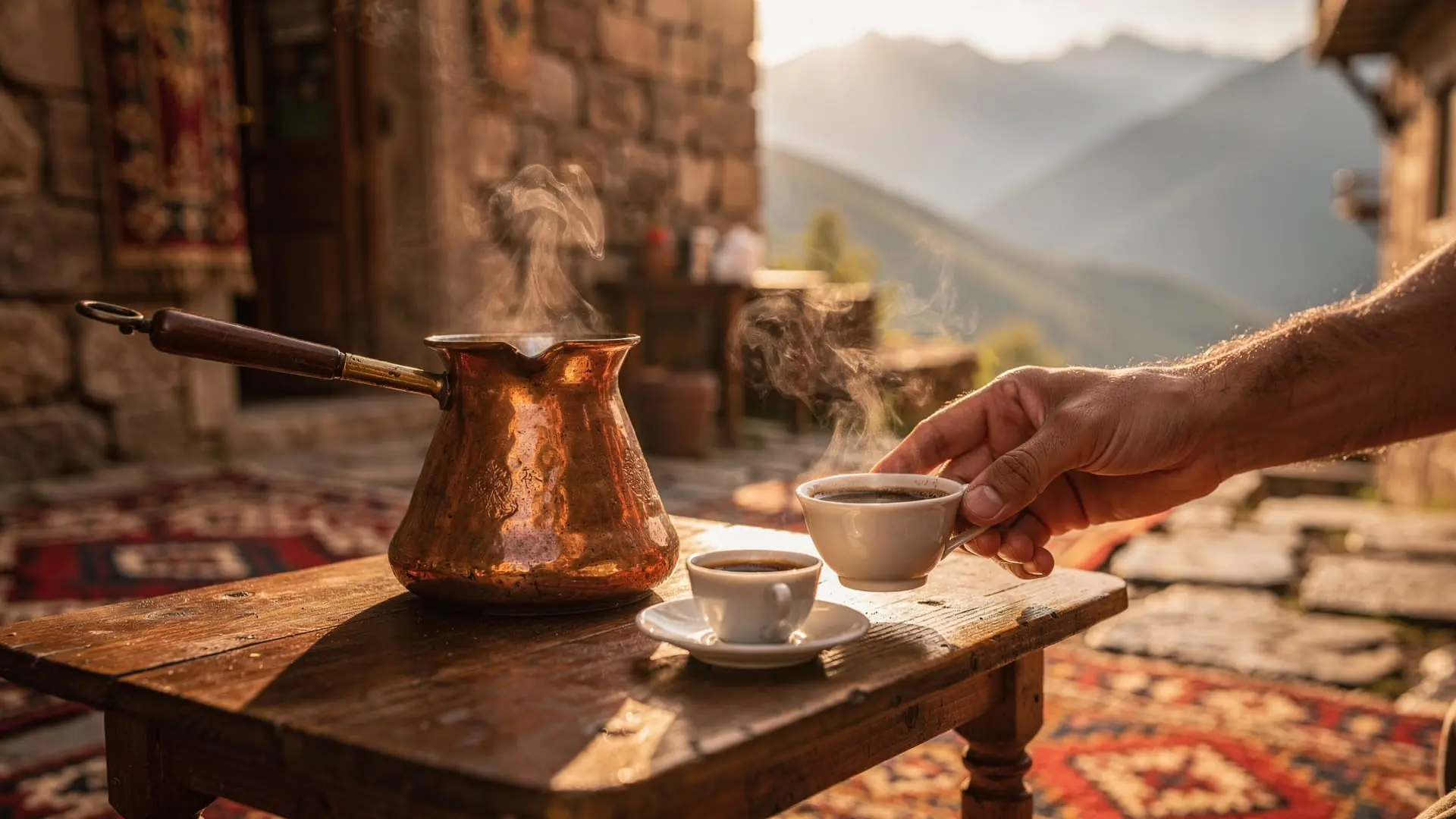
To a visitor, soorj looks simple: a small copper pot, a tiny cup, a thick black liquid with grounds at the bottom. But the simplicity is misleading. In Armenia, how you drink coffee, who you drink it with, and what you call it carry social and political weight that goes beyond caffeine.
Soorj (pronounced closer to “soorzh”) is the Armenian word for coffee. The drink is made by the same method as what is variously called Turkish coffee, Greek coffee, Arabic coffee, or Bosnian coffee across a wide arc of cultures — fine-ground coffee simmered in a small copper or brass cezve with water, served unfiltered. The grounds settle to the bottom of the cup; you drink from the top, stop before the silt, and — if you choose — turn the cup upside down on the saucer and wait for the grounds to form a landscape of symbols for fortune-telling.
Where soorj becomes distinctly Armenian is not in the method but in the meaning. And in the word.
| Where | Traditional cafés in Kond, Arabkir, or off Abovyan Street; homestays and guesthouses everywhere |
| Cost | Around 500–700 AMD ($1.20–1.70) at a traditional café |
| Time needed | 15–20 minutes for the ritual, longer with a fortune reading |
| Word to use | Soorj — never “Turkish coffee” |
| Best time | Morning or early-to-mid afternoon; rarely drunk after 6–7pm |
Why you should never call it Turkish coffee in Armenia
The context: the Armenian Genocide of 1915 resulted in the deaths of an estimated 1.5 million Armenians at the hands of the Ottoman state. Turkey officially denies the genocide; Armenia has made its recognition a matter of national and diaspora identity. The border between the two countries has been closed since 1993.
In this context, asking for “Turkish coffee” in an Armenian café or home is at best an indication that you are unaware of the history, and at worst genuinely offensive. The response will usually be polite — Armenians are extraordinarily hospitable to guests — but the awareness lingers. Use the word soorj. It costs nothing.
The same principle extends to comparisons. “Oh, this is like Turkish coffee” said to a local will be met with a correction at minimum. The shared method is a fact; the naming is a choice; in Armenia, the choice is clear.
How soorj is made
The cezve (Armenian: jajek or simply pot) is a small long-handled vessel, tapering at the top, typically made of copper or brass. Coffee is ground to a very fine powder — finer than espresso, closer to flour. The grind is critical; coarser grinds produce a gritty result; the correct grind creates a smooth, thick liquid.
The process:
- Add cold water to the cezve (one small cup per serving)
- Add finely ground coffee (one to two heaped teaspoons per cup)
- Add sugar if desired — şeker or just sugar: Armenian coffee is traditionally made in three styles: unsweetened (anurat), medium (kistrit), and sweet (ktsrats). Specify your preference when ordering
- Heat over very low flame or a sand bath (a tray of hot sand is the professional method), stirring initially
- Watch for the foam (kaymak) to rise; just before it boils over, remove from heat
- Let the foam settle, heat once more to the foam-rise point
- Pour slowly into the cup, tilting slightly to settle the grounds
The double-heating is the technique that makes soorj different from simply simmering coffee. The foam is prized; a soorj without foam is considered poorly made. In traditional cafés, the presentation — foam intact, cup warm, cezve set on the saucer — is taken seriously.
Fortune-telling from coffee grounds (tasseography)
The practice of reading fortunes in coffee grounds is called tasseography in English; the Armenian word is soorjabanutyun (coffee-reading). It is widespread across the Caucasus, Middle East, and Balkans, and in Armenia it carries both a serious and a playful register simultaneously.
The method: after drinking, the cup is turned upside down on its saucer, with a wish or question held in mind. The cup sits for several minutes until the grounds cool and the liquid has run down, leaving a landscape of marks on the inside of the cup. The reader (often a grandmother, an older woman friend, or a professional) interprets the shapes.
Common symbols in Armenian coffee reading:
- Bird in flight — good news coming, a journey
- Fish — abundance, luck, sometimes a pregnancy
- Snake — be cautious of someone close
- Ring — marriage or a stable relationship
- Tree — growth, health, stability
- Mountain — obstacles ahead, or the call of a journey
- Dots — money; their density indicates amount
The interpretations are not fixed — different readers have different vocabularies — and the practice is understood by most participants as somewhere between entertainment and emotional processing. People use it to articulate anxieties and hopes; the reading gives language to what is already felt.
In Yerevan, coffee-reading sessions happen at home far more than in commercial settings. Some cafés offer readings informally; asking the proprietor of a traditional café whether they read grounds will often produce a yes and an extended conversation.
Where to drink soorj in Yerevan
Traditional neighbourhood cafés — the best soorj in Yerevan is in small, unlabelled cafés in residential streets near Kond, Arabkir, and the streets off Abovyan. Also try the café at Malkhas Jazz Club for coffee before or after a performance. These are harder to navigate but immediately recognisable: small rooms, a few tables, a television, the smell of coffee. A soorj here costs 500–700 AMD (1.20–1.70 €) and arrives with a piece of Turkish delight or a small cube of sugar.
Achajour (Pushkin Street) — serves a very good soorj alongside its excellent breakfast. The café atmosphere is more polished than a traditional spot but the coffee is properly made.
Bekon — a neighbourhood café that bridges traditional and specialty styles. The soorj is made correctly; the setting is comfortable.
Calumet Café — one of the more characterful spots in central Yerevan, Calumet serves soorj alongside hookahs in some configurations, but the coffee is the point. Worth seeking out for the atmosphere.
Hotel cafés — many of Yerevan’s hotels serve soorj in their lobbies; the quality is variable and the price elevated, but it is convenient if you are staying nearby.
How soorj fits into an Armenian morning
The traditional Armenian morning begins with coffee, not breakfast. Soorj is prepared while the table is set; it arrives before the bread and cheese, or simultaneously. The morning cup is not a functional caffeine delivery; it is a signal that the day is beginning in a particular, unhurried way.
If you are staying in a guesthouse or homestay in Armenia, your host will almost certainly make soorj for you. For village homestay experiences, see the finding your Armenian village guide. Accepting it and sitting with it — rather than asking for instant coffee or a quick espresso — is one of the better ways to indicate that you are interested in the culture and not just passing through.
Cardamom soorj
Some Armenian families add a crushed cardamom pod to the cezve during brewing. The result is perfumed, slightly sweeter in character, and less bitter than plain soorj. This tradition is shared with much of the Arab world and reflects the old Silk Road connections of the region. In Yerevan restaurants it is rarely offered by default; ask if you would like it.
Soorj and the Armenian social calendar
Coffee appears at every gathering point in Armenian life:
- Morning hospitality — the first thing offered to any guest
- After dolma — the standard close of a traditional meal
- At funerals and memorial services — soorj is served at hokehats (memorial meals)
- During fortune-telling sessions — obviously
- Between classes and during breaks — the small cups that punctuate the Armenian working day
The quantity consumed per person is significant: two to four small cups daily is the norm for most Armenian adults, and the cups are small enough that this is less extreme than it sounds.
Soorj versus specialty coffee: coexistence in modern Yerevan
Yerevan’s specialty coffee scene (Lumen Coffee Roasters, Marshall, Bekon) exists alongside the traditional soorj culture without replacing it. The same Yerevan resident might have a filter coffee at Lumen in the morning and a soorj with their grandmother in the afternoon. The two traditions are not competing; they serve different social functions.
For visitors, trying both is worthwhile. The specialty coffee gives you the best bean-sourcing and barista skill Yerevan offers; the soorj gives you the culture, the ritual, and the grounds to read your fortune into. See our Yerevan café guide for the full café landscape.
A short soorj glossary
A handful of words make ordering and understanding soorj much easier: anurat (unsweetened), kistrit (medium sweet), ktsrats (sweet), kaymak (the prized foam on top), cezve (the small brewing pot, sometimes called jajek), and soorjabanutyun (coffee-ground fortune-telling). None of these require fluent Armenian to use — dropping even one or two into a café order is usually met with a pleased, slightly surprised response, since most visitors don’t bother.
Buying Armenian coffee to take home
The best souvenir coffee from Armenia is the fine-ground blend sold at GUM market and at specialty roasters. Lumen Coffee Roasters sells their single-origin beans and house blends packaged to take away. For soorj specifically, the pre-ground fine blends sold in GUM market (look for the vacuum-sealed packages) are the most practical for home use; they include the grind level already prepared.
Note: real Armenian coffee requires a cezve and a low-heat source. If you do not own a cezve, they are sold throughout GUM market and in kitchen goods shops on Mashtots Avenue for 2,000–5,000 AMD (5–12 €). Buy one. A cezve without an electric stovetop at home is not a problem — gas hobs, induction with an adaptor plate, and even careful use of a small camping stove all work, since the essential requirement is a very low, controllable flame rather than any specific heat source.
The cezve as cultural object
The cezve (the small long-handled pot used to make soorj) is a common household object in Armenia to a degree that surprises visitors from drip-coffee cultures. Every Armenian kitchen that takes coffee seriously owns at least one; many own several of different sizes (a 1-cup cezve and a 2-cup cezve produce different results even at the same proportions, because the surface area of coffee relative to water changes).
The cezve is also frequently given as a gift. Copper cezves with decorative hammering are sold throughout GUM market and at the Vernissage flea market in Yerevan — an honest and useful souvenir that actually gets used. A cezve without a coffee grinder is incomplete; if you plan to replicate soorj at home, budget for a burr grinder capable of a very fine setting (standard blade grinders often cannot achieve the Turkish-fine level required).
Etiquette when offered soorj as a guest
Being offered soorj in an Armenian home is not a casual gesture — refusing it outright can read as a small social misstep, even if the refusal is well-intentioned (dietary caution, caffeine sensitivity, or simply not wanting more). The better approach if you genuinely cannot or do not want to drink it is to accept the cup, take a sip or two, and let it sit rather than declining before it’s even poured; hosts read the gesture of acceptance as more important than finishing the cup. If you are hosted more than once in a day (common on village homestays or extended family visits), it is entirely normal to have three or four small cups across a single day — the volume is manageable precisely because the cups are so small. Complimenting the foam (kaymak) specifically is a small but genuine way to signal that you understand what makes a soorj well made, and hosts consistently respond warmly to it.
Coffee and gender in Armenian culture
It is worth noting a gendered dimension of soorj culture that sometimes surprises visitors. In traditional Armenian households, making coffee for guests is a female role — part of the same hospitality labour that covers preparing the table, rolling dolma, and managing the kitchen. The coffee is made by the woman of the house; this is not a rule that will be stated, but it is a pattern you will observe in traditional settings.
This does not mean men do not drink coffee, or that men cannot make it (many men who live alone make their own soorj without difficulty). It means that the act of making coffee for others is coded as hospitality work in a way that connects to broader patterns of Armenian domestic culture.
In Yerevan’s specialty cafés, this gender coding is absent — male baristas are as common as female ones, and the café as a non-domestic space operates outside traditional household dynamics. The Lumen and Marshall cafés attract a mixed gender clientele as producers and consumers of coffee equally. Visitors who notice and gently ask about this contrast — the home tradition versus the café tradition — often find it opens a genuinely interesting conversation with hosts about how Armenian domestic life is changing alongside its coffee culture.
Soorj at altitude: Armenian highland coffee
A minor but real phenomenon: soorj made at altitude (Armenia’s mountains, Aragats, or even the higher villages of Vayots Dzor) tastes slightly different from soorj at Yerevan’s 1,000 metres elevation. Water boils at a lower temperature above 2,000 metres; the coffee is slightly underextracted by the normal cezve method. The result is a paler, slightly thinner cup that some people prefer. If you are camping or hiking in the highlands and making soorj on a camp stove, use slightly more coffee than you would at sea level.
The soorj and the duduk: instruments of Armenian contemplation
There is an informal pairing in Armenian cultural life between soorj and the duduk — the ancient double-reed woodwind instrument that has its own UNESCO Intangible Cultural Heritage designation. Both are slow, slightly melancholic, and require attention. Both are heard at home rather than in performance spaces primarily. Both are offered to guests as a form of hospitality — here is music, here is coffee, here is what we can give you.
The duduk’s music and the ritual of soorj share a pacing that is distinctly Armenian: unhurried, non-functional in the sense that they cannot be rushed without losing what makes them valuable. See the Armenian duduk music guide for the instrument’s cultural context.
Frequently asked questions about Armenian coffee
Is soorj the same as espresso?
No. Both are strong and small, but the production method is different. Espresso uses pressurised hot water forced through packed grounds; soorj simmers coffee in water without pressure. Soorj has a different flavour profile — more bitter, earthier, thicker — and the grounds remain in the pot rather than in a puck. The social context is also different.
Can I get soorj without sugar?
Yes. Ask for anurat soorj (without sugar). Many Armenian cafés make soorj sweet by default; specifying your preference avoids an overly sweet cup.
Does the fortune-telling work?
That depends on what you mean by work. As a conversation starter, a way to articulate hopes and anxieties, and a window into Armenian family culture: it works very well. As a predictive tool for the future: evidence is limited.
What is the best time of day to have soorj?
Soorj is a morning and afternoon coffee; it is less common after 6–7 pm because of its caffeine content and because evenings in Armenia tend toward wine, beer, or oghi. The best moments: with breakfast at a traditional café, after a meal in a family setting, or mid-afternoon when the day slows.
Where can I learn to make soorj properly?
The traditional Armenian cooking class in Yerevan covers soorj alongside food; it is a practical way to learn the technique and understand the ritual. Alternatively, any traditional café proprietor who sees that you are curious will usually show you how they make it if you ask.
Does Armenian coffee taste different from region to region?
The blend and roast vary by family and locality. In Gyumri, the coffee is traditionally roasted darker. In villages, cardamom additions are common. In Yerevan’s specialty cafés, single-origin beans have changed the flavour profile from the blended roasts that defined soorj for generations. Broadly: expect variations within a shared framework rather than dramatically different drinks.
Is soorj served at Armenian Christmas and other holidays?
Yes. Coffee punctuates every Armenian celebration, and the Armenian Christmas guide describes how soorj typically follows the Christmas morning meal, much as it follows any significant family gathering. It’s less a holiday-specific drink than a constant thread running through the entire Armenian calendar, from ordinary mornings to the biggest feast days.
How does soorj fit alongside the rest of Armenian food and drink culture?
Soorj is one piece of a broader hospitality culture built around food and drink — see the Armenian food essential dishes guide for the fuller table, and the Armenian brandy guide for what typically follows soorj later in the evening, since the two drinks occupy different times of day in the same hospitality rhythm: coffee for mornings and afternoons, brandy or wine for evenings.