Yerevan café culture: the best brews & spots
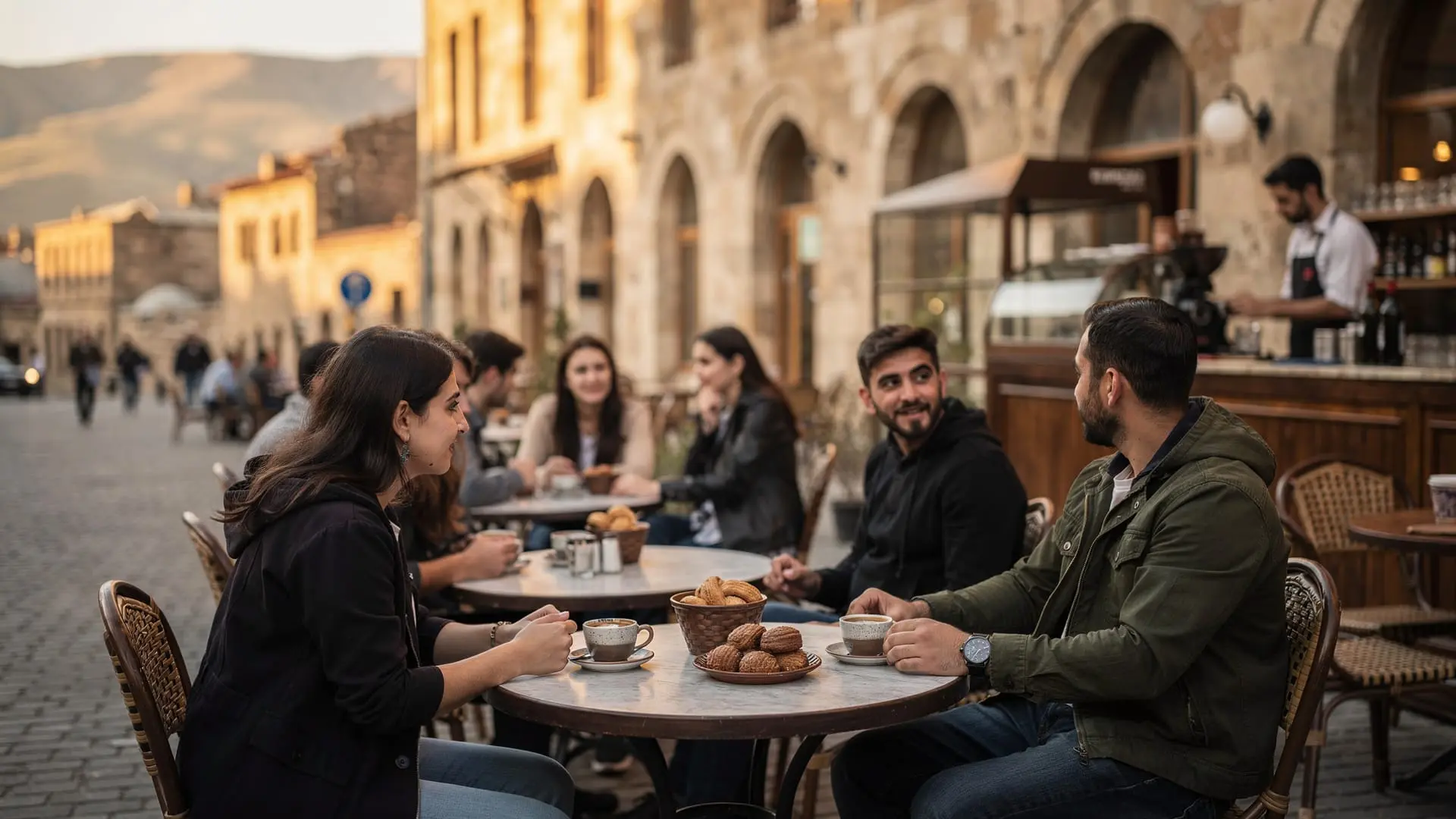
A city that takes its coffee seriously
Yerevan’s café culture is a recent and rapid evolution. A decade ago, the city’s coffee options split cleanly into traditional soorj (the thick, unfiltered Armenian coffee cooked in a small copper cezve) and the international chain Coffeeshop Company that spread across the post-Soviet space in the 2000s. The gap between them was considerable.
| Specialty coffee | 1,000–1,800 AMD — Lumen, Marshall, Bekon |
| Traditional soorj | 500–800 AMD — any neighbourhood café |
| Best area | Saryan Street coffee corridor |
| Best breakfast | Achajour (Pushkin Street) or GUM market |
| Hours | Most cafés 8 am–10/11 pm; busiest Sat–Sun mornings |
Since 2018, a genuine specialty coffee movement has taken root. Saryan Street and the streets around it have become a coffee corridor; roasters are sourcing single-origin beans with intent; barista championships are held; and the crowd nursing their oat-milk flat whites on a Saturday morning looks as comfortable as any equivalent in Tbilisi or Vienna.
Alongside this, the traditional café — where soorj arrives in a small copper cup with a piece of gata or sugar on the side — remains entirely alive. Both cultures coexist without conflict, and the city is richer for it.
The specialty coffee scene
Lumen Coffee Roasters
The flagship of Yerevan’s specialty scene. Lumen, on Saryan Street, roasts its own beans and takes the sourcing and production seriously: Ethiopian naturals, Colombian washed, Armenian-grown beans (experimental but interesting). The espresso-based drinks are well-calibrated; the filter coffee options change with the roast schedule.
The space is a whitewashed industrial-style room that gets genuinely busy on weekend mornings; arrive before 10 am for a quiet seat. Lumen also serves a short food menu — avocado toast, eggs, pastries — that makes it a complete breakfast stop. Prices are higher than a traditional café but below Western European equivalents: expect 1,200–1,800 AMD (3–4.50 €) for a coffee.
Location: Saryan Street (a 10-minute walk from Republic Square) Hours: 8 am–10 pm daily Best for: Filter coffee, espresso, weekend breakfast
Marshall Café
A smaller, more intimate café on one of the side streets off Abovyan. Marshall has a loyal following among Yerevan’s creative and tech community — the table-to-counter ratio suggests lingering is encouraged. The coffee is excellent (a Lumen-adjacent sourcing philosophy); the food menu is lighter. Better for a quiet working session than for a full breakfast.
Location: Abovyan area side streets Best for: Laptop-friendly coffee; afternoon break
Bekon
A neighbourhood café with an earnest, local character. Less known to tourists, which makes it slightly better for actually having a conversation. The soorj here is exceptional — a transition point between specialty coffee and the traditional style.
Location: Central Yerevan residential streets Best for: Locals-adjacent experience; traditional soorj in a modern setting
Traditional cafés and soorj culture
What to expect from traditional cafés
The traditional Armenian café is not a coffeehouse in the European sense. It is a small room, often in a basement or a courtyard, with a few tables, a television showing football or news, and a proprietor who will bring you soorj without much discussion. You will wait slightly longer than feels necessary for the coffee. This is part of the character.
Soorj arrives in a small copper or brass pot (cezve) with a tiny ceramic cup alongside. The grounds are at the bottom of the pot; you pour gently and stop before the grounds reach the cup. Drink slowly. If you want to read your fortune, wait until the grounds dry on the sides of the inverted cup — see the Armenian coffee guide for the tradition in full.
Prices at traditional cafés: 500–800 AMD (1.20–2 €) for a soorj. This is the cheapest coffee experience in the city.
Coffeeshop Company
The chain that was everywhere before specialty coffee arrived. Coffeeshop Company has good air conditioning, reliable wifi, and consistent (if not exceptional) coffee. It remains popular with tourists and older residents. Useful as a fallback when everything else is full; not the place to understand Yerevan’s café culture.
Northern Avenue and Republic Square cafés
The outdoor tables on Northern Avenue (the pedestrian artery from Republic Square to the Opera) fill on warm evenings from May through October. Most serve mediocre coffee at elevated prices; they sell the location, not the cup. Have a soorj here once for the atmosphere, then find your actual coffee elsewhere.
Where to have breakfast
Achajour
The best sit-down breakfast in central Yerevan. Achajour on Pushkin Street opens early and serves a traditional Armenian breakfast spread: lavash, matnakash, white cheese, matsun, eggs (scrambled or boiled), herbs, tomatoes, and olives. The coffee is good. Prices are mid-range but the quality justifies them: 4,000–7,000 AMD (10–17 €) for a full breakfast with coffee.
Hours: From 8 am daily
GUM market breakfast
The cheapest and most atmospheric breakfast option: walk to GUM market before 10 am, buy fresh lavash from the bread section, white cheese from the cheese vendors upstairs, and eat standing up or on the market steps. Add a churchkhela or dried apricots and a coffee from a market stall. Total cost: 1,500–2,500 AMD (3.50–6 €). See the GUM market guide for navigation.
Lumen Coffee Roasters breakfast
For a Western-style breakfast (eggs, avocado, pastry), Lumen is the most reliable option. Less distinctly Armenian than Achajour but comfortable and consistent.
The Saryan Street food and café corridor
Saryan Street has become the informal centre of Yerevan’s food and café culture since around 2020. Named after the Armenian painter Martiros Saryan, it connects Abovyan Street with the residential streets north of the centre, and its ground-floor spaces have been colonised by a concentration of food, wine, and coffee businesses.
Beyond Lumen, look for: natural wine bars (In Vino is the standard-bearer), small lunch spots with hand-written daily menus, and weekend pop-up food stalls in warm months. The street is most alive between 11 am and 3 pm on Saturdays and Sundays. It is one of the few places in Yerevan where you can idle without feeling like you are in a tourist zone.
The Cascade area cafés
The terraced gardens of the Cascade Complex have several cafés and food stalls embedded along the stairs. These sell acceptable coffee and snacks; they are best understood as a convenience when you are climbing the stairs rather than a destination in themselves. The views are the product; the coffee is incidental. For a better cup after visiting the Cascade, walk down Tamanyan Street toward the Abovyan cluster.
Late-night coffee and the evening extension
Yerevan’s café culture runs genuinely late. Most of the specialty cafés stay open until 10 or 11 pm, and the transition from daytime café to evening wine-bar is fluid on Saryan Street and Pushkin Street. After 10 pm, the remaining coffee drinkers tend to merge into the nightlife crowd; see the Yerevan nightlife guide for what comes next.
Coffee and food pairing: the Armenian morning
The classic Armenian café morning follows a loose sequence:
- Soorj or espresso on arrival
- Lavash with white cheese and herbs (often provided automatically in traditional spots)
- A piece of gata or pakhlava with a second coffee
- Fruits in season (melon in summer, dried apricots year-round)
This is not a formal progression; it is the rhythm of a slow morning that Armenian café culture enforces gently. Most specialty cafés import this rhythm without labelling it — the pastries come alongside the coffee, the table is yours for as long as you need it.
Practical tips for café visiting in Yerevan
Currency: Specialty cafés accept cards; traditional cafés are cash only. Keep small AMD notes for coffee.
Wifi: Most specialty cafés have wifi and expect it to be used. Traditional cafés often do not, which is its own pleasure.
Smoking: Indoor smoking was banned but enforcement varies. Traditional cafés in older buildings sometimes have a smoky character; outdoor terraces are nearly always smoke-free.
Tipping: Not expected at counter-service cafés. At table-service cafés, 10% is appreciated but not required. See our tipping guide for context.
Language: Most specialty café staff speak English. Traditional café owners often do not; pointing and numbers work fine.
The café as workspace in Yerevan
Yerevan has a large and growing remote-work and tech startup community, and its café culture reflects this. Most specialty cafés have reliable wifi and multiple power outlets; the working culture at café tables (open laptops, headphones, extended stays) is normal and accepted. You will not be moved on for spending three hours over one coffee, particularly at weekday off-peak hours.
Lumen Coffee Roasters and Marshall are the most laptop-friendly. Traditional cafés and the older neighbourhood spots are the opposite: small rooms, no wifi, conversation expected. Neither format is objectively better; they serve different modes of being in the city.
Seasonal café behaviour: terraces and winter spots
Yerevan’s café culture is dramatically more outdoor in warm months. From May through October, every café that has any exterior space deploys it: folding tables on pavements, rooftop access where buildings allow, courtyard gardens. The Saryan Street cafés extend onto the wide pavement; the Abovyan and Pushkin Street spots push tables out after 4 pm.
In winter, the outdoor furniture disappears and cafés become more intimate and crowded inside. Condensation on windows, the smell of coffee intensified by a small heated room, groups in heavy coats still in their chairs after the coffee is gone. Yerevan in January has an atmospheric café quality that the summer crowds dilute.
Armenian tea: the alternative to coffee
Coffee dominates the conversation about Armenian beverages, but tea (tey) has its own culture. Armenian mountain tea — dried flowers and herbs from the slopes of Aragats, Tavush, and Vayots Dzor — is served as a health drink and a digestion aid. The most common herbs: dried rosehip, chamomile, thyme, and the distinctive Armenian wild thyme (oragegan). At traditional cafés, ordering “Armenian tea” produces a glass of these steeped herbs, usually sweetened with local honey.
In Dilijan and the forested north, tea culture extends to fresh wild herb infusions and foraged-leaf teas that are a local speciality. The Dsegh wild tea foraging experience in Tavush is for the most engaged visitors.
Coffeeshops for diaspora Armenians
For diaspora Armenians visiting Yerevan, cafés are an important social infrastructure. The city has several spots that serve as informal gathering places for diaspora visitors — places where you are likely to hear French Armenian, American Armenian, and Russian Armenian conversations at adjacent tables.
Lumen, Achajour, and the cafés near Tsitsernakaberd (Genocide Memorial) and the Matenadaran are natural diaspora meeting points. These are not designated diaspora spaces; they are simply the central, accessible, quality spots where people find each other. For context on the diaspora experience in Yerevan more broadly, see our diaspora heritage trip guide.
Coffee and the morning walk: a suggested route
One of the better ways to spend a morning in Yerevan combines coffee with the city’s best walking:
7:30 am: Soorj at a neighbourhood café in the streets around Pushkin Street (the earlier the more traditional the atmosphere)
8:30 am: Walk north along Abovyan to the Matenadaran (opens 10 am Tuesday–Saturday; even the exterior is worth seeing early)
9:00 am: GUM market opens — buy lavash, cheese, and a churchkhela; eat in the market or on the steps outside
10:00 am: Walk south along Mashtots toward the Cascade Complex — the sculpture garden at the base is free and quiet in the morning
11:00 am: Second coffee at Lumen on Saryan Street (a 5-minute walk from the Cascade base)
Noon: Continue to the Vernissage flea market (weekend mornings only; the eastern side of Republic Park)
This route takes 4 hours at a casual pace, costs under 5,000 AMD (12 €) for food and two coffees, and covers the best of central Yerevan without any transport.
Frequently asked questions about Yerevan café culture
How much does coffee cost in Yerevan?
Traditional soorj at a neighbourhood café: 500–800 AMD (1.20–2 €). Espresso or filter coffee at a specialty café: 1,000–1,800 AMD (2.50–4.50 €). A full breakfast with coffee at Achajour: 5,000–8,000 AMD (12–20 €). Prices are considerably lower than Western Europe across all categories.
What is the difference between soorj and espresso in Yerevan?
Soorj is made by simmering fine-ground coffee with water (and sometimes cardamom or sugar) in a cezve over low heat. The grounds remain in the pot and settle to the bottom. Espresso is made by forcing pressurised hot water through tightly packed finely ground coffee. Both are intense; soorj is slower, more bitter, and culturally freighted. See the Armenian coffee guide for the full comparison.
Are cafés open on Sunday in Yerevan?
Yes. Sunday is one of the busiest days for cafés, particularly in the late morning. Lumen and Achajour are especially busy Sunday 10 am–1 pm. Arrive early or expect to wait.
Where do I find Yerevan’s best coffee?
Lumen Coffee Roasters on Saryan Street is the consensus answer for specialty coffee. For the best traditional soorj, Bekon and small neighbourhood cafés near Abovyan Street and the Kond district. For a complete breakfast with excellent coffee, Achajour on Pushkin Street.
Is there a café near the Matenadaran or Tsitsernakaberd?
The Matenadaran area (Mashtots Avenue upper section) has a few cafés within walking distance. For Tsitsernakaberd (Genocide Memorial), the options are limited immediately around the memorial — go before or after at a central café. For Erebuni Museum, even fewer options; take coffee before you go. See our Yerevan sightseeing guide for neighbourhood logistics.
Is Yerevan’s coffee scene comparable to Tbilisi’s?
Broadly yes, and the two cities are often compared by regional coffee enthusiasts. Yerevan’s scene is younger (post-2018) and more concentrated on Saryan Street, while Tbilisi’s is more dispersed across several neighbourhoods with a longer history. Both share a similar price range and a comparable focus on single-origin sourcing. Travellers doing the Yerevan–Tbilisi overland route will find the transition between the two coffee cultures seamless rather than jarring, and comparing the two scenes back to back is a small but genuine pleasure of a combined Caucasus trip.
What’s the difference between Lumen and Marshall?
Lumen is the larger, more established roaster with its own sourcing programme and a full food menu — the better choice for a sit-down breakfast or a first visit. Marshall is smaller and more intimate, popular with Yerevan’s tech and creative crowd for working sessions rather than full meals. Both serve excellent coffee; the choice comes down to whether you want a destination breakfast or a quieter corner to sit for a few hours.
Can I find good coffee to bring home from Yerevan?
Yes. Lumen and several other specialty roasters sell bagged beans in their own packaging, and some Armenian-grown experimental lots make for a genuinely distinctive gift that most coffee drinkers back home won’t have tried. Ask staff which current roast travels best — lighter roasts are more fragile over long transit than darker ones. Beans keep reasonably well in checked luggage; whole bean rather than ground preserves freshness longer for the trip home, and vacuum-sealed bags survive checked luggage handling better than the roaster’s standard retail packaging.
Coffee culture and Yerevan’s museums
Several of Yerevan’s museum visits pair naturally with a coffee stop, and knowing where to fit one in avoids the frustration of arriving at a closed café mid-visit. Before the Matenadaran opens at 10 am, the cafés on lower Mashtots Avenue are a good place for an early coffee — arrive at opening to have the manuscript galleries to yourself, so a 9 am coffee fits naturally into the schedule. Around Republic Square and the History Museum, the basement café inside the museum building is convenient but unremarkable; better coffee is a five-minute walk away on Abovyan or Tumanyan streets. Near the Parajanov Museum, the surrounding Saryan and Tumanyan streets area has the city’s best concentration of cafés, making a museum-then-coffee sequence one of the most pleasant combinations in central Yerevan. The same logic applies after Vernissage on weekend mornings — the market sits close enough to Republic Square that a post-shopping coffee requires no detour at all — walk five minutes and you’re at a café table with your Vernissage finds still in hand.