Visiting Tsitsernakaberd: a pilgrimage planner
Before you arrive: what this place is
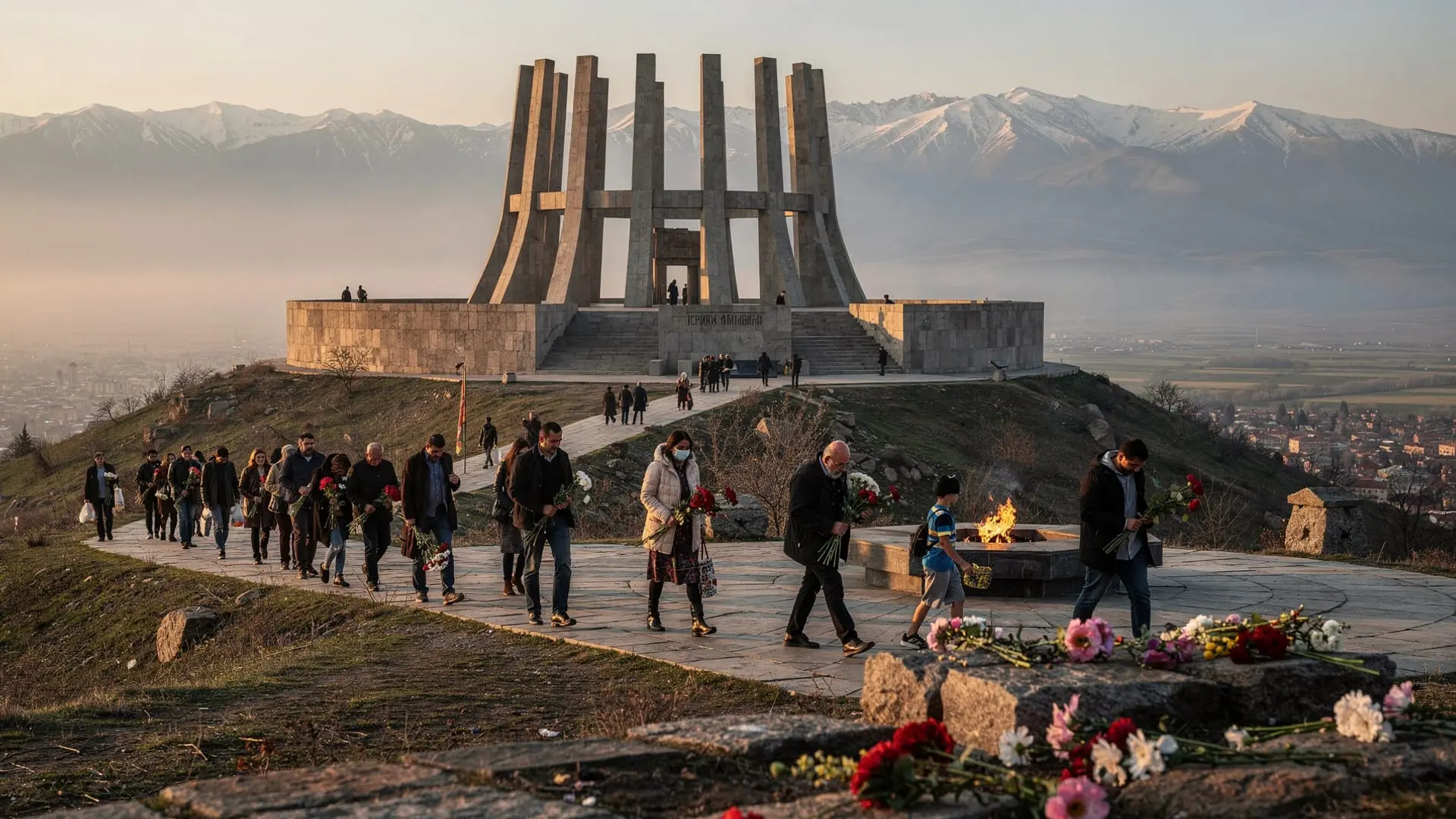
Tsitsernakaberd (“Swallow’s Fortress” in Armenian) sits on a hilltop above the Hrazdan River in the western part of Yerevan. The memorial complex, opened in 1967 during the Soviet era on the 52nd anniversary of the Genocide, has two main elements: the stele, a 44-metre needle of basalt pointing skyward, and the circular memorial structure containing the eternal flame around which visitors walk in silence.
| Where | Tsitsernakaberd hill, western Yerevan, ~3 km from Republic Square |
| Cost | Free — memorial and museum |
| Time needed | 1.5–2 hours minimum |
| Getting there | GG Taxi (~10–15 min), walk (~40 min), or city bus |
| Museum hours | Tuesday–Sunday, 10 am–5 pm; closed Mondays |
The Armenian Genocide was the systematic deportation and killing of the Armenian population of the Ottoman Empire, carried out primarily between 1915 and 1923. Estimates of the dead range from 600,000 to 1.5 million people. The Genocide is formally recognised by more than 30 countries including the United States (formally recognised 2021), France, Germany, Canada, and Russia. Turkey disputes the characterisation as genocide while acknowledging mass deaths occurred. This site documents and memorialises what happened.
For diaspora Armenians, visiting Tsitsernakaberd is not optional. It is the point of the trip — the place where the abstract family history of loss becomes concrete, where the universal and the personal converge, where placing flowers at an eternal flame is a direct continuation of a 110-year act of remembrance. See also finding your Armenian village for the genealogy dimension of a diaspora visit.
The site: what you will find
The eternal flame and memorial circle: The heart of the memorial is a circular stone structure with twelve slabs angled inward toward a central eternal flame, representing the twelve lost provinces of Western Armenia. Visitors walk around the flame in silence. The silence is instinctive — no sign instructs it, but no one speaks. Flowers are left at the base of the flame, particularly carnations and irises. In April, the ground around the flame becomes deep with flowers.
The stele: The 44-metre split basalt needle represents the resurgence of the Armenian people. It can be seen from much of western Yerevan. The split symbolises both the division of historical Armenia and the survival of the nation.
The museum (Tsitsernakaberd Institute and Museum): Below ground, entered through a long corridor. Hours: daily except Monday, 10 am to 5 pm (last entry 4:30 pm). Free entry. The museum presents the history of the Genocide through documents, testimonies, photographs, maps, and objects. Allow 1.5 to 2 hours for a thorough visit. The material is graphic in places — photographs of mass graves, deportation columns, American consul testimonies. Bring children only if they are genuinely old enough to engage with this (roughly 12 and above) and if you have discussed the history with them before arriving.
Photography inside the museum: permitted but please use discretion. No flash. Photographs of the eternal flame and the memorial complex outside are entirely appropriate.
The alley of remembrance: Leading from the entrance toward the memorial is an avenue of trees planted by visiting heads of state and dignitaries — including French President François Hollande, Russian President Vladimir Putin, Pope Francis, US President Barack Obama, and others. The tree plaques note the planter and date.
Dress code: The site is not a church and has no formal dress code, but modest, respectful clothing is appropriate. Come as you would for any memorial of this gravity.
April 24: the remembrance day experience
April 24 is the annual day of remembrance for the Armenian Genocide — the date in 1915 when Ottoman authorities arrested and murdered hundreds of Armenian intellectuals in Constantinople, marking the beginning of the organized killing.
Every year on April 24, hundreds of thousands of people walk from Yerevan’s centre to Tsitsernakaberd — Armenians from the Republic, diaspora visitors who have come specifically for this day, and official delegations. The procession begins in the morning and continues through the afternoon. The queues to approach the eternal flame stretch for hundreds of metres. The scene is overwhelming in scale and emotionally extraordinary.
For diaspora visitors considering April 24:
If you can be in Armenia for April 24, the experience is unforgettable and unlike anything else. You are not a tourist at Tsitsernakaberd that day — you are part of a living act of collective memory alongside hundreds of thousands of others doing the same thing. The diaspora and the Armenian Republic community merge. There is singing. There are tears. There is enormous dignity.
The practical challenge is the crowd. Walking to the memorial takes 2–3 hours from the city centre due to the volume of people. Getting close to the flame requires patience. The emotional intensity is very high. Plan accommodation in Yerevan for the night before and after — don’t schedule a day trip from another city.
April 23 and 25 offer a quieter but no less meaningful visit. The flowers from April 24 remain at the eternal flame; the atmosphere is contemplative. Many diaspora visitors who have been to the April 24 event choose April 23 or 25 on return visits precisely for the quieter experience.
Getting to Tsitsernakaberd
The memorial is in the Tsitsernakaberd district of western Yerevan, roughly 3 km from Republic Square.
- By GG Taxi: The easiest option. About 10–15 minutes from the centre, fare approximately 800–1,200 AMD (2–3 EUR). Ask for “Tsitsernakaberd” — every driver knows it.
- Walking: Possible in good weather — approximately 40 minutes from Republic Square along the Khanjyan and Arshakunyats Avenue route. The walk along the Hrazdan River gorge section is pleasant.
- By bus: Several city bus routes pass near Tsitsernakaberd; enquire at your hotel for the current route numbers as they change.
Practical visit notes
Opening hours: The memorial complex (eternal flame area) is open 24 hours, every day, free. The museum is open Tuesday–Sunday, 10 am to 5 pm. Closed Mondays. Free entry to both.
Duration: Allow 1.5 to 2 hours minimum. Some visitors spend 3 hours or more, particularly on a first visit.
Flowers: Bring flowers if you wish — this is very much encouraged and is part of the culture of the site. Carnations (red or white) and irises are most commonly brought. Flower sellers operate near the entrance on busy days. On quiet days, bring your own.
After the visit: Allow time. Do not schedule a busy activity immediately after the museum visit. A quiet walk in Haghtanak (Victory) Park nearby, or a slow café stop, is the more appropriate transition.
Yerevan: Walking Tour with a Local GuideThe Genocide in factual context
The Armenian Genocide is recognised as genocide by more than 30 countries including (as of 2026) the United States, France, Germany, Canada, Brazil, the Netherlands, Belgium, Sweden, and others. Scholars of genocide studies — including Raphael Lemkin, who coined the word “genocide” — have cited the Armenian case as foundational to their field.
Turkey maintains that the killings were the result of wartime deportations, civil conflict, and disease rather than a premeditated genocide, and that casualty figures are lower than Armenian sources claim. The historical consensus among genocide scholars and most peer-reviewed academic work supports the characterisation as genocide.
This guide presents these facts without editorial beyond the factual consensus of established scholarship. Visitors may form their own assessments. The site presents Armenian scholarship and witness testimony; the museum is not propagandistic in its presentation — it is documentary.
Combining Tsitsernakaberd with other diaspora sites
A diaspora heritage itinerary in Yerevan should set aside Tsitsernakaberd as its own half-day, emotionally separate from other sightseeing. Common combinations that work:
- Morning at Tsitsernakaberd, afternoon at Etchmiadzin: A spiritually coherent day — memorial in the morning, the mother cathedral in the afternoon. The drive to Etchmiadzin (25 km, 30 minutes) gives time to decompress.
- Morning at Tsitsernakaberd, afternoon at Matenadaran: A culturally coherent day — the depths of loss in the morning, the heights of civilisation in the afternoon. The Matenadaran is 15 minutes by taxi from Tsitsernakaberd.
- Tsitsernakaberd on its own: For many diaspora visitors, particularly on April 24 or a first visit, no combination is appropriate. The visit fills the day.
For the full heritage trip framework, see the diaspora heritage trip guide and the 5-day diaspora itinerary.
A note on grief
It is not unusual to cry at Tsitsernakaberd. It is not unusual to find it more overwhelming than you expected, or less, or differently. There is no correct way to experience this place. Armenians from the Republic, many of whom have relatives in diaspora communities, understand the emotional register of a diaspora visit to this site. You will not be looked at strangely.
There is sometimes something clarifying about grief when it has a physical location — when the abstract loss of a century becomes this hill, this flame, this walk with flowers in hand. Many diaspora visitors describe Tsitsernakaberd not as a source of additional sorrow but as a source of unexpected peace — the sense that the loss has been acknowledged and named in the permanent world, in stone and fire, and that this is enough.
The memorial in the context of a heritage trip
Tsitsernakaberd is not the entirety of a diaspora heritage trip to Armenia — it is its moral centre. What comes before and after matters.
Before Tsitsernakaberd: Many diaspora visitors find it useful to spend one or two days in Yerevan first — becoming comfortable with the city, eating Armenian food, hearing the language on the street — before visiting the memorial. Coming to Tsitsernakaberd on your first or second afternoon, jet-lagged and disoriented, risks experiencing it from behind a layer of numbness. Arrive in the country first. Ground yourself in the present before confronting the past.
After Tsitsernakaberd: Leave the afternoon unscheduled. A walk along the Hrazdan River gorge (which runs below the memorial hill), a slow coffee, a visit to Lovers Park, or simply returning to your hotel for an hour or two of quiet is the right pace. Do not go directly to a busy restaurant lunch or a monastery visit. The memorial deserves to be the last significant thing you experience on the day you visit it.
Etchmiadzin as a natural pairing: Many diaspora visitors find that pairing the Tsitsernakaberd visit (morning) with Etchmiadzin cathedral (afternoon) creates a coherent emotional arc — the depth of loss followed by the continuity of faith. The cathedral, 25 km from Yerevan, is the spiritual answer to the historical question that Tsitsernakaberd poses. The Armenian Apostolic Church survived. It is headquartered here. Drive there after Tsitsernakaberd.
The museum’s approach to history
The Armenian Genocide Museum-Institute at Tsitsernakaberd is scholarly rather than propagandistic in its approach. The documentation is anchored in contemporaneous sources: American consular dispatches (Ambassador Henry Morgenthau’s reports), German diplomatic correspondence (Germany was an Ottoman ally in 1915 and German military officers were present during the deportations), Ottoman official records that survived, and survivor testimonies collected systematically.
The museum does not present the genocide as a uniquely Armenian tragedy in isolation — it contextualises the Armenian Genocide within the broader history of late Ottoman collapse and the subsequent history of genocide recognition, prevention, and scholarship. Raphael Lemkin’s work in defining the concept of genocide drew explicitly on the Armenian case.
For diaspora visitors who want to go deeper into the historical record, the museum’s research library (open to registered users, separate from the public museum) holds extensive primary source collections.
Diaspora contributions to the memorial
The Tsitsernakaberd complex has been developed and maintained with diaspora support over decades. The original 1967 memorial was built during the Soviet period; subsequent expansions including the museum (opened 1995, on the 80th anniversary) and ongoing upgrades have involved diaspora financial contributions.
For diaspora visitors who wish to contribute to the memorial’s ongoing work, the Armenian Genocide Museum-Institute accepts donations. The diaspora contribution guide covers other channels for giving back during your trip.
Visiting as a non-Armenian or non-diaspora traveller
Tsitsernakaberd is not reserved for Armenians or diaspora visitors. Any visitor to Yerevan is welcome, and taking the time to understand the history before arriving is the most useful preparation you can do — the museum assumes some baseline context and moves quickly through documentary material. Approach the visit with the same seriousness you would bring to any major historical atrocity memorial elsewhere in the world. Non-Armenian visitors are not expected to perform grief they do not feel, but quiet, attentive behaviour around the eternal flame and inside the museum matters regardless of your personal connection to the history. If you are combining Armenia with a wider Caucasus trip, this is one of the few sites in the region where showing up informed is genuinely more respectful than showing up merely curious.
Weather, seasons, and what to bring
The hill at Tsitsernakaberd is exposed, and Yerevan’s climate is one of extremes — summer visits (June–August) can be intensely hot with little shade around the memorial circle itself, so bring water and a hat if visiting midday. Winter visits (December–February) can be cold and occasionally icy on the approach paths; the museum, being underground, stays a comfortable temperature year-round. Spring (April, the season of the anniversary itself) and autumn are the most temperate and the most visually striking, with the landscaped grounds at their best. Bring flowers if you plan to leave them, comfortable walking shoes for the paths around the memorial circle, and, if visiting the museum, a little more time than you expect — the material rewards a slow pace rather than a quick pass-through.
After the visit: where to decompress nearby
Haghtanak (Victory) Park, a short taxi ride away, offers open green space and views over the city — a genuinely useful decompression stop rather than diving straight into more sightseeing. Central Yerevan’s café culture, particularly around Saryan Street, is another option if you would rather sit somewhere quiet with a coffee than walk. Whichever you choose, resist the pull to schedule something demanding immediately afterward; even visitors who did not expect to be deeply affected often find they need the buffer.
Frequently asked questions about Tsitsernakaberd
Is entry to Tsitsernakaberd and the museum free?
Yes, completely free. The memorial complex and the museum charge no entry fee.
Is the museum suitable for children?
The museum presents graphic historical photographs and documented atrocity. It is appropriate for teenagers (13+) who have been prepared for what they will see. For younger children, the memorial complex and eternal flame area convey the significance of the site without the graphic museum content.
Can I attend the April 24 ceremony if I’m not Armenian?
Yes. Tsitsernakaberd on April 24 is not a closed event. People of all backgrounds, including non-Armenians, attend. The size and solemnity of the event are self-regulating.
Are there guided tours of Tsitsernakaberd?
The memorial does not typically offer on-site guided tours, but a hired private guide from Yerevan can accompany you and provide historical and personal context. This is often the most meaningful approach, particularly for diaspora visitors who want interpretation beyond the museum labels.
How does the April 24 commemoration proceed?
The official ceremony takes place in the morning with government and diplomatic officials. After the official ceremony ends (typically mid-morning), the memorial opens for the public procession. The procession continues through the afternoon. There is no formal programme for the public — visitors simply walk to the memorial, wait, approach the flame, leave flowers, stand in silence, and walk away. The simplicity is part of the power.
Is there parking at Tsitsernakaberd?
There is a car park at the site. On April 24 it fills completely and roads approaching the site are closed for the procession. On normal days, parking is straightforward.
How long should I plan for a first visit?
Plan for at least half a day rather than squeezing it between other activities. The museum alone takes 1.5–2 hours for a thorough visit, and most people need unhurried time afterward before returning to ordinary sightseeing. Treat it as the day’s central activity, not an add-on.
Should I visit alone or with others?
Both work, and the right choice depends on you. Visiting alone allows an unhurried, personal pace, particularly meaningful for diaspora visitors processing family history. Visiting with a companion or a private guide (see the GG Taxi guide for getting there independently) can help contextualise the museum’s historical material if you are less familiar with the background before arriving.