Kid-friendly monasteries in Armenia
Why monasteries with children work better than you’d expect
Parents often hesitate before adding a string of medieval monasteries to a family itinerary. The hesitation is understandable — most church and temple tourism is slow, dim and heavy on adult interpretation. Armenian monasteries, however, are a different kind of experience.
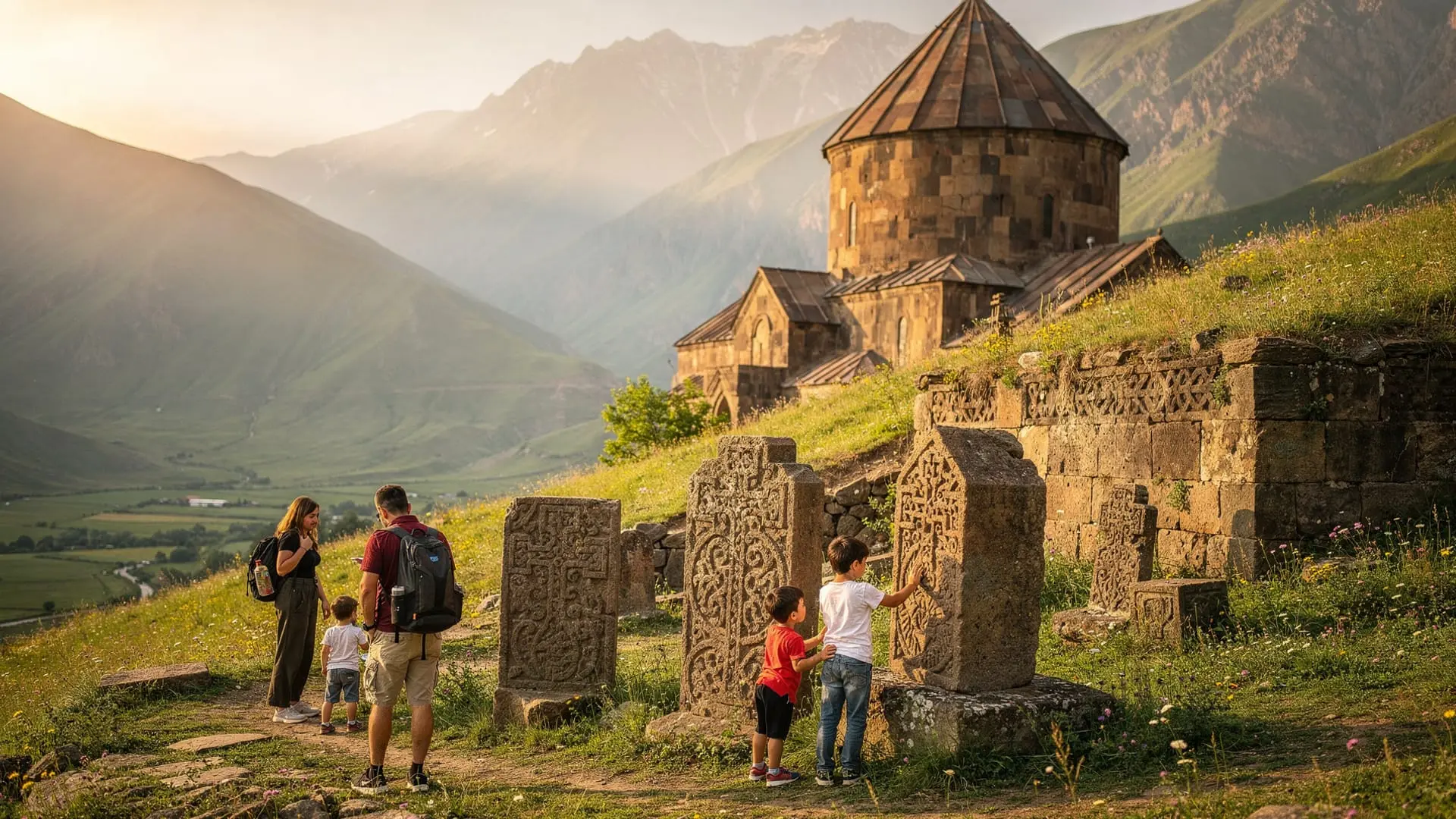
The Armenian Apostolic Church (which is Oriental Orthodox, distinct from both Roman Catholicism and Eastern Orthodoxy) built its monasteries as working agricultural and educational communities embedded in mountain landscapes. You visit them outdoors, in the open air, walking between stone buildings at various elevations with views across gorges, forests or lakes. There are no ropes, no “do not touch” signs on the khachkar cross-stones in the courtyards. Dogs often wander the grounds. Monks sometimes walk past.
For children, the most engaging monasteries have one of three qualities: drama (cliff settings, cave chambers, vertiginous stairs), adjacency to something non-religious (a pagan temple, a lake, a canyon), or a sense of mystery (carvings in stone, torchlit interiors, natural springs bubbling from floors).
The guide below is ranked loosely by family-friendliness, not by artistic or historical importance.
At a glance
| Monastery | Distance from Yerevan | Best age | Why kids like it |
|---|---|---|---|
| Geghard | 40 km / ~55 min | 4+ | Cave chambers, echoing acoustics, steep stairs to climb |
| Garni | 28 km / ~40 min | Any | Not a monastery at all — a pagan temple plus basalt canyon |
| Noravank | 120 km / ~1.5 hrs | 5+ | Red cliffs, climbable external staircase |
| Sevanavank | 65 km / ~1h15 | 3+ | 200 steps to count, huge lake views at the top |
| Haghartsin | 7 km from Dilijan | Any | Forest setting, hidden-in-the-woods feel |
| Khor Virap | 35 km / ~50 min | Any | Iron-ladder pit descent, Ararat views |
| Etchmiadzin | 25 km / ~30 min | 8+ | Cathedral treasury relics, best for curious older kids |
Geghard: the cave monastery wins every time
Distance from Yerevan: 40 km, about 55 minutes by car.
Walk from car park: 10 minutes, mostly flat.
Best age: 4 and up.
Stroller accessible: No — uneven stone paths.
Geghard (meaning “spear” — the site claims to have preserved the spear that pierced Christ’s side) is a 12th–13th century monastery partly hewn directly from the cliff. The cave churches are cool, slightly dark, and have natural springs seeping from the stone floors. The main gavit (antechamber) has khachkar reliefs carved directly into the rock wall. A secondary cave chamber higher up the cliff is reached by steep stone stairs with iron handrails — children tend to race each other up.
What children respond to most: the drama of the cave setting, the relief carvings that are clearly human-scale and touchable (within reason), and the echo of the interior chambers. Dress warmly — cave sections are 8–10°C cooler than outside.
Geghard is almost always combined with Garni (9 km downhill), which is the natural pairing for families. The two sites take about 3 hours combined.
Garni Temple, Geghard Monastery & Symphony of StonesGarni: the pagan temple bonus
Distance from Yerevan: 28 km, 40 minutes.
Walk from car park: 5 minutes.
Best age: Any.
Stroller accessible: Mostly — the temple itself is approached on a paved path.
Strictly speaking, Garni temple is not a monastery at all — it’s a 1st-century Hellenistic-style pagan sun temple, the only surviving pre-Christian temple in the former Soviet Union. It sits beside the ruins of a royal summer residence and overlooks the dramatic Azat River gorge.
Children find Garni visually striking because it simply doesn’t look like anything else they’ve seen in Armenia. Colonnaded, classical, unexpected — it reads as a smaller version of the Parthenon. The Garni Gorge (also called the Symphony of Stones) is accessible by a 15-minute walk from the temple: a wall of hexagonal basalt columns formed by ancient lava cooling is genuinely astonishing to children with any interest in natural patterns. Geologically identical to the Giant’s Causeway in Northern Ireland.
Combine with Geghard as a half-day. Start at Garni (lower, warmer), walk the gorge, then drive to Geghard.
Noravank: red cliffs and the double-decker facade
Distance from Yerevan: 120 km south, about 1.5 hours via the M2.
Walk from car park: 10 minutes.
Best age: 5 and up.
Stroller accessible: No — uneven paths and steps.
Noravank sits in a narrow gorge of sheer red limestone cliffs near Areni. The monastery itself (12th–13th century) is architecturally notable for the Church of St John, whose facade has a narrow external staircase leading to a second-storey door — children immediately want to climb it, and it is climbable.
The setting is the real draw: the monastery is enclosed on three sides by vertical red cliffs that glow orange in afternoon light. In spring, wildflowers grow from the cliff faces. In autumn, the cliffs deepen to crimson.
Combine with a stop at the Areni wine cave (15 km north) if you’re making a day trip of it, and with Khor Virap monastery if continuing south. The full Khor Virap + Noravank day is long but classic; read Khor Virap monastery guide for the Ararat view details.
Sevanavank: best for toddlers and lake lovers
Distance from Yerevan: 65 km east, 1 hr 15 min.
Walk from car park: The famous 200 steps up to the peninsula.
Best age: 3 and up (the steps are wide and safe).
Stroller accessible: No.
Sevanavank sits on a peninsula jutting into Lake Sevan at 1,900 m altitude. The monastery (9th century) is modest in scale but the lake views from the platform are spectacular. Children who can manage 200 steps up (and 200 down) are rewarded with a panorama of deep blue water and distant mountains.
The competition of counting the steps on the way up keeps even resistant children moving. The monastery courtyard is small but the space is open and the khachkars are weathered and interesting. Aim for early morning when the light on the lake is best.
Combine with a beach afternoon at Sevan town for a full family day. See Lake Sevan with kids for the beach guide.
Haghartsin: forest monastery for nature-loving families
Distance from Dilijan: 7 km, or a 5 km forest hike from Parz Lake.
Walk from car park: 5 minutes.
Best age: Any.
Stroller accessible: With difficulty — forest path is manageable but not paved.
Haghartsin (12th century) is remarkable for its forest setting — completely surrounded by old-growth beech and oak. The monastery itself is extensive: three churches, a gavit, a refectory, and extensive khachkar groups. The refectory is barrel-vaulted and atmospheric.
Children respond most to the forest atmosphere and the sense of arriving somewhere hidden rather than overtly displayed. The hike from Parz Lake (about 1 hour along a marked forest trail) is suitable for children aged 5 and up and is one of the better family walks in the national park. See the Dilijan National Park families guide for the full trail description.
Khor Virap: the Ararat view monastery
Distance from Yerevan: 35 km, 50 minutes south.
Walk from car park: 5 minutes.
Best age: Any.
Stroller accessible: Mostly.
Khor Virap monastery overlooks the Ararat plain from a low volcanic hill, with Mount Ararat (now in Turkey, visible from Armenia) filling the horizon on clear days. The monastery is historically significant — Gregory the Illuminator was imprisoned here in a pit for 13 years before converting Armenia to Christianity in 301 AD. You can descend into the pit itself via a steep iron ladder.
The pit descent is the highlight for children: the underground chamber is small, cool and has a genuine dungeon quality. Minimum height for safe ladder use is roughly 110 cm. The Ararat view — a 5,137 m extinct volcano rising from the flat plain — is genuinely dramatic, though note that haze and cloud frequently obscure the summit, particularly in summer afternoons. Morning visits are most reliable for a clear view.
Etchmiadzin: the mother cathedral for curious older children
Distance from Yerevan: 25 km, 30 minutes.
Walk from car park: On-site.
Best age: 8 and up for genuine engagement.
Stroller accessible: Yes — the precinct is paved.
Etchmiadzin (officially Vagharshapat) is the spiritual heart of the Armenian Apostolic Church — the world’s oldest national church, founded 301 AD. The cathedral complex is large and formal, with a cathedral (currently undergoing significant restoration), the Hripsime and Gayane churches (both UNESCO-listed), and an extensive museum.
For young children, the UNESCO precinct is less physically engaging than the monasteries listed above. For children with a genuine interest in history, religion, or architecture (aged 10 and up), the museum’s relics — including the alleged tip of Noah’s Ark, pieces of the True Cross, and the Spear of Longinus — are memorable conversation starters regardless of one’s views on their authenticity.
Making monastery visits interactive for children
The best monastery visits with children are not guided tours but explorations. Some approaches that work:
The khachkar hunt: Khachkars are the Armenian cross-stones — unique carved stone slabs combining a cross with interlacing geometric patterns. Every Armenian monastery has them; the largest collection in the world is at Noratus cemetery near Lake Sevan. Challenge children to count how many different khachkar designs they can find at a single monastery, or to find the oldest visible date carved in a stone. This transforms what could be passive observation into active looking.
The spring chamber game at Geghard: Geghard’s cave chambers include several with natural springs seeping from the rock floor. The chambers are cooler and darker than the exterior and have a quality children respond to — a sense of discovery. Let children lead the exploration of the inner chambers rather than herding them through.
Identifying animals in the carvings: Medieval Armenian church decoration includes pomegranates, grapes, eagles, lions, and geometric animals in the stone carvings. Finding the hidden animal in a particular relief keeps hands and eyes busy during what might otherwise feel like a long stop.
The candle: At every monastery, small wax candles can be bought at the entrance for 50–200 AMD. Light a candle with your children and place it in the sand tray near the altar. This is a participatory act rather than a spectator act, and children tend to remember it.
Practical monastery day planning
The classic Yerevan-area day: Garni + Geghard is 3–3.5 hours total with a car and is the most child-friendly day trip from Yerevan. The combination covers a pagan temple, a canyon of geometric basalt columns (Symphony of Stones), and a cave monastery. Few children find this dull.
The southern circuit: Khor Virap + Noravank is longer (about 6 hours driving and visiting combined) but the contrast of mountain and canyon landscapes keeps the journey interesting. Best with children aged 7 and above who can handle longer car journeys.
The lake day: Sevanavank + Sevan beach gives the monastery-plus-swimming combination that keeps all ages happy. The 200 steps are the price of entry; the beach is the reward.
The northern circuit: Haghpat + Sanahin in Lori is best as an overnight trip from Yerevan. The drive (3.5 hours each way) is too long for a single day with young children; staying overnight in Alaverdi or Vanadzor makes it workable.
From Yerevan: Khor Virap, Garni, and Geghard Day TripWhat to bring to any monastery visit
- Sun protection: Open monastery courtyards offer minimal shade. Hats and sunscreen are essential from May to September.
- Water: Dehydration is a risk for children. Carry more than you think you need.
- Layers: Cave sections of Geghard and underground chambers at Khor Virap are significantly colder than outside.
- Modest clothing: Armenia’s monasteries are active religious sites. Children do not need special dress codes enforced in the same way as adults, but long trousers or skirts for adults are expected inside churches.
- Small change: Candles sold at the entrance are typically 50–200 AMD. Lighting a candle alongside local families is a simple, meaningful participation.
For a full family week built around these sites, see the 7-day Armenia family itinerary.
Pacing a monastery day with young children
The single biggest mistake parents make with monastery days is treating them like an adult sightseeing itinerary — one site after another with minimal breaks. Children need built-in rest, and monasteries are actually well-suited to this because most sites have a shaded courtyard or a café nearby.
Build in a 20–30 minute “nothing” stop after every monastery — sitting, snacking, letting children run around a courtyard — before driving to the next site. This single habit prevents the mid-afternoon meltdown that ruins otherwise well-planned days.
Two monasteries, not three: For children under 7, cap the day at two monastery stops. Garni + Geghard is the ideal pairing precisely because it naturally includes a change of scenery (temple, then gorge, then cave) rather than three similar stone buildings in a row.
Watch the heat, not just the distance: A 40-minute drive in an air-conditioned car is easy on children; 90 minutes in the midday sun walking between a car park and a monastery entrance is not. Plan outdoor time for morning or late afternoon between May and September, and check the Lake Sevan with kids guide if you want to pair a monastery morning with a lake afternoon to cool off.
A guided family day covering Etchmiadzin, Zvartnots, Garni and GeghardFrequently asked questions about monasteries with kids
Do I need to be Christian to visit Armenian monasteries?
No. Armenian monasteries are visited by people of all backgrounds; the sites function simultaneously as active places of worship and open cultural heritage sites. Respectful curiosity is all that is expected.
Are there entry fees?
Most Armenian monasteries are free to enter. Garni temple charges a small fee (around 1,500 AMD per adult, children often free or reduced). Parking fees apply at some sites. The Etchmiadzin Treasury Museum has a separate entry charge.
Can very young children (under 3) manage monastery visits?
Yes, with caveats. Geghard and most other monasteries involve uneven stone paths unsuitable for pushchairs. Carrying infants in a front carrier or backpack carrier is the practical solution. The interior cave chambers at Geghard are cool — bring a layer for young children even in summer.
Which monastery combines best with a Sevan lake visit?
Sevanavank is the obvious combination — the monastery sits on the lake itself. A half-day trip from Yerevan to Sevanavank, followed by a beach afternoon at Sevan town, works well for families.
Is there food near the main monasteries?
Small stalls near Garni and Geghard sell lavash, cheese, fruit and cold drinks. Noravank has a café at the car park. Khor Virap is more remote — bring your own food. Near Sevanavank, the town of Sevan has plenty of fish restaurants.