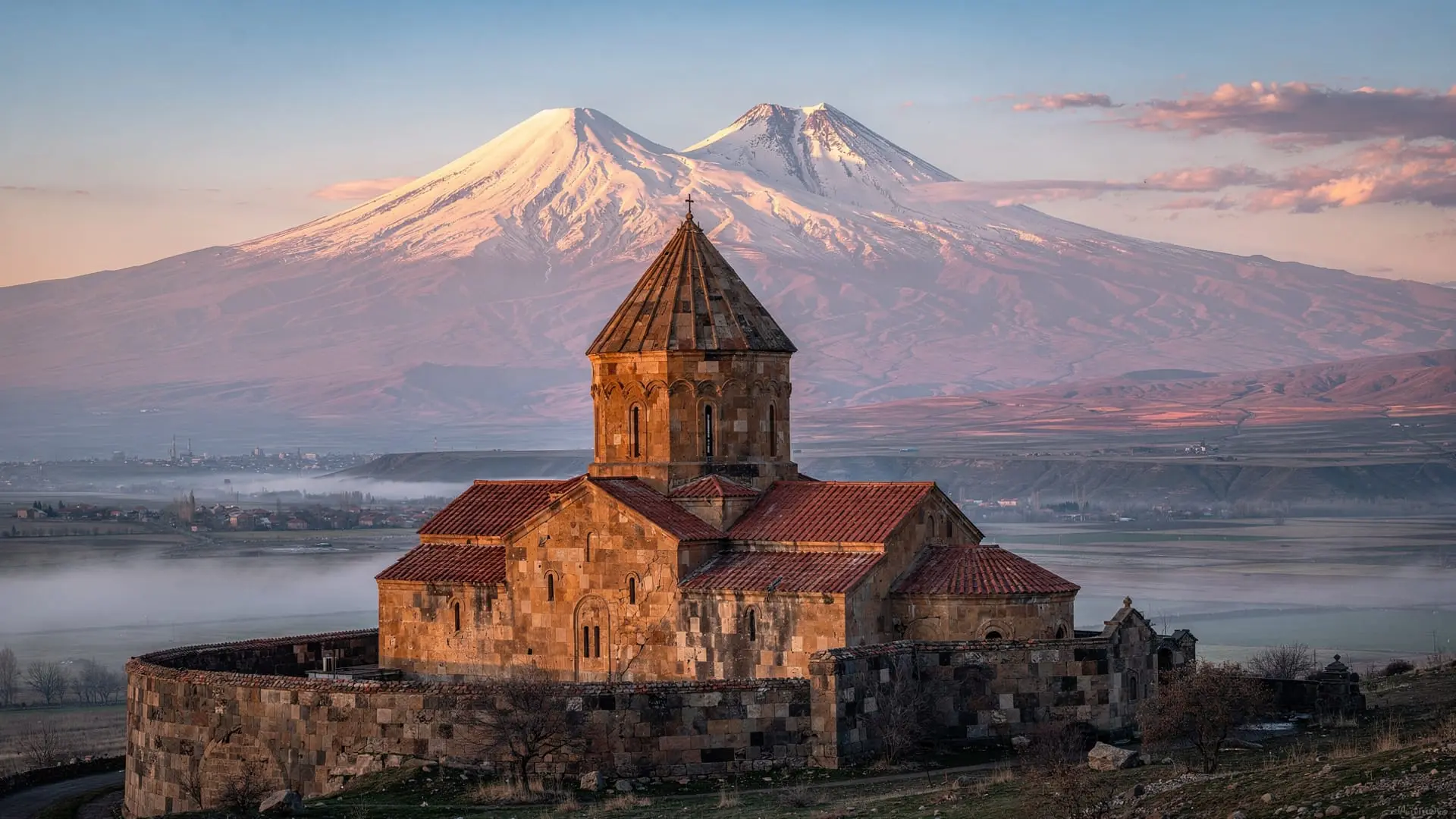
The monastery at the foot of a forbidden mountain
The image of Khor Virap is one of the defining photographs of Armenia: a small monastery on a low volcanic mound rising from flat agricultural land, and behind it — filling the entire horizon — the perfect white cone of Mount Ararat, barely 10 km away across the Turkish border. The contrast of foreground and background is almost surreal.
| Where | Ararat plain, 35 km south of Yerevan, 10–12 km from Mount Ararat |
| Cost | Free entry |
| Time needed | 45–90 minutes |
| Getting there | Car/taxi (50 min), marshrutka + local taxi, or guided tour |
| Best time | Sep–Nov or Mar–Apr, early morning, for clearest Ararat views |
Mount Ararat is in Turkey. It has been since the 1921 Treaty of Kars, which assigned the ancient Armenian heartland to the newly formed Republic of Turkey following the First World War and the Armenian Genocide. Armenians cannot visit the mountain; they can only see it. This is part of what makes Khor Virap so emotionally loaded — it’s not merely a monastery but a viewpoint onto a wound.
The monastery itself has a significant history beyond the backdrop. This is where Gregory the Illuminator was imprisoned in an underground pit for 13 years (287–300 AD) by the pagan king Tiridates III, before converting the king and the country to Christianity in 301 AD, making Armenia the world’s first Christian nation. The pit still exists, accessible via a steep iron ladder that descends into darkness beneath the main church.
The Ararat visibility problem
This is important: Mount Ararat is not always visible. Summer haze from June through August frequently obscures the mountain entirely — some visitors in July see nothing but grey murk behind the monastery. The clearest views occur:
- September–November: autumn air is cleaner, mountain stands sharp and snow-capped
- March–April: spring clarity, snow still on both peaks
- Early morning: before heat haze builds, even in summer
- After rain: the air clears dramatically for 24–48 hours
If you’re visiting specifically for the Ararat view, choose your time carefully. Tour operators rarely warn you about this. We will.
Getting to Khor Virap from Yerevan
By car or taxi: 35 km south of Yerevan via the road through Artashat. The drive takes 50 minutes. A return taxi costs 10,000–15,000 AMD (25–37 €). If combining with Noravank (another 100 km south), expect 25,000–35,000 AMD for a full-day car.
By marshrutka: Marshrutkas to Artashat depart from Gai Station, Yerevan (250 AMD, 40 min). From Artashat, a local taxi to Khor Virap costs 2,000–3,000 AMD. The monastery village is small — there is no public transport from Artashat.
By guided tour: by far the most common option. Khor Virap is almost always combined with other sites (Garni, Geghard, Noravank, Areni) in day tours from Yerevan.
What to see at Khor Virap
The monastery complex
The complex is small: the main Surb Astvatsatsin (Holy Mother of God) Church dates from the 17th century with earlier foundations, flanked by a smaller chapel. The interiors are modest — the interest here is the site, the views, and the pit.
Gregory’s Pit (Khor Virap itself)
Khor Virap means “deep pit” in Armenian. Beneath the main church, a vertical shaft drops about 5–6 metres into a dark underground chamber where Gregory the Illuminator was held for 13 years. Descent requires climbing down a nearly-vertical iron ladder — doable for most adults but claustrophobic if you dislike tight spaces. The pit itself is small (maybe 3×4 metres) and has an eerie presence. Light a candle if you have one. Allow 15 minutes.
The rampart walks and views
The monastery sits on the remains of the Urartian-era fortress of Artaxata. Walk the perimeter of the compound to find the best angles on Ararat — the northwest corner gives the classic composition with the double peak in profile.
The surrounding plain
The Ararat plain stretching south of Yerevan is some of the most fertile land in Armenia, covered with vineyards, orchards, and vegetable fields. On a clear day, the combination of agricultural foreground, medieval monastery, and snow-capped volcano is genuinely extraordinary.
Where to stay near Khor Virap
There is no accommodation at the monastery. Most visitors day-trip from Yerevan. The small village of Pokr Vedi (near Artashat) has a basic guesthouse but there is no reason to stay here rather than Yerevan.
Where to eat near Khor Virap
A few basic restaurants and stalls operate near the monastery parking lot, serving Armenian standards. None are particularly noteworthy. The better strategy: pack a lunch from Yerevan or plan to eat at a restaurant in Artashat town (30 minutes’ drive), where there are several decent local places.
If you’re combining with Noravank or Areni, lunch options improve dramatically — several village restaurants and winery restaurants operate along that route.
Tours and tickets
Admission: Free. Khor Virap monastery charges no entrance fee.
For combining Khor Virap with the southern monastery circuit: Khor Virap and Noravank combined day trip is one of the best-value southern Armenia tours.
If you have a full day and want to include the wine region: Khor Virap, Areni winery, and Noravank tour makes an excellent full-day circuit.
See our companion guide /guides/khor-virap-monastery-ararat-views/ for Ararat photography tips and seasonal advice.
From Yerevan: Khor Virap Monastery, Winery & Birds Cave TourBest time to visit Khor Virap
September–October: the gold standard. Ararat stands crystal-clear, the plain below the monastery is deep green, and the autumn light is warm.
March–April: spring clarity offers excellent mountain views. Wildflowers begin on the plain in April.
November–February: winter is manageable. Ararat is often snow-covered on both peaks and visibility can be exceptional on cold clear days. The monastery sees very few tourists.
May–June: still good, but summer haze begins in June.
July–August: highest risk of Ararat being obscured. If you must visit in summer, go early morning (before 09:00) or at dusk.
Practical tips
- Dress code: cover shoulders and knees. A scarf or shawl available at the entrance.
- Photography: bring a telephoto lens for Ararat close-ups. The mountain is about 10–12 km away.
- The pit ladder: it’s steep and vertical — not suitable for visitors with mobility difficulties or severe claustrophobia.
- Combine strategically: Khor Virap + Noravank makes a strong half-day/full-day circuit going south. Khor Virap + Garni + Geghard makes a different direction (east). Pick one per day.
- Opening hours: the complex is accessible daily from approximately 08:00 to sunset. There is no strictly enforced closing time.
See our day trip planning guide for combining Khor Virap with Noravank efficiently.
Frequently asked questions about Khor Virap
Can I see Mount Ararat from Khor Virap?
Yes, if weather permits. Ararat (5,137 m) is about 10–12 km from Khor Virap across the Turkish border. On clear days the mountain dominates the skyline completely. Summer haze (July–August) often obscures it. September–November and March–April offer the best visibility. There are no guarantees — plan accordingly.
Why is Mount Ararat in Turkey if it’s the Armenian symbol?
Ararat was assigned to Turkey under the 1921 Treaty of Kars following World War I and the Armenian Genocide. Armenia lost significant territories including Kars, Ardahan, and the region around Ararat. The mountain remains the national symbol of Armenia and appears on the country’s coat of arms, despite being politically inaccessible.
What is Gregory’s pit inside the monastery?
Gregory the Illuminator (Grigor Lusavorich) was imprisoned in an underground pit at the site for 13 years (287–300 AD) on orders of King Tiridates III. According to tradition, he survived through miraculous means. Upon his release, he converted the king to Christianity. A descent ladder leads down to the preserved pit, which you can enter.
How long should I spend at Khor Virap?
45–90 minutes is enough to see the monastery, descend into the pit, walk the perimeter, and photograph the Ararat views. Most visitors spend about an hour. If you’re a photographer waiting for optimal light conditions, you may want longer.
Is Khor Virap worth visiting if Ararat is obscured?
Yes, but it loses its primary selling point. The monastery has historical and religious significance independent of the view, and the pit is worth experiencing. But for a “destination photograph,” the view is the thing.
Can I combine Khor Virap with the Yerevan genocide memorial in one day?
Yes, easily — Tsitsernakaberd is in Yerevan itself and Khor Virap is only 35 km/50 minutes south, so both fit comfortably into a single morning-to-afternoon day. Many guided itineraries pair them deliberately: see our Tsitsernakaberd genocide memorial guide for visiting details.
Is it worth visiting Khor Virap twice in one trip?
For most travellers, once is enough unless you have a specific photography goal that the weather denied you the first time. If Ararat was obscured on a summer visit and you have a flexible itinerary, a second early-morning stop in the following days — especially after rain, when the air clears dramatically — can be worth the short detour from Yerevan for the view alone.
The Ararat question: politics, identity, and the view from Khor Virap
There is no avoiding it. Standing at Khor Virap and looking toward Mount Ararat is an act charged with political and historical meaning for every Armenian in a way that is unfamiliar to most foreign visitors.
Mount Ararat was the heartland of historical Armenia — the region around the Ararat valley was where the Armenian identity coalesced over millennia, where the Urartu kingdom built its citadels, where the medieval Armenian kingdoms had their capitals. The mountain is depicted on the Armenian coat of arms. It appears in thousands of years of Armenian poetry and literature. The cognac is named for it.
The mountain is now in Turkey. It has been since the 1921 Treaty of Kars, signed between the new Turkish Republic and Soviet Russia. The treaty assigned Kars, Ardahan, and the Surmali district (including Ararat) to Turkey. At the time, the First Republic of Armenia (1918–1920) had already been absorbed into Soviet Russia and had no part in negotiations. The Armenian people had no voice in the disposition of their historical territory.
This is the wound that Khor Virap makes visible. The best view of Armenia’s national mountain is available only from the Armenian side. Climbing the mountain requires a Turkish permit. The vast majority of Armenians have never stood on its slopes and never will, though it dominates their national imagination.
For diaspora visitors, this reality hits with particular force. For European or North American visitors unfamiliar with the history, it is worth arriving at Khor Virap knowing the context — it transforms the experience from “nice mountain backdrop” to something considerably more resonant.
The road to the monastery and the border
The final approach road to Khor Virap passes through the village of Pokr Vedi and farmland at the base of the Ararat plain. The Turkish border is approximately 10 km from the monastery as the crow flies — you can see the border zone clearly from the monastery’s northwest rampart wall. There are no border crossings in this area; the nearest crossing points between Armenia and Turkey would theoretically be at Gyumri (via Georgia) as Turkey and Armenia have no open land border. The frontier has been closed since 1993 with no current timeline for reopening.
The Ararat plain: agricultural richness
The plain stretching from Khor Virap to Yerevan and beyond is the agricultural heart of Armenia. Vineyards, orchards (apricots, peaches, pomegranates), vegetable cultivation, and grain fields cover this fertile volcanic soil. The Ararat valley was historically one of the most productive agricultural regions of the ancient Near East — supported by the rivers draining from both Armenian highlands and the Ararat volcanic complex.
The apricot trees that bloom in April on the outskirts of Yerevan come from these orchards. The apricot is the national fruit — the Armenian word for it, “tsiran,” is almost onomatopoeically linked to the country’s identity. The dried apricots sold throughout Armenia come primarily from this plain.
Genocide memory and the view from Khor Virap
For many Armenian and diaspora visitors, Khor Virap is inseparable from the wider story of loss commemorated at the Tsitsernakaberd genocide memorial in Yerevan. The two sites are often visited on the same day — the memorial in the morning, Khor Virap and the view of the lost homeland in the afternoon — because together they frame the same history from two angles: the memorial documents what happened, Khor Virap shows what was left behind. Guides who lead both stops in one day generally recommend the memorial first; arriving at Khor Virap with that context changes how the view lands.
Visiting independently versus with a guide
A self-drive or taxi visit to Khor Virap is straightforward — the site is small, free, and easy to navigate without a guide. What a guide adds is context: the 1921 Treaty of Kars, the reasoning behind the closed border, and the layered history of Gregory’s pit are easy to miss reading a signboard alone, and most on-site information is minimal. If Khor Virap is your only stop of the day, independent visiting works well. If you’re combining it with Noravank or the wine region around Areni, a private driver-guide typically costs little more than a taxi and adds considerably to the day, especially for first-time visitors to Armenia who want the historical throughline explained rather than pieced together afterwards.
Combining Khor Virap with the southern circuit
From Khor Virap, heading south into the Ararat province and beyond:
-
Khosrov Forest State Reserve (50 km east of Khor Virap): one of the oldest nature reserves in the world, established in the 4th century AD by King Khosrov II to protect his royal hunting grounds. The reserve covers 29,000 hectares of forest and steppe — a genuinely wild area rarely visited by tourists. Permits required; enquire at the Artashat provincial administration.
-
Areni and Noravank (100 km further south via Yeghegnadzor): the logical continuation of the southern arc. Most tours that include Khor Virap also continue to Areni and Noravank on the same day.
-
Jermuk (150 km south, via Yeghegnadzor): the spa town with its mineral water galleries and waterfall — a natural overnight extension for those going south.
See /itineraries/armenia-classic-5-days/ for a structured framework combining Khor Virap with the key southern sites.