Meeting relatives in Armenia: cultural & practical tips
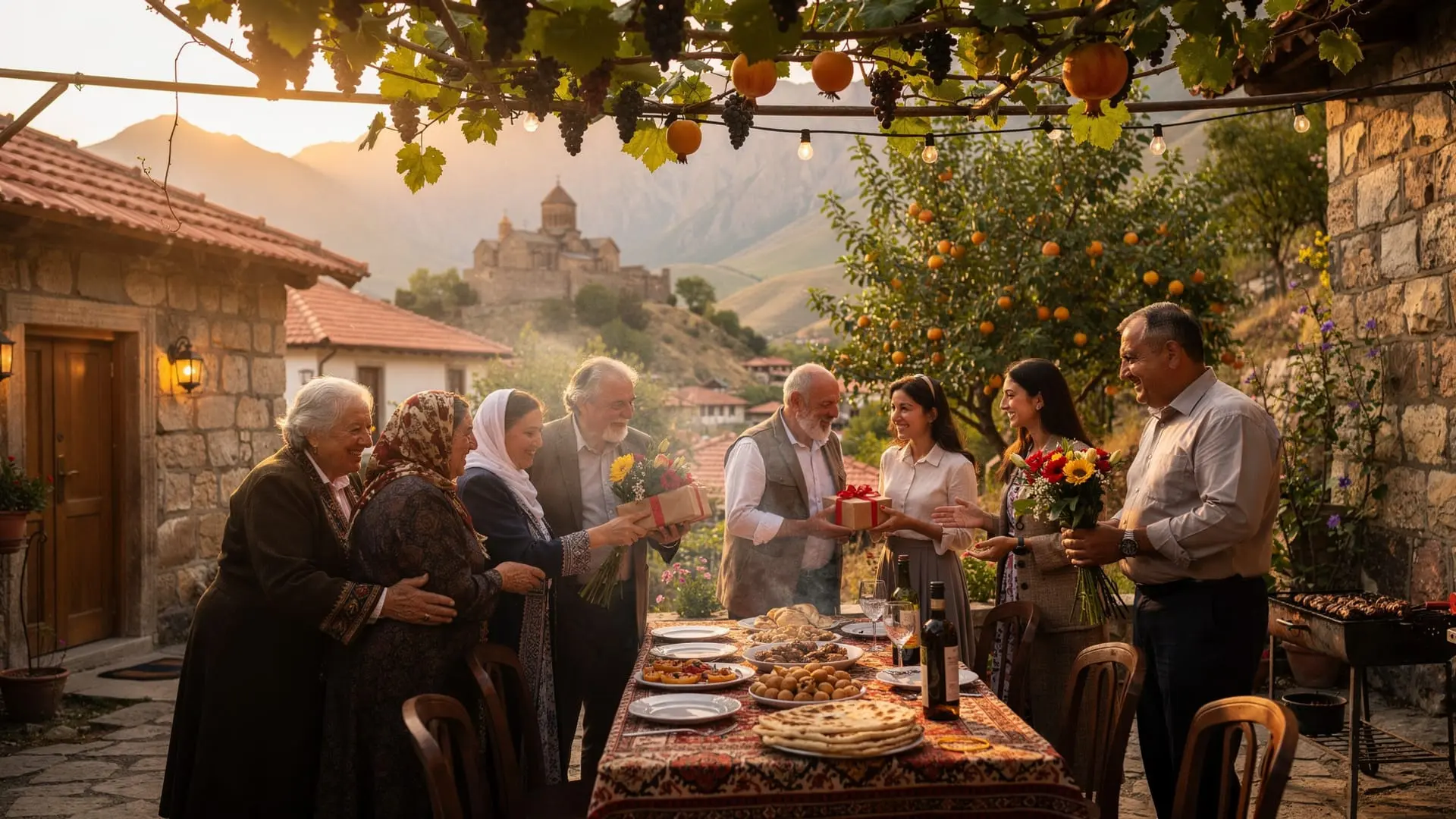
The reunion you may have been postponing
For many diaspora Armenians, the prospect of meeting relatives in Armenia produces a specific kind of anxiety — not fear exactly, but a mixture of anticipation, uncertainty, and self-consciousness. You have been hearing about these relatives your whole life: Aunt Hasmik in Yerevan, the cousin in Vanadzor whom your grandmother always mentioned, the Torossian branch that never left. And now the meeting is real.
The anxiety, when it exists, usually has several components: language (what if my Armenian isn’t good enough?), cultural expectations (what if I do something wrong?), family dynamics (what if there’s history I don’t know about?), and the basic strangeness of meeting people who are family by blood and genealogy but strangers by experience.
This guide tries to address all of these practically. Armenian hospitality culture is well-defined and generously forgiving of foreigners, including diaspora Armenians who are simultaneously foreign and family. The main risk is not that you will offend someone — it is that you will be so overwhelmed by hospitality that you forget to manage your own wellbeing.
At a glance
| First contact | At least a week’s notice, via social media, church networks or Repat Armenia |
| Gift budget | ~3,000–6,000 AMD for a proper Grand Candy box, plus something from home |
| Time to allow | 2–3 hours for a first home visit; can extend to 5–6 hours |
| Language | English, Russian or translation apps often bridge the gap |
| Village visits | Build in a full day — provincial hospitality rarely fits a short stop |
Before the visit: making contact
If you have a family connection in Armenia but have not been in regular contact, the first outreach is the most important step.
How to make contact:
- Through shared family members in the diaspora who may have maintained contact
- Through social media (Facebook is widely used in Armenia; Odnoklassniki and VK still have users among older generations)
- Through church networks — Armenian Apostolic church communities often maintain family contact lists
- Through Repat Armenia (repatarmenia.org) if you need help tracing relatives
What to say: Introduce yourself clearly — full name, which branch of the family you belong to, and the specific connecting relative (your grandmother was Mariam Petrossian, daughter of Arshak Petrossian from Sevan, etc.). Don’t assume they know who you are even if your branch has stayed in contact. Family trees get complicated across generations and continents.
Timing: Armenians appreciate notice. Call or message at least a week before you plan to visit, ideally more. Arriving unannounced is possible but considered slightly inconsiderate. Give them time to prepare — and preparing for a diaspora relative’s visit is something Armenian families take seriously.
Gifts: what to bring and what to avoid
Armenian gift-giving for family visits follows its own logic. The principles:
Bring something from your home country or city: Chocolates, biscuits, regional sweets, or a small food item specific to where you live in the diaspora. This carries more meaning than something generic. Los Angeles-Armenians bringing California almonds, Parisian-Armenians bringing French chocolates, Lebanese-Armenians bringing Lebanese sweets — all of these carry a story.
Grand Candy chocolate: If you arrive without gifts from home, or want to add a local option, Grand Candy is Armenia’s best-known chocolate brand and a universally appropriate gift. Available in every supermarket. A box of Grand Candy assorted chocolates (look for the large gift boxes in gold packaging) costs around 3,000–6,000 AMD (7–15 EUR). Do not buy the cheap mass-market version — buy the proper gift box.
Family photographs: Print photographs — physical prints — before you travel. This is something Armenian families treasure beyond most gifts. Photographs of your branch of the family: your parents, your children, your home. They will be looked at carefully and kept. A photograph album, even a simple one, is a profound gift for relatives who have lost physical connection with the diaspora branch of the family.
Alcohol: A bottle of good cognac or whisky from your home country is appropriate for male relatives who drink. Do not bring Armenian cognac to Armenia — it’s like bringing coal to Newcastle. Whisky, French cognac, or wine from wherever you live is better received.
What to avoid: Expensive gifts that create obvious financial asymmetry or obligation. Very personal items (clothing especially) unless you know sizes and preferences. Gifts that imply the Armenian relatives are less well-off than you (practical household items, for instance, unless specifically requested).
The hospitality dynamic: what you cannot refuse
Armenian hospitality is genuine, generous, and structurally incompatible with politeness-refusals. Understanding this in advance prevents the main cultural friction of diaspora family visits.
Food: When you arrive at an Armenian home, food will be put on the table. Not a symbolic amount — a full spread. Cheese, lavash, fruit, pickles, dolma, grilled meat, pastries, whatever they have or could acquire. The cultural expectation is that you eat. Saying “I’m not hungry” or “I’m on a diet” or “I already ate” will be politely heard and then ignored as the food is placed in front of you anyway.
The way to navigate this if you genuinely cannot eat is to take small portions of everything, compliment it specifically (this dish is wonderful, the lavash is incredible), and eat a little of each. Refusing categorically is interpreted as either an insult or a concern about the quality of the food.
Drinks: Coffee (soorj — Armenian coffee, thick and served in small cups) or tea will be offered immediately upon arrival. A glass of cognac or homemade fruit vodka (vodka made from mulberries, apricots, or grapes is common in Armenian households) will likely follow, regardless of time of day. If you don’t drink alcohol, say so clearly — this is respected. If you do drink, pace yourself. Armenian hosts who produce homemade spirits take pride in them.
Jan suffix: Armenians add “-jan” (roughly equivalent to “dear” or an affectionate diminutive) to names and family relationship words. You will be called by your name-jan constantly. This is pure affection. Address others the same way — Maria-jan, Grandfather-jan, Aunty-jan — and you will immediately register as someone who knows how Armenian families speak to each other.
Navigating generational differences
The gap between diaspora experience and Armenian Republic experience can be larger than the geographical distance suggests. Several tensions are worth anticipating:
Language: If your Armenian is limited or a different dialect (Western Armenian), conversations may default to English or through a translator. This is not a failure — it is a reality. Some relatives will have enough English or Russian for a functional conversation; others will need translation. Bring patience and a translation app as backup.
Expectations about diaspora life: Relatives in Armenia may have a idealised or outdated view of diaspora life — imagining that diaspora Armenians are uniformly wealthy, that life in Los Angeles or Paris is uncomplicated, that you have no struggles. The reality of diaspora life (racism, identity uncertainty, economic pressures, the difficulty of maintaining Armenian identity abroad) may be surprising to them. These conversations, when they happen, can be among the most meaningful of a heritage trip.
Political topics: Armenia has intense political divisions — particularly around the 2020 and 2023 conflicts, the question of Nagorno-Karabakh, and attitudes toward Russia, the West, and the government. Diaspora Armenians sometimes arrive with strong political views that may or may not align with what their relatives think. Listen more than you speak, particularly in your first meetings. Ask questions; don’t lecture.
The “why did you leave / why don’t you come back” dynamic: Relatives who stayed in Armenia sometimes feel abandoned by the diaspora; diaspora Armenians sometimes feel guilty about having a “better” life. Neither feeling is entirely rational but both are real. Name this gently if it surfaces.
Practical logistics of the visit
Where to meet: If relatives are in Yerevan, the choice of meeting at their home or at a restaurant is a cultural signal. An invitation to their home is intimate and means they want to host you fully. A restaurant meeting is more neutral. Both are perfectly fine; let them choose if possible.
How long to stay: For a first visit to a relative’s home, 2 to 3 hours is typically appropriate. Armenian hospitality operates on a time scale that can extend a visit to 5 or 6 hours if you allow it — because the food, the cognac, the photographs, the stories, and the emotion all take time. This can be wonderful or exhausting depending on your state. If you have other plans, say so in advance, gently. “I have to leave by 6 pm as I have another engagement” is a culturally acceptable exit, particularly if your host has also been given the full span of your attention during the visit.
If staying overnight: In smaller cities or villages, staying with relatives overnight may be offered and expected. This is a significant gift of trust. The guest room will be prepared; the household will reorganise around you. Accept if you can — these overnight stays are often among the most memorable parts of a heritage trip.
City Tour in Yerevan with local guideVisiting relatives outside Yerevan
Many diaspora Armenians have relatives not in Yerevan but in provincial cities (Gyumri, Vanadzor, Kapan) or in villages. The experience of a village visit is qualitatively different from a Yerevan apartment visit.
The food will likely include things produced on the property — vegetables from the garden, cheese from their animals, homemade wine or vodka. The hospitality is often even more generous, because having diaspora visitors is rarer and more significant in a village than in the capital.
Getting there: for villages beyond Yerevan, hire a driver for the day rather than relying on marshrutka connections, particularly if you are bringing luggage or gifts.
Time: a village visit almost always becomes a full day. Build this into your schedule.
For the broader context of how to contribute to rural communities during your visit, see the diaspora contribution guide.
After the visit: staying in touch
The visit will have more impact if you maintain some contact afterward. Exchange phone numbers (WhatsApp is widely used in Armenia). Send the photographs you promised. If you speak Armenian at any level, a message in Armenian — even simple, even imperfect — is received with disproportionate warmth.
For the full heritage trip framework, see the Armenia diaspora heritage trip guide.
Building relative visits into a wider Armenia itinerary
Most diaspora travellers combine a family visit with a broader trip around the country, and it’s worth thinking about sequencing. Meeting relatives early in a trip — within the first two or three days — often changes how the rest of the visit feels, since local family can suggest places, correct misconceptions from guidebooks, and sometimes join you for a day trip. If your relatives are in Yerevan itself, a natural pairing is a shared afternoon at somewhere emotionally resonant, such as the Matenadaran or a walk through Republic Square — Armenian relatives often take real pride in showing these places to family from abroad.
A guided Yerevan city tour — a good shared activity if relatives want to join for part of the dayFrequently asked questions about meeting relatives in Armenia
What if my relatives and I don’t share a language?
This is common and manageable. Basic communication works through gesture, facial expression, and the universal language of food and family photographs. Google Translate’s camera function (which can translate Armenian text in real time) and the voice translation function are genuinely useful. Bring a younger relative or a bilingual friend if at all possible for longer conversations.
Should I offer to pay when we eat at a restaurant together?
In Armenian culture, the host pays — and hosting a diaspora relative is a significant honour. Attempting to pay will usually be resisted vigorously. If you feel the obligation of reciprocity strongly, invite your relative to a separate restaurant meal where you are clearly the host. Or buy the Grand Candy and the cognac as your contribution.
What if I’m invited to a family celebration (birthday, wedding, baptism)?
Go, if you possibly can. Armenian celebrations are memorable, generous, and provide a level of family immersion that a regular visit cannot. Bring a gift appropriate to the occasion (money is acceptable for weddings; ask what the local custom is). Expect music, dancing, toasts, and food for six hours minimum.
How do I address older relatives respectfully?
Use “Mairig” (mother figure), “Hairig” (father figure), “Babik” (grandfather), “Mamik” (grandmother), “Keri” (uncle), “Kerikeen” (aunt), or simply their name with the -jan suffix. When in doubt, be more formal rather than less — older relatives in Armenia are accustomed to being addressed with respect by younger family members.
What if the visit is emotionally overwhelming?
It may be. The combination of family emotion, the weight of a heritage trip, and the reality of meeting people who are blood relatives but relative strangers can produce unexpected responses. This is entirely normal. Give yourself permission to step outside for air during a long visit. Your relatives will understand.
Is it appropriate to bring children to the first meeting with relatives?
Generally yes — children are a social lubricant in Armenian culture, universally welcomed, and their presence tends to make the emotional register of the meeting less formally intense. Relatives who might be formal and slightly nervous meeting an adult diaspora family member will often relax immediately when there are children to dote on. If anything, bringing children accelerates the warmth of the visit.
What topics are sensitive or best avoided?
Recent Armenian politics (particularly anything relating to the 2020 war, the Karabakh question, or the 2023 displacements) may be raw depending on your relatives’ circumstances. Socioeconomic comparisons — “things are so much cheaper here than in Paris” or “the internet is slow” — can inadvertently imply judgments about Armenian quality of life. Religious topics are generally fine but be aware of the distinction between Apostolic, Catholic, and Protestant Armenian communities if your relatives’ church affiliation differs from yours. Beyond these, most topics are open.
How do I handle being given food or gifts to take back to the diaspora?
Your relatives will almost certainly try to send you back with food — dried fruit, homemade preserves, local honey, perhaps a bottle of cognac. Accept what you can carry. The gesture is as important as the item. If something is truly impractical to transport, thank them genuinely and explain specifically (customs regulations, airline weight limits) — practical reasons are accepted gracefully in a way that a simple refusal is not.