Renting a car in Armenia: rules, roads & tips
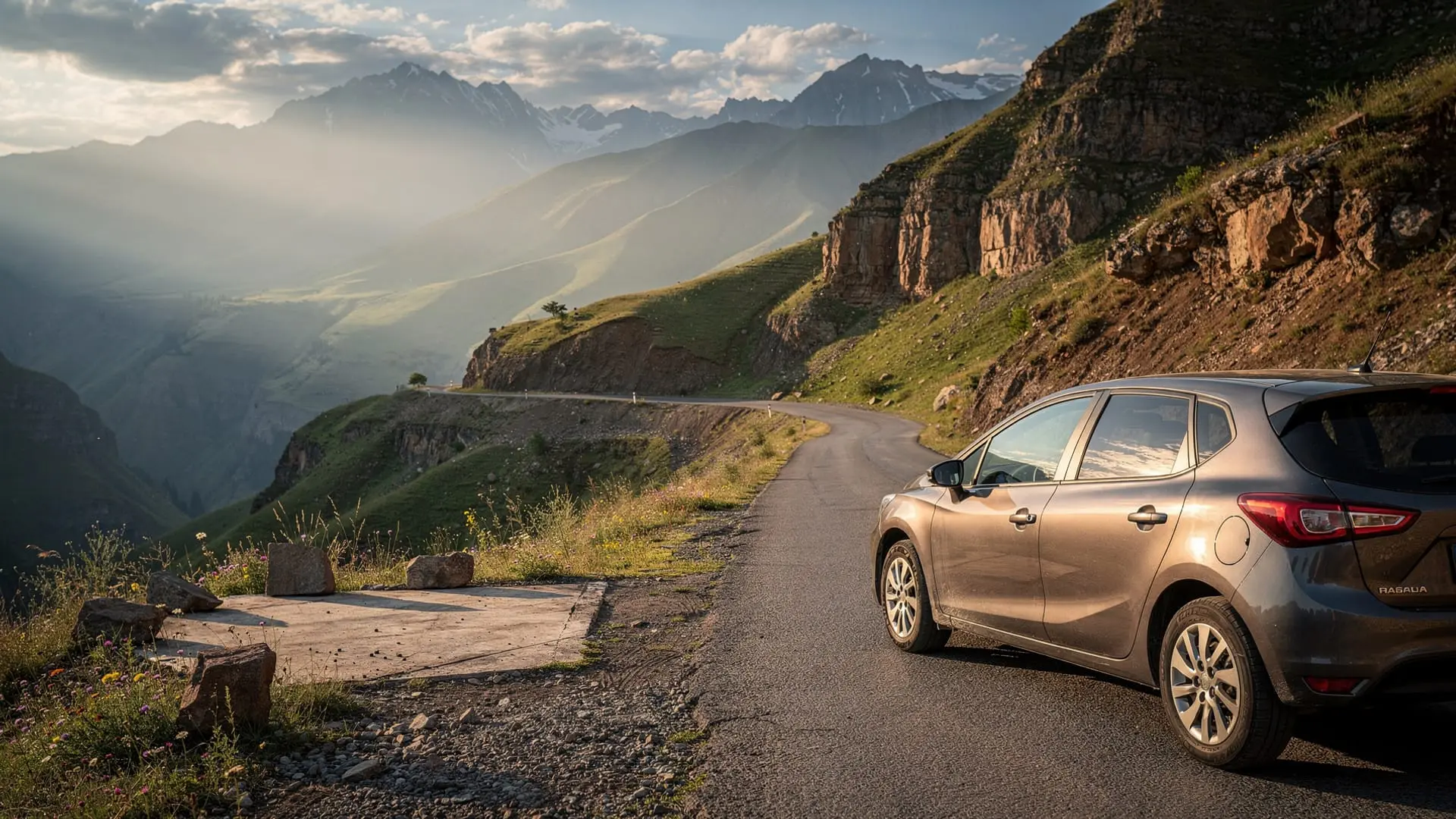
Why renting a car transforms your Armenia trip
Armenia’s top-tier sites — Tatev, Noravank, Haghpat, the Aragats valleys — are all reachable by marshrutka or guided tour. But a rental car gives you something neither option provides: the freedom to stop at the roadside lavash bakery on the M2 highway, walk to a half-forgotten monastery that no tour group visits, and pace your day around light rather than a driver’s schedule.
For 35–80 EUR per day, a car unlocks a level of Armenia that package tourists never reach.
| Where | Pick up in Yerevan (Zvartnots airport or city centre) |
| Cost | Around 35–60 EUR/day at local agencies, 55–80 EUR/day at international chains |
| Time needed | Book 2–3 weeks ahead in July–August |
| Getting there | International driving permit + home licence required |
| Best time | May–October for easiest mountain-road access |
Licence requirements
An international driving permit (IDP) is required. An IDP translates your home licence into Armenian and is technically required by law, even if many rental desks accept EU driving licences alone. To be safe:
- Get an IDP from your national automobile club before travelling (usually valid 1 year, costs around 15–20 EUR).
- Bring your original home driving licence alongside the IDP.
- US, Canadian, Australian, UK, and EU licences are all valid with the IDP supplement.
Armenia drives on the right, same as most of Europe and the USA.
Rental companies
International chains
Sixt, Hertz, and Enterprise all operate in Yerevan, primarily at or near Zvartnots airport and in the city centre. International brands offer the reassurance of standard insurance terms and internationally-recognisable breakdown support. Expect to pay 55–80 EUR/day for a compact car.
Local companies
Local agencies offer significantly lower prices — 35–60 EUR/day — and often have more flexibility on one-way rentals and mileage. Two well-regarded local operators are:
- Naniko (naniko.am): A reliable local chain with a good fleet and English-speaking staff at their Yerevan office.
- Cars Rent Armenia (carsrentarmenia.com): Smaller fleet, competitive prices, useful for longer rentals.
When using a local agency: read the insurance terms carefully, photograph the car thoroughly before departure (video is even better), and confirm what happens in case of breakdown in remote areas.
Booking tips
- Book at least 2–3 weeks ahead in July–August when demand peaks.
- Request automatic transmission if you need it — manuals dominate the fleet and automatics cost 10–20 EUR/day more.
- Check whether the rental includes unlimited kilometres; some local agencies cap daily mileage.
- Collision damage waiver (CDW) is worth having; excess insurance add-ons can reduce your liability significantly.
Road conditions: what to expect
Main highways
The M1 (Yerevan–Tbilisi), M2 (Yerevan–Gyumri–Batumi direction), and the road to Lake Sevan are generally in good condition — comparable to a secondary road in Eastern Europe. Speed limits are 90 km/h outside urban areas; Yerevan is 60 km/h.
Secondary roads to monasteries
Most monastery approach roads are paved but show their age: expect potholes, subsidence cracks, occasional loose gravel at corners. A standard compact car handles them fine at moderate speed.
Notable rough sections:
- Road to Tatev via Halidzor: The last 15 km from the main road to the cable car is paved but twisty — allow 30 minutes for this section alone.
- Selim caravanserai pass: A mountain pass at 2,400 m with a narrow road and occasional loose surface — breathtaking but demanding.
- Aragats higher roads: Above 2,500 m, roads become gravel/dirt. A standard car can manage in dry conditions; check the forecast.
- Geghard approach: Well-paved; no issues.
- Haghpat/Sanahin: Good road as far as Alaverdi, then a steep descent into the gorge — manageable in a standard car.
Mountain passes and seasons
Mountain roads in Armenia can be snowed in from November to March. The Vardenyats pass on the road to Jermuk and the Selim pass are sometimes closed in winter. Before heading into the mountains, check road conditions via the Armenian Road Police website or local advice.
Fuel
Petrol (benzin) costs approximately 600 AMD per litre (~1.46 EUR). Most towns have petrol stations; remote areas are thin on them. Fill up in larger towns before heading into Syunik or the Aragats highlands.
Diesel is slightly cheaper; LPG is widely available (many local cars run on gas — you’ll see “Gaz” signs). Premium 98-octane petrol is available at Shell and Lukoil stations in Yerevan.
Armenian driving culture: the honest assessment
Driving in Yerevan requires alertness. Lane discipline is loose, amber lights are treated as advisory, and overtaking on mountain roads can be aggressive. Pedestrians step into traffic confidently.
Outside Yerevan, the roads quieten dramatically and driving becomes much more relaxed. The greatest hazards on rural roads are:
- Potholes: Hit at speed they can damage tyres and suspension.
- Livestock: Cows, sheep, and the occasional horse wander onto roads in rural areas, especially near villages and in the early morning.
- Fog on mountain passes: Can appear suddenly at altitude; slow down and use fog lights.
- Slow tractors and farm vehicles: Common on secondary roads in harvest season (September–October).
Speed cameras exist on the main highways; police checkpoints are occasional and generally straightforward for tourists with valid documents.
Parking
In Yerevan, paid parking is available in the centre (around Republic Square and Northern Avenue) via parking meters. Rates are reasonable. In smaller towns and at monastery sites, parking is informal and usually free. Lock the car and do not leave valuables visible.
Insurance and legal requirements
- Third-party liability insurance is compulsory — this is usually included in rental packages.
- Collision damage waiver (CDW) covers damage to the rental car; usually optional but strongly recommended.
- Carry your passport, licence, IDP, and rental agreement in the car.
- Armenian police can stop vehicles for document checks; this is routine and not alarming.
Day trips by car: the practical advantage
A rental car most dramatically improves your ability to do multi-stop day trips that would require a private tour or two separate marshrutka days:
- Southern loop (1 day): Khor Virap → Noravank → Areni cave → back to Yerevan. By marshrutka, this requires three separate vehicles and timing luck. By car: 4–5 hours total driving, easily achievable.
- Tatev day trip: Yerevan → Wings of Tatev → Tatev monastery → back. About 500 km round trip, 8–9 hours of driving. Ambitious but doable. Better as an overnight in Goris.
- Aragats loop: Yerevan → Hovhannavank → Saghmosavank → Alphabet Monument → Lake Kari → Amberd → back. Perfect car day, 5 hours driving.
- Dilijan and Tavush: Yerevan → Lake Sevan → Dilijan → Haghartsin → Goshavank → back. An 8-hour loop only viable by car.
For monasteries in Lori (Haghpat, Sanahin, Akhtala), a car reduces a two-day marshrutka trip to a comfortable single-day drive from Yerevan: 200 km each way, 3.5–4 hours.
If self-driving still feels like too much on top of an unfamiliar country, a guided version of the same southern loop covers Khor Virap, Areni and Noravank with a driver who knows the road and can add commentary the highway signage never will.
From Yerevan: Khor Virap, Areni winery and Noravank private tourNavigation and apps for driving in Armenia
Google Maps works well in Armenia and has reasonably accurate road data. It shows traffic on the Yerevan ring road and main highways. Download offline maps for the regions you are visiting before your trip — in remote areas (Syunik, Lori highlands), data signal can be intermittent.
Maps.me has good offline maps of Armenia with foot trails, useful for combining driving with hiking. If you are going to Aragats or Transcaucasian Trail trailheads, having Maps.me with offline data downloaded is recommended.
Waze works in Armenia and can be useful in Yerevan city traffic, though fewer local drivers use it than Google Maps.
Road rules to know:
- Right-hand traffic.
- Roundabouts: cars already on the roundabout have priority (same as most of Europe).
- Parking: in Yerevan’s centre, paid zones are marked by blue lines. Payment by machine or via the Yerevan Parking app. Illegal parking is ticketed.
- Alcohol limit: 0% BAC for drivers. Armenia has strict anti-drunk-driving enforcement. Zero tolerance.
- Mobile phones: using a handheld phone while driving is illegal.
Fuel apps: Many petrol stations in Yerevan are branded (Shell, Lukoil, Flash) and have their own payment apps. Cash at rural stations remains the norm.
Driving to specific destinations: route notes
Khor Virap (35 km, 50 min from Yerevan): Follow the main M2 highway south, turning off toward Lusarat/Pokr Vedi. Well-signed. The last 3 km is a rural road. Free parking at the monastery.
Garni and Geghard (28–37 km, 40–55 min): Follow signs east from Yerevan toward Garni. The road is paved and reliable. Parking at both sites is a small informal lot (volunteer attendants may ask for 200–500 AMD parking tips).
Noravank (125 km, 2.5h): M2 south to Yeghegnadzor, then turn off into the Amaghu gorge on the B16 road. The gorge road is narrow but well-paved.
Tatev (250 km, 4h): M2 south all the way through Goris, then the final approach road. Allow extra time for the mountain sections above Sisian.
Haghpat and Sanahin (200 km, 3.5h): M6 north toward Vanadzor, then down into the Debed gorge via Alaverdi. The descent into the gorge is steep and twisty — drive slowly.
Aragats/Amberd (50–60 km, 1.5h): Northwest from Yerevan toward Aparan, then turn toward Ohanavan. The road to Amberd rises steeply through the Aragats foothills.
When not to rent a car
- Yerevan itself: Parking is a headache, GG Taxi is cheap, and the metro covers some routes. For city-only stays, skip the car.
- Tatev in peak season: The Wings of Tatev cable car access road gets seriously congested in July–August. A tour or marshrutka+cable-car combination sometimes flows better.
- If you are travelling solo on a tight budget: The cost of a car (35–80 EUR/day) plus fuel is often more than the cost of marshrutkas for the same route. The private tour vs marshrutka guide does this maths in detail.
One-way rentals and multi-region trips
If your itinerary is a loop back to Yerevan, any standard rental works. If you plan to end your trip somewhere other than Yerevan — crossing overland toward Tbilisi and dropping the car near the border, for instance — check one-way rental availability specifically. Not every local agency offers it, and those that do often charge a drop-off fee of 15,000–30,000 AMD depending on distance. International chains with a Zvartnots airport desk are generally more flexible for one-way returns than smaller local operators, though at a higher daily rate. Confirm this in writing before booking if your plans include an overland exit toward Georgia, since a same-city return is the default assumption in most rental contracts.
Frequently asked questions about renting a car in Armenia
Do I need an international driving permit for Armenia?
Technically yes — an IDP is required by Armenian law. In practice, some rental agencies accept EU licences alone, but it is not worth the risk of being stopped by police without one. Get the IDP from your national automobile club before you leave home.
Are Armenian roads really bad?
“Bad” is relative. Main highways are decent. Secondary and mountain roads vary from “potholed but passable” to “you probably want a cautious speed.” A standard hatchback or compact car handles 95% of tourist routes without difficulty; an SUV is only necessary for serious off-road tracks (Aragats summit road above 3,000 m, remote village tracks).
What fuel does Armenia use, and can I pay by card at petrol stations?
Standard 95-octane petrol (AI-95) and diesel are universally available. Card payment is accepted at branded stations (Shell, Lukoil, Flash) in Yerevan; rural stations may be cash-only (AMD). LPG is also widely available.
Can I drive a rental car into Georgia?
Most Armenian rental agencies prohibit cross-border use or charge a significant supplementary fee. Check your rental agreement. If you are planning a Yerevan–Tbilisi road trip, a private transfer or marshrutka is often simpler than a rental cross-border permit.
What is the speed limit in Armenia?
60 km/h in urban areas, 90 km/h on rural highways. School zones and some residential areas have lower limits. Speed cameras exist on the M1 and M2 highways.
Is there a minimum age to rent a car in Armenia?
Most agencies require drivers to be at least 21 years old, with a licence held for at least 1 year. Some require 23+ for full-size vehicles. Check with your chosen agency.
What happens if I get a flat tyre in a remote area?
Armenian rural areas have small car repair workshops (avtoservis) in most villages, often open early until late. Tyre repair is inexpensive (2,000–4,000 AMD typically). Carry the rental company’s breakdown number and check that your rental includes a spare tyre and the tools to change it.
Is it worth upgrading to an SUV or 4x4?
For the vast majority of tourist routes, no — a standard compact or hatchback manages the paved and lightly potholed roads to Noravank, Tatev, Haghpat and Sevan without issue. An SUV or 4x4 is genuinely worth the extra cost only for specific tracks: the upper Aragats roads above Lake Kari, remote Syunik village tracks, or winter driving on mountain passes. If your itinerary sticks to the main monastery and lake circuit, save the money.
Can I return the car with a different fuel level than I picked it up with?
Most Armenian rental agreements follow a “full-to-full” policy — you receive the car full and must return it full, or pay a refuelling surcharge that is usually higher than pump price. Fill up at a station near the return point before dropping the car off; in Yerevan, several branded stations sit close to both Zvartnots airport and the main city rental offices.