Tsitsernakaberd: visiting the Armenian Genocide Memorial
A place of mourning, not a tourist attraction
Tsitsernakaberd is not a monastery, a temple, or a cultural site in the conventional tourist sense. It is a memorial to the Armenian Genocide of 1915 — the systematic killing and deportation of Armenians in the Ottoman Empire under the Committee of Union and Progress government, in which an estimated 600,000 to 1.5 million Armenians died. It is a place of mourning and remembrance, central to Armenian national and diaspora identity, and it should be approached with that understanding.
This guide provides practical information for visitors — foreign tourists, diaspora Armenians returning to the homeland, and anyone who wants to understand what the site holds and what it means. It does not treat the memorial as an attraction to be rated or compared. It is what it is.
The complex sits on Tsitsernakaberd hill (the name means “swallow’s fortress” — an ancient hilltop site) on the western edge of Yerevan, overlooking the Hrazdan gorge.
| Where | Tsitsernakaberd hill, western Yerevan |
| Cost | Free — memorial grounds and museum, always |
| Time needed | 30 min for the memorial; 1.5–2 hours to include the museum |
| Getting there | 25-min walk from the Cascade, taxi, or city tour |
| Best time | Weekday mornings for a quiet visit; April 24 for remembrance |
Why this site matters
The 1915 Armenian Genocide is the foundational trauma of modern Armenian national consciousness. The deportations and killings, carried out systematically by Ottoman authorities from 1915 to 1923, ended the Armenian presence in Anatolia that had existed for more than three thousand years. Survivors fled to what is now the Republic of Armenia (then under Russian and later Soviet control), to Lebanon, Syria, France, the United States, and elsewhere — creating the diaspora communities whose descendants today number approximately 7–8 million people worldwide, more than double the population of the Republic of Armenia itself.
For diaspora Armenians, Tsitsernakaberd is often the first destination on returning to the homeland. The memorial is both a public acknowledgement of the catastrophe and a spatial affirmation that the Armenian people continue to exist — that the genocide did not succeed in its ultimate aim of elimination.
The Genocide has been formally recognised by over 30 countries, including France, Germany, Canada, and the United States (2021). Turkey continues to dispute the characterisation. This political dimension is part of the reality that surrounds the site; visitors should be aware of it, though it does not change the character of the memorial itself.
History of the site
- 1915–1923: The Armenian Genocide is carried out by the Ottoman government.
- 1965: The 50th anniversary of the Genocide. For the first time, large-scale public commemorations take place in Soviet Armenia — an event of extraordinary historical significance, as the Soviet state had generally suppressed direct discussion of the Genocide. Approximately 100,000 people march through Yerevan.
- 1967: The Tsitsernakaberd memorial complex is inaugurated. The architects were Sashur Kalashyan and Gazaros Aqopian. The eternal flame is lit.
- 1995: The Armenian Genocide Museum-Institute opens, initially as a small exhibition space.
- 2015: A major expansion and renovation of the museum is completed for the Genocide centenary. The underground museum is substantially enlarged and modernised.
The memorial complex
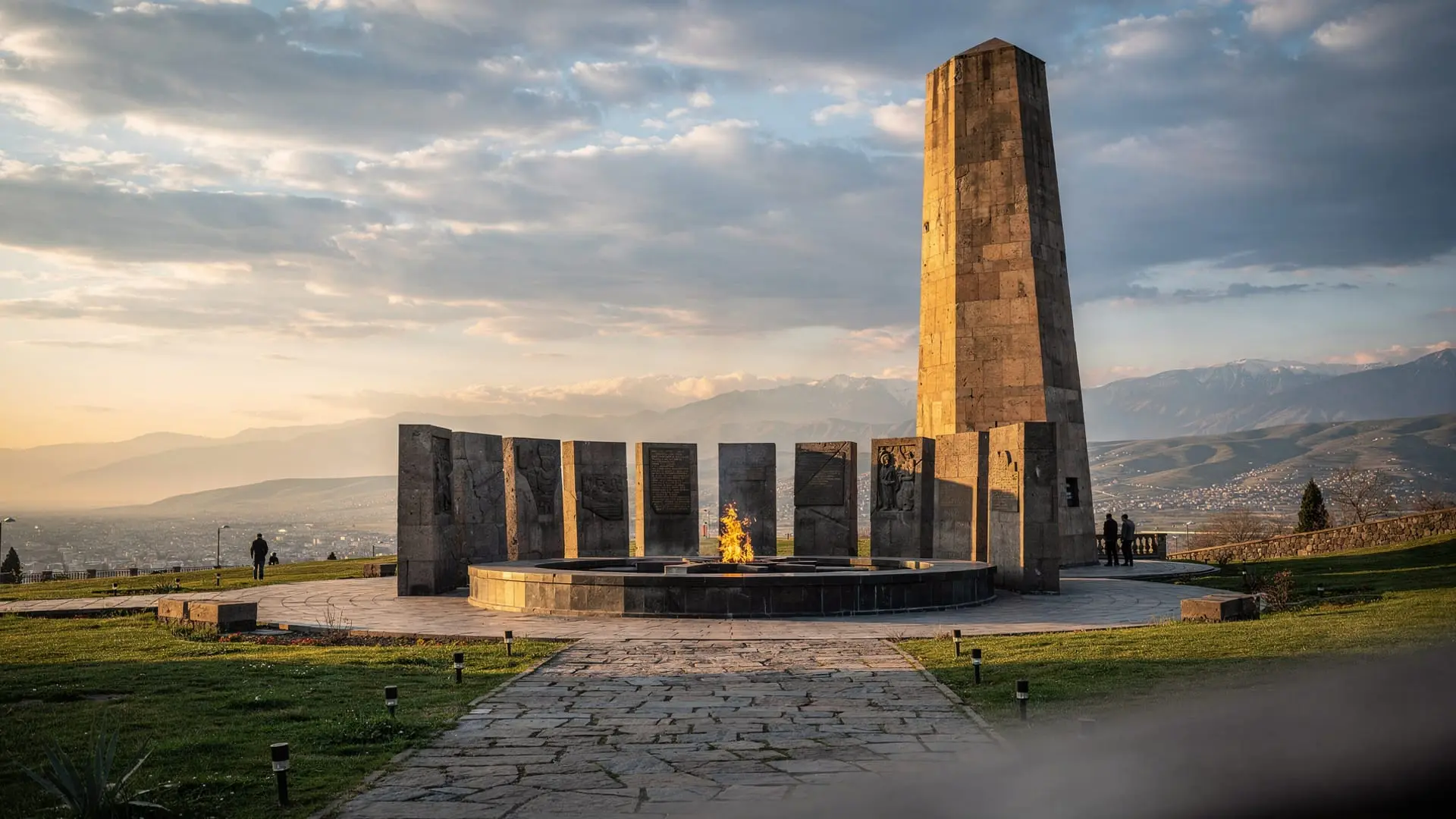
The eternal flame: The centrepiece of the memorial is a 12-petalled basalt cone open to the sky, about 100 metres in diameter. Inside this ring, at ground level, an eternal flame burns continuously in a circular stone basin. Visitors come to stand here, to be still, and often to lay flowers. On April 24, tens of thousands of people make this walk carrying red carnations — the traditional flower of remembrance. The flame has burned without interruption since 1967.
The eternal flame should be approached quietly. There are no instructions posted — the behaviour of those around you establishes the appropriate register. Photography is permitted (it is an outdoor public monument), but the atmosphere suggests restraint rather than vigorous composition-seeking.
The needle (stele): A 44-metre basalt needle — a single sharp column tapering to a point — stands adjacent to the flame cone. It represents the Armenian nation’s connection between earth and heaven, its persistence despite the attempt at obliteration. The stele was a Soviet-era modernist design choice that has aged well: its severity is appropriate.
The wall of memory: Twelve basalt slabs stand in a broken circle around the eternal flame. These represent the 12 provinces of historic western Armenia from which the Armenians were expelled. The broken circle — open, not closed — is a deliberate design choice, representing incompleteness: the wounds are not healed.
The park and allee of memory: A path called the Allee of Memory runs along the hilltop. Countries and diaspora communities that have formally recognized the Genocide have planted trees along this path; plaques identify each nation’s contribution. The allee is a quietly powerful space — a roster of international acknowledgement laid out in living trees. For the diaspora experience of Armenia more broadly, the meeting relatives in Armenia guide covers the practical and emotional dimensions of a heritage visit.
The museum (underground levels): The Armenian Genocide Museum-Institute is built into the hillside below the memorial. The architecture is deliberately subterranean — you descend into the earth, as into history.
The museum is large, well-designed, and sober in tone. It does not sensationalise. It presents:
- Historical context for the late Ottoman period and the rise of the Committee of Union and Progress
- Documentary evidence of the Genocide: Ottoman governmental orders, diplomatic correspondence, survivor testimonies, photographs
- Maps of the deportation routes and locations of massacres
- Personal histories of survivor families
- International recognition documents and diplomatic correspondence
- A section on the diaspora communities that formed from the survivors
Photography inside the museum: No flash photography is permitted. Tripods are not allowed. Still photography without flash is generally permitted; check current signage at the entrance, as policies have been updated. Video recording is generally restricted in the exhibition areas.
The museum requires approximately 1.5–2 hours to engage with properly. It is emotionally demanding content. Take whatever time you need.
How to get there
By foot from central Yerevan: Tsitsernakaberd hill is a 25-minute walk from the Cascade Complex, following the Hrazdan gorge path. The walk is pleasant and well-signposted.
By metro: The Yeritasardakan (Youth) metro station is about 1.5 km away. Exit the metro and walk west toward the Hrazdan gorge.
By GG Taxi: A taxi from Republic Square to Tsitsernakaberd costs AMD 600–1,000. This is the most direct option.
By tour: Some Yerevan city tours include Tsitsernakaberd as part of a half-day itinerary. Diaspora-focused tours invariably include it. See the Genocide Memorial pilgrimage guide for diaspora-specific planning.
Yerevan: guided city tour including TsitsernakaberdOn April 24: On Remembrance Day, roads to the hill are closed to private vehicles. Most Armenians walk in a mass procession from central Yerevan. If visiting on this date, join the procession on foot — it is an experience unlike any other.
Conduct and protocol
Tsitsernakaberd is a memorial, not a museum in the recreational sense. The following are not rules posted at the entrance — they are what the place calls for:
- Silence and stillness near the eternal flame. Conversations should be quiet; loud tourist commentary is inappropriate.
- Flowers: Red carnations are the traditional offering. Vendors sell them near the entrance. It is entirely appropriate for a visitor of any background to place flowers at the flame.
- Dress: There is no formal dress code (this is not a religious building), but casual tourist clothing — shorts, branded sportswear — sits uncomfortably with the atmosphere. Dress modestly out of respect.
- Photography: Outdoor memorial areas can be photographed. Inside the museum, no flash. Approach this as you would photograph a war cemetery in Europe: with restraint.
- Children: The museum content includes photographs of massacre and deportation. Use your judgment about whether children are ready for this. The outdoor memorial is appropriate for all ages.
April 24 — Remembrance Day
April 24 marks the anniversary of the arrest and deportation of Armenian intellectuals in Constantinople in 1915, widely taken as the beginning of the Genocide. It is a national public holiday in Armenia and a day of mourning across the worldwide diaspora.
In Yerevan, hundreds of thousands of people walk to Tsitsernakaberd throughout the day and into the evening, bringing flowers for the eternal flame. It is one of the most moving civic events in the country — a collective act of mourning and national affirmation simultaneously. Foreign visitors are welcome to participate. The procession begins at Republic Square and walks to the memorial via Baghramyan Avenue; it takes approximately 1.5 hours on foot.
If you are planning a visit to Yerevan in April, consider whether you want to be present on April 24 specifically. The weight of the day is real; many diaspora Armenians return to Armenia precisely for this occasion.
The 1915 Genocide: what happened
This is not the place for a comprehensive history. But some factual summary serves visitors who are not familiar with the events, and who will encounter them in the museum.
The Armenian Genocide was the systematic deportation and mass killing of the Armenian population of the Ottoman Empire, carried out by the Committee of Union and Progress (CUP) government between 1915 and 1923. The Armenians had lived in Anatolia for more than three thousand years; by 1923, the Armenian presence in what is now Turkey had been effectively eliminated.
The process involved:
- The arrest and killing of Armenian intellectuals, community leaders, and clergy in Constantinople beginning April 24, 1915
- The forced deportation of Armenian populations from their home regions to the Syrian desert
- Death marches across the mountains in summer heat, without food or water
- Organised massacres, including mass drownings in the Euphrates
- The systematic destruction of Armenian cultural and religious sites
Estimates of the death toll range from 600,000 to 1.5 million. The survivors — perhaps 300,000 people — fled to Russian-controlled eastern Armenia (the territory of the present-day Republic of Armenia), Lebanon, Syria, Egypt, France, the United States, and elsewhere. Their descendants constitute the Armenian diaspora.
The CUP government that carried out the Genocide was the same government allied with Germany and the Austro-Hungarian Empire in the First World War. Several German military officers witnessed the deportations and massacres and sent reports to Berlin; these documents are among the most important pieces of contemporary evidence in the historical record.
The Republic of Turkey, the successor state to the Ottoman Empire, disputes the characterisation of these events as genocide. The historical scholarly consensus is that the events constitute genocide by the most widely accepted legal and historical definitions. The International Association of Genocide Scholars has formally affirmed this position, as have more than 30 national governments.
The museum’s approach
The Armenian Genocide Museum-Institute at Tsitsernakaberd was established in 1995 and substantially expanded in 2015. Its curatorial approach is evidence-based and measured. It does not engage in emotional manipulation. It presents documents, photographs, testimony, and contextual history and allows visitors to draw their own conclusions from the evidence.
The permanent exhibition addresses:
- Pre-1915 context: The situation of Armenians in the late Ottoman Empire, including earlier massacres (1894–96, 1909 Adana)
- The Genocide: The decision, execution, and scale of the 1915–1923 events
- Survivor testimonies: Individual accounts from across the diaspora
- International context: Diplomatic correspondence, including the famous 1915 statement by France, Britain, and Russia condemning “crimes against humanity and civilisation” — one of the first uses of this phrase in diplomatic history
- Recognition and denial: The politics of historical acknowledgement
- Diaspora formation: How the survivors built communities abroad
The basement level holds the most challenging material, including photographs. Visitors should take whatever time they need; there is no pressure to move quickly.
For diaspora visitors
For Armenians of the diaspora visiting the homeland, Tsitsernakaberd often carries a different weight than it does for other visitors. It may be a first encounter with the physical geography of grief — a landscape that holds the loss that has been described in family stories, in communal commemorations, in the texture of diaspora identity. Some find the visit cathartic; others find it overwhelming; most find it necessary.
The guide Genocide Memorial pilgrimage guide is written specifically for diaspora travellers and addresses the particular experience of this visit in more depth, including how to trace ancestral village connections and how to use the museum’s genealogical research resources.
The diaspora and the homeland
The Armenian diaspora — approximately 7–8 million people spread across the United States, France, Russia, Lebanon, Syria, Argentina, Australia, and dozens of other countries — was formed primarily from the survivors and descendants of the 1915 Genocide. This demographic reality means that a large proportion of foreign visitors to Armenia are people whose families were directly affected by the events commemorated at Tsitsernakaberd.
For these visitors, Armenia is both a homeland and a foreign country. Most diaspora Armenians — particularly from the Western diaspora communities in France, the United States, or Lebanon — did not grow up in the Republic of Armenia and may speak Western Armenian rather than Eastern Armenian (the two dialects are mutually intelligible but distinct). The Armenia language and essential phrases guide covers both Eastern and Western Armenian basics for visitors. The homeland that their grandparents and great-grandparents came from was Anatolia — now Turkey — not the Caucasus. The Republic of Armenia is the remnant state, not the original homeland.
Tsitsernakaberd sits at the intersection of all these tensions. It memorialises a genocide that created the diaspora; it stands in a country that is itself a refuge state formed from survivors and their descendants; it faces Mount Ararat, the symbolic homeland that is now in Turkey. For diaspora visitors, the pilgrimage to Tsitsernakaberd is often described as simultaneously grief-producing and identity-affirming — a place where the loss is made concrete and the continuity of the people is asserted in the same act.
The Genocide Memorial pilgrimage guide addresses diaspora-specific questions in depth, including how to use the museum’s genealogical research resources to trace family histories from before 1915.
The hill and the view
Tsitsernakaberd hill itself has a history that predates the memorial by millennia — it was the site of a fortress in antiquity, and the hilltop’s strategic position above the Hrazdan gorge is still evident today. Beyond the memorial complex, the hill is planted with pine forest that has matured since the 1967 inauguration, and paths through this forest offer views over the Hrazdan gorge and, on clear days, toward Mount Ararat to the southwest — the same mountain that anchors so much of Armenian national symbolism and that appears, distantly, in the museum’s own narrative about the homeland the genocide’s survivors were forced to leave behind.
The pine forest surrounding the memorial is a quiet, contemplative space in its own right, separate from the more formal memorial architecture. Visitors who want a few minutes of reflection after the museum often find the wooded paths a useful transition before returning to the ordinary rhythm of a Yerevan day. There is no signage directing visitors here specifically — it rewards those who simply walk a little further than the eternal flame and the Allee of Memory, and it is one of the quieter green spaces in a city that, despite its parks and boulevards, does not have an abundance of forested walking terrain within easy reach of the centre.
Preparing for the visit
A few practical notes for visitors who want to approach Tsitsernakaberd thoughtfully:
Give yourself unstructured time. This is not a site to fit into a tightly scheduled itinerary between other stops. Most visitors find the museum and memorial together require both time and emotional space that a rushed visit does not allow.
Consider your state of mind that day. Many visitors — Armenian and non-Armenian alike — find the museum genuinely difficult content. There is no obligation to see everything; move through at whatever pace feels right, and it is entirely normal to need a break outside on the memorial grounds partway through.
Pair it thoughtfully with the rest of your day. Some visitors prefer to visit Tsitsernakaberd on its own, without other sightseeing scheduled immediately before or after. Others find it meaningful to follow it with time at Republic Square or a walk through the Cascade Complex, letting the contrast of a living, everyday Yerevan sit alongside what they have just seen.
English-language materials are available. Museum panels and the audio guide are available in English (as well as Armenian, Russian, and French), so language is not a barrier to a full visit for most international travellers.
There is no need to prepare extensively beforehand. The museum’s exhibits are structured to build historical context progressively, so visitors arriving with limited prior knowledge of the events are not at a disadvantage. That said, reading a short overview beforehand (as in this guide) can help orient you to the chronology before you encounter the more difficult material inside.
Tsitsernakaberd and April 24 in Yerevan
For a visitor in Yerevan on April 24, the city itself transforms. Flags are at half-mast. Shops and restaurants close for part of the day. The morning news programmes carry remembrance content. Schools observe a moment of silence.
The mass procession to Tsitsernakaberd begins gathering at Republic Square from early morning and continues throughout the day in waves — families, school groups, veterans’ organisations, diaspora visitors who have flown in specifically for this day, government officials, and the Catholicos of All Armenians in a formal procession. By early afternoon, the approach to the memorial is dense with people; the eternal flame is completely covered in red carnations.
If you are a foreign visitor in Yerevan on April 24:
- You are welcome to participate in the procession
- Buy red carnations from vendors near Republic Square or Tsitsernakaberd itself (AMD 100–200 each)
- Dress modestly — this is a day of mourning
- Be prepared for a long walk (the procession to Tsitsernakaberd from Republic Square is about 3.5 km each way) and dense crowds near the memorial
- Do not photograph mourners in distress without consent
- The atmosphere is solemn but not hostile to foreigners who approach respectfully
Practical visit info
Entry: Free. Always free. No ticket required for the memorial grounds or the museum.
Museum hours: Tuesday–Sunday, 11:00–18:00. Closed on Mondays. Open on April 24 from 08:00 (extended hours).
Memorial grounds: Open year-round, 24 hours a day. The eternal flame is always burning.
Photography: Outdoors freely permitted. Inside the museum, no flash; check current policy at entrance for video recording.
Facilities: A bookshop and research centre operate within the museum building. The bookshop sells publications on Armenian history and the Genocide in several languages.
Accessibility: The outdoor memorial is flat and fully accessible. The museum has elevator access to the underground levels.
Duration: Allow 30 minutes for the outdoor memorial and eternal flame. Allow 1.5–2 hours for the museum. A full respectful visit is 2–2.5 hours.
Frequently asked questions about Tsitsernakaberd
Do I need to be Armenian to visit Tsitsernakaberd?
No. The memorial and museum are open to all visitors. Many tourists of no Armenian heritage visit as part of a Yerevan itinerary and find the museum among the most affecting things they see in Armenia. Understanding what happened in 1915 is part of understanding Armenia.
Is the Armenian Genocide internationally recognised?
Over 30 countries have formally recognised it, including France, Germany, Canada, and the United States (2021 presidential declaration and congressional resolution). The Republic of Turkey continues to dispute the characterisation, a source of ongoing diplomatic tension. The historical record — documented in Ottoman government archives, diplomatic cables from multiple neutral countries, survivor testimony, and demographic evidence — is not a matter of scholarly controversy.
What is the significance of April 24?
April 23–24, 1915, marked the arrest and deportation of several hundred Armenian intellectuals, community leaders, and clergy from Constantinople by Ottoman authorities. This event is taken as the symbolic start of the genocide, though killings and deportations had already begun in Anatolia. April 24 is Genocide Remembrance Day in Armenia and in Armenian communities worldwide.
Can I visit the museum without visiting the memorial grounds?
Yes. The museum entrance is on the lower road approaching the hill; you can go directly to the museum without walking through the memorial grounds. However, experiencing both together provides a more complete understanding.
Is there a genealogical research service at the museum?
Yes. The Armenian Genocide Museum-Institute operates a genealogical research service that can assist visitors in finding records relating to family members affected by the Genocide — village of origin, deportation records, and in some cases survivor records. Contact the museum in advance if this is relevant to your visit.
How does Tsitsernakaberd compare with other genocide memorials worldwide?
It is one of the oldest national genocide memorials in the world — opened in 1967, before the Yad Vashem museum renovation, before the Holocaust Memorial Museum in Washington. The eternal flame design predates most comparable memorials. It is a site of genuine architectural distinction and one of the most important memorial spaces in the post-Second World War world.
How much time should I set aside if I am short on time in Yerevan?
At minimum, 45 minutes for the outdoor memorial and eternal flame — this alone conveys the site’s significance even without the museum. If your schedule allows only one substantial cultural stop in Yerevan, many visitors consider Tsitsernakaberd more essential than any single monastery or museum in the city itself.
Is Tsitsernakaberd within walking distance of central Yerevan?
Yes, roughly 25 minutes on foot from the Cascade Complex, following the Hrazdan gorge path. It is a pleasant walk in good weather and gives a period of quiet reflection before arriving. A taxi from Republic Square takes only a few minutes and costs very little.