Why Armenians celebrate Christmas on January 6
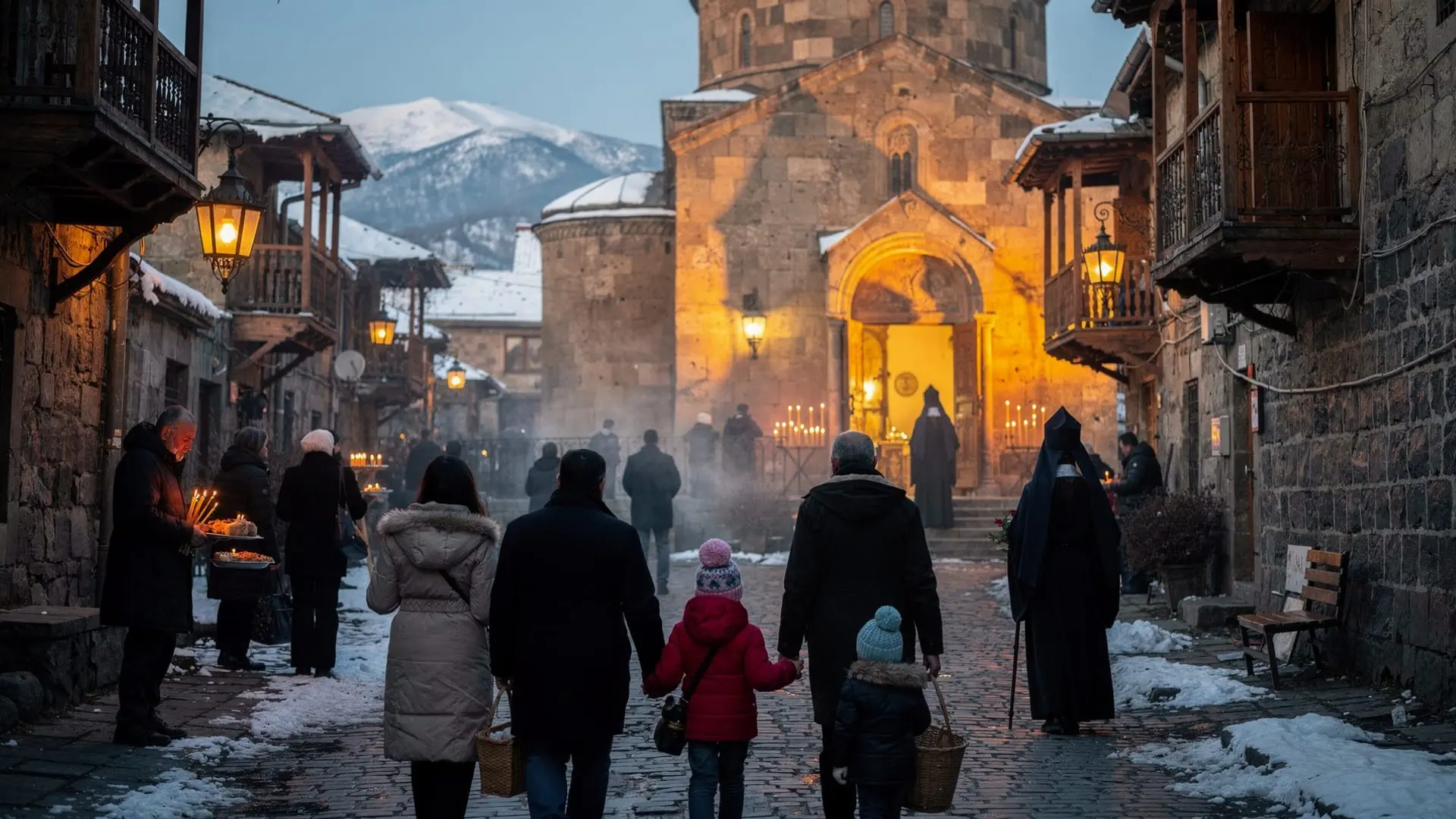
The confusion at the hotel
I was in Yerevan in late December one year, which is a specific experience. The city decorates for the New Year — tree in Republic Square, lights on Abovyan Street, the Cascade illuminated in blue and white — but the decorations are for the new calendar year, January 1, not for Christmas. December 25 is an ordinary working day. The hotel restaurant was fully booked on December 31 and completely empty on December 24.
| When | January 6 (Christmas Eve service begins evening of Jan 5) |
| Where to go | Etchmiadzin (main service) or Yerevan’s St. Gregory the Illuminator Cathedral |
| Duration | Liturgy runs around 3 hours |
| Dress | Modest, warm — cathedrals are unheated and services are long |
| Weather | Around -2 to 7°C, occasional snow |
When I mentioned this to the receptionist — a young woman named Nairi who had studied in France and spoke impeccable French — she explained it patiently: “Christmas for us is January 6. That’s the real Christmas. December 25 is a Western thing.” She said it without any particular edge, the way you’d explain a simple factual matter. Which is what it is.
Armenian Christmas falls on January 6. To understand why, you need to understand a bit about how the early Christian church split on the question of dates, and why the Armenian Apostolic Church has never felt any particular reason to change.
Theophany: the original Christian festival
In the earliest centuries of Christianity, the church did not observe December 25 as the birth of Jesus. The date that mattered was January 6 — the feast of Theophany (Epiphany in Western Christianity), which combined the celebration of the Nativity, the baptism of Jesus in the Jordan by John the Baptist, and the manifestation of the divine Trinity. For early Christians, the baptism was the moment of divine revelation — “theophany” meaning “appearance of God” — and the birth and baptism were understood as two aspects of a single theological event.
The December 25 date for the Nativity was established by the Western (Roman) church in the 4th century, partly to coincide with the Roman festival of Sol Invictus, the unconquered sun. The Eastern churches were slower to adopt this date, and some never did. The Armenian Apostolic Church, the Coptic church in Egypt, and the Ethiopian Orthodox church all retained January 6 as the date for the Nativity.
This is not a deviation from “proper” Christianity — it is the original calendar of the Eastern churches, preserved intact. The Armenian Apostolic Church is one of the oldest Christian institutions in the world (Armenia converted in 301 AD, before Rome) and it has maintained the January 6 Nativity because it is theologically coherent: birth and baptism, the earthly arrival and the divine revelation, belong together.
What the distinction means
A visitor unfamiliar with this can make certain mistakes. The most common is arriving in Armenia in late December expecting Christmas atmosphere and being puzzled by its absence. The Christmas market on Mashtots Avenue, the decorations, the spirit of celebration — these are all present, but they’re calibrated for New Year’s Eve, which is Armenia’s main winter celebration in terms of family gatherings and festivity.
December 31 into January 1 in Yerevan is loud, celebratory, and (around Republic Square) extremely crowded. There are fireworks visible from most parts of the city. Extended family gatherings are the norm; restaurants are fully booked. The spirit is similar to Christmas Eve in Western Europe.
January 6 is different in character — more religious, more intimate. Armenian families attend the liturgy. The day has a quieter, more observant quality than January 1, though it is also a public holiday. Children may receive gifts on both dates (January 1 from Kaghand Papik, the Armenian equivalent of Father Christmas, and January 6 from the Nativity celebration), though practice varies by family.
The Armenian Apostolic Church: a brief clarification
This is worth addressing clearly because it comes up repeatedly among visitors: the Armenian Apostolic Church is not Catholic, not Greek Orthodox, and not in communion with either Rome or Constantinople. It is one of the Oriental Orthodox churches — a family that also includes the Coptic (Egyptian), Ethiopian, and Syriac churches — which separated from the Byzantine church at the Council of Chalcedon in 451 AD.
The theological distinction that caused the split is technical and no longer practically divisive, but the institutional separation has persisted for fifteen centuries. The Armenian church has its own theological tradition, its own liturgical calendar (hence January 6), its own architecture, its own music, and its own ecclesiastical structure headed by the Catholicos at Etchmiadzin.
For visitors, the practical implication is this: if you enter an Armenian church expecting Roman Catholic mass or Eastern Orthodox liturgy, you will encounter something related but distinctly different. The language of the liturgy is Classical Armenian (Grabar), unchanged since the 5th century. The chant is modal and uses tones that have no close Western equivalent. The vestments and liturgical objects have their own visual tradition.
Understanding this context doesn’t require any theological knowledge. But knowing that the Armenian church is its own thing — ancient, autocephalous, and not a branch of any other tradition — helps you hear the service on its own terms rather than as a variant of something more familiar.
The liturgy and the candles
The Armenian Christmas liturgy on January 6 is one of the most beautiful church services I have attended anywhere. I went to the one at Etchmiadzin — the mother cathedral of the Armenian Apostolic Church, 25 kilometres west of Yerevan — on a January 6 visit, arriving early enough to find a place inside.
The service begins in the dark. The cathedral interior is lit primarily by candles — hundreds of small ones arranged before icons and in floor candelabra — and the smell of incense arrives before the clergy do. The Armenian liturgical chant is distinctive: deep, modal, harmonically rich in a way that feels simultaneously ancient and alive. It bears no resemblance to Western church music and only a general family resemblance to Byzantine chant.
The Catholicos — the Supreme Patriarch of the Armenian Apostolic Church — presides at Etchmiadzin on major feast days. His vestments on this occasion are elaborate, gold-threaded, centuries old in their design if not always in their manufacture. The processional that begins the service involves clergy moving through the cathedral with candles, incense, and banners. The congregation stands throughout — Armenian church tradition has no pews in the Western sense, though there are usually benches along the walls for those who need them.
The service lasts about three hours. I stayed for all of it. By the end, the cathedral was fuller than I had expected — this was not a declining-church experience but one of active, populated observance.
The food
Armenian Christmas food has its own specific character, distinct from both the New Year’s spread and everyday cooking. The traditional fast before January 6 is broken with a meal that emphasises restraint followed by celebration: the fast-breaking meal often includes fish, rice, and dried fruits, though practice varies by region and family.
The use of dried fruits is interesting. Armenian cooking has deep ties to dried apricots, figs, prunes, and sultanas — fruits that would have been preserved from the summer harvest and available through the winter. A Christmas compote of dried fruits stewed with wine and spices, called anoushabour (literally “sweet soup”), appears on many tables. It is warming, slightly sweet, and the kind of thing that tastes specifically of this occasion.
Wine appears, of course. Armenian Christmas is not a dry celebration. Red wine from the Areni region — Areni Noir specifically — is the traditional accompaniment, a dark, slightly austere wine that suits the January cold and the seriousness of the occasion.
The fish that appears as part of the fast-breaking meal is often ishkhan (Sevan trout) if the family can get it, or carp from the Ararat valley. Tolma (stuffed vine leaves) is common. Gata — the sweet, buttery bread that appears at many Armenian celebrations — makes an appearance.
New Year vs Christmas: what you’ll actually find
For a visitor arriving in December or early January, it’s worth being clear about which celebration you’re in. New Year’s Eve — December 31 — is the big domestic holiday: families gather, tables are loaded with food, Yerevan goes loud at midnight. Kaghand Papik, the Armenian Father Christmas figure who brings gifts on New Year’s, is everywhere in the weeks before December 31. The city is warm, celebratory, and the restaurants are fully booked.
January 1 through January 5 is the quieter stretch — the post-New Year’s lull before Christmas. Yerevan restaurants and shops are open. Prices at hotels drop noticeably. The Cascade complex is quieter than usual. This is, actually, a very pleasant time to be in the city.
January 6 brings the liturgy and the family Christmas. Then Armenians get a second New Year via the Julian calendar — Armenian Old New Year — which falls on January 14 in years when the calendars align. After that, the holiday season is considered complete.
For travelers: when to come
If you want to experience Armenian Christmas, plan for January 6 (or the evening of January 5, when the Christmas Eve service begins). Etchmiadzin is the most significant venue; the Yerevan Cathedral (St. Gregory the Illuminator, on Tigranashen Street) also holds a major service. Arrive early — the liturgy begins at midnight on Christmas Eve or early morning on January 6, depending on the specific service.
December 31 through January 1 in Yerevan is also worth experiencing for the New Year celebration, which is warm, family-centred, and genuinely festive. The two celebrations — New Year on January 1 and Christmas on January 6 — mean that Armenia has something close to a two-week winter festival season, which is an enviable situation.
The weather in Yerevan in early January is cold — typically -2 to 7°C — with occasional snow. This is not the time for monastery day trips to higher elevations, but the city itself is at its most intimate: fewer tourists, good hotel prices, and the specific pleasure of being somewhere that has its own relationship with the calendar.
If you want to stay somewhere warm and active on December 25, Tsaghkadzor ski resort is open and busy — the ski season runs from December through March, and the Armenian ski culture doesn’t particularly observe December 25 either. It’s a useful reminder that different countries organise time differently, and travelling in January is a way of experiencing that difference directly.
The Armenian public holidays guide has full details on dates and regional variations for all the major Armenian celebrations throughout the year.
New Year vs Christmas at a glance
| New Year (Dec 31–Jan 1) | Christmas (Jan 6) | |
|---|---|---|
| Character | Loud, domestic, fireworks | Quiet, religious, reflective |
| Where to be | Republic Square, Yerevan | Etchmiadzin or a city cathedral |
| Crowds | Large, city-wide | Concentrated at church services |
| Food focus | Big family spread, all night | Fast-breaking meal, anoushabour, fish |
| Best for visitors | Atmosphere, street energy | Liturgy, quieter city, cheaper hotels |
Etchmiadzin beyond the liturgy
If you arrive a day or two before January 6, it is worth spending time at Etchmiadzin outside the service itself. The complex includes the treasury museum, with relics said to include a fragment of Noah’s Ark and the Holy Lance, and the ruins of nearby Zvartnots Cathedral are a short taxi ride away. Outside the Christmas rush, the Armenian alphabet monument makes an easy half-day combination if you have a car or driver, since it sits on the same road west of Yerevan. None of this requires booking — you simply need patience with the cold and, on January 6 itself, an early arrival if you want to be inside the cathedral rather than watching from the courtyard on a screen.
Practical notes for the liturgy
Cathedrals in Armenia are unheated stone buildings, and a three-hour service in January means standing in near-freezing temperatures for long stretches — dress as if for outdoor winter, not indoor churchgoing. Modest dress is expected (shoulders and knees covered), and headscarves for women are customary though not always strictly enforced for visitors. Phones should be silent and photography during the liturgy itself is generally discouraged, especially near the altar. If the cathedral is full, standing in the courtyard with the doors open still lets you hear the chant and follow the procession, which is how many locals experience it too.
Private day trip combining Yerevan sights and EtchmiadzinFrequently asked questions
Is Armenian Christmas the same date as Russian Orthodox Christmas? They fall on the same day, January 7 on the old Julian calendar reckoning, but for different reasons — the Russian Orthodox Church uses the Julian calendar for its liturgical dates generally, while the Armenian Apostolic Church observes January 6 (Gregorian) specifically because it never split Nativity from Theophany. The overlap is coincidental rather than shared theology.
Can tourists attend the January 6 liturgy at Etchmiadzin? Yes — the service is open to the public and no ticket or registration is required. Arrive well before the stated start time if you want a place inside the cathedral rather than the courtyard, since it is the most attended service of the year alongside Easter.
For more on Armenia’s calendar of celebrations, see the genocide memorial guide for the other major date on the civic calendar, April 24, and the Republic Square history guide for context on where the New Year’s Eve crowds gather.