Wings of Tatev celebrates 15 years: what to know
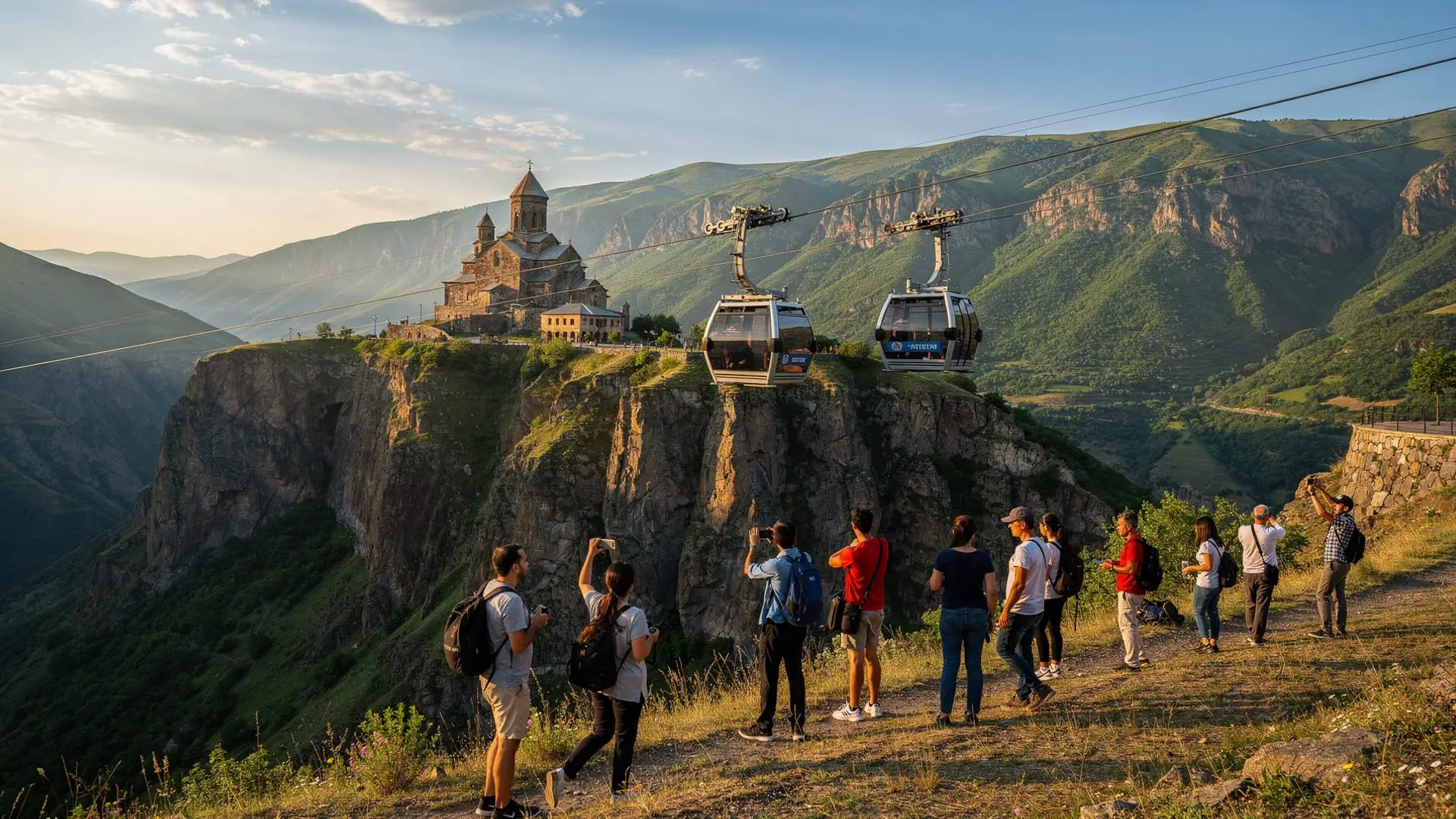
A look back at the Wings of Tatev’s 15th anniversary events in October 2025, plus current fares, crossing times, and how to plan the visit as the cable car heads into its 16th year of operation.
| Length / height | 5,752m long, up to 320m above the Vorotan gorge |
| Crossing time | Approx. 11–13 minutes |
| Fares (spring 2026) | 7,000 AMD one way / 10,000 AMD return |
| Hours | 9:00am–6:00pm (summer); reduced in winter |
| Best time to arrive | Before 9am, especially July–August |
Fifteen years over the Vorotan gorge
A correction worth making at the outset: I’ve seen the headline “Wings of Tatev celebrates 15 years” in several places recently, and I want to be precise. The Wings of Tatev opened on 16 October 2010. That means October 2025 was the 15th anniversary, which passed with events and media attention last autumn. What we’re running up to now — in April 2026 — is the approach to year 16. The headline reads “15 years” in the sense that the cable car is in its 16th year of operation, not that it’s freshly turned 15.
This matters because some of the anniversary event information floating around refers to the 2025 celebrations that have already occurred. I’ll cover what actually happened and what the current state of the cable car and monastery experience looks like as of early 2026.
The 15th anniversary events (October 2025)
The 15th anniversary in October 2025 was marked with several events organised by Armenian Caritas (the operator) in partnership with the Tourism Committee of Armenia. These included:
A free-crossing weekend on 18-19 October, when visitors could ride the cable car at no charge — which, predictably, created substantial queues but was widely reported as a success in terms of celebrating the milestone with local visitors and diaspora who attended specifically for the occasion.
A cultural program at Tatev Monastery with traditional music, duduk performances, and an exhibition of photographs documenting the construction and first fifteen years of operation. The exhibition traced the engineering story of the cable car — the German engineering firm Doppelmayr did the design — alongside the social and tourism impact on the communities of Syunik.
Press coverage that reached international outlets including several European newspapers and travel magazines, contributing to what operators are calling a record autumn for the site in terms of visitor numbers.
The cable car today
The Wings of Tatev cable car is 5,752 metres long, crosses the Vorotan gorge at a maximum height of 320 metres above the river, and takes approximately 11-13 minutes to cross. It has been operated without a major incident since 2010, with scheduled maintenance closures typically in November and occasionally for weather-related temporary suspensions.
Fares as of spring 2026: 7,000 AMD one way, 10,000 AMD return. Children under five free, children 5-12 at half fare. These prices represent modest increases from the 2018 figures of 3,500/5,000 AMD that I mentioned in an earlier post, but remain very reasonable for what is one of the most dramatic infrastructure experiences in the Caucasus.
The cabin holds 25 passengers. During peak season (July-August and the 15th anniversary weekend), waits of 45 minutes to an hour are common. Spring and autumn arrivals before 9:00 a.m. typically involve much shorter waits. The cable car runs from 9:00 a.m. to 6:00 p.m. in summer, with reduced hours in winter.
| Fare | Spring 2026 price |
|---|---|
| Adult one way | 7,000 AMD |
| Adult return | 10,000 AMD |
| Children under 5 | Free |
| Children 5–12 | Half fare |
For the fuller comparison of gorge-crossing options — cable car versus the walking path described below — see the Devil’s Bridge and Tatev natural wonders guide, which covers the wider Vorotan gorge landscape.
Full-day tour from Yerevan to Tatev Monastery and Wings of Tatev cable carWhat you find at Tatev Monastery
Tatev Monastery is a 9th-10th century complex on the plateau above the gorge, one of the largest and most significant medieval monastic complexes in Armenia. The main Cathedral of Sts. Paul and Peter, consecrated in 895, is the centrepiece; surrounding it are the Church of St. Gregory, the Chapel of the Virgin, refectory buildings, the oil press dating from the 9th century, and the extraordinary Gavazan column — a free-standing oscillating column designed as an early seismic warning device.
The monastery was in continuous use until the 18th century, suffered earthquake damage in 1931, and has been undergoing ongoing restoration since the 1990s. The current state is substantially restored but not sanitised — you can still see earthquake damage in some sections and the quality of various restoration phases varies. It remains a functioning monastery with resident monks.
Allow two to three hours at Tatev if you want to see it properly: the main churches, the courtyard, the Gavazan column, the oil press, the outer walls and the gorge views from the perimeter. The monastery has a small canteen inside the complex serving soup and bread; the food is adequate and the prices are not inflated.
The ongoing significance
The Wings of Tatev has been more than a tourist attraction since its 2010 opening. It transformed the economic viability of the Tatev monastery visit — before the cable car, reaching Tatev from Yerevan in a day was an extremely long drive with time for only a rushed visit. The cable car cut the access time dramatically and made the monastery a genuine day-trip destination.
The surrounding community in Halidzor and Tatev village has benefited visibly from the visitor volumes. Guesthouses, small restaurants, and souvenir operations support livelihoods that the monastery visit makes possible. Whether this has been well-managed in terms of not overwhelming a heritage site — that’s a legitimate question. The visitor numbers have been substantial and the monastery is sometimes crowded in ways that affect the experience.
For the anniversary year, the visit experience in 2026 remains what it’s been: extraordinary, worth the logistics from Yerevan, better in shoulder season than peak summer. The complete Tatev guide covers the timing, logistics, and what to see in detail.
The engineering behind the record
The Wings of Tatev was designed and built by the Austrian engineering firm Doppelmayr, the same company responsible for cable car systems in the Alps and numerous high-profile installations worldwide. The technical specifications required to span the Vorotan gorge — a distance of 5,752 metres, a height difference of 320 metres between the departure station at Halidzor and the arrival point at the monastery — were substantial, and the project was completed in approximately two years of construction before the October 2010 opening.
The cable system uses two parallel tracks running in opposite directions: one cable carries the gondola to the monastery while the other returns the empty gondola to Halidzor. The gondola holds 25 passengers standing or seated. The span between support pylons in the central section — the part of the crossing where you look down at the Vorotan River 320 metres below and there is nothing but cable between you and the void — is one of the longest unsupported cable car spans in the world.
What the engineering achieves is a crossing that feels different from a standard cable car not just because of the height but because of the duration. Thirteen minutes over that gorge is enough time to settle into the experience, to notice the swallows flying below you, to watch the monastery come into focus as you descend toward it. The record exists because of specific choices made about the route — the geometry of the gorge made a shorter crossing impractical — and those choices, inadvertently, created something that is genuinely moving to experience.
The gorge path and alternative access
For visitors who prefer not to return by cable car, the gorge path descends from the monastery plateau to the Vorotan River and then climbs back up to Halidzor on the opposite side. The path takes approximately 90 minutes and involves some scrambling on loose stone near both ends. In dry conditions it is manageable for any reasonably fit person; in wet conditions or winter, it is not advised.
The path offers views of the gorge and monastery from below that are unavailable from the cable car: the basalt columns of the Vorotan canyon walls, the river itself, and looking back up at the monastery perched on its plateau. Several people in the gorge on our visit were running it — trail runners who had found it on a map and decided it was a good afternoon’s activity. It is.
Most visitors who use the gorge path do so as a descent and then take the cable car back up. The descent-to-ascent ratio (it’s easier going down) and the time consideration (you need the cable car running for the return) make this the practical option. If you want to walk in both directions, arrive early and budget 4-5 hours for the full loop.
What the coming year looks like
The approach to the 16th anniversary in October 2026 is expected to involve further programming at the site, building on what worked in the 2025 celebrations. The Armenian Tourism Committee has been using the cable car and monastery as a marketing anchor for the country’s adventure and heritage offer, which means continued investment in the visitor experience at both the Halidzor station and the monastery complex.
One development worth mentioning: the visitor centre at Halidzor has been expanded and improved since my first visit in 2018. The exhibition on cable car construction and the history of the Tatev monastic complex is now worth spending 20-30 minutes with before you board, rather than the somewhat perfunctory signage that used to greet visitors.
Planning your visit
From Yerevan, Tatev is 250 kilometres and approximately four hours by car in good conditions. The marshrutka route via Goris is available from Kilikia bus station, typically 5-6 hours with connections. Spending a night in Goris is the recommended approach: it turns a punishing same-day return into two manageable days, allows for a Khndzoresk cave village visit alongside Tatev, and is genuinely more pleasant than a clock-watching day trip from the capital.
The cable car station is at Halidzor, about 20 kilometres from Goris by road. Taxis between Goris and Halidzor run regularly and cost around 2,000-3,000 AMD each way. If you’re in a group of three or more, chartering a taxi for the day from Goris to cover Khndzoresk in the morning and the cable car in the afternoon is the most efficient approach: around 15,000-20,000 AMD for the full day.
In the peak summer months of July and August, plan to arrive at Halidzor by 8:30-9:00 a.m. to beat the organised tour groups from Yerevan, which typically arrive mid-morning. The cable car runs until 6:00 p.m., so there is no shortage of options for the return journey even if you linger at the monastery.
The Syunik province guide covers the full region including Karahunj, Sisian, and Shaki waterfall. The complete Tatev guide and the day trip guide to Tatev from Yerevan cover the timing and logistics in full. If you’re deciding between Tatev and Armenia’s other great cliffside monastery, the Tatev vs Noravank comparison is a useful next read.