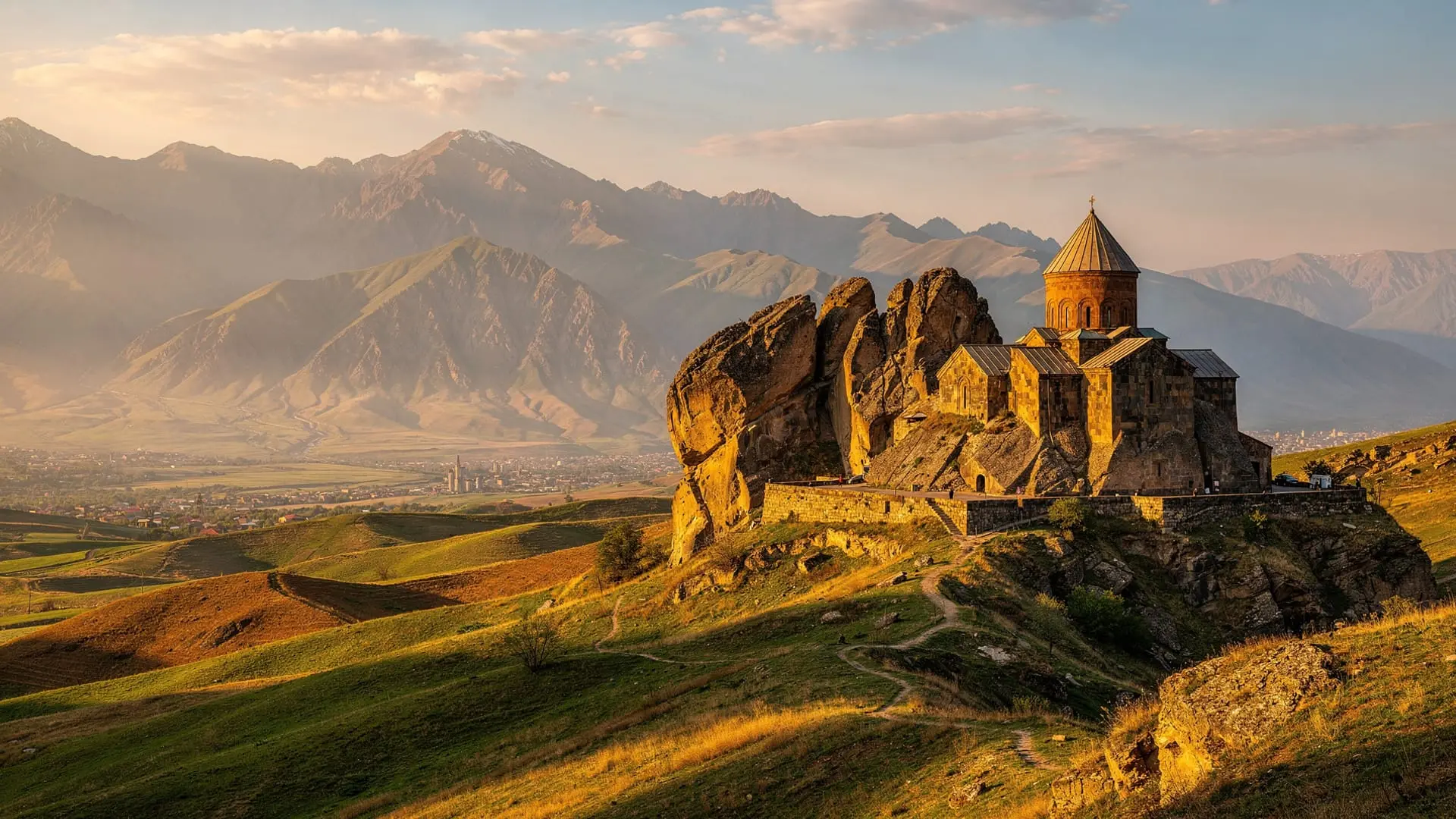
Frescoes that survived eight centuries
Akhtala is not one of the famous names on Armenia’s monastery circuit, and that is precisely its value. Set on a rocky promontory 17 km west of Alaverdi in the Debed river valley, the monastery is enclosed within the remains of a medieval fortress — massive walls of dark stone that still stand to full height in places, giving the complex an unusually military character. And inside the main church, the walls are covered in frescoes.
| Where | Debed valley, Lori, 17 km west of Alaverdi |
| Cost | Free entry (small donation customary) |
| Time needed | Around 1 hour on site |
| Getting there | Car from Yerevan (~3h 15min) or taxi from Alaverdi (~4,000–6,000 AMD return) |
| Best time | May–June, Sep–Oct; church accessible year-round |
These are not the faded, damaged frescoes you find in many Armenian churches. Akhtala’s murals — painted in the Byzantine-Georgian style of the 13th century — are among the best-preserved in the South Caucasus. The colours retain remarkable vibrancy: deep ochre, lapis blue, and the earthy red that characterises the Georgian manuscript tradition. The paintings cover the entire interior of Surb Astvatsatsin church, from the apse to the nave walls, depicting the Virgin and Child, the Evangelists, scenes from the life of Christ, and a full cast of saints in the Byzantine iconographic style.
Akhtala was a mixed-tradition monastery — built by the Armenian Zakarid dynasty in the 13th century but used by Georgian orthodox monks, which explains the Georgian stylistic influence in the frescoes. The monastery was active until the Mongol invasions disrupted the Lori region in the 1230s and 1240s. After that, it passed through various hands and periods of abandonment; the frescoes survived largely because the church was used for agricultural storage in later centuries, an ironic preservation.
Getting to Akhtala from Yerevan
By car: The drive from Yerevan takes approximately 3 hours 15 minutes (185 km). Take the M4/M6 highway north toward Vanadzor, then continue to Alaverdi and follow the signs west toward Akhtala along the Debed valley.
From Alaverdi: 17 km west of Alaverdi on the Debed valley road — about 25 minutes by car. A taxi from Alaverdi costs approximately 4,000–6,000 AMD return.
From Vanadzor: 45 km east of Vanadzor, about 45 minutes by car. Combine with a visit to Odzun (nearby) if approaching from Vanadzor direction.
Guided day tour: Akhtala is commonly included in Lori day tours that also cover Haghpat and Sanahin. It works well as the third monastery of a northern Armenia day.
Armenia: Odzun, Akhtala and UNESCO heritage sites full-day tour
What to see at Akhtala
The fortress walls
The first thing you notice at Akhtala is the scale of the fortification. The monastery sits within a walled compound that once served as a genuine military fortress — the walls still stand 5–8 metres high in several sections, with the original towers partially intact. Walking along the outer perimeter (accessible) gives a sense of how defensible this position was: the rocky promontory drops sharply on three sides.
The fortress dates from the same 13th-century Zakarid construction period as the main church. The Zakarids — an Armenian dynasty that served the Georgian Crown under Queen Tamar and her successors — built extensively across northern Armenia and were responsible for the military-monastery hybrid typology seen at Akhtala. The blend of military architecture and religious buildings on the same promontory is unusual in Armenia and worth appreciating as an integrated design.
The church of Surb Astvatsatsin and its frescoes
The main church, dedicated to the Holy Mother of God and dating from 1205–1216, is the primary reason to visit Akhtala. From the outside, it looks like a standard Armenian basalt church with a typical conical dome. Inside, it is something different.
The frescoes cover every surface of the interior — apse, nave walls, lunettes above the doors, vaulting. They are in the Georgian-Byzantine iconographic tradition, different from the purely Armenian style you find at Tatev or Geghard: the figures are more elongated, the colour palette richer and more Byzantine in its use of gold ground tones. The damage is uneven — some sections have lost their top layers to moisture and time, while others remain remarkably complete.
The apse programme is the most impressive: a Deesis scene (Christ enthroned with the Virgin and John the Baptist in supplication) at the top of the apse conch, with the twelve apostles arranged below in two registers. The proportions and the quality of the drawing are clearly the work of skilled court painters, probably brought from Tbilisi or Ani.
Secondary structures
Within the fortress walls, several secondary structures survive in varying states of preservation:
- A small chapel of Surb Astvatsatsin (western)
- The ruins of what was likely the monks’ refectory or living quarters
- A medieval wine press, visible near the southern wall
The secondary structures are less well-maintained than the main church. Visitors are free to explore the entire compound.
Combining Akhtala with Haghpat and Sanahin
Akhtala sits 15 km west of Sanahin and 18 km west of Haghpat. All three are in the Debed valley corridor, making them natural companions for a focused Lori day:
Standard Lori day itinerary:
- Morning: Sanahin (45 min) → Haghpat (1 hour) → Alaverdi (lunch, 1 hour)
- Afternoon: Akhtala (1 hour) → return to Yerevan or continue to Vanadzor
For travellers interested in the full Lori picture, Odzun basilica is 10 km from Akhtala — a 7th-century basilica of a completely different architectural type and period.
Vanadzor (45 km east of Akhtala) is the most comfortable overnight base in Lori, with several good hotels and restaurants.
Yerevan: Haghpat, Zarni-Parni, Akhtala and Aramyans tour
How Akhtala compares to its Debed valley neighbours
All three monasteries sit within a 20-minute drive of each other, but they reward visitors differently, so it helps to know what each one is actually for before you plan the day.
| Site | Draw | Crowds | Time to allow |
|---|---|---|---|
| Akhtala | Byzantine-Georgian frescoes, fortress walls | Quiet, rarely groups | ~1 hour |
| Haghpat | UNESCO architecture, khachkars | Moderate, tour buses | ~1 hour |
| Sanahin | UNESCO architecture, oldest structures | Moderate, tour buses | ~45 min |
If time only allows one stop and frescoes interest you more than architecture, Akhtala is the better pick over the two UNESCO sites. For a broader read on how Lori’s monasteries fit together, see the Haghpat and Sanahin UNESCO guide.
Tours and tickets
There is no set entrance fee for Akhtala monastery, though a small donation is customary. The site is generally open during daylight hours; if the main church is locked, a caretaker lives on site and will open it.
The frescoes are in the process of ongoing conservation — sections of scaffolding may be present inside the church depending on when you visit. Photography of the frescoes is permitted without flash.
Where to stay near Akhtala
There is no accommodation in Akhtala village itself. The nearest options are:
Alaverdi (17 km east): Hotel Alaverdi offers basic but functional rooms. Good enough for a Lori overnight if you are doing the full monastery circuit. Around 15,000–22,000 AMD per room.
Tufenkian Avan Dzoraget Hotel (60 km east, near Vanadzor): The most comfortable accommodation in the region. A converted historic manor in the Dzoraget gorge, with an excellent restaurant serving regional Lori cuisine. Rates from 60,000–90,000 AMD. Worth booking if you plan to spend two days exploring Lori at a relaxed pace.
Vanadzor hotels: 45 km east, approximately 45 minutes by car. Vanadzor has several business-class hotels and is a comfortable base for the entire Lori monastery circuit.
For the cross-border traveller arriving from Tbilisi, Akhtala is typically a day-trip stop rather than an overnight. The drive from Tbilisi allows a comfortable return the same day.
Practical tips
The frescoes are the priority: Don’t rush through the exterior to get to the church — the fortress walls are worth 20 minutes — but the frescoes are the irreplaceable attraction. Spend at least 30 minutes inside the church, moving slowly around the nave.
Lighting: The interior is dim. A head torch is useful for reading the detail in the upper registers of the frescoes. Daylight from the church windows provides the best natural light in the early afternoon (the church faces south-west).
Less visited: Unlike Haghpat and Sanahin, Akhtala rarely sees large tour groups. Weekday visits are typically quiet; you may have the complex entirely to yourself.
Road condition: The road from Alaverdi to Akhtala along the Debed valley is paved and in reasonable condition. There is a bridge over the Debed that may be single-lane; take care approaching from the east.
Combine with Odzun: If you have a car, the drive from Akhtala to Odzun village (10 km south) adds only 20 minutes to your day and the 7th-century basilica at Odzun is one of the most interesting early Christian structures in Armenia.
Currency and driving: Bring AMD cash — there is no card payment at the site or in Akhtala village. If you are self-driving rather than booking a tour, check the renting a car in Armenia guide for insurance and road-condition notes on regional routes, and the marshrutka guide if you prefer public transport (though marshrutka access to Akhtala itself is limited — a car or tour is the practical option).
Best season for the whole Lori loop: If you are timing a Lori trip around weather rather than just Akhtala’s opening hours, the best time to visit Armenia guide breaks down month-by-month conditions for northern Armenia.
Frequently asked questions about Akhtala monastery
Why are Akhtala’s frescoes in the Georgian rather than Armenian style?
Akhtala was built and first used by the Zakarid dynasty — an Armenian noble family that served the Georgian Crown and built extensively across northern Armenia in the 12th–13th centuries. The Zakarids commissioned Georgian court painters for Akhtala’s frescoes, resulting in the Byzantine-Georgian iconographic style rather than purely Armenian conventions. This dual cultural heritage makes Akhtala unusual among Armenian monasteries.
Are the Akhtala frescoes better than those at other Armenian sites?
Akhtala’s frescoes are considered the most extensive and best-preserved Byzantine-style fresco programme in Armenia. For comparison, most Armenian churches have either lost their original frescoes entirely or retain only fragments. The quantity of surviving painted surface at Akhtala — essentially the entire interior of the main church — is exceptional.
How does Akhtala fit into a Lori day trip?
Akhtala is most logically combined with Haghpat and Sanahin — all three are in the Debed valley, 15–20 km apart. A morning at Sanahin and Haghpat, followed by an afternoon at Akhtala, covers the most important Lori sites in a single day if you leave Yerevan early (07:00–07:30). Alternatively, stay overnight in Vanadzor or Alaverdi for a more relaxed pace.
Is Akhtala accessible from Tbilisi?
Yes. Akhtala is approximately 75 km from the Georgian border at Bagratashen–Sadakhlo, and about 3 hours from central Tbilisi. Combined with Haghpat and Sanahin (all in the same valley corridor), Akhtala is a feasible addition to a Tbilisi-based northern Armenia day trip — though a very long one.
Is Akhtala worth visiting if I only have time for one Lori monastery?
If frescoes and atmosphere matter more to you than UNESCO status, yes. Akhtala’s interior is more visually striking than Haghpat’s or Sanahin’s, and the near-total absence of crowds makes it feel like a discovery rather than a stop on a circuit. See the Lori region overview for how it fits alongside the province’s other sites.