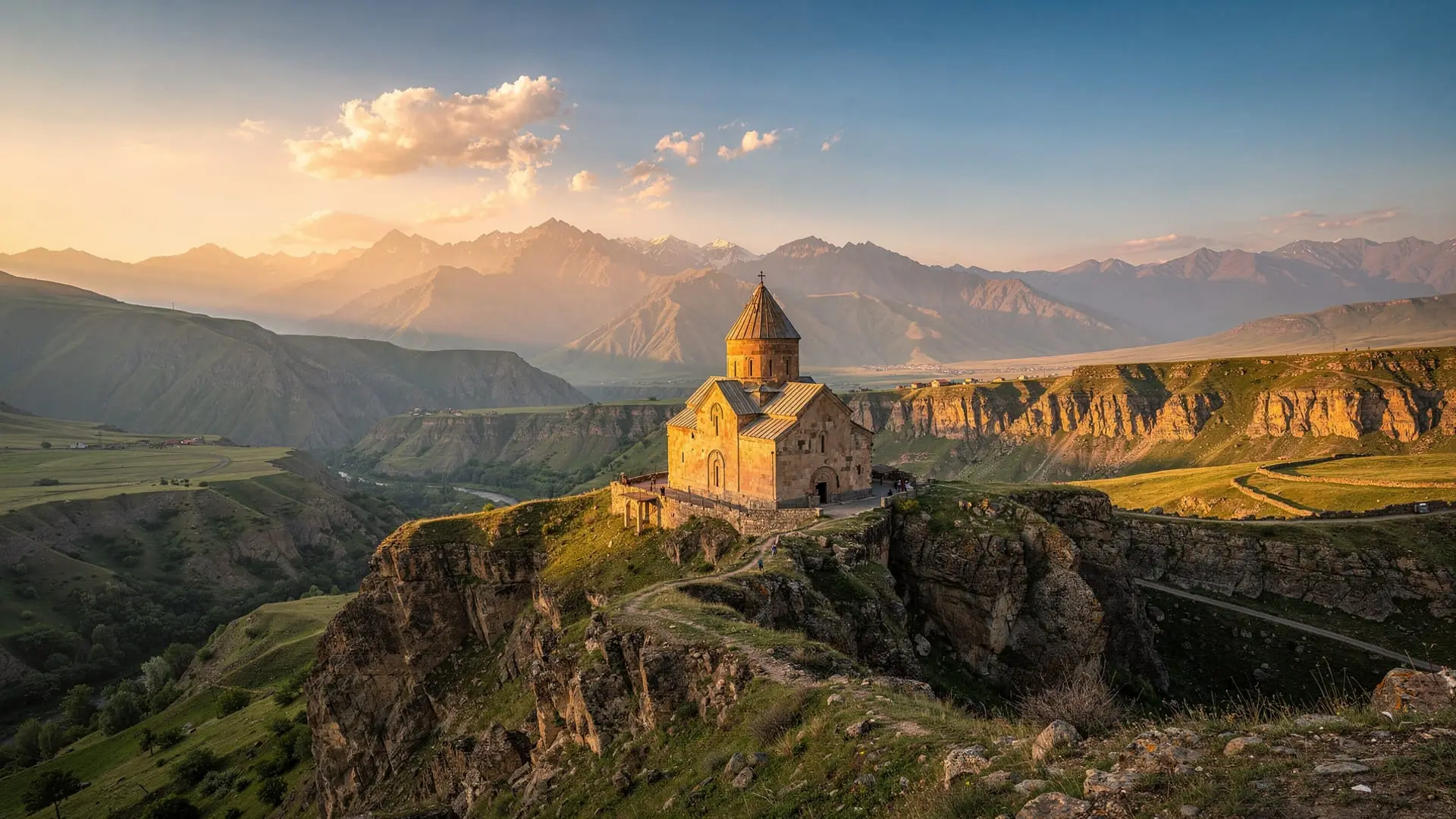
Seven centuries before the great monasteries
Armenia’s famous monasteries — Tatev, Geghard, Haghpat, Sanahin — date from the 9th to 13th centuries. To understand what Armenian Christian architecture looked like before that creative peak, Odzun basilica is an important stop. Built in the 7th century, it represents the first great era of Armenian ecclesiastical building: the basilica type that directly preceded the domed cross-in-square churches that define the Armenian medieval tradition.
Odzun village sits on the edge of the Lori plateau at about 1,500 metres elevation, 24 km south of Alaverdi along a road that climbs through forest before emerging onto an open highland. The basilica stands at the entrance to the village — immediately visible from the road, its proportions unmistakably ancient.
The church is a three-nave basilica: a long central hall flanked by two narrower side aisles, roofed in dark stone with a simple clerestory. This typology comes directly from Syrian and Byzantine basilica traditions of the 5th and 6th centuries, and Odzun is one of the finest surviving examples in the South Caucasus. Unlike later Armenian churches, which drew inward to the domed interior, a basilica opens horizontally — you experience it as a procession down the central nave, with light coming from the upper windows above the side aisles.
| Season | Months | What to expect |
|---|---|---|
| Spring | Apr–May | Wildflowers on the plateau meadows, cool clear air, road from Alaverdi usually clear by early April |
| Summer | Jun–Aug | Warm but rarely hot at 1,500 m; villagers active in the fields; most reliable light for photography |
| Autumn | Sep–Oct | Golden plateau grasses, hazy views over the Debed gorge — arguably the best season overall |
| Winter | Nov–Mar | Accessible but the plateau road can ice over; 4WD recommended, exposed and cold at the basilica |
Getting to Odzun from Yerevan
By car: Approximately 3 hours from Yerevan (175 km). Take the M4/M6 north toward Vanadzor, continue to Alaverdi, then follow the road south up the plateau toward Odzun village.
From Alaverdi: 24 km south of Alaverdi, on a paved road that climbs through forest. About 30–35 minutes by car. A taxi from Alaverdi costs approximately 4,000–7,000 AMD return (the driver will usually wait while you visit).
Guided tour: Odzun is occasionally included in comprehensive Lori day tours, usually combined with Akhtala, Haghpat, and Sanahin. It adds a significant detour (48 km round trip from the main Alaverdi–Haghpat road) and is usually only included in private tours where the itinerary can be customised.
Armenia: Odzun, Akhtala and UNESCO heritage sites full-day tour from Yerevan
What to see at Odzun
The basilica of Odzun
The church of Surb Astvatsatsin (Holy Mother of God) at Odzun was built in the 7th century, most likely during the Catholicos Anastas period, and is one of the oldest continuously functioning church buildings in Armenia. The three-nave basilica plan, dark basalt construction, and restrained proportions represent an architectural type that largely gave way to the domed cross-in-square form after the 9th century. Odzun’s preservation is therefore significant: it gives a direct experience of how early Armenian Christians worshipped before the dome and the gavit became standard.
The western facade has a carved portal with a carved lintel bearing a simple cross-relief — the kind of monumental simplicity that characterises 7th-century Armenian religious art before the more elaborate decorative programmes of the medieval period. The interior is airy and horizontal: you are struck immediately by the length and openness of the space compared to the compressed verticality of later Armenian churches.
Look for the carved stone estrade (platform) near the apse — a survival from the original liturgical arrangement, when the clergy occupied a raised space separated from the congregation by a low screen.
The early Christian monuments
Adjacent to the basilica, in the open cemetery ground, are several late antique carved stone stelae — upright monumental stones bearing Christian cross reliefs and inscription fragments in early Armenian script. These pre-date the construction of the basilica and suggest that Odzun was a Christian settlement of significance before the 7th century. The stelae are weathered but still readable in parts; the relief carvings show the influence of both Armenian and Syrian Christian artistic traditions.
The village of Odzun
Odzun itself is a quiet highland village whose population has shrunk significantly since the Soviet era. The village architecture — stone farmhouses with long wooden balconies — is typical of Lori’s highland settlements. The surroundings are open plateau farmland with views down into the Debed gorge to the west.
There are no restaurants in Odzun village. Bring food and water if you are making a dedicated trip; alternatively, eat in Alaverdi before or after.
Why architecture specialists rate Odzun highly
Art historians studying the evolution of Armenian church design treat Odzun as a hinge point rather than a footnote. The three-nave basilica form Odzun preserves was the dominant Armenian church type for roughly two centuries before the domed cross-in-square plan took over — the plan you see at Haghpat, Sanahin, and almost every major Armenian monastery built after the 9th century. Standing inside Odzun and then inside Haghpat’s main church on the same day makes the shift from horizontal, processional space to vertical, centralised space immediately legible in a way that reading about it does not. For visitors with even a passing interest in architecture, that comparison is the real reason to make the detour, more than any single carving or artefact at Odzun itself.
Combining Odzun with other Lori sites
Akhtala monastery (10 km north of Odzun, 15 minutes by car) pairs naturally with Odzun for a morning focused on Lori’s lesser-known heritage. Start at Odzun for the 7th-century context, then drive north to Akhtala for the 13th-century frescoes.
Haghpat and Sanahin (25–30 km northeast of Odzun) complete the Lori trifecta of UNESCO-listed sites. A full northern Armenia day could run: Odzun → Akhtala → Sanahin → Haghpat — though this is ambitious for a single day from Yerevan.
Alaverdi (24 km north) is the most logical lunch stop and the place to use the cable car to experience the Debed gorge.
Best time to visit and seasonal notes
The Lori plateau has distinct seasons that affect the Odzun visit in different ways:
Spring (April–May): The highland meadows around Odzun village are bright with wildflowers — anemones, poppies, and the yellow globe flowers typical of Lori’s subalpine grasslands. The temperature is cool and pleasant, and the road from Alaverdi is clear of snow by early April in most years. Spring is one of the best times for both the basilica and the surrounding landscape.
Summer (June–August): Warmer but rarely hot at 1,500 metres. The village is at its most populated; local families are active in the fields. The basilica interior is cool and pleasant even on warm days. This is the most reliable time for photography given the consistent light and clear skies.
Autumn (September–October): Perhaps the most dramatic season. The plateau grasses turn golden, and the views from the village toward the Debed gorge below acquire a hazy, atmospheric quality in October. The light is excellent for photography throughout the day.
Winter (November–March): Odzun is accessible in winter, but the plateau road from Alaverdi can be icy or snow-covered. The basilica is surrounded by open ground that becomes very exposed in cold wind. Only recommended for visitors with 4WD and appropriate winter preparation. The site in snow is visually striking, however.
Practical tips
The detour is worth it if: you are driving in Lori with a car, you have a genuine interest in early Christian architecture, or you are doing a comprehensive Lori exploration over two days.
The detour is not essential if: you are on a tight schedule doing Haghpat and Sanahin as a day trip from Yerevan and have no particular interest in basilica typology. The UNESCO monasteries are the primary draws in Lori; Odzun is for those who want to go deeper.
Altitude: Odzun sits at 1,500 metres — the highest point in this page’s list of Lori destinations. Mornings can be cold even in summer; carry a jacket.
Photography: The basilica’s three-nave interior is the best photography subject. The proportions are difficult to capture in a single frame — stand at the western end and use a wide-angle lens. The exterior from the approach road is the most photogenic elevation.
No facilities: Odzun has no cafés, toilets, or shops adjacent to the basilica. A public toilet may be available near the village centre (ask locals). Plan accordingly.
Frequently asked questions about Odzun
When was Odzun basilica built?
Odzun basilica is generally dated to the 7th century AD, making it one of the oldest continuously standing church buildings in Armenia. The exact date of construction is debated, but most Armenian and international art historians place it within the 6th–7th centuries. The three-nave basilica form it uses predates the domed cross-in-square type that became the standard Armenian ecclesiastical form from the 9th century onward.
What is a basilica and how does it differ from later Armenian churches?
A basilica is a long rectangular building with a central nave and flanking side aisles, lit by upper-level clerestory windows. This form was the standard early Christian church type across the Mediterranean and Near East from the 4th to 7th centuries. Armenian architects adopted the basilica in the 5th–7th centuries before developing the distinctive domed cross-in-square form. The great monasteries of Haghpat, Sanahin, Tatev, and Geghard are all domed churches — Odzun represents the earlier type that those buildings replaced.
Is Odzun worth visiting if I am only doing a one-day Lori trip?
For most visitors on a standard Lori day trip from Yerevan, Haghpat and Sanahin are the priority, and Akhtala is a worthwhile addition. Odzun is best suited to visitors who have a particular interest in early Christian architecture or who are spending two days in Lori. If you are doing a one-day trip and have to choose between Akhtala and Odzun, Akhtala’s frescoes are generally the more impressive experience for non-specialist visitors.
Can I reach Odzun without a car?
Technically yes — there are local marshrutkas from Alaverdi that serve nearby villages, and you can ask around for services to Odzun specifically. In practice, public transport to Odzun is unreliable. A taxi from Alaverdi is far more practical; agree a price (approximately 4,000–7,000 AMD return including waiting time) before departure.
For an overview of what else the wider Lori province has to offer beyond the UNESCO monasteries, see the regional guide.