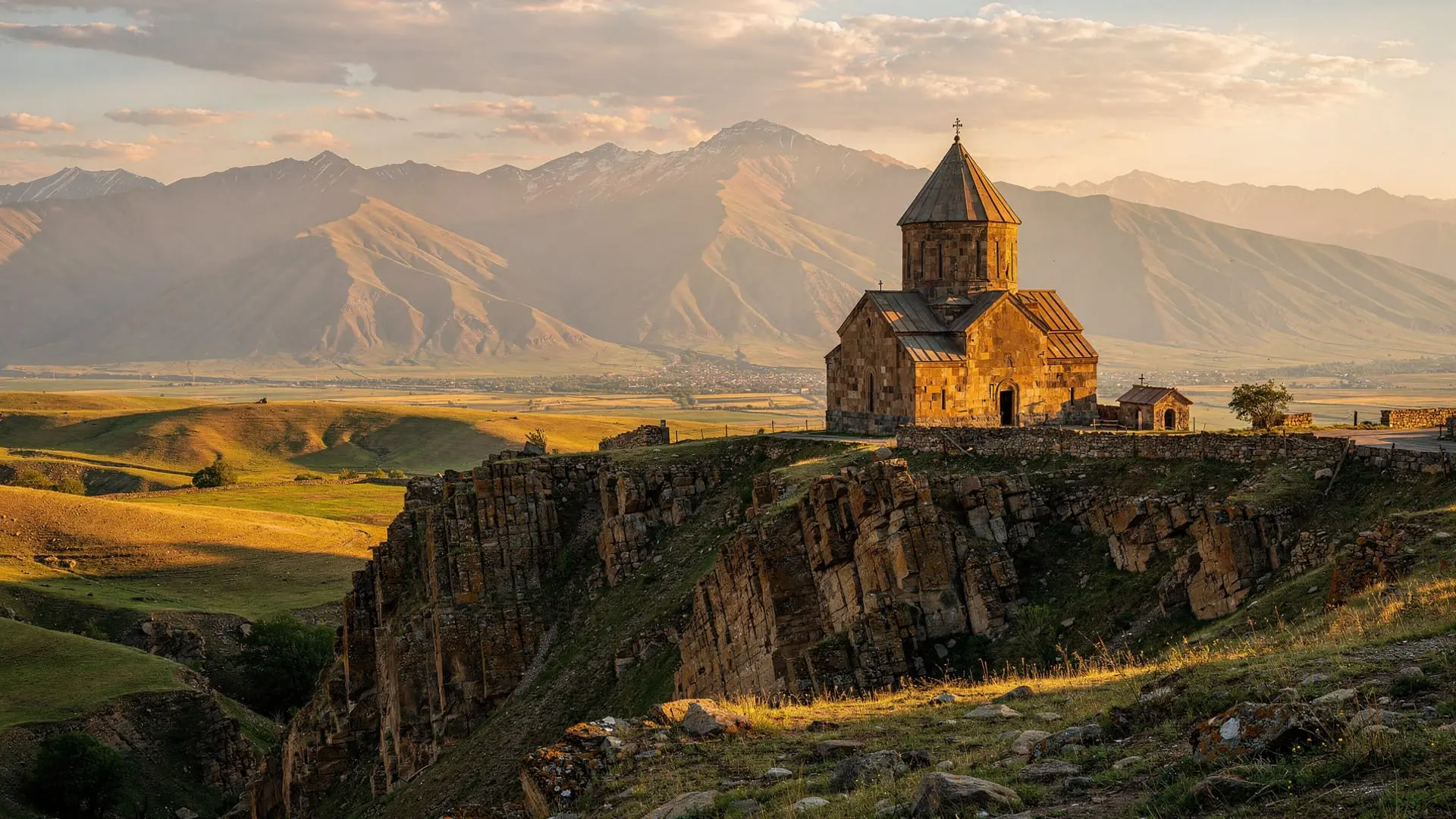
The UNESCO monastery that changed Armenian architecture
In 1996, UNESCO added two monasteries in Armenia’s Lori province to the World Heritage List: Haghpat and Sanahin. Of the two, Haghpat is the more architecturally ambitious — a complex that unfolds across a plateau above the Debed river gorge like a medieval stone village, with church after church, a gavit of exceptional scale, a library tower, and refectory remains that tell the story of a community that once drew scholars from across the medieval Caucasus.
Haghpat was founded in the 10th century and reached its peak under the patronage of the Kiurikian dynasty in the 10th–11th centuries. The main church, Surb Nshan, was constructed in 976–991 AD by Queen Khosrovanush. The complex grew substantially in the 12th–13th centuries, absorbing multiple churches, funerary chapels, and a gavit large enough to have functioned as a meeting hall. At its height, Haghpat was a major centre of manuscript production — the monastery’s scriptorium produced illuminated manuscripts of which more than 70 survive in collections around the world, including works associated with the poet and musician Sayat-Nova, who spent part of his life in this region.
The location amplifies everything. Haghpat sits on a spur above the Debed gorge, 200 km north of Yerevan and just 1 hour’s drive from the Georgian border. The drop into the gorge below is dramatic; the surrounding landscape is one of the least touristically developed in Armenia, which means you often have the complex largely to yourself outside of organised tour groups.
| Where | Lori province, Debed gorge, 200 km north of Yerevan |
| Cost | Free admission |
| Time needed | Half day, combine with Sanahin |
| Getting there | Car (3h30 from Yerevan), guided tour, or day trip from Tbilisi (~1h from the border) |
| Best time | May–June and September–October |
Getting to Haghpat from Yerevan
The drive from Yerevan to Haghpat takes approximately 3 hours 30 minutes (200 km). This is not a short journey — be realistic about the time commitment when planning a day trip. The route goes north via Vanadzor on the M4/M6 highway, then branches toward Alaverdi and up to Haghpat village.
By car: The fastest and most flexible option. The road to Haghpat is paved all the way. The village is small and parking is available just outside the monastery gates.
By marshrutka and taxi: Take a marshrutka from Yerevan’s Kilikia terminal to Vanadzor (around 1,200 AMD, 2 hours), then connect to Alaverdi by local marshrutka (30 minutes). From Alaverdi, a taxi to Haghpat takes about 20 minutes and costs 3,000–5,000 AMD. This multi-leg journey is feasible but requires patience.
Guided day tour from Yerevan: The most common option for visitors without a car. Day tours typically combine Haghpat with Sanahin and sometimes Akhtala, returning to Yerevan in the evening after a very long day (departure by 07:00 recommended). Several operators also offer overnight Lori tours.
From Tbilisi (cross-border option): Haghpat is approximately 1 hour from the Armenian side of the Bagratashen–Sadakhlo border crossing, and about 2.5–3 hours from central Tbilisi. This makes Haghpat and Sanahin genuine day-trip destinations from Tbilisi — there are multiple Georgian-based operators running this route, and it is popular with tourists who are based in Georgia.
Armenia: private tour to Haghpat and Sanahin monasteries from Yerevan
Tbilisi transfer: Haghpat and Sanahin stops to/from Yerevan
What to see at Haghpat
The church of Surb Nshan
The Cathedral of the Holy Cross is the founding church of the complex, built in 976–991 AD by Queen Khosrovanush. It is the largest structure at Haghpat, and the most imposing — a tall single-nave church of dark basalt and tuff, with a conical drum-and-dome roof that is the defining silhouette of the complex from the gorge below.
The interior is vast and dark, lit by narrow windows in the apse and by candlelight. The carved altar screen, the khachkars embedded in the walls, and the faded inscriptions above the side chapels reward slow examination. A small room to the north of the nave contains several medieval khachkars, including fragments that were moved here for preservation.
The gavit (narthex) of Surb Nshan
Attached to the west facade of Surb Nshan, the gavit was built in the 13th century and is the largest single hall at Haghpat. The ceiling vaulting is the architectural highlight of the entire complex — a forest of interlocking stone arches that rises to a central lantern, admitting a shaft of light that falls on the stone floor. The structural logic of this ceiling, where no arch is self-supporting and the whole system works as an integrated vault, has been studied by architectural historians as a precursor of certain Gothic structural ideas.
Haghpat’s gavit is often compared to that at Sanahin (10 minutes away). Both are exceptional; Haghpat’s is slightly larger and its ceiling is considered the more technically ambitious.
The library and bell tower
The separate library building (Grchnadar), to the northwest of the main church, was built in the 13th century for the storage and copying of manuscripts. It is a low two-storey structure of good basalt masonry — unpretentious from the outside, but significant as one of the few purpose-built monastic libraries surviving in Armenia. The manuscripts produced here, including those associated with Sayat-Nova’s era, are now dispersed among the Matenadaran in Yerevan and collections in Venice, Jerusalem, and Vienna.
The bell tower, standing separately from the church on the western edge of the plateau, dates from 1245. From its base, the view over the Debed gorge is the best at Haghpat — the drop is vertiginous and the forested valley stretches north toward Georgia.
The church of Surb Grigor and funerary chapel
A smaller church dedicated to Saint Gregory the Illuminator, built in the early 13th century, stands to the east of the main cathedral. Its portal has some of the most detailed carved decoration at Haghpat — palmette borders and interlocking cable motifs. Inside, several Kiurikian princes are buried in the walls, with carved stone memorial portraits.
Sayat-Nova connection
Sayat-Nova (1712–1795), Armenia’s most celebrated poet and ashug (troubadour), spent time in the monasteries of Lori and his manuscripts were preserved here before eventually reaching the Matenadaran. Several of his 220 known songs were written in Armenian, Georgian, and Azerbaijani — a testament to the cosmopolitan court culture of 18th-century Lori. A small panel inside Surb Nshan acknowledges this connection.
Haghpat in the wider Caucasus picture
Haghpat’s real appeal for many travellers is that it sits at the intersection of Armenian heritage and cross-border logistics — it’s one of the few UNESCO sites in the region genuinely convenient from both Yerevan and Tbilisi. If you’re planning a longer Caucasus trip, our overland guide to the Yerevan–Tbilisi route explains how Haghpat and Sanahin fit into the drive, and the Caucasus night train guide covers the rail alternative if you’d rather not drive the whole way. For a broader look at how Lori’s UNESCO pair compares with Armenia’s other great monastery complexes, see our Haghpat and Sanahin UNESCO monasteries guide.
Travellers building a longer northern loop sometimes pair Haghpat with a detour east toward Lake Sevan rather than backtracking straight to Yerevan — it adds distance but turns two separate day trips into one continuous route. See our Lake Sevan and Dilijan day trip guide for how that leg works.
Combining with Sanahin and Akhtala
Haghpat and Sanahin are 10 minutes apart by car and almost always visited together — they are UNESCO-listed as a pair. Akhtala monastery is 15 km west, adding another 30 minutes of driving. A focused morning can cover all three.
For a cross-border Caucasus itinerary, combine Haghpat and Sanahin with a stop at Alaverdi (the cable car over the Debed gorge) and then continue north to the Georgian border. From there, Tbilisi is 2.5 hours away.
Tour from Yerevan to Tbilisi visiting Sanahin, Haghpat and Akhtala
Tours and tickets
There is no entrance fee for Haghpat monastery. The site is maintained by the Armenian Apostolic Church and the local municipality. The main church is open during daylight hours; some secondary structures may be locked — a caretaker can assist.
Official guided tours from Yerevan covering Haghpat typically cost 35,000–60,000 AMD per person for a group tour, or 80,000–120,000 AMD for a private vehicle. Tbilisi-based tours covering northern Armenia (Haghpat, Sanahin, Alaverdi) tend to be slightly cheaper given the shorter driving distance.
Practical tips
The drive is long: 3h30 from Yerevan means you need to leave by 07:00–07:30 for a comfortable day trip. Most guided tours depart by 08:00. If you are coming from Yerevan for just Haghpat and Sanahin, consider overnighting in Vanadzor or Alaverdi to avoid a very long day.
Tbilisi visitors: If you are based in Tbilisi, this is among the most accessible UNESCO sites in Armenia. The border crossing at Bagratashen–Sadakhlo (also called Debed–Ninotsminda depending on which map you use) is straightforward. See the practical guide to the Bagratashen border crossing for procedures and hours.
Weather: Lori sits at 700–1,000 metres and experiences genuine winters. In January–February, temperatures drop below freezing. Snow can affect roads but the Haghpat road itself is rarely impassable. Carry warm layers if visiting in winter.
Photography: The best light for the main church exterior is morning (east-facing front). The gavit ceiling is best photographed from a tripod with a wide-angle lens — bring one if you have it. The bell tower and gorge view are spectacular at golden hour.
Frequently asked questions about Haghpat monastery
Why is Haghpat a UNESCO World Heritage site?
Haghpat and Sanahin were listed together by UNESCO in 1996 as outstanding examples of Armenian medieval monastic architecture, representing the culmination of the Bagratid architectural school in the 10th–13th centuries. The listing recognises their architectural innovation (particularly the gavit ceiling vaulting systems), their historical significance as manuscript production centres, and their exceptional state of preservation given their age.
Can you visit Haghpat from Tbilisi in one day?
Yes. Haghpat is approximately 2.5–3 hours from central Tbilisi by car, passing through the Bagratashen–Sadakhlo border crossing. Combined with Sanahin, a day trip from Tbilisi is feasible if you leave by 08:00. Multiple Georgian tour operators offer this route regularly.
What manuscripts were produced at Haghpat?
Haghpat’s scriptorium was active from the 10th through the 13th centuries, producing illuminated manuscripts — primarily biblical texts, religious commentaries, and hymnals. Among the most notable is the Haghpat Gospels of 1211, now held in the Matenadaran manuscript library in Yerevan. The monastery’s association with Sayat-Nova relates primarily to manuscript preservation rather than production — some of his manuscripts were kept here before the Matenadaran collection was established.
How does Haghpat compare to Sanahin?
Both monasteries are exceptional. Haghpat is slightly larger, has a more varied collection of structures, and its main gavit ceiling is considered the more ambitious architectural achievement. Sanahin has a more rugged, atmospheric quality and its name translates as “older than that one” — a reference to a tradition that Sanahin was founded before Haghpat. They are different enough in character to justify visiting both, which most visitors do given their proximity.
Is Haghpat worth visiting if I have already seen Geghard and Tatev?
Absolutely. Haghpat belongs to a different architectural tradition from Geghard (rock-cut) and Tatev (cliff-edge drama). Haghpat is a plateau complex with extraordinary interior spaces — particularly the gavit — and the 10th-century founding church Surb Nshan is one of the great early medieval buildings in the South Caucasus. For anyone seriously interested in Armenian religious heritage, Haghpat is essential.
Should I do Haghpat as a day trip from Yerevan or overnight in Lori?
If Haghpat and Sanahin are your only Lori stops, a very early departure day trip from Yerevan is workable but long — expect to be back after dark. If you can spare the time, overnighting near Alaverdi or Vanadzor turns a rushed day into a relaxed one and leaves room to add Akhtala or the Debed gorge cable car. Travellers continuing on to Georgia don’t need to worry about this at all, since Tbilisi is only a couple of hours further north.