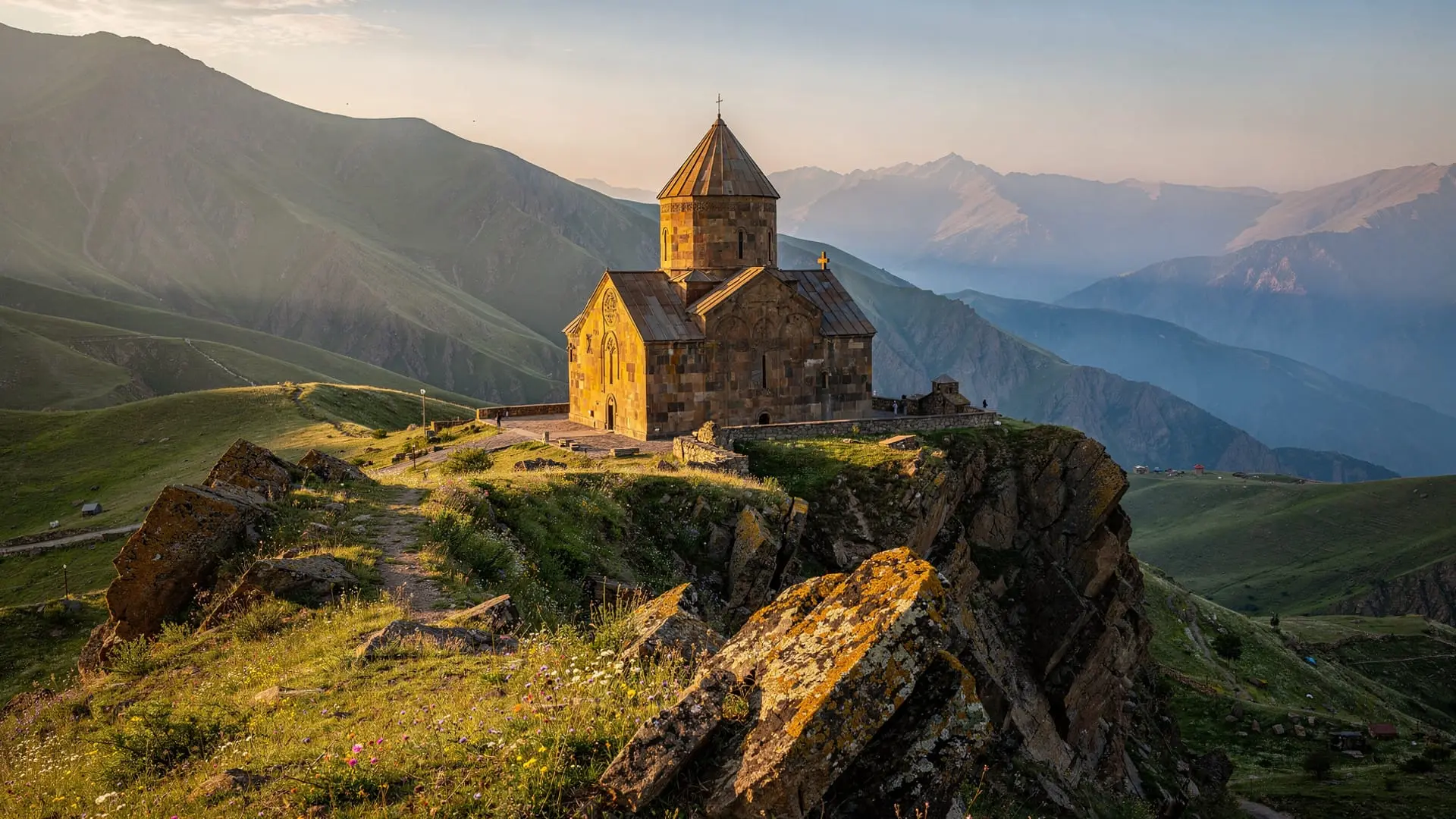
The village that gave Armenia its most beloved poet
Every Armenian knows Hovhannes Tumanyan. The poet and writer (1869–1923) is as central to Armenian literary identity as Pushkin is to Russian — his fables, poems, and stories are memorised by schoolchildren, quoted at family tables, and depicted in monuments from Yerevan to the diaspora. His four-volume collected works have been translated into more than 80 languages. And the village where he was born, Dsegh, sits in a mountain valley in Lori province, 15 km east of Alaverdi.
Dsegh is not a polished cultural heritage destination. It is a living village — about 700 people, stone farmhouses, a school, a small market — where the connection to Tumanyan feels embedded in the local identity rather than packaged for tourists. The Tumanyan House Museum is modest: the original family house and orchard, a small collection of manuscripts and personal effects, and a garden where the poet reportedly sat and wrote.
For Armenian visitors, Dsegh is a pilgrimage with emotional weight. For international visitors, it is a window into the role of literary heritage in Armenian national identity and an unusually authentic encounter with highland Lori village life.
| Where | Lori province, 185 km / 3h15 north of Yerevan |
| Cost | Museum ~1,000 AMD; foraging tour priced separately |
| Time needed | Half day |
| Getting there | Car (via Alaverdi) or GYG foraging tour with transport included |
| Best time | May–September; village roads harder in winter |
Getting to Dsegh from Yerevan
By car: Approximately 3 hours 15 minutes (185 km) from Yerevan. Take the M4/M6 north, pass Vanadzor, continue to Alaverdi, then follow the local road east into the mountains toward Dsegh. The road is paved but narrow in the final section.
From Alaverdi: 15 km east, about 25 minutes by car or taxi. A taxi from Alaverdi costs approximately 4,000–6,000 AMD return.
By organised tour: Dsegh is sometimes included in comprehensive Lori tours, and there is a specific foraging experience organised from the village that operates through the GetYourGuide platform. This is the most accessible way to visit without a car.
Wild tea foraging in Dsegh village — half-day guided experience
What to see and do in Dsegh
The Tumanyan House Museum (Tumanyan Museum)
The museum consists of the original family home where Hovhannes Tumanyan was born on February 19, 1869, and lived until he left for Tiflis (Tbilisi) at age 10 to begin his education. The house has been preserved as it appeared in the 1870s: a traditional Lori stone building with a veranda, a central living space, a sleeping area, and a stone-flagged yard with a fruit tree that Tumanyan’s family planted.
Inside, the museum holds manuscripts of Tumanyan’s works — both originals and facsimiles — along with personal correspondence, paintings commissioned by Soviet-era artists depicting scenes from his poems, and photographs from the poet’s later life in Tiflis. The exhibits are labelled in Armenian and Russian; if you read neither, bring a guide or use a translation app on your phone.
The highlight for literary visitors is the manuscript room, where you can see the handwritten drafts of some of his best-known poems. The calligraphy of his manuscripts — the looped, flowing classical Armenian script — is beautiful even without reading the content.
Admission: approximately 1,000 AMD. The museum is open Tuesday–Sunday, 10:00–17:00; closed Mondays.
The memorial garden and monument
Behind the house, a garden with fruit trees and stone benches was created during the Soviet era as a memorial park. A bronze bust of Tumanyan (by sculptor Ara Sargsyan) stands at the entrance. The garden is pleasant and unhurried — a good place to sit with a copy of Tumanyan’s poems if you have brought one.
Wild tea foraging
One of the more unusual organised activities in Lori is a guided wild herb and tea foraging tour in the forests above Dsegh. The forests around the village contain a variety of highland herbs that are collected by local families for herbal teas, medicinal preparations, and cooking: mountain thyme (vayri sezan), wild marjoram, St. John’s wort, and several species specific to the Lori highlands.
A half-day foraging tour led by local experts includes a walk through the forest, identification of edible and medicinal plants, and a tea preparation session back in the village using the herbs collected. It is the kind of experience that connects you to local ecological knowledge rather than packaged cultural performance.
The village itself
Dsegh repays a slow walk. The stone houses, many with traditional wooden balconies, the small central square, the elementary school painted in the national colours — the village has a coherent character shaped by long habitation and the particular climate and topography of the Lori highlands. The surrounding meadows and forests are good for informal hiking; no marked trails, but the terrain is open enough to navigate independently.
Dsegh’s literary landscape beyond the museum
Much of the setting Tumanyan wrote about is still recognisable on the ground. The Lori highland scenery that anchors Anush — steep pastures, scattered stone farmsteads, the particular quality of highland light — surrounds the village largely unchanged. Some visitors with a literary bent walk the meadows above the village with a copy of the poem in hand, matching landscape to text. This is not a signposted “literary trail” in the European sense; it is closer to standing where the writer stood and understanding why the place produced the writing it did. Locals are generally happy to point out features connected to Tumanyan family lore if you ask, even without shared language, given the village’s outsized pride in its most famous son.
Hovhannes Tumanyan: context for international visitors
Tumanyan wrote primarily in the Armenian vernacular of his era, and his work encompasses lyric poetry, narrative poems, folk-tale retellings, and short prose. His most famous works include:
- Anush (1892): a lyric narrative poem set in the Lori mountains, considered his masterpiece
- The Bravest Man and A Drop of Honey: fables widely used in Armenian primary education
- Loretsi Sago (Sago from Lori): a comedic narrative poem beloved for its regional specificity
Tumanyan also served as a political figure during the catastrophic period of 1915–1923, advocating for Armenian refugees and writing about the violence against his people. His late poems carry the weight of that era, and his death in 1923 came when he was already weakened by years of relief work.
The phrase often quoted about Tumanyan — “the poet of all Armenians” — captures something real about his status. He wrote in a way that Armenian communities across the diaspora, regardless of dialect, could access and claim.
Combining Dsegh with other Lori sites
Alaverdi (15 km west) is the natural combination. Visit the Tumanyan Museum in the morning, then drive to Alaverdi for the cable car to Sanahin and the drive to Haghpat.
Akhtala monastery (25 km west of Dsegh via Alaverdi) adds the frescoed fortress-monastery to a Lori day.
Vanadzor (50 km southwest) is the most comfortable overnight base, allowing a more relaxed exploration of Dsegh and the monastery circuit over two days.
Where to stay near Dsegh
Dsegh has no hotels. Accommodation options for the area:
Alaverdi (15 km west): Hotel Alaverdi is the most convenient base for combining Dsegh with the western Lori sites (Sanahin, Haghpat, Akhtala). Basic but adequate.
Tufenkian Avan Dzoraget Hotel (65 km southwest, near Vanadzor): The premier accommodation in the Lori region — a beautifully restored historic manor in the Dzoraget gorge. An excellent choice if you are doing a two-day Lori circuit and want comfort. Rates from approximately 60,000–90,000 AMD.
Vanadzor: 50 km southwest, with several hotel options at different price points. A good base for covering both the eastern Lori plateau (Dsegh, Odzun) and the Debed valley monasteries (Haghpat, Sanahin).
Family guesthouses in nearby villages: If you speak basic Armenian or Russian, informal village stays can sometimes be arranged through local contacts. The district museum in Stepanavan may be able to suggest options.
Practical tips
Bring Armenian reading material: If you read Armenian or have a translation of Tumanyan’s poems, bring it. The museum experience is richer with even a basic familiarity with his work. Free translations of Anush and some shorter poems are available online.
No cafés adjacent to the museum: The village has a small local shop and a couple of informal tea houses, but no café-restaurant in the tourist sense. Bring a packed lunch from Alaverdi or Vanadzor, or plan to eat there before or after.
Museum hours: Confirm opening hours before making a dedicated trip (Tuesday–Sunday, 10:00–17:00 as of 2026; closed Mondays). The museum occasionally closes for maintenance or national holidays.
The foraging tour: Book the wild tea foraging experience in advance, particularly in July–August when demand is higher and the guide’s calendar fills up.
Frequently asked questions about Dsegh
Who was Hovhannes Tumanyan?
Hovhannes Tumanyan (1869–1923) is the most celebrated poet in the modern Armenian literary canon. Born in Dsegh, Lori, he wrote lyric and narrative poetry, folk-tale adaptations, and prose in the vernacular Armenian of the Caucasus. His narrative poem Anush (1892), set in the Lori mountains, is considered his masterpiece. He is often called “the poet of all Armenians” for his ability to speak across regional and diaspora divisions. His later life was marked by efforts to aid Armenian genocide survivors; he died in Moscow in 1923.
What can I see at the Tumanyan House Museum in Dsegh?
The museum consists of the original family home (preserved as it appeared in the 1870s), a manuscript and archive room, Soviet-era paintings depicting scenes from his poems, personal correspondence, and a memorial garden with a bronze bust. Exhibits are labelled in Armenian and Russian. The museum is modest in scale but intimate and genuine — this is the actual house, not a reconstruction.
Is the wild tea foraging tour suitable for all ages?
Yes. The foraging walk is through relatively flat forest and meadow terrain around Dsegh village, suitable for adults and children from around age 8 upward. The pace is leisurely, with frequent stops for plant identification and explanation. The session ends with a tea preparation and tasting. No special equipment is needed.
How does Dsegh fit into a northern Armenia itinerary?
Dsegh works best as a half-day addition to a Lori circuit that includes Haghpat, Sanahin, and Alaverdi. If you are spending two days in Lori (recommended), Dsegh fits naturally on the second day alongside Akhtala and Odzun.
Is Dsegh worth visiting if I don’t know Tumanyan’s work?
Yes, though the experience is richer if you do. Even without prior familiarity, the museum’s setting — an intact 1870s stone farmhouse, a genuine literary pilgrimage site for Armenians — and the village’s untouched highland character make it worthwhile as a window into rural Lori life and the outsized role literature plays in Armenian national identity. Pairing the museum visit with the wild tea foraging tour gives non-literary visitors a hands-on activity that stands on its own.