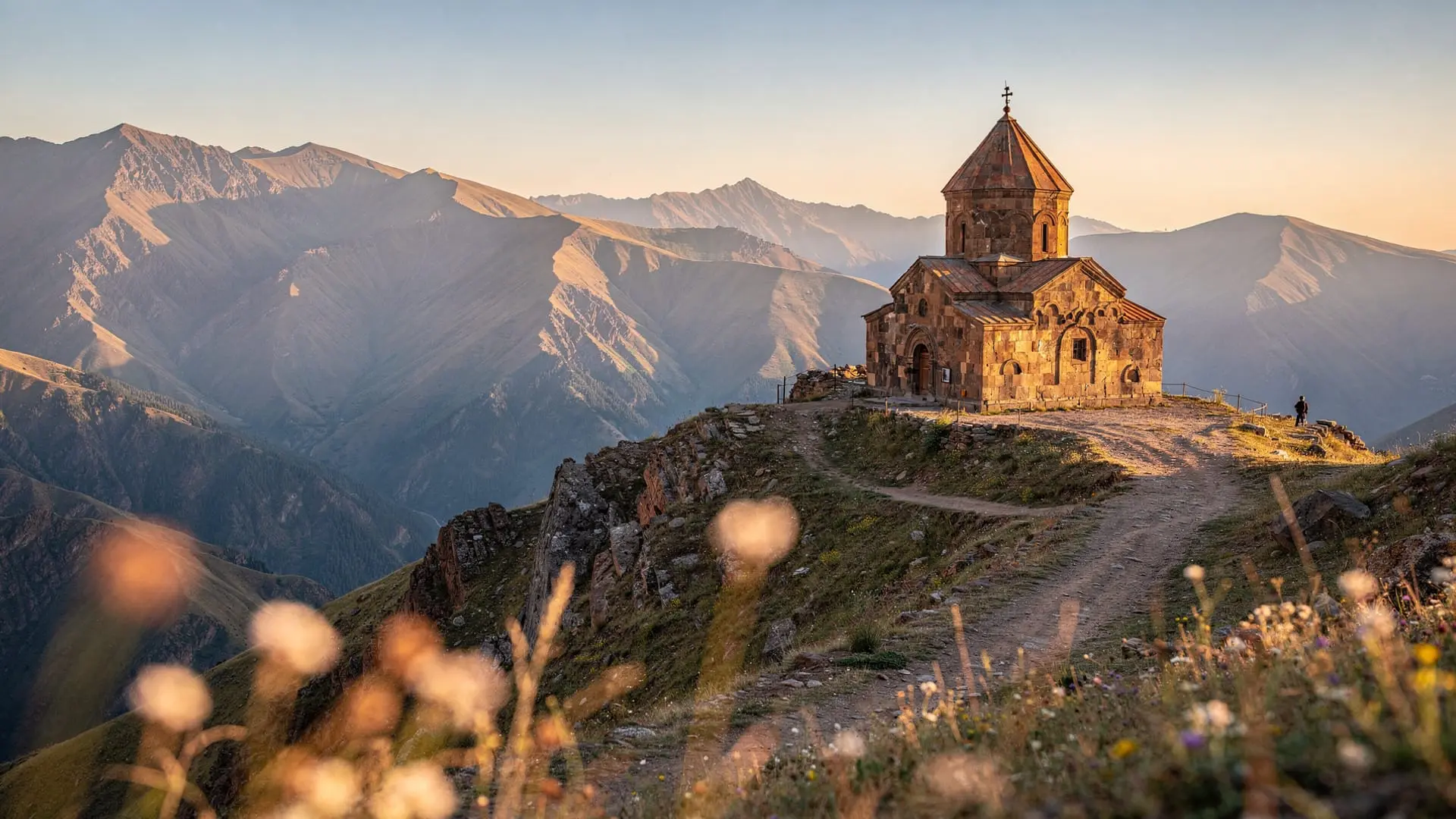
Northern Lori’s forgotten gem and its botanical park
Stepanavan is the second town of Lori province after Vanadzor, sitting on the Lori plateau at 1,400 metres elevation in northern Armenia. It is less visited than Vanadzor and entirely off the standard tourist circuit — most travellers who reach the Lori monasteries do so via the Debed valley road to the east, bypassing the plateau entirely. Stepanavan’s detour value lies in two things: the Dendropark botanical garden 35 km to the north, and the ruined Lori Berd fortress within walking distance of town.
| Where | Lori plateau, 165 km (2h30) north of Yerevan |
| Cost | Dendropark ~500 AMD entry; taxi to Dendropark ~6,000–10,000 AMD return |
| Time needed | 1 day, or 2 days combined with the northern Lori circuit |
| Getting there | Marshrutka from Kilikia terminal (~2h, ~1,500 AMD) or self-drive |
| Best time | May–June for blooms, September for autumn colour |
The Stepanavan Dendropark (also called the Dendropark of Stepanavan) was established in 1931 by botanist Areg Grigori Manafyan, one of those Soviet-era scientists who built remarkable institutions in improbable places. The park covers 35 hectares of forest in the Dzoraget river valley and contains more than 1,000 plant species from around the world — conifers from North America, Far Eastern broadleaves, Himalayan species, Mediterranean and Caucasian endemic plants — organised in systematic botanical sections. The central arboretum section, planted in the 1930s, now contains mature trees up to 40 metres tall.
This is not a manicured formal garden. The Dendropark has the slight wildness of a place maintained with limited resources, which is part of its charm — wandering the forest paths between century-old specimens from five continents in a remote Lori valley feels genuinely extraordinary.
Getting to Stepanavan from Yerevan
By car: Approximately 2 hours 30 minutes (165 km). The most direct route runs north from Yerevan on the M4 highway, then northwest through Vanadzor and up to the plateau toward Stepanavan. An alternative scenic route goes via Spitak and the Lori plateau directly.
By marshrutka: Marshrutkas from Kilikia terminal in Yerevan serve Stepanavan (approximately 2 hours, 1,500 AMD). From Stepanavan, local transport to the Dendropark area (35 km north) is limited; a taxi from Stepanavan to the Dendropark costs approximately 5,000–8,000 AMD return.
From Vanadzor: Approximately 65 km west of Vanadzor on the Lori plateau road — about 1 hour by car.
Getting to the Dendropark from Stepanavan
The Stepanavan Dendropark is located approximately 35 km north of Stepanavan town, in the Dzoraget river valley near the village of Gyulagarak. By car, the drive takes about 40 minutes on a good paved road that descends from the plateau into the valley.
A taxi from Stepanavan to the Dendropark and back (with waiting time while you visit) costs approximately 6,000–10,000 AMD. Confirm the return arrangement before the driver leaves.
What to see in and around Stepanavan
The Stepanavan Dendropark
The park’s 35 hectares are divided into botanical sections by plant origin: North American conifers (including Sequoiadendron and Abies species reaching 30+ metres), East Asian broadleaves, Mediterranean and Caucasian species, and a section of ornamental trees and shrubs. The oldest plantings date from the 1930s and early 1940s.
Walking paths wind through the collections, some well-maintained, others less so. A map of the botanical sections is available at the entrance kiosk (when staffed). The park is open from approximately April through October; during winter, deep snow on the plateau can make access difficult.
Admission: approximately 500 AMD.
Best time: May–June for spring blooms (particularly in the ornamental flowering tree sections) and September for autumn colour in the deciduous sections. The Sequoia grove is impressive year-round.
| Season | What you’ll see | Notes |
|---|---|---|
| Apr–May | Park reopens, early blooms | Some paths still muddy from snowmelt |
| Jun–Jul | Full canopy, ornamental flowers | Warmest, most comfortable plateau weather |
| Sep | Autumn colour in deciduous sections | Best light for photography |
| Nov–Mar | Closed or largely inaccessible | Deep plateau snow, kiosk unstaffed |
Lori Berd (Lori fortress)
On a rocky promontory at the confluence of the Dzoraget and Urut rivers, a short drive from Stepanavan, lie the extensive ruins of Lori Berd — the medieval fortress that was the capital of the Kiurikian kingdom in the 10th–12th centuries. This is the same dynasty that built Haghpat and Sanahin monasteries; the fortress was their political and military seat.
The ruins are substantial: defensive walls that still stand to significant height, the outlines of royal halls and a palatial church, cisterns and storage rooms carved into the rock. The setting — on a triangular promontory with sheer drops on two sides — makes the military logic immediately obvious. The site is rarely visited and poorly signposted; the approach is via an unpaved track from the road.
Lori Berd is historically significant as evidence of the political geography of medieval Armenia, but it requires imagination to appreciate — there is no visitor centre and the ruins demand archaeological knowledge to interpret fully. Worth visiting if you have a particular interest in medieval Armenian history; less essential for general visitors.
Stepanavan town
The town itself has a central square with the expected Soviet-era statue (Stepan Shahumyan, the Bolshevik revolutionary after whom the town was renamed from Dzhalalogly in 1924), a district museum, and the administrative buildings typical of an Armenian provincial centre of the Lori plateau.
The district museum contains ethnographic collections from the Lori highlands — traditional costume, agricultural tools, folk weaving — and a small archaeological section with finds from the pre-Christian settlements of the area. It is a modest institution but a genuine reflection of local highland culture.
Combining Stepanavan with other Lori sites
A logical northern Lori itinerary using Stepanavan:
From Yerevan: Drive to Stepanavan (2h30) → Dendropark in the morning (1.5–2 hours) → Lori Berd in the early afternoon (1 hour) → continue east toward Vanadzor (1 hour) → base at Vanadzor or continue to Alaverdi for the monasteries the next day.
Combining with Dsegh: Dsegh village (Tumanyan birthplace) is approximately 45 km east of Stepanavan. Both can be covered on the same day if you have a car and are doing a comprehensive Lori plateau exploration.
For a two-day Lori itinerary:
- Day 1: Yerevan → Stepanavan → Dendropark → Lori Berd → overnight in Stepanavan or Vanadzor
- Day 2: Vanadzor → Alaverdi (cable car) → Sanahin → Haghpat → Akhtala → return to Yerevan
Yerevan: 1-day horseback riding in the lush region of Lori
Food in Stepanavan
Stepanavan does not have a developed restaurant scene — most visitors eat at the hotel restaurant or a handful of simple cafés around the central square serving standard Armenian fare: khorovats, khashlama, lavash-wrapped greens and regional cheeses. If you want a fuller sense of what you’re eating, the Armenian food essential dishes guide covers the staples you’ll see on every plateau-town menu. Don’t expect much beyond 9–10pm; the town is quiet after dark.
Where to stay in Stepanavan
Hotel Milenium — the best-known hotel in Stepanavan, with standard rooms at approximately 18,000–25,000 AMD. Restaurant on site serving Armenian standards.
Family guesthouses — several families in Stepanavan and the surrounding villages rent rooms informally. Ask at the hotel or the district museum for recommendations.
For more comfortable accommodation, Vanadzor (65 km east) has better options, and the Tufenkian Avan Dzoraget Hotel in the Dzoraget gorge is the region’s premium choice.
Practical tips
Dendropark logistics: The park is 35 km from Stepanavan, not in the town itself. Don’t assume you can walk there. Arrange a taxi in advance or rent a car.
Dendropark opening: The park is seasonal (approximately April–October) and the entrance kiosk is not always staffed. The park itself may be accessible even when unstaffed; admission is generally on the honour system outside peak season.
Lori Berd access: The approach road to Lori Berd is unpaved and can be muddy after rain. A high-clearance vehicle is helpful. The path from the road to the fortress promontory involves some rough terrain.
Weather: Stepanavan sits at 1,400 metres — significantly cooler than Yerevan in all seasons. Pack a warm layer even in summer; mornings and evenings are cool.
Combine for efficiency: Stepanavan rewards visitors with a car who are doing a comprehensive two-day Lori circuit. It is less practical as a standalone day trip from Yerevan given the 2h30 drive and the relatively limited specific attractions.
Frequently asked questions about Stepanavan and the Dendropark
What is the Stepanavan Dendropark?
The Stepanavan Dendropark is a botanical garden established in 1931 in the Dzoraget river valley, 35 km north of Stepanavan town. Covering 35 hectares, it contains more than 1,000 plant species from around the world — including species from North America, East Asia, the Himalayas, and the Mediterranean — organised in systematic botanical sections. It is one of the most biodiverse botanical collections in the South Caucasus and one of Armenia’s lesser-known natural attractions.
Is the Dendropark worth visiting if I am not a botanist?
Yes. You don’t need botanical knowledge to appreciate the Dendropark. The park is fundamentally a mature forest of extraordinary diversity, with enormous trees from five continents creating a canopy that feels genuinely exotic in an Armenian valley. The experience of walking among 40-metre Sequoia trees that have been growing here since the 1930s, or under a canopy of East Asian maples in autumn colour, is compelling for any nature lover.
What is Lori Berd and can I visit it independently?
Lori Berd (Lori fortress) is the ruined medieval capital of the Kiurikian dynasty, on a promontory near Stepanavan. It can be visited independently — there are no tickets or guides required. The approach is via an unpaved road from the main highway; the final section requires walking. The ruins are extensive but poorly interpreted; a basic knowledge of medieval Armenian history helps you appreciate what you are seeing.
How does Stepanavan fit into a northern Armenia tour?
Stepanavan is best included in a two-day northern Lori exploration rather than squeezed into a single day from Yerevan. On a one-day Lori trip, most visitors focus on Haghpat and Sanahin (the UNESCO sites), with Akhtala as a possible addition. Stepanavan and the Dendropark are more suitable for travellers with a car who want to see the quieter, less touristic side of Lori — the plateau landscapes, the botanical garden, the village life that the Debed valley circuit bypasses.
Can I visit Stepanavan by public transport without a car?
It’s possible but slow. A marshrutka from Yerevan’s Kilikia terminal reaches Stepanavan town in about 2 hours, but the Dendropark itself is 35 km further north with no scheduled public transport — you’ll need a taxi arranged from the town (around 6,000–10,000 AMD return with waiting time). Lori Berd is closer and can be reached on foot or by a short taxi ride. Travellers without a car generally get more out of Haghpat and Sanahin, which sit directly on the marshrutka-served Debed valley road.
Is Stepanavan a good day trip from Yerevan?
It’s a long day given the 2h30 drive each way — feasible with a car but tiring, and it leaves little slack for Lori Berd or a relaxed pace at the Dendropark. Stepanavan works better as part of a two-day northern Lori route, overnighting in Stepanavan or Vanadzor, than as a rushed single-day round trip.