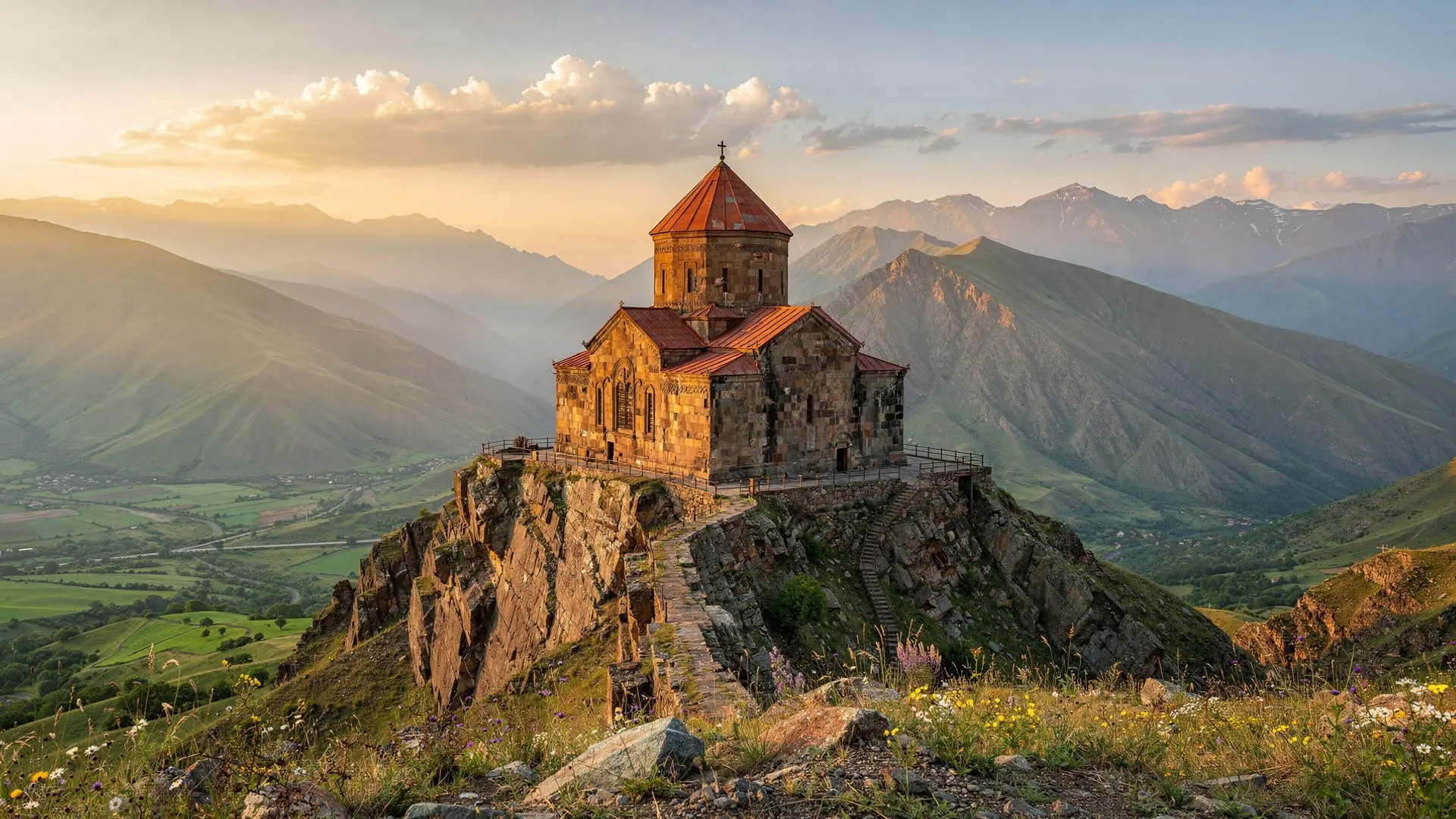
The province that gives Yerevan its best day trips
Kotayk province wraps around Yerevan on the east and northeast, occupying a landscape that shifts from the sun-baked lowlands of the Hrazdan valley to the forested slopes of the Geghama mountains and the ski village of Tsaghkadzor at 1,900 metres. Within 50 km of the capital, Kotayk contains several of the most-visited sites in the entire country.
| Where | East of Yerevan; Garni 28 km, Tsaghkadzor 55 km |
| Cost | Free at Garni/Geghard/Symphony; taxi loop around 10,000–15,000 AMD |
| Time needed | 1 day (Garni-Geghard) to 2 days (add Tsaghkadzor) |
| Getting there | Marshrutka to Garni, taxi onward, or guided tour |
| Best time | Apr–Oct for sights; Dec–Mar for Tsaghkadzor skiing |
Garni and Geghard are the flagship combination — the former a pagan Hellenistic temple dating to the 1st century AD, the latter a cave monastery carved directly into the basalt cliffs of the Azat River gorge and inscribed on the UNESCO World Heritage List. Between them, the Symphony of Stones — a canyon wall of hexagonal basalt columns resembling a gigantic pipe organ — is one of the most unusual geological formations in Armenia. The three sites together are the most popular single-day excursion from Yerevan.
North of this cluster, Tsaghkadzor is Armenia’s main ski resort — modest by Alpine standards but functional, with 27 km of runs, a gondola to 2,819 metres, and a pleasant Soviet-era spa town character that makes it worth visiting even in summer.
Geography and getting there
By car: Garni is 28 km from Yerevan, 40 minutes. Geghard is 9 km further (15 minutes). Tsaghkadzor is 55 km from Yerevan, 1 hour. All roads are good.
By marshrutka: regular services from Yerevan to Garni (from Kilikia Station, approximately 300–500 AMD, 1 hour). From Garni to Geghard, a local taxi or tour vehicle is needed — no public transport covers this stretch. Tsaghkadzor has regular marshrutka service from Yerevan.
By tour: the Garni + Geghard + Symphony of Stones combination is the most-offered and most-booked day tour from Yerevan — dozens of operators run this route daily.
What to see in Kotayk
Garni temple
The only surviving pre-Christian Hellenistic temple in Armenia, built (or rebuilt) by King Tiridates I in the 1st century AD as a dedication to the sun god Mihr. The Ionic columns, carved frieze, and bathhouse complex are extraordinarily well-preserved for a structure this old — partly because it was maintained as a royal summer residence, partly because of painstaking restoration in the 1960s–70s after a 1679 earthquake collapsed it. The setting on a triangular promontory above the Azat River gorge adds drama. See Garni temple.
Geghard monastery
A 4th-century monastery complex (much of it carved directly from the cliff) at the head of the Azat River gorge — a UNESCO World Heritage Site since 2000. The main church and chapels use both built and cave-carved architecture; the transition from daylight exterior to dark carved interior is visceral. The acoustics in the cave chambers are remarkable — if Armenian pilgrims are present and singing, the sound is extraordinary. Plan 1.5–2 hours. See Geghard monastery.
Symphony of Stones (Garni gorge)
A section of the Azat River canyon where centuries of lava flow cooled into spectacular hexagonal basalt columns, stacked like a gigantic pipe organ for hundreds of metres. The walk along the gorge from the parking area takes 30–45 minutes. Best in morning light. Often combined with Garni temple on the same visit. See Symphony of Stones.
Tsaghkadzor ski resort
Armenia’s only functioning ski resort, with 27 km of runs serviced by a gondola and three chair lifts. The ski season runs from approximately December to early March depending on snowfall. Outside ski season, the gondola provides access to the high plateau above Tsaghkadzor (2,819 m) and the trails around Kecharis monastery (12th century) in the town below are excellent walking. See Tsaghkadzor ski resort.
Bjni village and fortress
A small village east of Hrazdan with a medieval fortress on a volcanic plug above the Hrazdan gorge — less visited and more atmospheric than the major sites. Recommended for travellers with their own car who want to explore beyond the standard circuit. See Bjni village & fortress for the full site guide.
Which Kotayk site should you prioritise?
If your time in Kotayk is limited to a single stop, the choice depends on what you want from the day:
| Site | Best for | Time needed | Crowds |
|---|---|---|---|
| Garni temple | Ancient architecture, gorge views | 45–60 min | Moderate–high, tour buses midday |
| Geghard monastery | Cave architecture, UNESCO status | 1.5–2 hrs | High, especially weekends |
| Symphony of Stones | Geology, easy walking | 30–45 min | Low–moderate |
| Tsaghkadzor | Skiing, gondola, quieter pace | Half day–full day | Low outside ski season |
| Bjni fortress | Off-the-beaten-path, no crowds | 30–45 min | Very low |
For most first-time visitors, the Garni–Geghard–Symphony of Stones trio in one day covers the essential Kotayk experience efficiently. Save Tsaghkadzor and Bjni for a second day or a dedicated northern loop toward Lake Sevan.
Best base
Yerevan is the natural base for day trips to Garni, Geghard, and Symphony of Stones. Tsaghkadzor is an excellent overnight option for ski season or for combining with Lake Sevan (25 km east).
How long to spend
One day from Yerevan: the classic Garni + Geghard + Symphony of Stones circuit takes 5–6 hours comfortably (including driving). Add lavash baking at a family workshop near Garni for a cultural bonus.
Two days: add Tsaghkadzor (ski in winter, gondola and Kecharis in summer) and a drive along the Hrazdan gorge. Overnight in Tsaghkadzor.
Sample 2-day plan
- Day 1: Yerevan → Garni temple → Symphony of Stones → Geghard monastery → lavash baking experience → return Yerevan
- Day 2: Yerevan → Tsaghkadzor → gondola → Kecharis monastery → lunch → Lake Sevan (25 km, 30 min) → Sevanavank → return Yerevan
Choosing between a tour, a taxi and your own car
Kotayk rewards a little planning on transport, because the sites sit close together but are not served equally by public transport. Our comparison of a private tour versus a marshrutka weighs the trade-offs in detail. If you are tempted by the freedom of the open road, the car rental guide covers what to expect, while the GG Taxi app guide explains how to hail a ride from Yerevan without negotiating at the kerb. For the shared minibuses that serve Garni and Tsaghkadzor, read about getting around Armenia by marshrutka before you set out.
A shared group tour suits travellers who want to see the headline sites without thinking about logistics. A private driver suits those who care about light, pace and the freedom to linger when a site is quiet. Driving yourself suits people who want to add Bjni or a spontaneous stop along the gorge. None of these is wrong; the right choice depends on how much flexibility you want and how much of the day you are willing to spend organising it.
Reading the landscape of Kotayk
It helps to understand why the province looks the way it does. The basalt columns of the Symphony of Stones, the carved cliffs around Geghard and the volcanic plug at Bjni all belong to the same story: this is volcanic country, shaped by lava and then cut by rivers. Travellers curious about that wider story will enjoy our overview of Armenia’s volcanic landscapes, which puts the Azat gorge into context alongside other formations across the country.
The human layer sits on top of the geological one. Pagan temple, early Christian monastery, medieval fortress and Soviet-era spa town each show a different chapter of Armenian history within a short drive of one another. That density is exactly why Kotayk works so well as a first outing from the capital: a single day gives you a real sense of how many centuries are stacked in this small country.
Travelling with family
Kotayk is among the easier regions to visit with children. The days are short, the drives are manageable, and the sites offer variety: a temple to climb around, a gorge to walk, caves to explore and, in winter, snow. For ideas on pacing, our guide to kid-friendly monasteries in Armenia suggests how to keep younger travellers engaged, and the family itinerary shows how a Kotayk day can slot into a longer trip. Build in generous breaks, bring snacks, and let the lavash workshop serve as a hands-on highlight rather than an afterthought.
Combining Kotayk with the rest of your trip
Kotayk fits naturally into most routes. If you are building a first visit, the classic five-day itinerary and the weekend in Yerevan plan both make room for the Garni and Geghard circuit. Travellers drawn to sacred architecture can pair the province with the monastery pilgrimage itinerary, and winter visitors will find extra ideas in our Tsaghkadzor ski resort guide and the broader winter travel guide.
If you would like more depth on a single site before you go, the complete guide to Geghard monastery goes beyond the overview given here. For the second-day loop, the Tsaghkadzor and Sevan day combination and the Sevanavank page help you decide how long to give the lake. Many visitors return to Yerevan for the evening, where dinner is a welcome reward after a full day on the road.
Practical tips for a smoother day
- Start early. The quiet hours at both Garni and Geghard are the most rewarding, and the light on the gorge is kinder in the morning.
- Dress for the setting. Geghard is a working place of worship, so shoulders and knees are best covered, and the cave interiors can feel cool even on a warm day.
- Wear shoes with grip. The paths around the gorge and the stone steps at the monasteries can be uneven or slippery, especially after rain or frost.
- Carry water and a small snack. Services are limited between sites, so it is wise to be self-sufficient.
- Keep your plans flexible in winter. Snow and ice can change road conditions, so check before you commit to a driving day.
- Leave time to simply sit. The best moments here are often unplanned: a pause above the gorge, a conversation with a baker, or the sound of chanting drifting out of a chapel.
Tours covering Kotayk
For Garni, Geghard, and lavash baking combined: Garni and Geghard tour with lavash baking from Yerevan .
For Tsaghkadzor, Lake Sevan, and Kecharis in one day: Tsaghkadzor, Kecharis, and Lake Sevan guided tour .
Full trip logistics for a self-arranged Garni–Geghard day are in our Garni and Geghard day trip guide, and details on the lavash-baking add-on are in our lavash baking experience guide.
Frequently asked questions about Kotayk
Can I visit Garni and Geghard without a tour?
Yes — both sites are reachable by marshrutka to Garni (then taxi to Geghard), though this requires some waiting time management. Most independent travellers rent a car, book a shared day tour, or hire a GG Taxi from Yerevan for the day. A private taxi from Yerevan for the Garni–Geghard–Symphony loop costs approximately 10,000–15,000 AMD.
Is the road to Geghard difficult?
No — the road from Garni to Geghard is paved and well-surfaced (9 km, 15 minutes). Standard cars have no issues. The gorge road is narrow in sections but has no serious obstacles.
Is Tsaghkadzor ski resort suitable for beginners?
Yes — there are several beginner runs and a ski school. Equipment rental is available on-site. The main challenge is that the resort is not large by European standards and can feel crowded on peak winter weekends. For first-time skiers, the smaller crowds on weekdays are preferable.
Can I visit Geghard in winter?
The monastery is open year-round, but the gorge road can ice over in January–February. Check conditions before driving in winter. The cable car to the monastery does not exist — you drive or walk up the gorge road regardless of season.
What is the lavash baking experience near Garni?
Several family workshops near Garni village offer demonstrations of traditional lavash baking in a tonir (underground clay oven). Visitors watch and participate in the stretching and baking process, then eat the fresh lavash with local cheese and herbs. UNESCO added Armenian lavash baking to its Intangible Cultural Heritage list in 2014. Cost is typically 3,000–5,000 AMD per person.
Is Bjni fortress worth the detour?
Only for travellers with a car and a specific interest in less-visited sites. Bjni sees a fraction of the traffic that Garni and Geghard receive, and the fortress itself is modest compared to Amberd or Tatev — but the near-total absence of other tourists and the volcanic-plug setting above the Hrazdan gorge make it a rewarding half-hour stop for anyone doing a second day in Kotayk.