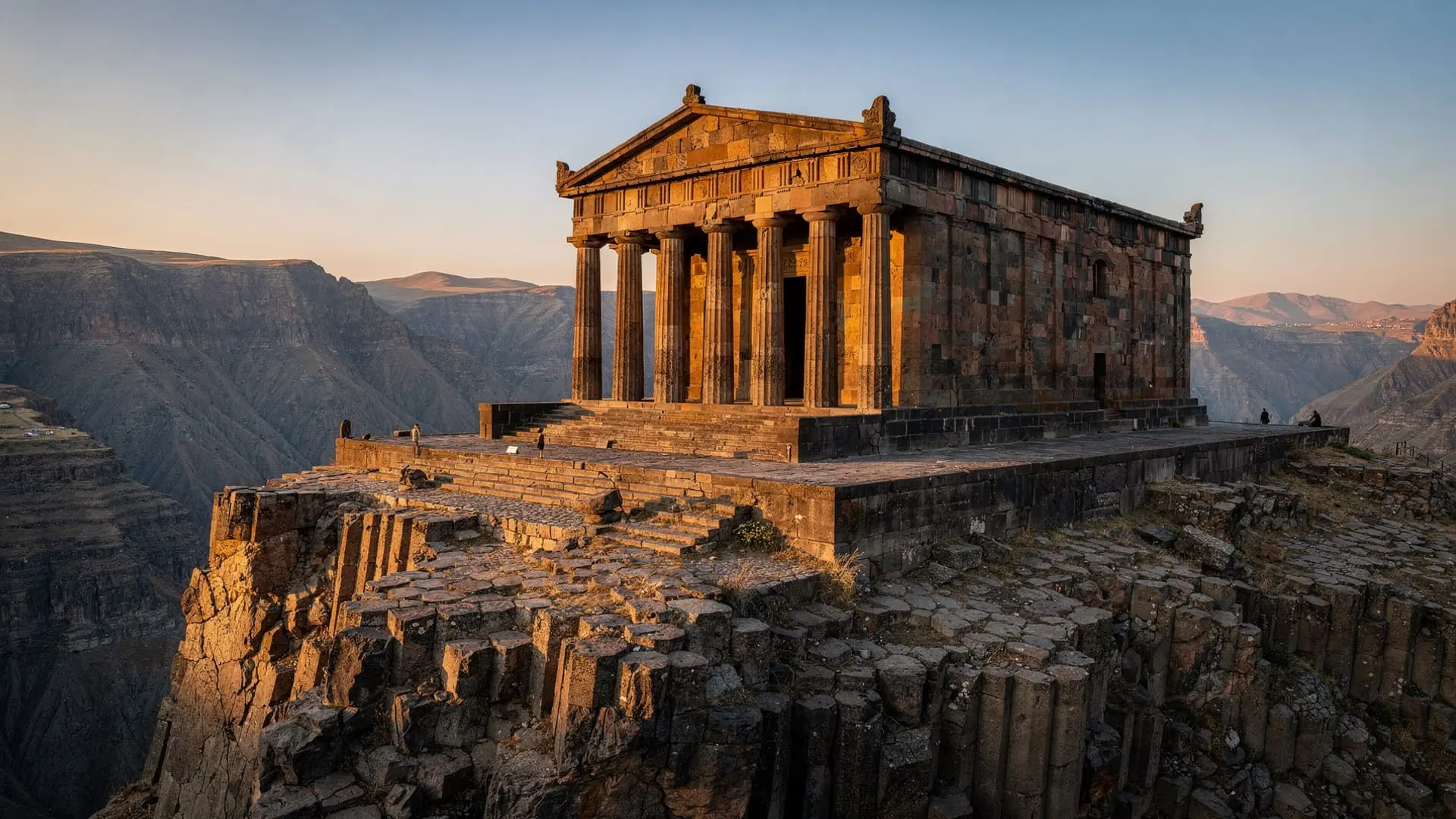
Armenia’s only Hellenistic temple — still standing
Garni is the anomaly of Armenian heritage tourism. In a country where almost every monument is a Christian church, Garni stands as a pristine Greco-Roman temple from the 1st century AD, dedicated to the sun god Mihr (Mithra). It predates Armenia’s conversion to Christianity by three centuries, and the fact that it survived — while every other pagan temple was dismantled after 301 AD — is one of the country’s great historical mysteries.
The temple was partially destroyed by an earthquake in 1679 and lay in rubble for nearly three centuries. Between 1969 and 1975, Soviet archaeologists and architects reconstructed it using original stones, which had been carefully catalogued and numbered before the earthquake toppled them. The reconstruction is genuine — not a fabrication — and the temple stands today as it would have appeared in the 1st century: a peristyle structure of 24 Ionic columns, raised on a stepped podium above the dramatic Azat river gorge.
Coming here with Geghard Monastery (9 km further into the same gorge) makes for one of the best half-days in Armenia.
| Where | Kotayk province, 28 km east of Yerevan |
| Cost | Temple ~3,500 AMD; Symphony of Stones gorge free |
| Time needed | Half day (combine with Geghard for 4–5h total) |
| Getting there | Marshrutka from Gai Station (~250–300 AMD) or taxi/tour (~40 min) |
| Best time | Apr–Jun and Sep–Oct; avoid midday heat Jul–Aug |
Getting to Garni from Yerevan
By car or taxi: 28 km from central Yerevan, about 40 minutes via the main Yerevan–Garni road. A return taxi from Yerevan should cost 8,000–12,000 AMD (20–30 €) for Garni alone; 15,000–20,000 AMD if you’re combining with Geghard. Negotiate before departure or use GG Taxi.
By marshrutka: Marshrutkas to Garni depart from Gai Bus Station (also called Kilikia) in Yerevan. They leave when full, typically starting around 09:00–10:00. The fare is around 250–300 AMD one way. There is no fixed schedule — if you get stranded, a taxi back to Yerevan from Garni costs about 3,000–5,000 AMD.
By guided tour: This is the most common option for first-time visitors. Most Yerevan-based tour operators offer a Garni–Geghard combo, often with a lavash baking experience included. See the tours section below.
Driving yourself: the road from Yerevan is well-paved and straightforward. There is a car park adjacent to the temple complex.
What to see and do at Garni
The Garni temple
The temple itself takes about 30–45 minutes to explore fully. Admission to the complex is 3,500 AMD (around 8.50 €). The temple stands within a walled royal summer palace complex — look for the 3rd-century bathhouse mosaics just inside the entrance: black-and-white geometric patterns depicting sea gods and fish, surprisingly well-preserved.
A small museum on site covers the history of the Arsacid dynasty and the temple’s reconstruction. The real reward is climbing the steps of the temple and looking out over the gorge — the view is genuinely dramatic, with the Azat River visible 300 metres below.
Symphony of Stones (Garni gorge)
A 20-minute walk (or a short drive) from the temple leads to the edge of the Azat river canyon, where an extraordinary geological formation covers the cliff face: thousands of perfectly hexagonal basalt columns, stacked like organ pipes, rising 50 metres. Local guides call it the “Symphony of Stones” and the metaphor works — from the right angle, the columns look like a massive pipe organ.
To reach the gorge floor and walk among the columns, descend the marked path from the cliff top. The path is steep in places and can be muddy after rain; wear shoes with grip. The gorge floor offers the best photographs, with the columns reflected in the river during high water (April–May).
Admission to the gorge: free to enter.
Lavash baking
Several family-run operations in the village of Garni offer traditional lavash baking experiences — you make the unleavened flatbread yourself in an underground tonir (clay oven). Sessions typically last 45 minutes and include as much lavash as you can eat with local spreads. Prices are around 5,000–8,000 AMD per person. These experiences are not polished tourist attractions; they’re genuine encounters with a household food tradition that UNESCO lists as intangible cultural heritage.
Many of the combined tours from Yerevan include a lavash session as part of their itinerary.
Geghard Monastery
Only 9 km further up the gorge road from Garni, Geghard is a UNESCO World Heritage monastery partially carved into the living rock — the most visually striking religious site in the Kotayk region. Always combine the two on the same day.
Where to stay near Garni
Most visitors treat Garni as a day trip from Yerevan. There is no compelling reason to overnight here unless you want an early start on the gorge trails.
Garni Hotel — a small family-run guesthouse in the village; basic but clean, with home-cooked breakfasts that feature local lavash and churchkhela. Around 15,000–20,000 AMD per room.
Eco Village Garni — glamping-style wooden lodges above the gorge, popular with young couples and Instagram photographers. Prices vary; book directly.
For more comfort, Yerevan is 40 minutes away and offers the full range from hostels to 5-star hotels.
Where to eat near Garni
The village of Garni has a handful of family restaurants serving Armenian standards — khorovats (barbecue), dolma, freshly baked lavash, herb salads. The quality is genuine but menus are in Armenian; pointing works fine.
Mirhav — a roadside restaurant known locally for good khorovats. The courtyard fills up on weekends when Yerevan families come for the day. Prices are low: a full meal for two runs 5,000–8,000 AMD.
Avoid the vendor stalls at the temple parking lot — they sell overpriced tourist snacks. Walk 5 minutes into the village for real food at half the price.
Tours and tickets
The Garni–Geghard day trip is the most popular half-day from Yerevan. Group tours typically cost 8,000–15,000 AMD per person and include transport, a guide, and sometimes the lavash experience. Private tours cost 25,000–50,000 AMD for the car.
If you want to include lavash baking: this tour adds a lavash workshop to the Garni–Geghard circuit, making it a richer cultural experience.
For a private option with more flexibility on timing: private Garni and Geghard tour lets you linger at the gorge without hurrying to catch the group.
See also: Garni & Geghard day trip guide from Yerevan.
Garni, Geghard, Azat Canyon Sunset TourBest time to visit Garni
April–May: wildflowers bloom on the canyon edges, the river runs full and turquoise, and the light on the temple is soft and golden. Excellent.
June: warm and pleasant. Crowds begin building on weekends.
July–August: hot at midday (sometimes 33–36°C in the gorge). Visit early morning or after 16:00. Weekends are very crowded — families from Yerevan picnicking in every available space.
September–October: ideal. Cooler temperatures, golden afternoon light, significantly fewer crowds than peak summer.
November–March: atmospheric but the gorge path can be slippery. The temple complex is always accessible. Winter mornings with frost on the basalt columns are extraordinary for photography.
Practical tips
- Opening hours: The temple complex is open daily 09:00–19:00 (winter: closes 18:00). The gorge is always accessible.
- Admission: 3,500 AMD (~8.50 €) for the temple complex. The gorge is free.
- Photography: bring a wide-angle lens for the Symphony of Stones. Morning light (08:00–10:00) hits the columns directly.
- Facilities: toilets and a café at the temple entrance. Basic.
- Combination with Geghard: allow 4–5 hours total for both sites at a comfortable pace.
- Getting back to Yerevan: marshrutkas return from Garni village (not reliable in the afternoon). A taxi back is safer. Negotiate or use GG Taxi — see our GG Taxi guide.
Frequently asked questions about Garni
Why did Armenia’s pagan temple survive when all others were destroyed?
No definitive answer exists. The most plausible theory is that the Garni royal summer palace remained in use by Armenian kings after Christianisation, and the temple within it was repurposed as a summer residence rather than demolished. A 5th-century inscription mentioning the “cool house” at Garni supports this.
How long does it take to visit Garni temple?
The temple and the adjacent bathhouse mosaics take about 30–45 minutes. Add another 45–60 minutes for a round-trip walk into the Symphony of Stones gorge. Total with travel from Yerevan: 3–4 hours, or half a day if you include lunch in the village.
Can I visit Garni without a tour?
Yes. Take the marshrutka from Gai Station in Yerevan (250–300 AMD), visit independently, and taxi back. The temple has explanatory panels in Armenian, Russian, and English. A guide enriches the context but is not necessary.
Is Garni worth visiting in winter?
Surprisingly yes — the gorge looks dramatic under snow, the temple is less crowded, and the basalt columns are spectacular against a grey sky. The descent to the gorge floor requires caution on icy sections.
What is the connection between Garni and the Symphony of Stones?
They are the same gorge. The Azat river carved the canyon that both the temple overlooks and the basalt columns line. They are about 20 minutes’ walk apart. Visit both on the same trip.
How is Garni different from visiting Geghard?
Garni is a pagan Hellenistic temple and royal palace complex from the 1st century AD; Geghard, 9 km further, is a Christian monastery partly carved into rock, dating from the 12th–13th centuries. They represent different eras and religions of Armenian history, and seeing both back to back — pre-Christian secular architecture followed by medieval Christian monasticism — is one of the more instructive historical contrasts available near Yerevan.
Garni in depth: history, reconstruction, and the gorge
The Garni temple: pagan survival in a Christian country
The mystery of Garni’s survival has several competing explanations. The most archaeologically supported is that the complex continued as a royal summer residence after Tiridates III’s conversion to Christianity in 301 AD. A 5th-century Greek inscription found on site mentions “the cool house” (probably the bathhouse), suggesting the palace remained in use well into the Christian period.
A secondary factor may be political. King Tiridates — the same king who imprisoned Gregory the Illuminator for 13 years and later converted — may have valued the Garni summer palace too much to demolish its most impressive structure. The temple served as the throne room and ceremonial centre of the summer complex.
The temple is dedicated to Mihr (Mithra), the Persian/Armenian sun deity, and faces east in traditional solar-cult orientation. The Hellenistic style reflects the pervasive influence of Greek architecture throughout the Near East following Alexander’s campaigns — Armenians of the Arsacid dynasty adopted Greek architectural forms and language as markers of royal sophistication.
The 1679 earthquake and reconstruction
The earthquake of June 4, 1679 — one of the largest in Armenian history — destroyed Garni temple along with much of Yerevan’s old town. Contemporary accounts describe the columns collapsing and the podium splitting. For nearly three centuries, the ruins lay in an overgrown state, documented only by travellers and archaeologists.
The Soviet-era restoration (1969–1975) was led by architect A. Sahinian using a meticulous anastylosis approach: each stone in the ruins was numbered, photographed, and catalogued before reconstruction. Where original stones were missing (about 15–20% of the total), replacements were cut from the same local volcanic tuff quarry. The reconstruction is widely considered one of the most faithful anastylosis projects in Soviet-era archaeology.
The result is authentic: you are looking at the original stones, mostly in their original positions. The temple is not a replica.
What the bathhouse mosaics tell us
The 3rd-century bathhouse just inside the temple complex is easy to walk past quickly, but it repays a closer look. The black-and-white geometric mosaic floor depicts sea deities and marine creatures — a Greek inscription running along one edge reads roughly “we worked without receiving anything,” widely interpreted as either a joke by the mosaic craftsmen or a boast about their skill despite modest pay. It is one of the few surviving inscribed floor mosaics anywhere in the Caucasus, and its survival through the temple’s collapse and centuries of rubble is itself somewhat remarkable — most of the temple’s stonework was scattered by the 1679 earthquake, but the mosaic floor, being underground within the bath structure, escaped the worst of the damage.
The Azat Gorge beyond Garni
The Azat River canyon extends for approximately 25 km through the Kotayk plateau before entering the Ararat plain. The Garni section with the Symphony of Stones is only one part of a longer geological spectacle.
For serious hikers, a multi-hour walk down the Azat canyon from Garni to Geghard or beyond is possible — the gorge floor alternates between river crossings, boulder fields, and sections of relative ease. The hiking is unmarked and requires good navigation. Several adventure tour operators in Yerevan offer guided Azat canyon hikes. See /guides/garni-geghard-day-trip-yerevan/ for options.
The canyon also offers some of the best bouldering in Armenia — the hexagonal basalt columns near the river break into clean geometric holds that attract a small but dedicated climbing community.
Lavash baking: the UNESCO tradition at Garni
Lavash is the unleavened flatbread at the heart of Armenian food culture. The baking technique — slapping the dough against the inside wall of a tonir (underground clay oven) — has been practiced continuously for thousands of years in this region. UNESCO added lavash to its Intangible Cultural Heritage list in 2014.
The Garni area has several family operations offering lavash baking experiences. These are not staged tourist performances — the families bake lavash for their own consumption and open the process to visitors as a supplementary income. You shape the dough on a special cushion-shaped pad (oval), slap it against the oven wall, wait 90 seconds, and peel off the thin, crackling bread. It is harder than it looks. The result, eaten immediately with butter, herbs, and white cheese, is one of the simplest and most satisfying food experiences in Armenia.
Prices: approximately 5,000–8,000 AMD per person, usually includes unlimited eating. Many guided tours include lavash baking as part of the day trip. See /guides/lavash-baking-experience/.
Garni vs Geghard: two very different sites, nine kilometres apart
Visitors sometimes assume Garni and Geghard are variations on the same theme because they’re always paired together. They are not. Garni is a Hellenistic pagan temple and royal palace — Greco-Roman columns, a bathhouse, secular history. Geghard is a Christian monastery carved into living rock, with cave churches and a Proshyan mausoleum. Seeing them back to back is one of the more striking historical contrasts available in a single afternoon anywhere in the Caucasus: a pre-Christian royal retreat followed by a medieval monastic complex, both in the same gorge, separated by a nine-kilometre drive and roughly twelve centuries of history.
Extending toward Yerevan’s eastern suburbs
Travellers with a car and a spare hour sometimes combine Garni with a stop at Charents Arch or the wider Kotayk countryside on the drive back into Yerevan — vineyards, roadside fruit stalls in late summer, and views back toward Mount Ararat on clear days. This isn’t essential, but it turns a there-and-back half-day into a more leisurely loop if your schedule allows it.