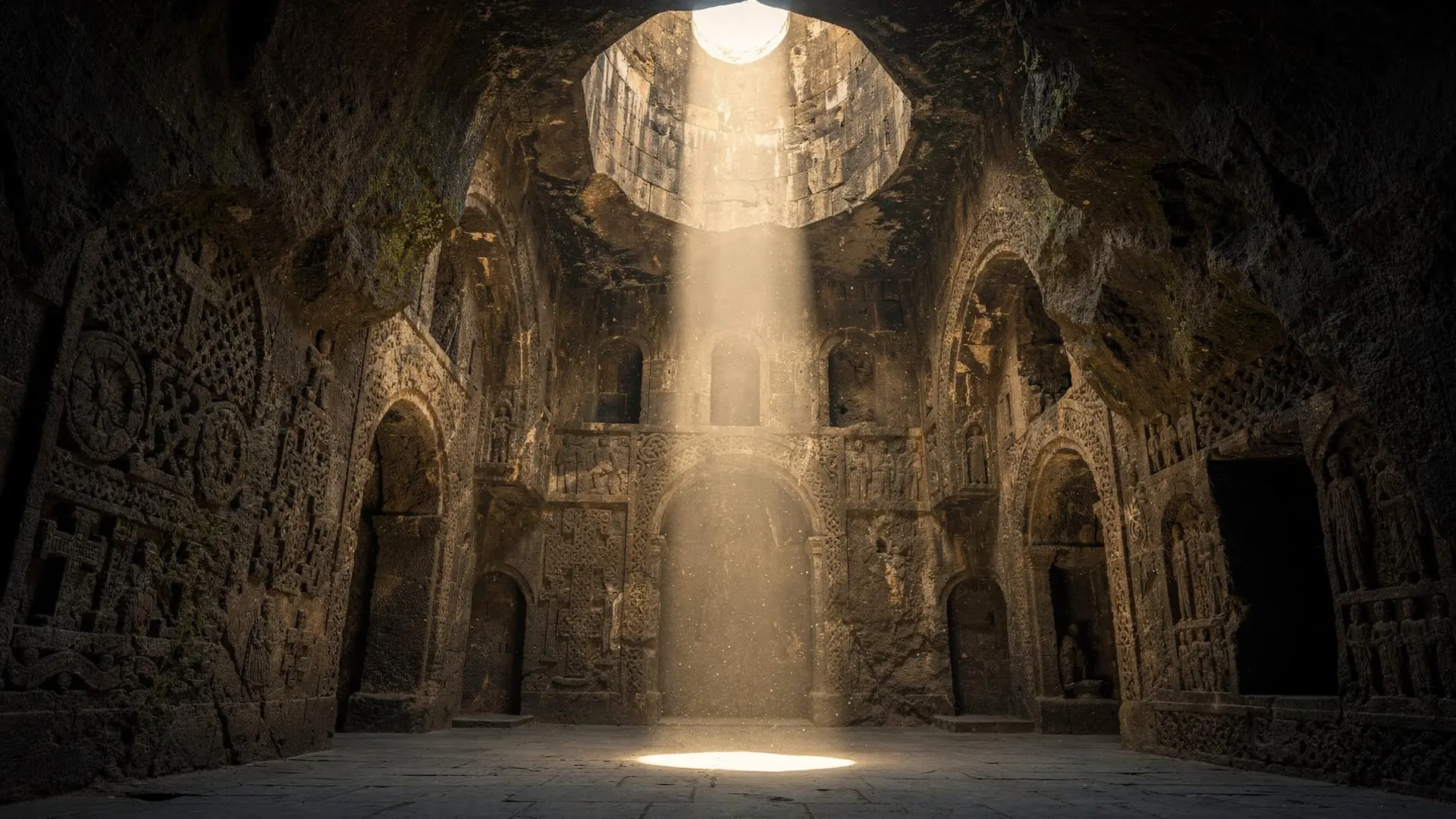
The monastery carved from living rock
Geghard is one of those places that photographs fail to prepare you for. The approach through the Azat river gorge — sheer volcanic walls, pine-scented air, the sound of the river — already feels ceremonial. Then the monastery appears, built partly from free-standing masonry and partly carved directly into the cliff face, as if the mountain had opened to receive it.
The name Geghard means “spear” in Armenian — a reference to the spear that pierced Christ’s side at the Crucifixion, which was supposedly brought here and kept as a relic until the 13th century (it has since been moved to Etchmiadzin). But the monastery’s other name, Ayrivank, meaning “cave monastery,” better captures what makes it extraordinary: this is a working complex of churches, side chapels, burial niches, and khachkars (cross-stones) hewn from the rock over several centuries, culminating in the 13th-century Proshyan mausoleum chambers deep inside the mountain.
UNESCO inscribed Geghard as part of the Monasteries of Haghpat and Sanahin in 2000. It is, without question, one of the architectural masterpieces of medieval Armenia.
| Where | Kotayk province, 37 km east of Yerevan (9 km past Garni) |
| Cost | Free entry (donations at the candle stand) |
| Time needed | 45–90 min (4–5h combined with Garni) |
| Getting there | Taxi/tour (~55 min); marshrutka to Garni + local taxi onward |
| Best time | Apr–Jun and Sep–Oct; weekday mornings before 10:30 quietest |
Getting to Geghard from Yerevan
By car: Geghard is 37 km from central Yerevan — 28 km to Garni, then 9 km further up the gorge road. The drive takes 50–60 minutes. The road to the monastery is paved but narrow in the final section; parking is available at the main gate.
By taxi: A return taxi from Yerevan covering both Garni and Geghard costs 15,000–20,000 AMD (37–49 €). Negotiate the full return journey before departure, or use GG Taxi. For GG Taxi setup, see our GG Taxi guide.
By marshrutka: There is no direct marshrutka to Geghard. Take the marshrutka to Garni (from Gai Station, 250–300 AMD) and then arrange a local taxi for the 9 km onward to Geghard (around 2,000 AMD).
By guided tour: The majority of visitors come on a half-day Garni–Geghard group tour from Yerevan. This is the most efficient option. See tours section below.
Winter note: The gorge road can be icy in January–February after snowfall. Check conditions before driving independently. Tours typically still run in winter but may alter scheduling.
What to see at Geghard
The main gavit (narthex)
Enter through the gate and you’ll find yourself in the main courtyard, facing the Cathedral of the Holy Mother of God (1215). Before entering the cathedral, pause in the gavit — the large vaulted antechamber with an oculus in the ceiling open to the sky. This dramatic skylight was a deliberate design choice, flooding the dark interior with a shaft of light. The walls are covered with khachkars of varying ages; the carved decoration combines Armenian, Persian, and Byzantine influences in ways that feel more architectural fusion than imitation.
The Cathedral of the Holy Mother of God
Built in 1215 under the Zakarids, the main church is a masterpiece of early 13th-century Armenian architecture. The interior is relatively dim, lit by candles sold near the entrance (lighting a candle and placing it on the sand tray is a local custom; visitors are welcome to participate). The carved decoration on the interior columns — animals, vines, geometric patterns — is extraordinarily fine. Allow your eyes to adjust to the low light before moving through.
The cave churches (Avazan)
Through a door in the north wall of the gavit, you enter the cave complex proper — churches and chapels hewn entirely from the volcanic rock. The first cave church (1240) has a spring in its floor from which a stream still flows, considered sacred. The sound of the water, the shadows, the smell of old stone and candle wax: this is one of the most atmospherically charged interiors in Armenia.
The second cave church (1283) served as a mausoleum for the Proshyan princes. Its carved ceiling is a tour de force of medieval stone-cutting: an intricate rosette pattern of interlocking geometric bands, with a chain-relief motif that symbolises the Proshyan family emblem. This chamber is often quieter than the main cathedral — worth sitting in for five minutes.
The exterior walls and khachkars
Don’t rush out immediately after the cave churches. The courtyard walls are covered with khachkars spanning multiple centuries. Vendors outside the gate sell small hand-carved replicas — prices are negotiable, and these are genuine local craftsmanship (unlike the mass-produced versions in Yerevan tourist shops).
Where to stay near Geghard
Almost everyone visits as a day trip from Yerevan. There are no hotels at Geghard itself. The nearest accommodation is in Garni village (9 km, family guesthouses from 15,000 AMD) or back in Yerevan.
For Yerevan accommodation options, see our main Yerevan guide.
Where to eat near Geghard
A handful of family restaurants operate along the gorge road between Garni and Geghard, serving khorovats (barbecue), grilled trout, lavash, and herb salads in shaded outdoor spaces beside the river. These are genuine local establishments — not tourist traps — and a river-side lunch here after visiting the monastery is a pleasure. Prices: 3,000–6,000 AMD per person for a full meal with drinks.
The vendors at the monastery gate sell churchkhela, dried fruit, and small snacks. Fine for a quick bite. Overpriced by local standards but not egregiously so.
Tours and tickets
Admission: Free. Geghard monastery charges no entrance fee. Donations at the candle stand support monastery maintenance.
Guided tours from Yerevan (Garni + Geghard combo):
For a tour that also includes the lavash baking experience: Garni and Geghard with lavash baking .
If you want to combine Geghard with Khor Virap in a single day: Khor Virap, Garni, and Geghard day trip is a popular full-day circuit.
See our dedicated guide at /guides/geghard-monastery-cave-complete-guide/ for architectural details and photography tips.
Best time to visit Geghard
April–May: best overall. The gorge is green, the river runs strong, crowds are manageable.
September–October: excellent. Cooler than summer, excellent light for photography (the carved interiors benefit from lower angle autumn sun through the oculus).
June: still good, getting busier on weekends.
July–August: the most crowded period. Arrive before 10:00 or after 15:00. Groups from Yerevan pour in between 10:30 and 14:00.
November–March: peaceful and atmospheric. Some of the best photographs of the gorge are taken in winter with snow on the cliffs. The road is passable except after heavy snowfall. January–February: check conditions.
Practical tips
- Dress code: cover shoulders and knees as a sign of respect; a scarf or shawl at the entrance helps. Usually not strictly enforced for visitors, but it’s considerate.
- Candles: buy a candle near the entrance (200–500 AMD) and follow local custom in lighting and placing it. This is not a tourist performance — the monastery is an active place of worship.
- Photography: permitted throughout the complex. No tripods inside the cave churches. Low light means a fast lens or high ISO is essential.
- Crowds: weekday mornings before 10:30 are significantly quieter than weekend afternoons.
- Combined visit: Garni temple is 9 km back toward Yerevan. Visit Garni first (the earlier start makes the gorge walk more pleasant) then Geghard.
Frequently asked questions about Geghard
Is Geghard a UNESCO World Heritage site?
Yes. Geghard was inscribed together with Haghpat and Sanahin monasteries under the title “Monasteries of Haghpat and Sanahin” in 2000. (The two Lori monasteries share one UNESCO inscription; Geghard is a separate inscription under “Monastery of Geghard and the Upper Azat Valley.”)
What makes Geghard different from other Armenian monasteries?
The cave churches. Most Armenian monasteries are free-standing stone buildings. At Geghard, a significant part of the complex is carved directly into the volcanic tuff cliff — an extraordinary technical and artistic achievement from the 12th–13th centuries.
Can you enter all the chambers?
Yes, all main chambers are open to visitors. The spring chamber and Proshyan mausoleum (the deepest cave spaces) are accessible through the main gavit. Occasionally side chapels may be closed for religious services or restoration.
How long should I spend at Geghard?
45–90 minutes for a thorough visit, including time to absorb the cave churches and the courtyard. If you’re combining with Garni and a gorge walk, plan 4–5 hours total.
Is Geghard worth visiting without Garni?
They are only 9 km apart and Garni has the Symphony of Stones gorge — there is almost no reason to visit one without the other. The logical pairing also makes geographical sense. See our Garni–Geghard day trip guide.
What should I do if a service is happening when I arrive?
Stay respectful and toward the edges of the chamber, keep noise and photography to a minimum, and avoid walking between the officiant and the congregation. Services are not staged for visitors, but observing quietly is welcomed — the acoustics of the cave churches during a liturgy are genuinely extraordinary and worth pausing for rather than avoiding.
Geghard in depth: architecture, meaning, and the Azat valley
The cave churches: technical achievement
Carving entire churches from volcanic rock is not merely unusual in Armenia — it is extraordinarily rare in the broader history of world architecture. Most rock-cut churches (at Lalibela in Ethiopia, the cave churches of Cappadocia in Turkey, the early Christian sites of southern Italy) were cut into relatively soft sandstone or tuff that yields to iron tools with manageable effort.
Geghard’s cave churches were cut into basalt-laced volcanic tuff that is significantly harder. The tools were iron; the process was slow. The spring cave church — the first chamber you enter through the north door of the gavit — shows the chisel marks on the ceiling, still visible after 800 years. The scale of the undertaking: an entire church interior, with columns, arches, ornamental bands, and a roof oculus, cut from the living rock to millimetre accuracy. No room for error.
The acoustic effect of the cave churches is remarkable. The vaulted ceilings and stone walls create a resonant chamber that transforms even a whispered chant into something cathedral-like. During religious services, the a cappella singing of the Armenian liturgy in these chambers is one of the most powerful acoustic experiences available in the Caucasus.
The Zakarids and the Proshyans
Geghard’s two main construction phases reflect two patronage dynasties. The Cathedral and main gavit (1215) were built under the Zakarids (also written Zakarians), a dynasty of Armenian military commanders who led Armenia under Georgian suzerainty following the Arab-era devastation. The Zakarids rebuilt much of medieval Armenian ecclesiastical architecture; their patronage marks are found at Haghpat, Sanahin, and numerous other sites.
The cave churches (1240–1283) were funded by the Proshyan princes, who acquired the monastery from the Zakarids in 1211. The Proshyan chain motif — a carved relief of interlocking chain links — appears repeatedly in their mausoleum chamber and serves as both heraldic symbol and theological statement (a chain binding earth to heaven).
The Proshyan family tomb is accessible in the second cave chamber. The carved genealogy on the walls names the buried princes and their lineages. Reading these inscriptions requires Classical Armenian — a guide can translate key passages.
The spear of Longinus and the monastery’s name
The spear that gives the monastery its Armenian name (Geghard = spear) is the spear of Longinus — the Roman soldier who, according to the Gospel of John, pierced Christ’s side at the Crucifixion. The Apostle Thaddeus (Tadeos) supposedly brought this relic to Armenia in the 1st century AD; it was kept at this monastery for centuries. The relic was moved to Etchmiadzin in the 13th century, where it remains in the Treasury Museum. The monastery kept the name.
The relic-driven foundation of pilgrimage sites was a common pattern in medieval Christianity worldwide. What makes Geghard unusual is that the site itself — independent of any relic — is extraordinary enough to sustain continuous veneration. The place is the thing.
Photography inside the cave churches
The cave churches present real photographic challenges: very low light (candles and indirect daylight only), dark volcanic stone that absorbs rather than reflects, and the ethical consideration of photographing an active worship space.
Practically: a camera capable of high ISO (3200+) without excessive noise is essential. A prime lens at f/1.8–f/2.0 allows shorter exposures. The oculus of the main gavit is the great exception — on sunny days it creates a single shaft of light through the dark interior that is one of the most extraordinary natural lighting effects in Armenian architecture. This shot typically occurs 10:00–12:00 on clear days. Arrive early, wait for the light, and be patient.
Tripods are not permitted inside the cave churches. Handheld at high ISO is the only option.
The Azat canyon as a hiking destination
The canyon between Garni and Geghard is hikeable on foot — either along the gorge floor (more adventurous, involves river crossings in spring/early summer when the river runs high) or on the rim road. The 9 km between the two sites takes about 2–2.5 hours walking. The gorge views are excellent from both levels, and the basalt geology of the Symphony of Stones is visible from the rim walk.
A few adventure operators offer guided canyon walks that descend to the Azat River floor and walk between the two sites at water level. This is the most immersive way to experience the geology — particularly in May when the river is full and the canyon vegetation is green. See options via /guides/garni-geghard-day-trip-yerevan/.
Comparing Geghard to Armenia’s other rock-cut and monastery sites
| Site | What makes it different | Distance from Yerevan |
|---|---|---|
| Geghard | Cave churches cut into volcanic tuff, Proshyan mausoleum | 37 km |
| Noravank | Free-standing red-cliff setting, dramatic gorge | ~120 km |
| Khndzoresk | Abandoned cave village, swinging bridge | ~215 km |
Geghard remains the most accessible of Armenia’s rock-carved sites from Yerevan, which is part of why the Garni–Geghard half-day is the single most popular excursion out of the capital.
Visiting during an active service
Because Geghard is a working monastery rather than a museum, timing sometimes coincides with a religious service — baptisms and smaller liturgies are not unusual, especially on weekends. If you arrive during one, the etiquette is straightforward: stay toward the edges of the chamber, keep photography discreet or pause it entirely, and don’t walk between the officiant and the congregation. Far from being an inconvenience, witnessing a service in the cave acoustics is often the most memorable part of a visit — the chant reverberating through volcanic stone carved eight centuries ago is not something a quiet daytime visit replicates.
What to bring for a proper visit
Beyond a scarf or shawl for the dress code, a few practical items make the difference between a rushed look and a proper visit: a torch or phone light for the darker corners of the second cave chamber (candlelight alone leaves some of the Proshyan carving hard to make out), small AMD notes for a candle at the stand, and sturdy shoes for the uneven stone floor, which is original medieval paving rather than a levelled modern surface. If you’re combining with the Azat canyon walk toward Garni, add proper hiking shoes and water — the gorge route has no facilities along the way.